


Effective retail media onboarding delivers a measurable first campaign that ties ad exposure to a clear sales or iROAS outcome, and the single best first action is agreeing KPI definitions, attribution windows, and data access with the retail media network before anything else moves forward. Done well, this process typically runs a few weeks depending on how many systems need to connect. Done poorly, it drags into months of rework.
TL;DR:
- Clear KPI and measurement agreement before launch ensures accurate attribution and avoids costly rework during onboarding.
- Technical setup, including pixel placement and data sharing, typically takes 2 to 6 weeks, with existing infrastructure speeding up onboarding.
- Standardized reporting fields and transparent measurement practices are crucial for scaling retail media investments and internal reconciliation.
- Managed onboarding offers more support for brands new to a network, while self-service suits experienced teams with internal resources.
- Regular governance, shared tracking, and KPI documentation prevent delays and misalignment in multi-party retail media campaigns.
Table of Contents
- Advertiser onboarding checklist: from contract to first impression
- Roles, governance, and internal workflows
- Technical and data requirements advertisers must confirm before launch
- First campaign playbook: the first 30 to 90 days
- Measurement, attribution, and reporting: what to demand from an RMN
- Common onboarding pitfalls and practical fixes
- How to scale and optimize after activation
- Kontrol Media: hands-on execution for advertiser onboarding and retail media operations
- Self-service versus managed retail media: who does what
- Retail media platforms and their onboarding quirks
- Aligning advertiser goals with what the network can actually deliver
- Training and support advertisers can expect during onboarding
- What onboarding playbooks still get wrong
- Getting onboarding right without adding headcount
- FAQ
- Sources
Advertiser onboarding checklist: from contract to first impression
Onboarding fails most often because teams skip ahead to creative and targeting before the commercial and technical groundwork is settled. I have watched brands lose two or three weeks reworking a campaign because nobody confirmed which attribution window the retailer uses. The fix is sequencing: each step below builds on the one before it, and skipping the order creates rework later.
- Lock the commercial and legal terms. Confirm inventory access, minimum spend commitments, billing cycles, and any data-sharing clauses before signing. This is where the brand’s legal and procurement teams, not the media team, usually own the pen.
- Agree KPI and reporting definitions in writing. Document the primary KPI (return on ad spend, incremental sales, new-to-brand rate), the attribution window, and the reporting cadence and fields you expect to receive.
- Map audience and targeting options. Identify which identity methods the network supports, what segments exist out of the box, and what privacy constraints limit targeting for your category.
- Prepare creative and assets against real specs. Get the retailer’s creative specifications early and build a standard template set so you are not reworking files for every placement.
- Confirm technical setup. This includes pixel placement, server-side event tracking, and SFTP or API access for reporting feeds, validated with a test report before launch, as detailed in the CRM setup checklist for small business.
- Run campaign ops and pre-launch QA. Verify flight dates, budgets, pacing rules, and a final checklist pass before the campaign goes live.
Each step has a different owner. Contracting usually sits with brand legal and the retailer’s sales team. KPI definitions need sign-off from the brand’s marketing lead and the retailer’s measurement team. Technical setup is almost always a joint effort between the brand’s data team, the agency’s trafficking desk, and the retailer’s ad tech partner.
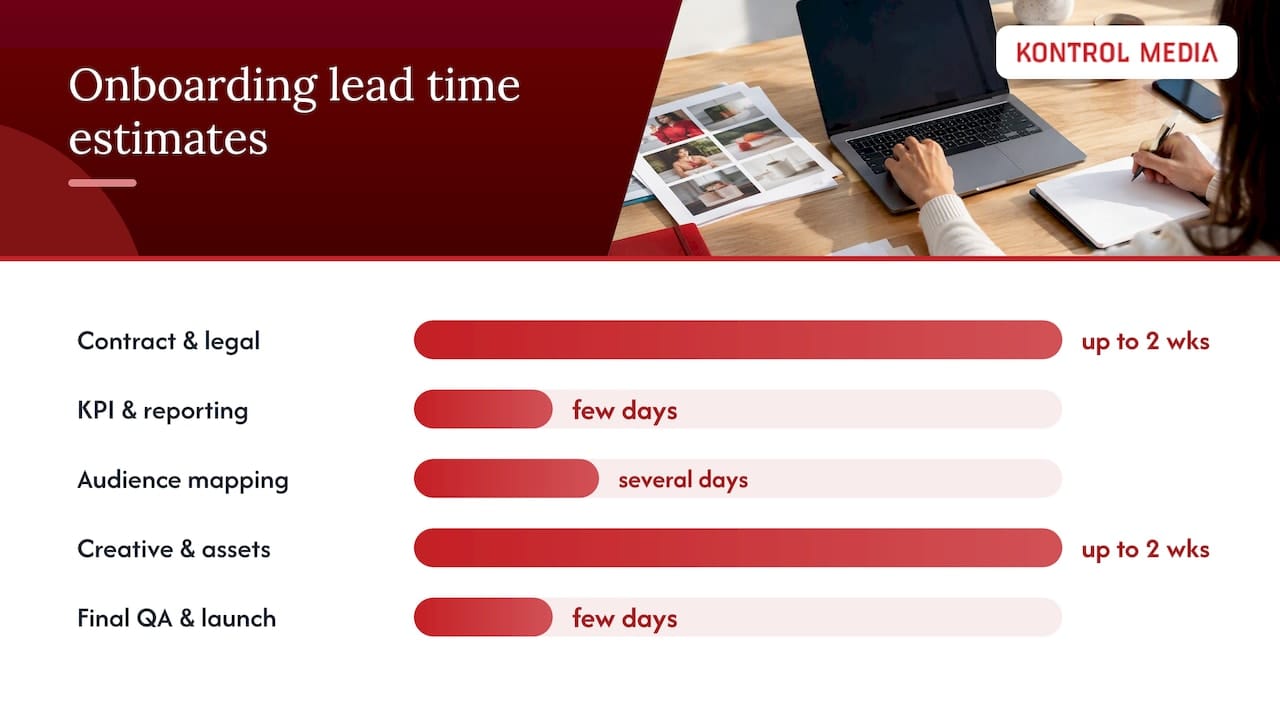
A realistic lead-time estimate includes contracting and legal review taking up to a couple of weeks depending on negotiation, KPI and reporting agreement within a few days, audience and identity mapping several business days, creative production and approval up to a couple of weeks, technical integration and test reporting varying considerably, and final QA and launch within a few business days.
Brands that have run campaigns on a given network before can often compress this timeline significantly by reusing existing pixels, templates, and KPI definitions. First-time advertisers on a new network should plan for the fuller six-week window, particularly if clean room matching or a new identity method is involved.
Pro Tip: Ask the retail media network for a sample test report before you sign anything. If they cannot produce one on request, that is a signal their reporting pipeline is not mature enough to support clean measurement.
Roles, governance, and internal workflows
Onboarding breaks down when nobody is clear on who approves what, and by when. The retailer or network owns inventory, platform access, and the raw measurement pipeline. The brand owns business objectives, budget, and creative direction. The agency, when one is involved, typically owns campaign trafficking and day-to-day optimization. A data or tech owner, whether in-house or a vendor, owns the integrations that make measurement possible.
Setting service-level expectations early prevents the most common delays:
- Creative approval: 2 to 3 business days from submission to retailer sign-off.
- Data delivery and test feeds: 5 business days from request to a working sample file.
- QA fixes after a failed test: 48 hours for a retrafficked and reverified asset.
A simple RACI example for the technical setup step: the brand’s data team is Responsible for providing first-party data, the retailer’s ad tech team is Accountable for validating the feed, the agency is Consulted on timing and creative dependencies, and brand leadership is Informed once the test report passes.
Cross-functional alignment matters more than any single document. A short weekly stand-up between the brand, agency, and retailer contact during the onboarding window, paired with a shared tracker that lists open items and owners, catches misalignment before it becomes a missed launch date. Kontrol Media’s retail media network operations work leans on exactly this kind of lightweight, shared governance to keep multi-party onboarding from stalling.
Pro Tip: Put the KPI definition document and the RACI chart in the same shared folder as the media plan. Teams that keep governance separate from the plan tend to forget it exists by week three.
Technical and data requirements advertisers must confirm before launch
Clean measurement starts with the plumbing, not the dashboard. Before a campaign goes live, brands need to settle on an identity matching approach. Hashed email matching is common and relatively easy to implement, loyalty ID matching tends to be more accurate within a single retailer’s ecosystem, and clean room matching offers the strongest privacy posture but takes longer to set up and usually requires both parties to have compatible infrastructure.
Required data flows typically include impressions, clicks, media cost, conversions, and, where the retailer supports it, SKU-level sales data. Without SKU-level detail, it becomes difficult to separate halo effects from direct response, which matters when you are trying to defend budget for a second flight.
A basic test-report checklist before launch should confirm:
- Impressions and clicks reconcile within a reasonable tolerance against the ad server’s own numbers.
- Conversion events fire correctly and match expected volume from a small controlled test.
- Cost data reflects the actual negotiated rate, not a list price placeholder.
- SKU or category-level sales data, if promised, actually appears in the test file.
Privacy and compliance checkpoints deserve their own pass. Confirm how personally identifiable information is handled, whether consent has been captured for the audiences being targeted, and whether any data shared between brand and retailer is anonymized or aggregated before it leaves either system. This is not a box-checking exercise: it is the difference between a defensible program and a legal exposure.
The IAB/MRC Retail Media Measurement Guidelines recommend consistent viewability standards and IVT filtration disclosures as part of a comparable measurement framework. That means advertisers should request IVT filtration rates and viewability methodology directly from the network during onboarding, not after the first invoice arrives. Kontrol Media’s work on retail media network setup often starts exactly here, because the technical and data layer is where most onboarding timelines actually slip.
First campaign playbook: the first 30 to 90 days
The first campaign on a new network is not about scale. It is about learning fast enough to make a defensible second decision. A 30/60/90 structure keeps that learning disciplined instead of accidental.
- Days 1 to 30: validate the basics. Confirm tracking is accurate, creative is approved and live, and early signals (click-through rate, conversion rate) are in a plausible range. The acceptance criterion here is operational, not a sales number: does the data pipeline work?
- Days 31 to 60: run a structured test. Build a small matrix that varies one or two dimensions, such as placement type or audience segment, while holding creative constant, so you can isolate what is actually driving performance.
- Days 61 to 90: decide on scale. Review results against the KPI agreed during onboarding and make a go, pause, or pivot call based on the data, not on gut feel.
A practical test matrix might cross two placements (search and product page) against two audience segments (new-to-brand and existing buyers), holding creative constant within each cell. Pinning a holdout group, whether at the store cluster or SKU level, gives you a baseline to compare against rather than guessing at what would have happened anyway. Kontrol Media’s piece on incrementality in retail media walks through why this kind of holdout design matters more than a single attributed ROAS number.
Budget-wise, resist the urge to spread spend thin across every available placement in month one. A concentrated test with enough volume to read results cleanly beats a scattered program that never reaches statistical confidence in any single cell.
Creative guidance varies by placement. Search placements reward concise, benefit-led copy tuned to query intent. Product page placements need creative that complements, rather than competes with, the retailer’s own product imagery. In-store digital out-of-home needs shorter, high-contrast creative built for a glance rather than a read.
Decision rules should be set before results come in, not after. A reasonable framework: scale spend if the test cell beats the agreed KPI threshold with a sample large enough to trust, pause if performance is flat or the sample is too small to read, and change the approach (new creative, different audience) if early signals are directionally promising but not yet conclusive.
Pro Tip: Write your scale, pause, and pivot thresholds into the onboarding document itself, before day one. Deciding the rules after you see the data almost always leads to moving the goalposts.
Measurement, attribution, and reporting: what to demand from an RMN
Measurement is where most onboarding conversations get vague, and vagueness here is expensive. The IAB/MRC Retail Media Measurement Guidelines recommend attribution windows of 3, 7, 14, 28, or 30 days, along with a minimum set of reporting fields meant to make results comparable across networks. Advertisers should pick an attribution window during onboarding and make sure it is documented, not left to default settings that can shift silently.
Minimum reporting fields worth insisting on before launch include designated market area, daily-level granularity, placement type, impressions, clicks, cost, conversions, device type, and audience segment. Without this level of detail, reconciling retail media results against an in-house marketing mix model becomes close to impossible. Kontrol Media’s guide to retail media KPIs lays out which of these fields matter most depending on the campaign objective.
ANA research found that lack of measurement standardization is the top barrier marketers cite when trying to scale retail media investment, which is exactly why locking in comparable reporting fields during onboarding, rather than negotiating for them later, matters so much.
IVT filtration and viewability disclosures deserve the same scrutiny. Ask the network for their IVT filtration methodology and viewability measurement standard in writing, and request periodic third-party validation where the network offers it. A network that cannot describe its own filtration approach is not one you can measure cleanly against.
Reconciling an RMN’s attribution window with an in-house MMM takes some translation work. If the network reports on a 14-day window but your MMM is built on weekly aggregated data, agree up front on how the two will be mapped, rather than discovering the mismatch after the first quarterly review.
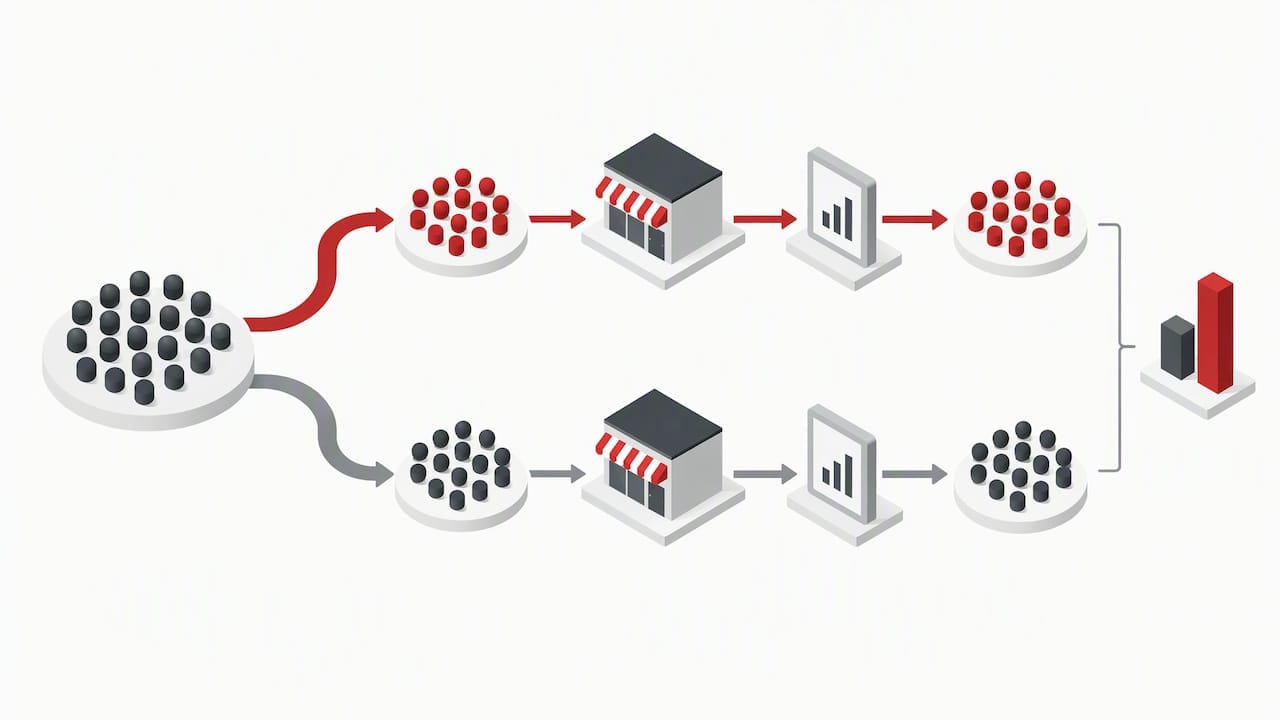
Incrementality testing is the most reliable way to validate whether a network’s claimed results reflect real lift. A holdout group, whether geographic, store-cluster, or audience-based, isolates the sales that would not have happened without the campaign, which a simple attributed ROAS number cannot do on its own.
Common onboarding pitfalls and practical fixes
Most onboarding delays trace back to a small set of repeat problems, each with a clear fix.
- Late or missing data access. Require a test feed and a contractual SLA for data delivery before the contract is finalized, not after.
- Misaligned KPI definitions. Use a written KPI-definition template and walk through it line by line with the retailer’s measurement team before launch.
- Creative rejections and spec mismatches. Build pre-approved templates and run an early creative QA pass against the retailer’s actual specs, not a generic set.
- Over-reliance on a single ROAS number. Plan an incrementality or holdout test alongside the headline metric so you are not making scale decisions on a number that can overstate impact.
- Privacy gaps. Confirm legal and IT sign-off on data handling and consent before any first-party data moves, using a short checklist rather than a verbal assurance.
None of these fixes are complicated on their own. What causes the real damage is discovering them mid-flight, when a campaign is already live and the fix means pausing spend.
How to scale and optimize after activation
A validated test only matters if the learning gets carried forward. Build a shared learning agenda with the retailer that documents what worked, what did not, and why, so the next flight does not relitigate the same questions.
- Set clear decision rules in advance for when results justify scaling budget, holding steady, or reallocating elsewhere.
- Revisit rates, bundled placements, or added-value analytics once you have a track record with the network, since most retailers have more room to negotiate for proven advertisers than for new ones.
- Turn repeated learnings, winning audiences, high-performing creative formats, into reusable templates rather than rebuilding from scratch each quarter.
- Use incrementality results and marketing mix modeling together to decide how much budget a given retail media network deserves relative to other channels.
Kontrol Media’s execution-first operations playbook treats this scaling phase as its own discipline, distinct from the initial setup, because the governance that gets a first campaign live is not the same governance that sustains a multi-network program.
Pro Tip: Revisit your KPI definitions every two quarters, even if nothing seems broken. Networks update their measurement methodology more often than advertisers expect, and a quiet change can throw off a comparison you didn’t know to question.
Kontrol Media: hands-on execution for advertiser onboarding and retail media operations
Kontrol Media Consultancy builds its practice on tailored business strategy paired with hands-on execution, working with clients ranging from private equity portfolio companies to large enterprises. Two of its service lines map directly onto the onboarding gaps described above: standing up a retail or commerce media network for brands and retailers building a program from scratch, and retail media network operations for running and scaling one that already exists. Some firms build revenue-generating marketing partnerships that help brands and their agencies reach home buyers and homeowners through the real estate channel, which draws on the same operational discipline, data integration work, and governance structure that advertiser onboarding requires. Across its services, the firm pairs strategy work with execution across sales, marketing, and business development functions, rather than handing a brand a deck and walking away.
Self-service versus managed retail media: who does what
Self-service platforms give advertisers direct control over targeting, budgets, and creative uploads through a dashboard, with the retailer providing the tooling but little hands-on campaign management. This suits brands with an internal team that already understands the platform and has the bandwidth to manage pacing and optimization directly.
Managed service shifts much of that day-to-day work to the retailer’s or an agency partner’s team, who handle setup, targeting recommendations, and ongoing optimization on the advertiser’s behalf. This suits brands onboarding to a new network for the first time, or those without a dedicated retail media specialist in-house.
The onboarding implications differ meaningfully. Self-service onboarding puts more of the technical setup and QA burden on the brand’s own team, while managed onboarding shifts much of that burden to the retailer or agency, in exchange for less direct control over daily decisions. Neither model removes the need for the brand to define its own KPIs and confirm data access. Those two items stay the advertiser’s responsibility regardless of which model is chosen.
Retail media platforms and their onboarding quirks
Every major retail media network runs its own onboarding process, and the differences are rarely cosmetic. Some networks lean heavily on self-service dashboards with light-touch account management, which speeds up onboarding for experienced teams but leaves less room for hand-holding on technical setup. Others run a more managed process, with dedicated onboarding specialists who walk advertisers through identity matching and reporting setup, which takes longer but reduces the risk of a botched technical integration.
Identity and data infrastructure also varies. Some networks rely primarily on loyalty ID matching, others lean on clean room partnerships for a more privacy-forward match, and the choice affects both onboarding timeline and the granularity of reporting you can expect to receive.
In-store and digital out-of-home inventory brings its own onboarding path entirely, closer to traditional media buying than to search or display. The IAB’s in-store retail media standards define store zones, exposure definitions, and recommended reporting windows, which means an advertiser onboarding into DOOH inventory needs a different test-report checklist than one onboarding into a search campaign. Advertisers running across multiple networks should expect to repeat a version of the full checklist for each one, since very little standardizes automatically between them.
Aligning advertiser goals with what the network can actually deliver
The fastest way to waste an onboarding cycle is to set a KPI the network’s own capabilities cannot support. A brand chasing new-to-brand customer acquisition needs a network with mature identity matching and audience segmentation, while a brand focused on defending existing market share against a competitor on the same shelf may lean more on share-of-voice and conquesting placements.
Start the goal-setting conversation with what the network’s reporting can actually measure, not with the metric your internal dashboard already tracks. If a network cannot report SKU-level sales, building a campaign around SKU-level ROAS sets up a reporting gap from day one. Matching the objective to the available measurement, rather than the reverse, prevents the awkward mid-flight conversation where the KPI quietly changes because the data was never going to support it.
Bringing trade marketing and media planning teams into the same conversation early also matters. The IAB’s own buyer guidance notes that brands and agencies often work in silos between trade and media functions, which leads to duplicated spend or misaligned goals across a retail media investment. A shared goal-setting session before onboarding starts, with KPI definitions it, closes that gap before it becomes a budget fight.
Training and support advertisers can expect during onboarding
Most retail media networks offer some combination of onboarding documentation, a dedicated account or platform specialist, and self-service help centers, though the depth varies widely by network and by advertiser tier. Larger advertisers or those committing to higher spend levels typically get more hands-on support, including a named onboarding contact and scheduled check-ins during the first 30 to 90 days.
Smaller or newer advertisers may find themselves leaning more on self-service documentation and platform tutorials, which makes internal training a bigger priority. Building a short internal runbook, covering KPI definitions, reporting cadence, and who owns each onboarding step, gives a brand’s team something durable to reference after the retailer’s own onboarding specialist has moved on to the next account. For brands without the internal bandwidth to build and maintain that runbook, outsourced execution partners can fill the gap directly, which is part of what Kontrol Media’s advertiser acquisition work is built to support.
What onboarding playbooks still get wrong
Most advertiser onboarding advice treats the process as a checklist problem: get the pixels firing, get the creative approved, launch on schedule. That framing misses the real failure point, which is almost always a measurement definition nobody wrote down. I have seen more campaigns stall over a disputed attribution window than over a missing pixel.
The conventional advice also overstates how much standardization currently exists across retail media networks. ANA’s own research backs this up directly: standardization, not technology, is the gating factor holding back bigger retail media budgets. Treating every network’s reporting as interchangeable is the single costliest assumption a brand marketer can carry into a new onboarding cycle.
What I would prioritize differently: spend more of the onboarding window on the KPI and measurement conversation, even if it means a slower technical start. A campaign that launches two weeks late with clean, agreed measurement beats one that launches on time and produces a number nobody can defend in the next budget review.
— Mark Kapczynski
Getting onboarding right without adding headcount
If the checklist above looks like a lot to coordinate alongside a full marketing calendar, that reaction is fair: most brand teams are not staffed to run full-time retail media operations on top of everything else. Kontrol Media works with brands at exactly this point, handling the setup and data integration work of standing up a retail or commerce media network and then running day-to-day retail media network operations once the first campaigns are live.
A short discovery call is the fastest way to find out where your current onboarding process has gaps, whether that is data integration, measurement governance, or simply having an execution partner to run the 30/60/90 plan while your internal team stays focused on strategy.
- We map your existing KPI definitions and data access against what the retailer can actually deliver before anything launches.
- We handle the technical integration work, including identity matching and test reporting, so the first campaign does not stall in QA.
- We run ongoing operations once the test phase proves out, so scaling does not fall back on an already-stretched internal team.
Visit Kontrol Media’s services page to see the full range of support, or reach out directly to talk through your current onboarding timeline.
FAQ
What does successful advertiser onboarding in retail media look like?
Successful onboarding produces a live campaign with clean, agreed-upon measurement tied to a KPI defined before launch, typically within 2 to 6 weeks depending on technical complexity. The key sign of success is that the first report everyone receives matches what was promised during onboarding, with no surprise gaps in attribution or reporting fields.
What is the difference between self-service and managed retail media onboarding?
Self-service onboarding gives the advertiser’s own team direct control over setup and daily management through a dashboard, while managed onboarding shifts much of that work to the retailer’s or an agency’s team. Brands without an internal retail media specialist tend to get more value from a managed approach, at least for the first campaign.
What attribution window should advertisers request from a retail media network?
The IAB/MRC guidelines recommend attribution windows of 3, 7, 14, 28, or 30 days, and advertisers should pick and document one of these during onboarding rather than accepting a platform default. Matching that window to how your internal marketing mix model is built helps avoid reconciliation problems later.
How long does retail media advertiser onboarding typically take?
Onboarding generally runs 2 to 6 weeks, with technical integration, pixels, identity matching, and test reporting, as the biggest variable in that timeline. Advertisers with existing infrastructure on a given network can often onboard a new campaign in under two weeks by reusing prior setup.
Why does measurement standardization matter for onboarding?
ANA research found that a lack of measurement standardization is the top barrier marketers cite when trying to scale retail media investment, which makes locking in comparable reporting fields during onboarding especially important. Without that agreement up front, comparing results across multiple retail media networks becomes difficult to defend internally.
Sources
- IAB/MRC Retail Media Measurement Guidelines
- With Retail Media Experiencing Meteoric Growth, ANA Survey Finds Marketers Are Optimistic But Cautious