


The strongest agency partnership strategy is a value-based, measurement-first model built on shared governance and jointly owned KPIs, not a transactional vendor relationship renewed by habit. Two levers make this work immediately: a unified measurement system that both sides trust, and a governance cadence that gives the partnership a single accountable owner on each side. We build these systems with clients every day, and the firms that commit to them outlast the pitch cycle entirely.
TL;DR:
- Long-term agency relationships now average nearly seven years, with integrated agencies lasting around 87 months and media-only agencies about 44 months.
- Effective partnerships rely on shared KPIs, unified measurement systems, and clear governance structures with dedicated owners to prevent early erosion.
- Onboarding and regular review cycles should focus on setting expectations, establishing shared metrics, and maintaining transparent communication.
- Building a shared measurement stack with modeling, attribution, and holdout tests fosters trust and clarity in AI-driven campaigns.
- Leadership habits like proactive risk flagging, documented playbooks, and recurring executive check-ins significantly improve partnership stability over time.
Table of Contents
- Why long-term partnerships pay off
- Core principles and framework for an agency partnership strategy
- Partnership lifecycle: a practical playbook
- Measurement and transparency: building a shared measurement system
- How we apply this strategy at Kontrol Media
- Leadership habits that determine partnership success
- Ready to build a partnership strategy that lasts
- FAQ
- Sources
Why long-term partnerships pay off
The data on this has shifted meaningfully in the last decade. Average client-agency tenure rose to roughly seven years, up from 3.2 years in 2016, according to the ANA and 4As tenure report. That is not a minor correction. It reflects a structural change in how clients think about agency relationships, favoring depth over the churn that defined the 2010s.
The same research breaks tenure down by agency type: integrated full-service agencies average 87 months with a client, while media-only agencies average 44 months. The gap tells its own story about where strategic depth gets rewarded. Pitches are expensive too, and the cost works against short-term thinking: clients report that agency pitches can be costly, often hundreds of thousands of dollars per pitch, a figure that makes a mediocre but stable partnership look cheap by comparison.
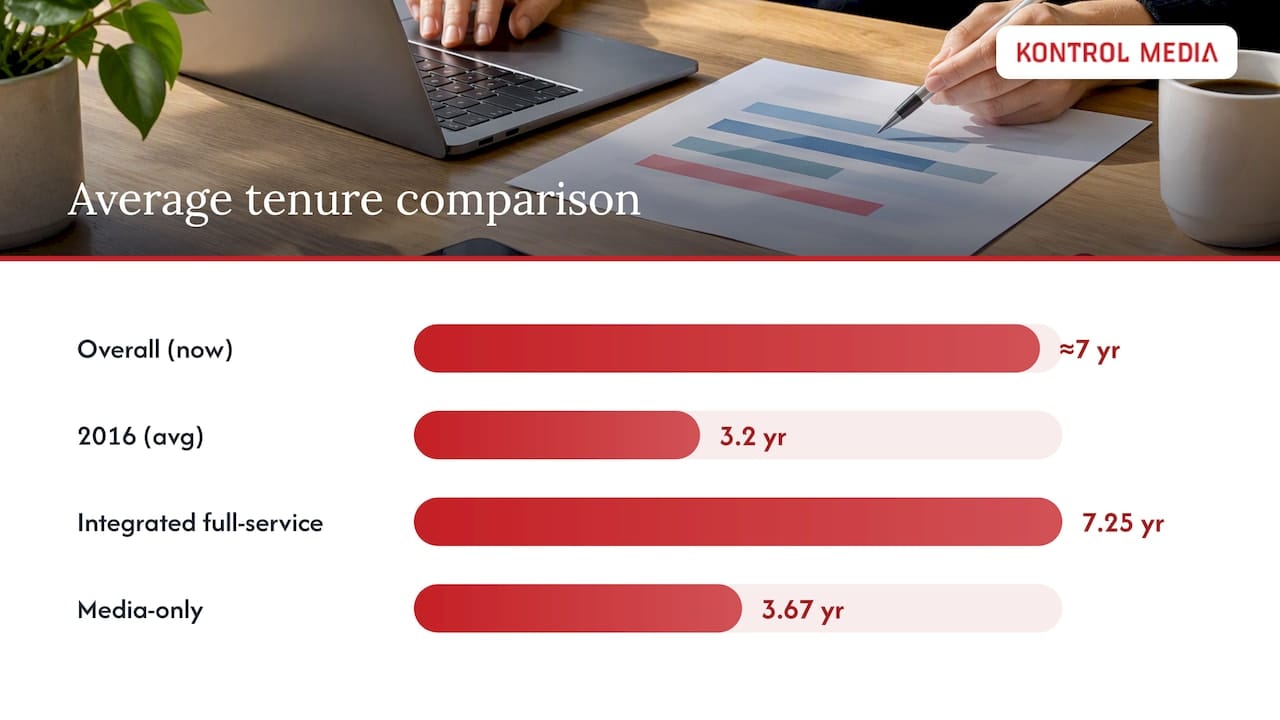
Clients without mandatory review periods tend to have longer tenures, and independent agencies generally report longer relationships, according to ANA/4As research on AOR relationships. Reducing formal review frequency, paired with predictable onboarding, correlates directly with how long a partnership survives.
What clients say they actually want backs this up:
- Proactive communication, not reactive reporting after something breaks.
- Strong, structured onboarding that sets expectations early.
- Strategic leadership from the agency, not just campaign execution.
The business case follows naturally. A formal partnership strategy protects revenue predictability, deepens institutional knowledge of the brand, and lets both sides stop relitigating fundamentals every budget cycle.
Core principles and framework for an agency partnership strategy
A durable partnership rests on a handful of pillars, and skipping any one of them tends to surface as friction within the first two quarters.
- Alignment on business outcomes. Every scope of work ties back to a business metric the client’s leadership actually tracks, not a vanity media metric.
- Unified measurement. Both sides agree on one source of truth for performance before the first campaign launches, not after a dispute.
- Governance and cadence. Decisions have a documented owner, a review rhythm, and an escalation path that does not require a crisis to activate.
- Transparent resourcing. Staffing, hours, and third-party costs are visible to the client, which removes the most common source of distrust.
- Shared learning. Insights from one workstream feed the next, so the relationship compounds instead of restarting every quarter.
Governance works best with a single named owner on the client side and a single strategic lead on the agency side, supported by a small steering committee that meets monthly and a RACI document that spells out who decides what, from creative approval to budget reallocation. Vague ownership is where most partnerships quietly erode.
Incentive structures matter as much as governance. A blended model, retainer plus a performance component tied to agreed incremental metrics such as incremental sales or ROAS, keeps both sides focused on outcomes rather than hours billed.
Pro Tip: Put the RACI chart in front of both teams before the kickoff call, not after the first disagreement.
Partnership lifecycle: a practical playbook
Turning the framework into motion follows a fairly consistent sequence, whether the relationship is a new retainer or a reset of an existing one.
Finding fit:
- Map the agency’s actual capabilities against the scope, not its pitch deck.
- Run a scoped pilot project before committing to a full retainer.
- Watch for culture fit signals during the pilot: responsiveness, candor, and how disagreements get handled.
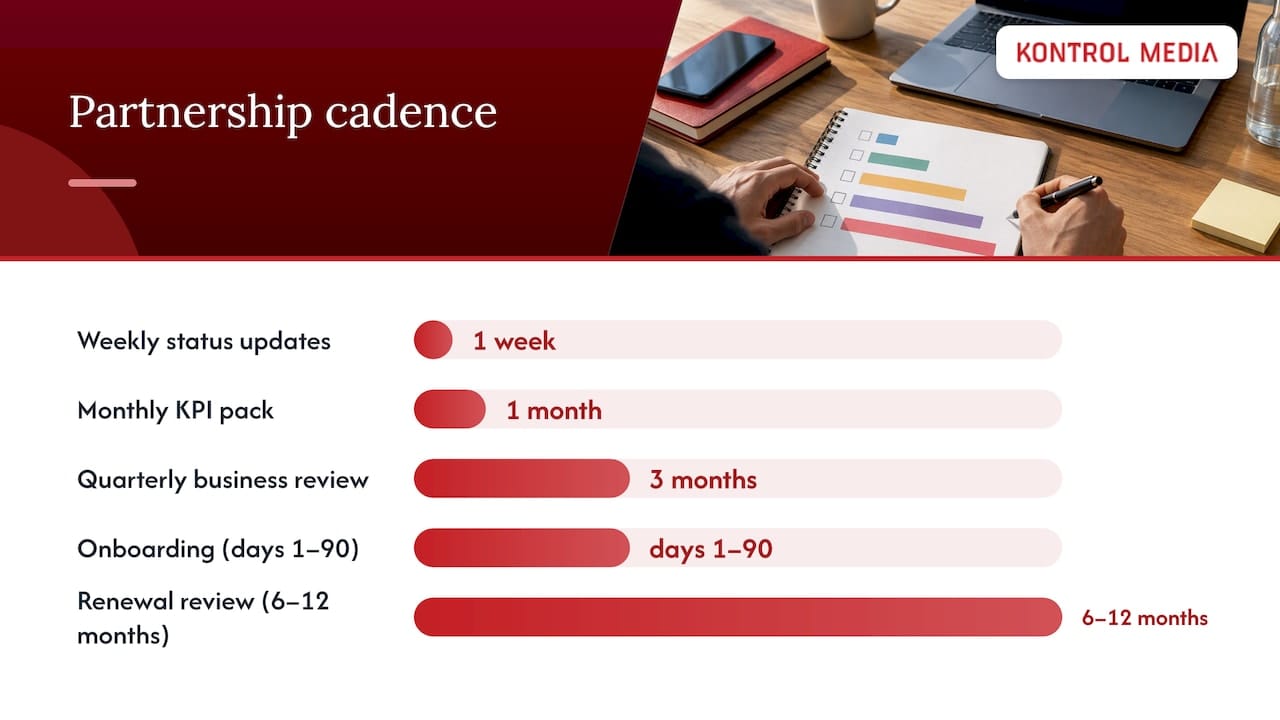
Onboarding, roughly days 1 to 90:
- Hold a kickoff meeting that sets shared KPIs and clarifies the RACI; Client Services Collective’s benchmark research recommends a focused seventy-minute executive session for this.
- Run a two-week data-access sprint so the agency has clean access to the systems it needs.
- Publish a documented 30/60/90 plan in a shared workspace both teams can see.
- Confirm reporting formats and cadence before the first full month of work begins.
Operating routines:
- Weekly status updates that flag risk early rather than at the quarterly review.
- A monthly KPI pack tied to the metrics defined at kickoff.
- A quarterly business review that revisits strategy, not just last quarter’s numbers.
- A governed experimentation budget so new ideas get tested without derailing the core plan.
Renewal should be a scheduled conversation, not a surprise. Reviewing the relationship every six to twelve months, rather than defaulting to an annual pitch, gives both sides room to adjust the scope without starting over.
Measurement and transparency: building a shared measurement system
Measurement is where most partnerships either earn trust or lose it. A practical stack combines marketing mix modeling for channel-level visibility, multi-touch attribution for campaign-level detail, and holdout tests for incrementality that neither model alone can prove. The IAB’s State of Data 2025 companion guide recommends exactly this combination, pairing MMM with MTA and automated incremental testing through holdouts or synthetic controls.
Operationalizing it takes a few concrete steps:
- Define a shared metric taxonomy so “ROAS” and “incremental sales” mean the same thing to both teams.
- Write data contracts that specify what gets shared, how often, and in what format.
- Build dashboards both sides can access directly, rather than relying on slide decks.
- Set a validation cadence: a weekly leading-indicator dashboard, a monthly incrementality check, and a quarterly MMM refresh.
Half of brands report concerns about transparency in how agencies use AI, according to the IAB State of Data 2025 report, which recommends phased AI governance: defined use cases, formal training, output-level KPIs, and a review board for higher-stakes applications. Explainable reporting on how AI-assisted decisions get made keeps that confidence intact rather than asking clients to take it on faith. Our guide to iROAS measurement for retail media walks through how this taxonomy applies specifically to commerce media environments.
How we apply this strategy at Kontrol Media
We built our practice around the gap between strategy decks and the work that actually moves revenue. Our partnership development services focus on structuring agreements that both sides can execute against from day one, not just sign.
Our core capabilities map directly onto the framework above:
- We help brands and agencies build revenue-generating marketing partnerships through the real estate channel, including agent outreach and ad programs.
- We stand up and operate retail and commerce media networks, which requires the same governance and measurement discipline this playbook describes.
- We provide hands-on execution across sales, marketing, and business development, not strategy alone.
We have worked with a range of notable brands across industries. On measurement, we typically start by agreeing on a metric taxonomy before any media moves, and on onboarding, we favor a short pilot scope over a full retainer commitment until both teams have proven they can execute together.
Leadership habits that determine partnership success
The most common failure we see is not a bad strategy. It is reactive communication: an agency that reports problems instead of flagging risk before it becomes one. Poor onboarding compounds this, because teams that skip a documented 30/60/90 plan spend the first quarter guessing at expectations.
The fix is habitual, not structural. A single strategic owner on each side, recurring executive check-ins separate from campaign status calls, and a documented playbook that survives staff turnover. Partnership health shows up in relationship metrics too: responsiveness, how disagreements get resolved, whether strategic ideas come from the agency unprompted. Those signals surface problems months before a campaign KPI does.
— Mark Kapczynski
Ready to build a partnership strategy that lasts
A partnership strategy only works when someone owns the execution, not just the plan. We help brands and agencies put the governance, measurement, and onboarding pieces in place so the relationship survives past the first renewal date.
Depending on where you are, that might mean:
- Structuring a new partnership agreement with shared KPIs from day one, through our business strategy and marketing services.
- Standing up a retail or commerce media network with governance built in from the start.
- Operating an existing network with the measurement discipline this playbook describes, through our retail media network operations work.
If you are evaluating a new agency relationship or resetting one that has stalled, reach out to our team and we will walk through what a working governance model looks like for your situation.
FAQ
What is an agency partnership?
An agency partnership is a formal, ongoing working relationship between a brand and an agency built around shared business outcomes rather than a single project. It typically includes agreed KPIs, a governance structure with named owners on both sides, and a review cadence that replaces repeated pitch cycles.
What are the 5 key marketing strategies?
Definitions vary across the industry, but a common framework for a partnership-driven marketing approach includes alignment on business outcomes, unified measurement, governance and cadence, transparent resourcing, and shared learning across workstreams. These five pillars give both the brand and the agency a consistent structure to evaluate and improve the relationship over time.
Can you give me an example of a marketing partnership?
A retailer working with an outside team to stand up and operate a commerce media network is one practical example, where the partnership spans strategy, technical setup, and ongoing revenue operations rather than a single campaign. We build and run these partnerships directly, including media partnerships through the real estate channel that connect brands with in-market homebuyers through agent networks.
What is a strategy agency?
A strategy agency focuses on the planning layer of marketing and business growth, setting direction before any execution begins, though many firms now blend strategic planning with hands-on execution rather than keeping the two separate. This hybrid approach tends to produce clearer alignment, since the same team that sets the plan is also accountable for carrying it out.
Sources
- New ANA and 4As Report Reveals Client-Agency Relationship Tenure Has Doubled Since 2016 | About the ANA | ANA
- The Agency-Client Benchmark Report 2025: What Clients Really Think — Client Services Collective
- IAB State of Data 2025_Companion Guide