


Retail data monetization means turning first-party shopper and transaction data into revenue through retail media, audience and analytics products, and supplier partnerships. The biggest gains come from retail media networks selling on-site and off-site ad placements, packaged audience insights sold as subscriptions or API access, and brand partnerships built on aggregated behavioral data rather than raw records. Done well, it diversifies revenue, lifts margins, and deepens relationships with the suppliers who already depend on your shelves.
TL;DR:
- Successful retail data monetization depends on building a strong identity infrastructure and measurement stack before expanding off-site advertising efforts.
- Retail media revenue can reach 2 to 5 percent of total sales, with on-site margins typically between 70 and 90 percent, significantly boosting profit margins.
- Privacy-safe audience segments and analytics products should be packaged carefully to maintain customer trust and meet regulatory standards like CCPA and GDPR.
- Reliable monetization requires integrating data from POS, e-commerce, loyalty programs, in-store sensors, and third-party sources, all with proper consent management.
- Organizational clarity, strong ownership, and external expertise are vital to operationalize retail media programs and accelerate revenue growth.
Table of Contents
- Why Monetize Retail Data Now?
- Retail Media Networks: What To Sell and How Measurement Wins Deals
- Audience Products: Selling Insight, Not Just Impressions
- Supplier and Brand Partnerships: Structuring Deals That Scale
- What Technology Foundation Powers Reliable Monetization?
- How Do You Monetize Data Without Losing Customer Trust?
- Building the Team: How To Operationalize Monetization
- What ROI Can Retailers Actually Expect?
- What’s Next for Retail Media and Data Monetization?
- Where Does Retail Data Actually Come From?
- Kontrol Media’s Perspective on Building vs. Buying Expertise
- Ready to Turn Your Data Into a Revenue Line?
- Sources
Why Monetize Retail Data Now?
The math has changed fast. Retail media has become one of the highest-margin businesses a retailer can run, with several forecasts placing the total retail media market near or above $100 billion in the mid-2020s, and some retailers earning 2 to 5 percent of total revenue from media alone.
Cookie deprecation and the collapse of third-party tracking have made brand advertisers desperate for exactly what retailers already own: purchase-verified, consented, first-party data tied to real transactions. That scarcity is why advertisers pay a premium for retail media over open-web display.
The Opportunity: Retail media revenue can carry 2 to 5 percent of total retail revenue at margins far above core retail operations, according to Coresight’s alternative revenue research.
None of this works without customer trust. Retailers who treat data monetization as a bolt-on ad business, rather than an extension of the loyalty relationship, tend to see it erode faster than it builds.
Retail Media Networks: What To Sell and How Measurement Wins Deals
On-site inventory is the easiest place to start. Sponsored product listings, native placements in search and category pages, and homepage takeovers all sell against intent signals no open-web platform can match. Off-site extension, pushing your audience data into a brand’s own display, social, or connected TV buys, is where the real ceiling sits, but it demands far more infrastructure.
Measurement is what separates a durable retail media network from a commodity ad reseller. Retailers that can prove incrementality with documented identity joins command premium CPMs; those that cannot get treated like generic inventory and get squeezed on price.
- On-site products: sponsored listings, native placements, homepage and category takeovers.
- Off-site extension: audience match to display, social, and CTV inventory through DSP partnerships.
- Measurement layer: clean-room verification, closed-loop attribution, third-party benchmarking.
- Packaging: self-service platforms for smaller advertisers, managed-service deals for enterprise brand budgets.
Off-site activation only makes sense once you have the audience scale and identity infrastructure to back it. Trying to sell off-site inventory before your match rates are solid usually damages advertiser trust faster than it builds revenue.
Pro Tip: Launch on-site sponsored listings first and reinvest that early margin into your identity and measurement stack before you pitch off-site deals. Advertisers forgive a smaller network far more readily than they forgive unverifiable results.
Audience Products: Selling Insight, Not Just Impressions
There are two distinct businesses hiding inside your customer data: selling access to audience segments for activation, and selling the analytics themselves as a standalone product. The first monetizes reach; the second monetizes knowledge.
Retailers can package privacy-safe audience segments and let advertisers activate them through DSPs, private marketplaces, or clean rooms, never handing over raw personal data. Alongside that, dashboards, subscriptions, and API access let brands buy ongoing category insight without touching a single record.
- Segment access: activation via DSPs, private marketplaces, or clean-room matching.
- Analytics subscriptions: recurring dashboard access priced per seat or per category.
- API access: usage-based pricing for programmatic queries into aggregated trend data.
- Reporting expectations: buyers want lift measurement, category benchmarks, and refresh cadence, not a static PDF.
Explore audience activation playbook approaches before locking in a pricing model, since the packaging decision shapes everything downstream, including which sales team can actually close the deal.
Supplier and Brand Partnerships: Structuring Deals That Scale
Suppliers already want what you have: proof that their products move, and audiences to reach efficiently. The strongest offers stay privacy-safe by design.
- Aggregated category insights sold on a subscription or per-report basis, with no individual-level data exposed.
- Campaign audience access where the brand pays for reach against a defined segment, activated on your platform or theirs.
- Test-and-learn programs that let a supplier run a small pilot with agreed measurement before committing to a full-year contract.
Every contract needs four things spelled out plainly: scope of allowed use, reporting cadence and format, pricing mechanics (flat fee, CPM, or revenue share), and a clean termination clause. Watch for red flags on both sides of the table, vague measurement promises and requests for individual-level PII are the two most common ways these deals go sideways.
Pro Tip: Structure every new supplier partnership as a 90-day pilot with a pre-agreed measurement framework before signing a multi-year deal. It protects both sides and gives you a real case study to sell the next partnership.
What Technology Foundation Powers Reliable Monetization?
Nothing here works on spreadsheets and good intentions. Four components form the baseline: a customer data platform or master data management layer, an identity graph, consent management infrastructure, and clean-room capability for privacy-safe matching.
Identity match rates decide how much your off-site inventory is actually worth. Retailers that can’t produce documented, privacy-compliant identity maps risk having their audiences commoditized by advertisers who simply buy cheaper reach elsewhere. That single capability gap is the difference between negotiating from strength and taking whatever CPM a DSP offers.
- CDP or MDM: unifies POS, e-commerce, and loyalty data into one customer view.
- Identity graph: resolves hashed emails, mobile ad IDs, and CTV device IDs into a persistent match.
- Consent management: tracks opt-in status at the granular level required for each activation channel.
- Measurement stack: attribution modeling, incrementality testing, and third-party verification.
The Trust Gap: Retailers who invest early in identity resolution and clean-room infrastructure consistently negotiate stronger advertiser rates than those selling unverified reach.
Data quality problems compound here faster than anywhere else in the business. A loyalty database with duplicate records or stale opt-ins doesn’t just hurt personalization, it directly caps how much an advertiser will pay for access to it.
How Do You Monetize Data Without Losing Customer Trust?
Privacy-by-design isn’t a compliance checkbox, it’s a product feature buyers now expect to see. Aggregation, scoped consent, and visible opt-out controls should be built into the monetization product from day one, not patched on after a complaint.
Regulatory frameworks like the CCPA and GDPR set the floor, not the ceiling, and industry standards around data minimization increasingly define what a “responsible” retail media program looks like to advertisers evaluating partners.
- Aggregate before you activate: individual-level data rarely needs to leave your environment.
- Scope consent by use case: a customer opting into personalized offers hasn’t automatically opted into third-party ad targeting.
- Make opt-outs visible and functional: a buried settings page erodes trust the moment a customer notices it.
- Communicate value, not just policy: tell customers what they get in exchange for data use, not just what you’re doing with it.
Retailers exploring formal frameworks for this can look at data governance models built for ROI and compliance together, since treating governance and revenue as separate workstreams is exactly how loyalty erosion starts.
Building the Team: How To Operationalize Monetization
Most retail media programs stall not from bad technology but from bad org design. A centralized media product team, one that owns pricing, measurement, and advertiser relationships, tends to scale faster than data monetization scattered across marketing, IT, and merchandising with no single owner.
- Run a diagnostic on your current identity match rates, consent posture, and available inventory before promising anything to advertisers.
- Design a pilot with one clear hypothesis, a defined measurement plan, and a fixed timeline.
- Recruit anchor advertisers, ideally suppliers who already sell through you and have incentive to see the pilot succeed.
- Iterate pricing from flat-fee pilots toward CPM or revenue-share models once measurement proves out.
- Scale the sales motion with a dedicated advertiser-facing team once volume justifies it.
The shift from project mentality to operational posture is what separates retailers running a real media business from those running a one-off experiment that never repeats.
What ROI Can Retailers Actually Expect?
Retailers running mature media programs report media revenue reaching 2 to 5 percent of total revenue, with on-site advertising margins running 70 to 90 percent, well above core retail margins.
Margin Reality: On-site retail media commonly runs 70 to 90 percent margin, while off-site extension carries thinner margins but far greater reach.
- Sponsored listing programs typically lift conversion on featured SKUs without cannibalizing organic sales when capped properly.
- Promotion optimization powered by purchase data reduces wasted markdown spend by targeting offers to shoppers likely to convert anyway.
- Combining loyalty, personalization, and media into one flywheel compounds impact rather than treating each as a separate initiative.
A grocery chain running a modest on-site sponsored program can often reach payback within a year once identity and measurement infrastructure is already in place. A specialty retailer layering audience products on top of an existing loyalty base tends to see faster adoption, since the trust relationship already exists. Track your own key retail media metrics from day one so the second pilot is easier to sell internally than the first.
What’s Next for Retail Media and Data Monetization?
Measurement standardization is coming whether retailers are ready or not, with IAB and MRC-style frameworks pushing toward independent verification as table stakes rather than a differentiator. Identity is shifting too: hashed email matching is giving ground to mobile ad ID and CTV household joins, and retailers slow to adapt will see off-site value erode.
Regulatory scrutiny on data sharing will likely tighten before it loosens, particularly around cross-retailer data cooperatives. Watch for new product models emerging alongside advertising: subscription-based insight products and “retail-as-a-service” offerings that let smaller brands rent a retailer’s entire media and data infrastructure rather than building their own.
Where Does Retail Data Actually Come From?
Every monetization strategy is only as good as the data feeding it, and most retailers underuse sources they already own long before they need new ones.
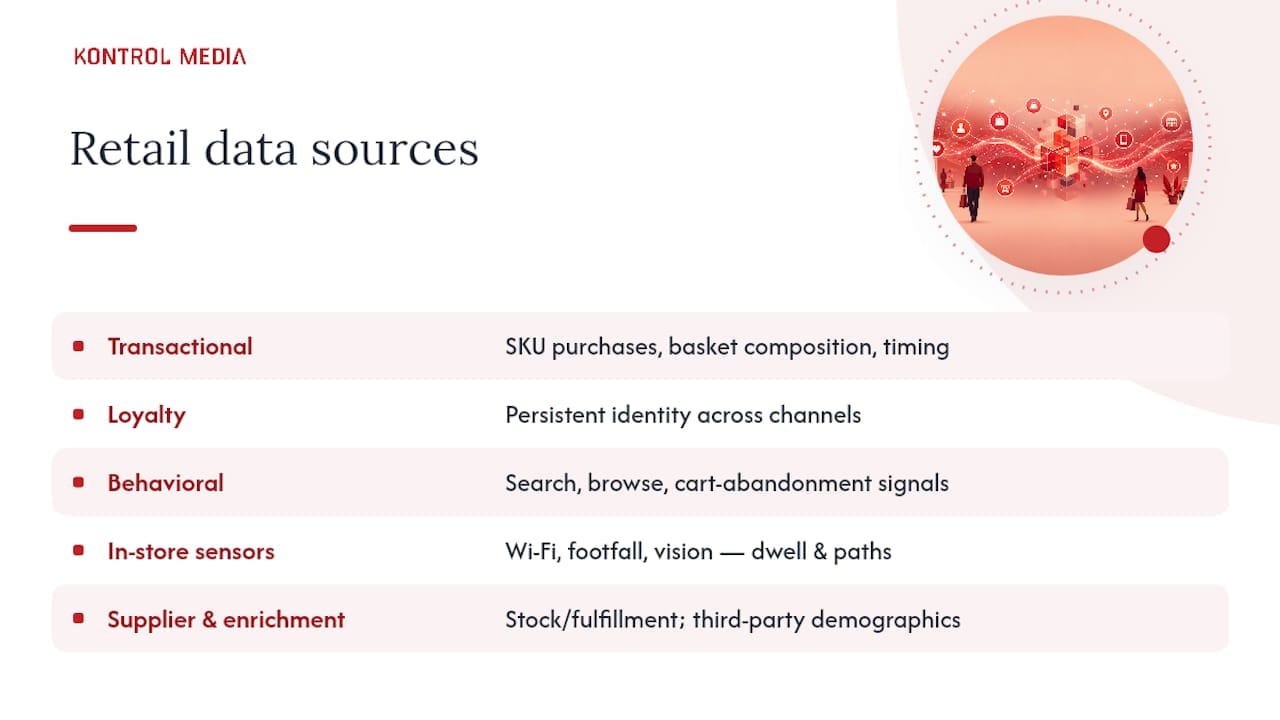
Transactional data from POS and e-commerce systems forms the backbone: SKU-level purchases, basket composition, and timing patterns that no third-party dataset can replicate. Loyalty program data adds identity persistence across channels, letting you connect a single customer’s in-store and online behavior over time. Behavioral and clickstream data from your website and app captures intent signals, search terms, browse paths, cart abandonment, that reveal what customers wanted even when they didn’t buy.

In-store data is the most underdeveloped source for most retailers. Wi-Fi analytics, footfall counters, and increasingly computer vision systems capture in-store data monetization opportunities that mirror what e-commerce sites have exploited for years: dwell time, path-to-purchase, and shelf-level engagement. Supplier and inventory data, stock levels, fulfillment patterns, and out-of-stock rates, feeds directly into the operational optimization products suppliers will pay to access. Third-party enrichment, used carefully and with consent, can fill demographic gaps without replacing the first-party foundation that gives your data its actual value to advertisers.
Collection methods matter as much as the sources themselves. Point-of-sale integration, mobile app SDKs, loyalty card scans, and consented web tracking each carry different consent obligations and different data quality profiles worth auditing before you build a monetization product on top of any single one.
Kontrol Media’s Perspective on Building vs. Buying Expertise
Most retailers underestimate how much of this is organizational, not technical. Retail media networks fail more often from unclear ownership than from bad data infrastructure.
That is where a consultant earns their keep: standing up the retail media operation, building the advertiser sales motion from scratch, and productizing audience insights into something suppliers actually want to buy. Kontrol Media has done this work directly with brands and platforms navigating exactly these tradeoffs, including retail media network strategy engagements.
Hiring outside expertise accelerates value most when internal teams lack advertiser sales experience or when the first pilot needs to prove itself fast. Start with a diagnostic, then design the first pilot around your strongest inventory.
— Mark Kapczynski
Ready to Turn Your Data Into a Revenue Line?
Kontrol Media builds and operates retail and commerce media networks end to end, from standing up the technical foundation to recruiting and closing the advertisers who will actually spend against your audience. That is the specific gap most retailers hit: they have the data, they lack the advertiser sales muscle and network operations experience to monetize it fast.
Clients come to Kontrol Media when they need someone who has already built these networks and closed these advertiser deals, not another framework to implement alone. The typical starting point is a diagnostic that reviews your current data infrastructure, identity match rates, and inventory readiness, then scopes a pilot built around your strongest assets first. If you’re ready to see what a working retail media pilot could look like for your business, stand up a retail or commerce media network with a team that has already done it, or reach out through Kontrol Media’s contact page to scope your first engagement.
Sources
For deeper research, Coresight’s alternative revenue models playbook covers the operational shift retailers need to make. BCG’s first-party data growth engine research explains the four-lever flywheel referenced throughout this guide. Snowflake’s data monetization fundamentals resource breaks down subscription and API pricing models in more technical depth.
- The new first-party data economy: How to turn data into margin (Amperity)
- First-party data is retail’s next growth engine (BCG)
- Retail media networks: The data layer behind the ad revenue (GSDSI)
- Playbook: Retail’s Alternative Revenue Models—Monetizing Media, Data and Infrastructure (Coresight)