


Incrementality in retail media is defined as the portion of conversions or sales directly caused by an ad campaign that would not have occurred without that ad exposure. This is the core question every retail media strategist should be asking: did my campaign actually drive new sales, or did it just take credit for purchases that were going to happen anyway? 52% of US brand and agency marketers now use incrementality testing as of Q2 2026, making it a mainstream discipline rather than a niche experiment. Understanding what does incrementality mean in retail media is no longer optional for serious marketing professionals. It is the difference between spending confidently and spending blindly.
What does incrementality mean in retail media?
Incrementality is the causal lift an ad campaign produces above and beyond what would have happened organically. Think of it this way: a shopper who was already planning to buy a product from Amazon or Walmart does not represent an incremental sale, even if they clicked your sponsored product ad on the way to checkout. The sale was going to happen regardless. True incrementality captures only the sales your advertising actually caused.
This distinction matters because retail media networks report attributed sales, not incremental sales. Attribution assigns credit to ad touchpoints based on association. Incrementality proves causation. 56% of advertisers now prioritize incremental sales over ROAS as their primary KPI in retail media networks. That shift reflects a growing recognition that attributed revenue numbers can be flattering but misleading.

The IAB and major retail media networks including Amazon Ads, Walmart Connect, and Kroger Precision Marketing have all moved toward incorporating incrementality frameworks into their measurement standards. This is not a trend. It is a structural correction to how retail media performance gets evaluated.
How is incrementality measured in retail media?
Measuring incrementality requires a controlled experiment. You split your audience into two groups: a test group that sees your ads and a control group that does not. After the campaign runs, you compare conversion rates between the two groups.
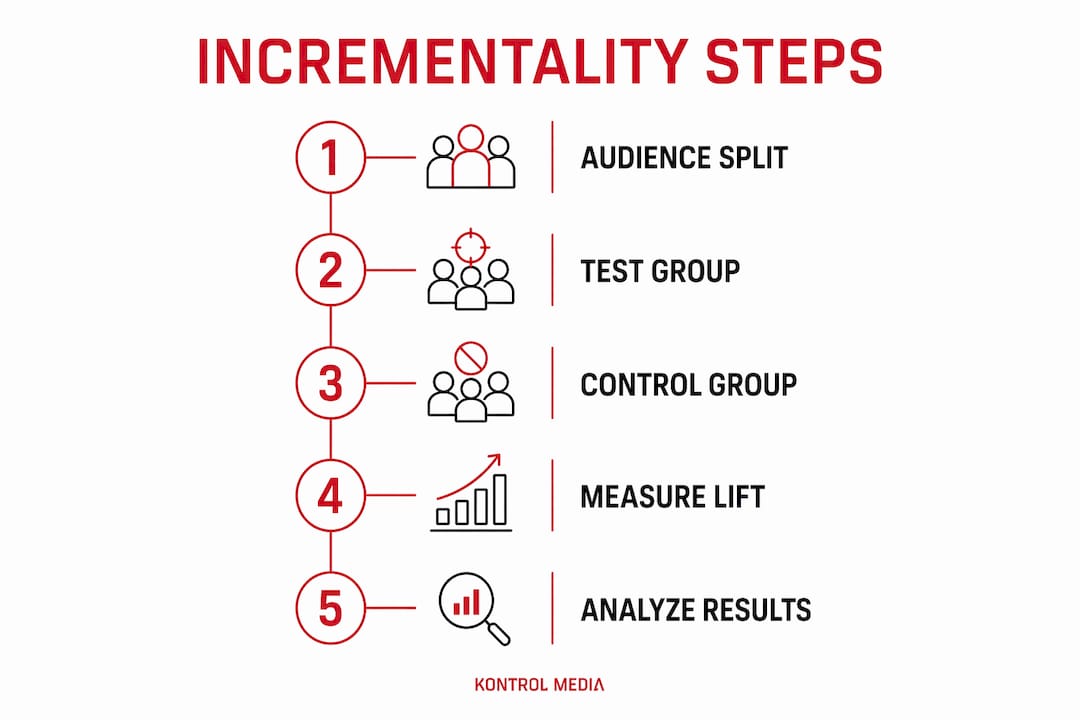
The standard formula is straightforward:
Incremental Lift = (Test Conversion Rate minus Control Conversion Rate) divided by Test Conversion Rate
A 25% incremental lift means 1 in 4 conversions was directly caused by ad exposure. The other 3 would have happened without the campaign. That context changes how you read a ROAS number entirely.
Here is a simplified example of how the math works in practice:
| Group | Conversions | Conversion Rate |
|---|---|---|
| Test (saw ads) | 400 out of 10,000 | 4.0% |
| Control (no ads) | 300 out of 10,000 | 3.0% |
| Incremental Lift | 100 conversions | 25% |
The 100 incremental conversions are the ones your campaign actually drove. Everything else was baseline demand.
Three core methodologies power incrementality analysis in retail:
- Holdout audience tests: A randomly selected control group is withheld from ad exposure for the campaign duration. Conversion rates are compared at the end.
- Ghost ad experiments: Placebo creatives run in live auctions for the control group, ensuring both groups experience identical auction dynamics. Ghost ad experiments reduce experiment dilution by 92% and tighten ROAS confidence intervals by 35%. That is a significant accuracy improvement.
- Geo-holdout tests: Specific geographic markets are withheld from campaigns while matched markets run ads. Results are compared across regions to isolate lift.
Pro Tip: Run incrementality tests for a minimum of two full purchase cycles to account for natural demand variation. A one-week test in a category with a 30-day purchase cycle will produce unreliable lift estimates.
Measuring incrementality requires withholding ads from control groups, which creates a short-term revenue trade-off. You are deliberately not showing ads to some buyers to get accurate data. Budget planning must account for this cost.
How does incrementality differ from traditional attribution?
Attribution and incrementality answer different questions. Attribution asks: which touchpoints were present before a conversion? Incrementality asks: which touchpoints actually caused the conversion? The first is a correlation exercise. The second is a causal one.
Standard attribution models, including last-click, first-click, and multi-touch models used across Google Ads, Meta Ads Manager, and most retail media dashboards, assign credit based on proximity or weight. They do not prove that removing any touchpoint would have changed the outcome. This creates a systematic over-crediting problem.
Incrementality isolates the value of marketing efforts distinct from baseline demand or organic sales that attribution models routinely miss. The practical implication is significant: a campaign can show strong attributed ROAS while delivering near-zero incremental lift. You are paying for credit on sales that were already going to happen.
Key distinctions between the two approaches:
- Attribution tells you where conversions were associated with your ads. Incrementality tells you which conversions your ads caused.
- Attribution is always-on reporting. Incrementality is a periodic experimental check.
- Attribution is vulnerable to false positives. Incrementality, when designed correctly, is not.
- Attribution data is available in real time. Incrementality results require a test period to reach statistical significance.
“Incrementality testing is a periodic experimental approach, not a real-time report. It serves as a causal check to guide strategy and platform investment.” — Cometly
The most effective measurement programs use both tools together. Attribution handles day-to-day optimization. Incrementality validates whether the attribution model is telling you the truth. Think of incrementality as the audit function for your attribution data.
What strategic benefits does incrementality offer in retail media?
Incrementality metrics shift retail media evaluation from reach and impressions to a strategic investment with measurable ROI. That shift has real consequences for how finance teams, procurement leaders, and CMOs view retail media budgets.
Consider a concrete example. A campaign on a retail media network reports $500,000 in attributed sales. Incrementality testing reveals that only $150,000 of those sales were actually caused by the ads. The incremental ROAS on that $150,000 is the number that matters to your CFO. It is the number that determines whether the budget grows or gets cut.
The strategic applications of incrementality in retail media are specific and practical:
- Budget reallocation: Shift spend from channels with low incremental lift to those with verified causal impact.
- Platform evaluation: Compare incremental ROAS across Amazon Ads, Walmart Connect, Instacart Ads, and Criteo to identify which networks drive net-new growth.
- Cannibalization detection: Identify campaigns that are simply capturing demand that would have converted through organic search or direct navigation.
- Finance alignment: Present incremental ROAS to procurement and finance stakeholders as a credible, auditable metric rather than a self-reported attribution number.
Incrementality testing enables marketers to optimize spend confidently by isolating true incremental sales and avoiding the over-crediting that attribution produces. That confidence is not just analytical. It is organizational. When finance trusts the measurement, retail media budgets get treated as growth investments rather than cost centers.
Pro Tip: When presenting incrementality results to finance teams, lead with incremental ROAS rather than total attributed ROAS. The gap between the two numbers is your credibility asset. It shows you understand the difference between credit and causation.
For a deeper look at the key retail media metrics that complement incrementality, including share of voice and new-to-brand rates, the 2026 Marketer’s Guide from Kontrol Media covers the full measurement stack.
What are advanced incrementality testing techniques?
Ghost ads represent the most significant methodological advancement in incrementality testing. Rather than simply withholding ads from a control group, ghost ads deliver placebo creatives in live auctions. The control group participates in the same auction dynamics as the test group but sees an unrelated ad. This eliminates auction-level selection bias, which is one of the most common sources of measurement error in holdout tests.
Geo-holdout tests solve a different problem. Geo-holdout incrementality tests reliably expose cannibalization effects from branded search campaigns that inflate attributed conversions. Branded search is particularly vulnerable to this distortion. A shopper who types a brand name into a search bar was already intending to buy. Showing them a paid search ad and claiming credit for the conversion is attribution inflation, not incremental growth.
Branded search campaigns often inflate attribution by 30–70% through cannibalized conversions revealed by geo-holdout testing. That range is wide, but even the low end represents a material misallocation of budget.
The industry is moving in a clear direction. Incrementality adoption is accelerating due to privacy-related tracking limitations and demand for accountability across retail media platforms. As third-party cookies disappear and pixel-based attribution becomes less reliable, experimentation-based measurement becomes the only credible alternative. Incrementality is not a workaround for privacy changes. It is a more rigorous methodology that privacy changes are forcing the industry to adopt sooner than it otherwise would have.
For marketers building out their iROAS measurement frameworks, geo-holdout and ghost ad methodologies are the two techniques worth prioritizing in 2026.
Key takeaways
Incrementality is the only retail media metric that proves causation rather than correlation, making it the foundation of credible campaign measurement.
| Point | Details |
|---|---|
| Incrementality defined | It measures only the sales caused by ads, not sales that would have happened organically. |
| Core measurement method | Use holdout audience tests and compare test versus control conversion rates with the standard lift formula. |
| Attribution vs. incrementality | Attribution assigns credit by association; incrementality proves causation through controlled experiments. |
| Strategic budget impact | Incremental ROAS, not attributed ROAS, is the number finance teams trust for budget decisions. |
| Advanced techniques | Ghost ads and geo-holdout tests eliminate selection bias and expose cannibalization from branded search. |
The metric that changes how you see everything
I have spent years working inside retail media strategy, and the single most clarifying shift I have seen in measurement practice is when a marketing team runs their first real incrementality test and sees the gap between attributed sales and incremental sales for the first time. It is often uncomfortable. A campaign that looked like a strong performer on the dashboard suddenly looks much more modest when you strip out the baseline demand it was taking credit for.
What I find most interesting is that this discomfort is actually productive. It forces a more honest conversation about what advertising is supposed to do. The goal is not to be present when a sale happens. The goal is to cause a sale that would not have happened otherwise. That is a fundamentally different objective, and incrementality is the only measurement framework that holds campaigns accountable to it.
The marketers I respect most are the ones who run incrementality tests even when they are nervous about what the results will show. They understand that accurate measurement, even when it reveals underperformance, is the foundation of better decisions. Fragmented reporting creates trust gaps between marketing and finance. Incrementality fixes that by grounding the conversation in experimental evidence rather than attribution models that everyone secretly suspects are optimistic.
The direction this industry is heading is clear. Experimentation is becoming the spine of retail media measurement. The teams that build that capability now will have a structural advantage when every platform is eventually held to the same standard.
— Mark Kapczynski
How kontrol media helps you measure what actually matters
Retail media measurement is only as good as the methodology behind it. At Kontrol Media, we build, operate, and drive revenue for retail media and commerce media networks, and incrementality testing is central to how we evaluate performance for every client.

Whether you are running sponsored product campaigns on an established retail media network or standing up your own commerce media operation, we help you move beyond attributed sales to verified incremental lift. Our consulting work with organizations like Experian, BuzzFeed, and West Monroe reflects a consistent commitment to measurement that finance teams can trust. If you are ready to build a retail media strategy grounded in real causal data, explore our retail media consulting services and see how we approach measurement from strategy through execution.
FAQ
What does incrementality mean in retail media?
Incrementality in retail media measures the sales or conversions directly caused by an ad campaign that would not have occurred without that ad exposure. It isolates true advertising-driven growth from baseline or organic demand.
How is incrementality different from ROAS?
ROAS measures total attributed revenue divided by ad spend, including sales that would have happened without the ad. Incrementality measures only the causal lift, making incremental ROAS a more reliable indicator of true campaign value.
Why do branded search campaigns distort attribution?
Branded search campaigns frequently claim credit for conversions from shoppers who were already intending to buy. Geo-holdout tests reveal that branded search attribution is inflated by 30–70% through cannibalized conversions.
How long does an incrementality test need to run?
An incrementality test should run for at least two full purchase cycles for the product category being measured. Shorter tests risk capturing demand fluctuations rather than true incremental lift.
Is incrementality testing worth the short-term revenue trade-off?
Yes. Withholding ads from control groups creates a short-term revenue cost, but the accuracy gained from the test produces better long-term budget decisions that far outweigh the temporary sacrifice.
Recommended
- Key Metrics for Retail Media: 2026 Marketer’s Guide | Kontrol Media Consultancy
- The Shift in Advertising Spend – How Retail Media Networks Are Changing the Game | Kontrol Media Consultancy
- The Rise of Retail Media: How Commerce Media Is Powering the Next Ad Revolution | Kontrol Media Consultancy
- Commerce Media Networks: The Next Evolution in eCommerce Advertising | Kontrol Media Consultancy