


Brand positioning strategy is defined as the deliberate process of occupying a distinct, valuable place in a customer’s mind relative to competitors and needs. This is not a tagline exercise or a campaign brief. It is the spine of every business and marketing decision your organization makes. The role of brand positioning strategy extends far beyond messaging. It shapes how customers perceive your value, whether they pay premium prices, and whether they come back. Frameworks from Michael Porter’s generic strategies to April Dunford’s five-component positioning model give leaders structured ways to make these decisions with clarity and conviction.
How does brand positioning shape customer perception and behavior?
Positioning defines what a brand is in the customer’s mind, not just what the company claims to be. That distinction matters enormously. A brand can spend millions on advertising and still occupy no meaningful mental real estate if its positioning is vague or inconsistent.
The mechanism works through two mediating factors: brand image and perceived value. Research involving 265 customers found that perceived value fully mediates the relationship between brand image and behavioral intentions. This means customers do not act on awareness alone. They act when they believe a brand delivers something worth their money and loyalty.

Perceived value is the conversion engine. Brand equity creates the foundation, but without a clear positioning strategy that builds perceived value, that equity sits dormant. Companies like Apple and Patagonia demonstrate this in practice. Apple’s positioning around design and simplicity justifies premium pricing. Patagonia’s positioning around environmental responsibility drives repeat purchases from a deeply loyal segment.
The difference between brand awareness and meaningful positioning is measurable. Awareness tells you a customer has heard of you. Positioning tells you what they believe about you. Only the second one drives purchase decisions.
| Positioning Outcome | Measurement Approach |
|---|---|
| Brand image strength | Brand image surveys with target segments |
| Perceived value | Price sensitivity analysis and willingness-to-pay studies |
| Behavioral intentions | Purchase intent tracking and repeat purchase rates |
| Positioning gap | Comparison of intended vs. actual customer perception data |
Pro Tip: Run a simple perception audit twice a year. Ask your best customers to describe your brand in three words, then compare those words to your intended positioning. The gap between those two sets of words is your most honest strategic feedback.
What frameworks guide effective brand positioning strategy?
Two frameworks stand above the rest for structuring brand positioning work: April Dunford’s five-component model and Michael Porter’s generic strategies. They operate at different levels, and the best positioning work uses both.
April Dunford’s framework, detailed in her book Obviously Awesome, starts with competitive alternatives rather than product features. Most companies make the mistake of describing what they do before establishing what customers would use instead. Dunford’s five components are competitive alternatives, unique attributes, value those attributes deliver, the target market that cares about that value, and the market category that frames the brand. This sequence forces a customer-first perspective that most internal positioning exercises skip entirely.
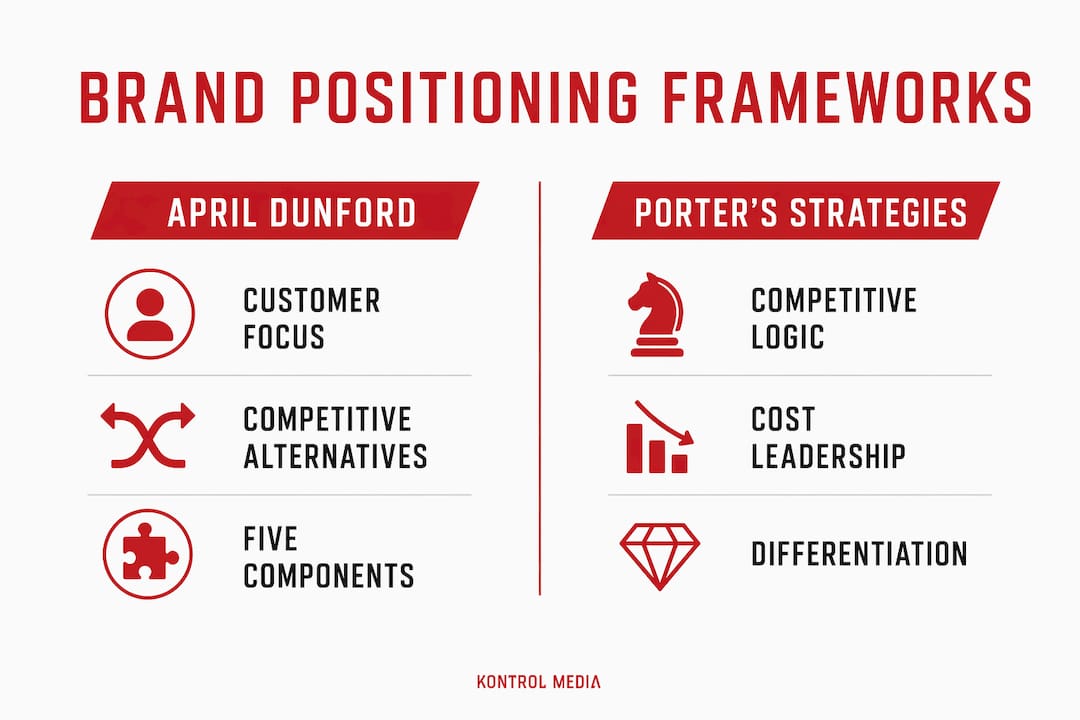
Porter’s generic strategies operate at the competitive logic level. Companies must commit to a positioning logic of cost leadership, differentiation, or focus. Trying to occupy two positions simultaneously produces what Porter called “stuck in the middle,” a condition where the brand stands for nothing specific and competes poorly on all dimensions.
| Framework | Primary Focus | Best Used For | Key Risk |
|---|---|---|---|
| April Dunford’s Five Components | Customer perspective and category design | Product and service positioning clarity | Skipping competitive alternatives step |
| Porter’s Generic Strategies | Competitive logic and market positioning | Business-level strategic direction | Attempting multiple positions at once |
| Positioning Gap Test | Perception vs. intention alignment | Ongoing measurement and refinement | Ignoring segment-specific perception data |
Positioning also operates at two levels simultaneously. Overall brand positioning sets the broad identity, while attribute-level positioning addresses specific target groups with tailored proof points. A financial services firm might position broadly as “trustworthy and transparent” while positioning its small business product specifically around speed and simplicity for that segment.
Pro Tip: Before any positioning workshop, ask every leadership team member to write down the brand’s position in one sentence without consulting each other. If you get five different answers from five leaders, you have a positioning problem, not a messaging problem.
What are the key benefits and risks of brand positioning strategies?
Clear positioning delivers seven measurable business benefits. Companies with consistent positioning grow 33% faster according to market analysis. That number reflects something real: when everyone inside and outside the organization understands what the brand stands for, decisions get made faster and resources get allocated more efficiently.
The seven benefits are worth naming directly:
- Market differentiation: A clear position separates you from competitors in the customer’s mind, reducing direct price comparisons.
- Customer loyalty: Customers who understand and believe in your position return more often and advocate more loudly.
- Pricing power: Brands with strong perceived value command premium prices without losing market share.
- Marketing efficiency: Every campaign, channel, and message pulls in the same direction, reducing wasted spend.
- Competitive advantage: A well-defended position is hard for competitors to replicate quickly.
- Brand recall: Consistent positioning creates mental shortcuts that make your brand the first one customers think of in your category.
- Sustainable growth: Positioning creates a platform for product and market expansion that feels coherent rather than scattered.
The risks of poor positioning are equally concrete. Unclear positioning causes strategy fragmentation and culture drift inside the organization. When the leadership team cannot agree on what the brand stands for, the marketing team invents its own version, the sales team invents another, and the product team builds toward a third. Customers feel that incoherence, even if they cannot name it. They just stop trusting the brand.
Loss of creative focus is another downstream consequence. When positioning is vague, creative teams fill the vacuum with whatever feels interesting in the moment. The result is a brand that looks different every year and builds no cumulative recognition.
How do you implement and measure a brand positioning strategy?
Implementation starts with leadership, not marketing. Positioning is an upstream decision that guides all downstream business and marketing choices. Delegating it entirely to the marketing team produces a positioning statement that lives in a brand deck and influences nothing.
Here is a practical implementation sequence:
- Align leadership first. Conduct a positioning workshop with the full leadership team before involving marketing or creative teams. Use April Dunford’s framework as the structure. Get explicit agreement on competitive alternatives and the target market segment.
- Audit current brand image. Survey existing customers and prospects to understand what they currently believe about your brand. Use open-ended questions alongside structured scales to capture both emotional and rational perceptions.
- Identify the positioning gap. Compare intended positioning with actual perceptions to find mismatches. Common gaps include targeting the wrong segment or claiming differentiation that customers do not actually experience.
- Integrate across functions. Positioning must run through product development, customer experience, communications, and internal culture. A positioning statement that only lives in marketing materials is not a positioning strategy. It is a tagline.
- Establish measurement cadence. Track brand image scores, perceived value metrics, and behavioral intention data on a regular schedule. Connect these metrics to revenue outcomes to build the business case for sustained positioning investment.
- Refine iteratively. Markets shift, competitors move, and customer needs evolve. Treat positioning as a living strategic asset, not a one-time project. Schedule a formal positioning review annually and a lighter perception audit every six months.
Effective positioning requires analyzing brand image and then crafting identity to create a distinctive, recognizable presence for the target group. The measurement framework matters as much as the positioning itself. Tracking only awareness or brand equity proxies misses the actual conversion mechanism. You need to measure brand image and perceived value as the mediating factors that turn equity into revenue.
Pro Tip: Build a simple positioning scorecard with three metrics: brand image alignment score, perceived value rating, and purchase intent index. Review it quarterly with your leadership team alongside revenue data. When those metrics move together, you have proof that positioning is working.
Key takeaways
Brand positioning strategy is a leadership decision that shapes customer perception, drives behavioral conversion, and creates the organizational alignment needed for sustainable growth.
| Point | Details |
|---|---|
| Positioning is a leadership decision | Delegating positioning to marketing alone causes fragmentation across strategy, culture, and execution. |
| Perceived value drives conversion | Brand equity only converts to revenue when positioning builds strong perceived value in the customer’s mind. |
| Two frameworks complement each other | Use April Dunford’s model for customer-facing clarity and Porter’s generic strategies for competitive logic. |
| Measurement must go beyond awareness | Track brand image scores and perceived value metrics to capture the full impact of positioning on behavior. |
| Positioning requires cross-functional integration | Effective positioning runs through product, experience, communications, and culture, not just marketing campaigns. |
Positioning is a compass, not a campaign
I have sat in enough leadership offsites to know the pattern. The CEO opens the session, someone puts up a slide with the brand’s mission statement, and within twenty minutes the conversation has drifted to Q3 revenue targets and headcount. Positioning gets treated like a marketing deliverable rather than the strategic compass it actually is.
The most damaging mistake I see organizations make is treating positioning as a one-time project. They hire a branding agency, spend three months on workshops and creative exploration, land on a positioning statement, and then move on. Eighteen months later, the sales team is pitching something different, the product team has launched features that contradict the stated differentiation, and the marketing team is running campaigns that feel disconnected from the brand identity. Nobody made a bad decision. They just stopped using the compass.
Leadership involvement in positioning workshops is not optional. It is the difference between a positioning strategy that shapes culture and one that collects dust. When the CEO and the CFO have internalized the brand’s position, it shows up in hiring decisions, partnership choices, and capital allocation. That is when positioning actually works.
The other thing I have learned is that positioning clarity is a competitive moat. When your team knows exactly what you stand for and what you do not stand for, they make better decisions faster. They say no to the wrong partnerships. They build the right features. They write better copy without needing three rounds of approval. Clarity compounds. Vagueness costs you more than you can measure.
If you are a marketing leader reading this, the most valuable thing you can do this quarter is not launch a new campaign. It is to get your leadership team in a room and test whether they can articulate the brand’s position consistently. The answer will tell you everything about where your next investment should go. You can also explore how branding and messaging strategies connect positioning to execution across channels.
— Mark Kapczynski
How kontrol media helps you build a positioning strategy that sticks
Positioning work fails when it stays in a slide deck. At Kontrol Media, we work with marketing leaders and executive teams to move positioning from concept to execution across sales, marketing, and business development. We have done this for organizations like Experian, BuzzFeed, REMAX, and West Monroe, companies that needed more than a brand refresh. They needed strategic alignment that drove measurable growth.
Whether you are entering a new market, repositioning after an acquisition, or trying to close the gap between how you see your brand and how your customers do, Kontrol Media brings the frameworks and the execution muscle to get it done. Explore our thinking on comprehensive business strategy and see how positioning fits into the broader strategic picture. If you are ready to talk through your positioning challenges directly, reach out to our team and let us get to work.
FAQ
What is the core role of brand positioning strategy?
Brand positioning strategy defines the deliberate place a brand occupies in a customer’s mind relative to competitors and needs. It guides all downstream marketing, product, and business decisions rather than functioning as a standalone messaging exercise.
Why is brand positioning a leadership decision?
Unclear positioning causes strategy fragmentation and culture drift when left solely to marketing teams. Leadership alignment on positioning ensures it shapes hiring, partnerships, product development, and customer experience consistently.
How does positioning affect customer behavior?
Positioning works through brand image and perceived value. Perceived value fully mediates the path from brand image to behavioral intentions, meaning customers act when they believe the brand delivers real worth, not simply when they recognize it.
What is the difference between april dunford’s framework and porter’s generic strategies?
April Dunford’s framework starts from the customer’s perspective by identifying competitive alternatives first, while Porter’s generic strategies define the competitive logic a company commits to: cost leadership, differentiation, or focus. Both frameworks are necessary and operate at different levels of strategic decision-making.
How do you measure brand positioning effectiveness?
Track brand image alignment scores, perceived value ratings, and purchase intent indices on a regular schedule. Measurement frameworks for positioning should go beyond awareness metrics to capture the mediating factors that convert brand equity into actual revenue.