


Effective sales compensation design starts with business strategy, not spreadsheets. The plan has to define pay around actual roles rather than titles, keep mechanics like thresholds and accelerators transparent, and connect every payout to a metric that maps to a real company goal. Get those anchors right, and the rest of the article shows you how to build, model, and govern the plan around them.
TL;DR:
- Alignment of pay mix with sales roles is essential, with heavier variable pay suited for hunters and more base pay for account managers.
- Effective plans limit themselves to key metrics such as revenue, margin, or bookings, and keep mechanics like thresholds and accelerators simple and transparent.
- Running regular quarterly reviews, testing payout models, and ensuring legal and CRM attribution compliance are critical to plan stability and clarity.
- Distributing quotas accurately and avoiding retroactive changes or caps on top performers prevent misaligned incentives and maintain seller trust.
- Using technology platforms for real-time transparency and external expertise can help prevent disputes, misbehavior, and plan breakdowns.
Table of Contents
- What Are the Core Principles of Sales Compensation Design?
- How Do You Build a Sales Compensation Plan Step by Step?
- What Operational Mistakes Break Sales Compensation Plans?
- How Kontrol Media Approaches Sales Compensation Design
- How Does Sales Compensation Shape Seller Motivation and Behavior?
- How Should You Measure Whether a Compensation Plan Is Working?
- What Legal and Compliance Risks Should Compensation Designers Watch For?
- What Technology Supports Sales Compensation Management?
- How Often Should You Review and Communicate Sales Compensation Plans?
- A Practitioner’s View on Trade-Offs
- Get Hands-On Help Designing Your Sales Compensation Plan
- Sources
- FAQ
What Are the Core Principles of Sales Compensation Design?
Strategy comes first. Before anyone touches a commission rate, leadership has to answer a blunt question: what does the business need sellers to do this year? New logo growth, retention, margin expansion, and product mix each pull compensation design in a different direction, and WorldatWork’s guidance on sales compensation makes the case plainly: the most effective plans are built from the business outward, with strategic priorities set before quotas or accelerators enter the conversation. Skip this step and you end up with a plan that pays well but points in the wrong direction.
Role clarity matters more than most compensation committees admit. A “sales rep” title can hide wildly different jobs, an account executive closing net-new logos, a customer success manager protecting renewals, a solutions engineer supporting technical deals. SHRM’s toolkit on designing compensation for sales professionals recommends designing pay around the job and its accountabilities, not the title on the org chart. That distinction lets you assign different pay mixes to different motions instead of forcing every seller into one template.
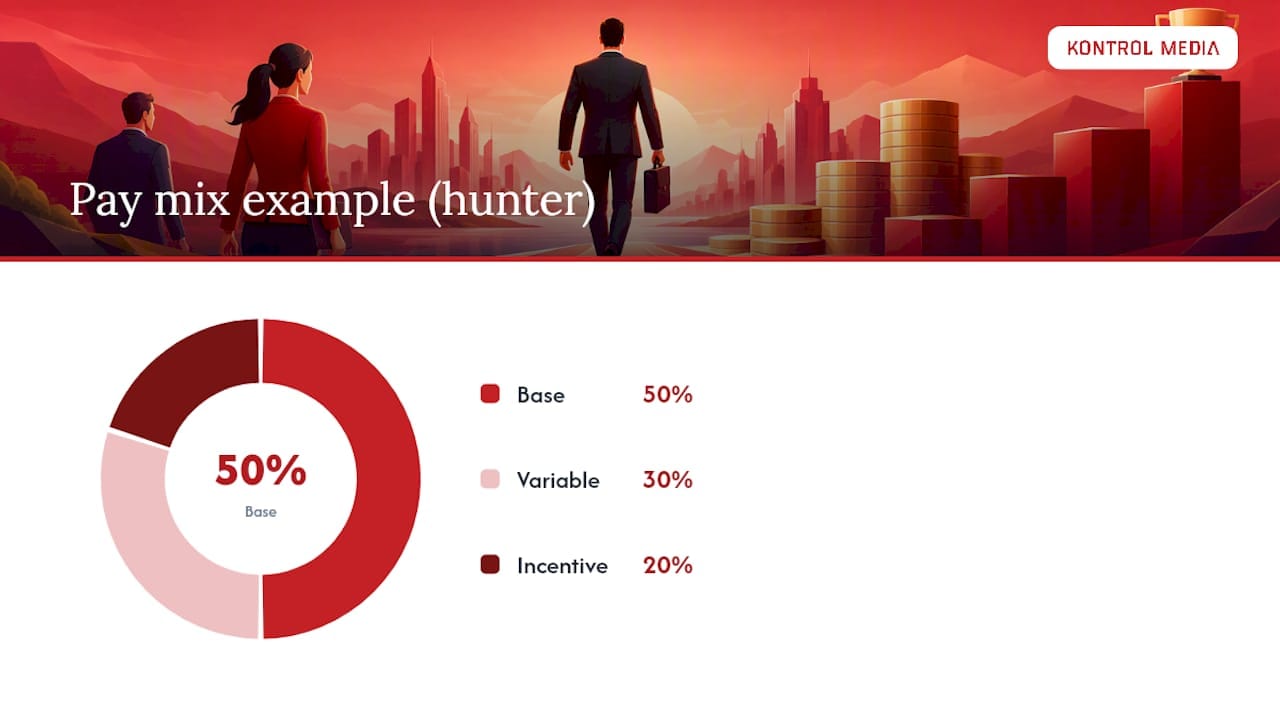
Pay mix, the split between base salary and variable pay, is where culture becomes visible. A hunter role closing six-figure new business might run 50/30/20 fixed to on-target incentive, while an account manager renewing existing contracts might sit closer to 80/20. Heavier variable weighting signals urgency and rewards outcome; heavier base weighting signals stability and rewards process. Neither is universally right. The mix has to match the sales motion and the risk you are willing to put on the seller’s shoulders.
Measures need discipline. Salesforce’s guide to sales compensation is direct about this: the strongest plans limit themselves to metrics that actually matter and keep the mechanics transparent enough that sellers can calculate their own paycheck. That usually means one financial measure (revenue, margin, or bookings), maybe one strategic measure (a specific product line or new segment), and an activity measure only when the sales cycle is long enough that outcomes lag behavior by months.
Mechanics are where good intentions die in the details. Thresholds decide when payout starts. Accelerators decide how payout scales past target. Caps decide whether your best performers keep earning or hit a ceiling that pushes them out the door.
- Set a threshold below which no incentive pays, typically 60% to 80% of quota.
- Use marginal accelerators, ones that apply only to the dollars earned above a tier, not the whole balance.
- Avoid caps on payout for top performers; capping success is one of the fastest ways to lose your best sellers.
- Pay on a schedule sellers understand and can verify against their own numbers.
Pro Tip: If a seller cannot recreate their own commission check with a calculator and their CRM dashboard, the plan is too complicated. Simplicity is a design feature, not a compromise.
How Do You Build a Sales Compensation Plan Step by Step?
Optymyze’s step-by-step framework argues that skipping steps in the design sequence is what produces misaligned plans later, and the sequence below follows that logic.
- Define the strategic objective. Decide, in measurable terms, what the plan needs to produce over the next 12 months, whether that is new logo revenue, upsell attach rate, or margin protection.
- Segment roles by motion. Group sellers by how they actually sell (hunting, farming, technical support), then assign pay mix rationale to each group rather than applying one mix company-wide.
- Set quotas using both directions. Blend top-down targets (what finance needs) with bottom-up territory builds (what each rep’s pipeline can realistically support), then validate the two against each other.
- Pick the commission structure and accelerator math. Choose your archetype, tiered, straight-line, or multiplier, and build the marginal accelerator curve, along with gate requirements and ramp rules for new hires.
- Model affordability and ROI. Run the payout model against realistic attainment distributions, checking what the plan costs at median, 75th percentile, and 95th percentile performance, so finance signs off before launch, not after.
- Pilot or phase the rollout. Launch with a subset of the sales team or a single region, pair it with training materials, and confirm CRM attribution rules assign credit correctly before scaling company-wide.
- Establish governance. Put a quarterly comp review on the calendar, synced with product roadmap reviews, backed by a dashboard that tracks payout-to-plan ratios and quota attainment distribution.
Each step produces a deliverable you can hand to finance, legal, or the sales leadership team before moving to the next one. That documentation trail is what saves you when someone asks, three quarters later, why the plan pays the way it does.
What Operational Mistakes Break Sales Compensation Plans?
Quota diagnostics catch problems before they become resentment. When your top-down number and your bottom-up territory build diverge by more than roughly 15%, that gap is a signal to redesign territories or adjust headcount, not to force-fit individual quotas until the math works.
- Prefer marginal accelerators over cumulative repricing, and never apply an accelerator retroactively to deals already closed.
- Use non-recoverable draws during ramp, paired with milestone-based graduation (first qualified pipeline, first closed deal, first deal above threshold) rather than a fixed calendar.
- Fund SPIFs from incremental margin, keep them short (30 to 90 days), and reserve them for specific launches or quota gaps, not as a permanent patch on a weak base plan.
- Choose holdbacks over clawbacks when you need to validate revenue before paying in full; clawbacks after the fact damage trust even when they are contractually justified.
- Resist the urge to add a fourth or fifth metric, more tiers, or hard caps, each one adds complexity without adding motivation.
Pro Tip: Before launch, run three tests: does the payout model match the CRM’s attribution logic, has legal reviewed the plan document for enforceability, and has finance confirmed the funding source for any SPIFs. Skipping any one of these three is how plans end up in dispute by the second quarter.
How Kontrol Media Approaches Sales Compensation Design
They build compensation plans starting from the business plan outward, not from a commission template. That means starting with the product roadmap and marketing calendar, then working backward into pay mix and metrics so sellers are never incentivized to chase a segment the company is quietly deprioritizing.
Kontrol Media’s client roster, including Experian, BuzzFeed, HuffPost, RE/MAX, Enthusiast Gaming, and West Monroe, spans private equity portfolio companies, middle market public companies, and large enterprises, each with different sales motions and different compensation risk tolerances.
- Internal HR and finance teams often have the compensation math right but lack the go-to-market context to know which metrics actually matter this year.
- A hands-on partner earns its keep when quota disputes, rep turnover, or misaligned incentives are already showing up in pipeline data.
- Kontrol Media’s business and marketing strategy services pair compensation modeling with the sales team design work needed to make a new plan stick.
How Does Sales Compensation Shape Seller Motivation and Behavior?
Sellers optimize for whatever gets measured, not for whatever the sales leader hopes they will do. That single fact explains most of the friction between compensation plans on paper and seller behavior in practice. A plan that pays only on new logo revenue will produce sellers who chase new logos even when a renewal is sitting right in front of them, because renewals do not move their number.
Pay mix changes risk tolerance directly. Heavier variable weighting pushes sellers toward higher-risk, higher-reward activity, chasing bigger deals, working longer sales cycles, tolerating more quarter-to-quarter income swings. Base-heavy mixes produce steadier, more process-oriented behavior, which fits account management and long-cycle technical sales better than it fits aggressive new business hunting.
Accelerators do more behavioral work than base commission rates. A rep sitting at 95% of quota in the final week of the quarter behaves very differently depending on whether the next dollar of revenue earns the same rate as the last, or triggers a meaningfully higher rate. Marginal accelerators reward the sprint to close; flat commission rates leave that motivation on the table.
The subtler risk is what compensation design does not measure. If a plan ignores product mix entirely, sellers will push whatever is easiest to sell, not whatever the roadmap needs to succeed. Building marketing and sales alignment into the plan’s metrics is often the fix, because it forces the incentive structure to reflect where the company actually needs volume, not just where the deals are easiest to close.
How Should You Measure Whether a Compensation Plan Is Working?
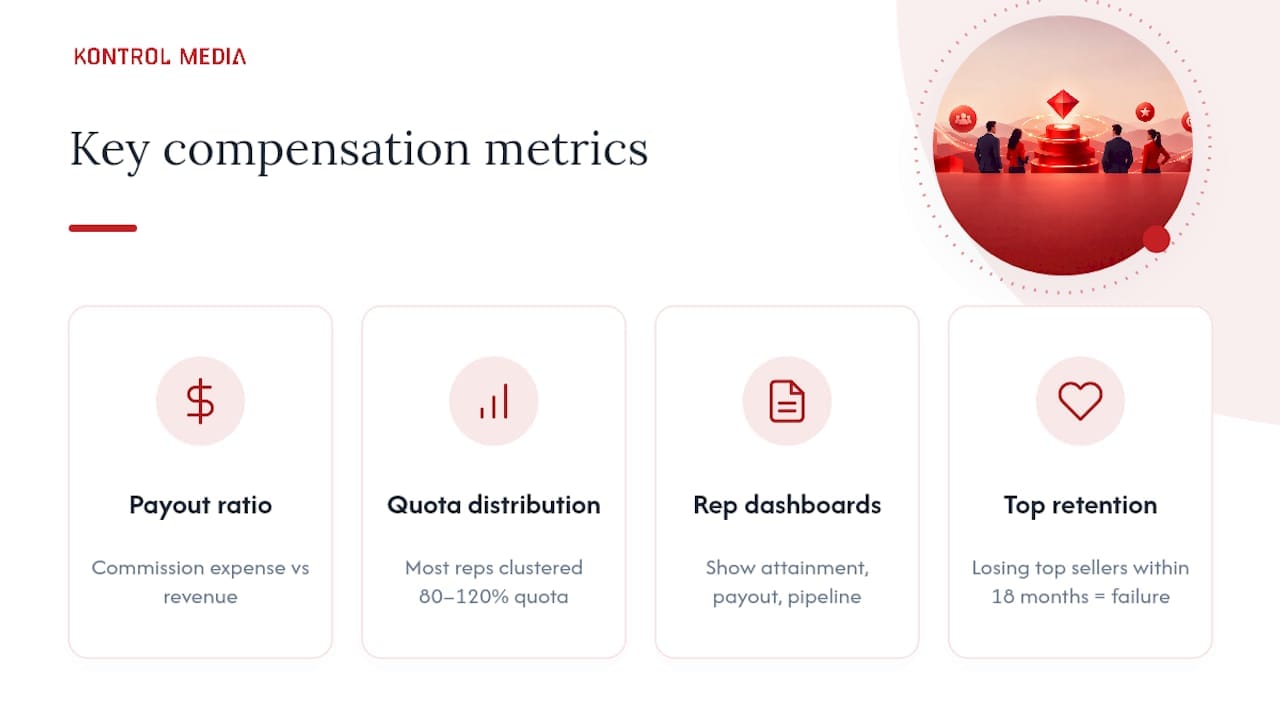
Payout-to-plan ratio is the first number to watch. If total commission expense as a percentage of revenue drifts meaningfully from what you modeled during design, either attainment assumptions were wrong or the plan is paying for the wrong behavior.
Quota attainment distribution tells you more than the average attainment rate. A healthy plan typically shows a roughly bell-shaped curve, with most reps clustered near 80% to 120% of quota. A distribution with a long tail of reps stuck under 60%, or a cluster of reps blowing past 150%, both suggest quota-setting problems rather than a performance problem.
Rep-level dashboards that show attainment, payout, and pipeline coverage side by side let compensation managers spot trouble before it shows up in turnover numbers. Watch specifically for reps who hit quota through a handful of large deals versus reps who hit quota through consistent smaller wins, the plan should reward both paths if both paths serve the business.
Retention among top performers is the ultimate effectiveness test. A plan that is technically well-modeled but loses its best sellers within 18 months has failed regardless of what the spreadsheet says. Cross-referencing comp data with customer retention strategies is worth doing when your plan weights renewals heavily, since seller behavior and customer retention are more tightly linked than most comp committees assume.
What Legal and Compliance Risks Should Compensation Designers Watch For?
Commission agreements are contracts, whether or not anyone calls them that. Most jurisdictions require clear, written terms on when commission is earned, when it becomes payable, and what happens to unpaid commission if a rep leaves before a deal closes or before a payout date. Ambiguity here is what turns a compensation dispute into a lawsuit.
Timing rules vary by state and by role classification, and several states have specific statutes governing when earned commissions must be paid after termination. A plan document silent on this question is a liability, not a convenience.
Draws need careful legal structuring. A recoverable draw that functions as a loan against future commission has different tax and legal treatment than a non-recoverable draw treated as guaranteed base pay, and getting this distinction wrong creates wage-and-hour exposure.
Changing a plan mid-year carries its own risk. Most jurisdictions expect advance notice before material changes take effect, and retroactively repricing already-earned commission is both a morale problem and, in some cases, a legal one. Any compensation redesign should get a legal and finance review before rollout, not after a complaint arrives.
What Technology Supports Sales Compensation Management?
Incentive compensation management platforms exist specifically to keep commission calculations transparent, auditable, and connected to CRM data, so payout is not a manual spreadsheet exercise prone to error. These systems calculate commission automatically as deals close, apply accelerator tiers correctly, and give reps real-time visibility into what they have earned.
CRM attribution rules matter as much as the compensation platform itself. If the CRM does not clearly define which rep gets credit for a multi-touch deal, split-credit disputes will surface no matter how well the compensation math is designed. Attribution logic needs to be settled before a plan launches, not discovered during the first payout cycle.
Modeling and simulation tools let compensation managers test payout scenarios against different attainment distributions before committing budget, catching an accelerator curve that would blow the incentive budget if 20% of the team overperforms. Dashboards that pull payout, attainment, and quota data into one view are what let a compensation manager or sales leader spot a problem in week three of the quarter instead of week thirteen.
How Often Should You Review and Communicate Sales Compensation Plans?
Quarterly review cadence is the practical minimum for any plan tied to a fast-moving product or market. PMGuru’s research on aligning compensation and product strategy points out that comp and roadmap drift apart when they run on separate review cycles, so syncing the compensation review to the same calendar as product roadmap reviews keeps incentives pointed at what the company is actually building next.
Communication has to happen before launch, not just at launch. Sellers need to see plan mechanics, run through example calculations, and ask questions before their first paycheck under the new plan arrives. A plan that surprises reps on payday has already lost credibility, regardless of how sound the underlying math is.
Governance ownership should sit with someone specific, usually a compensation manager or sales operations leader, who tracks payout-to-plan ratios, fields disputes, and flags when quota attainment distributions start looking abnormal. Without a named owner, plan drift becomes nobody’s job to catch.
A Practitioner’s View on Trade-Offs
Favor higher variable pay for pure hunting roles and base-heavy pay for long-cycle or account management roles, the risk profile should match the job. Simplicity beats micro-optimization every time; a plan sellers can explain to each other in one sentence outperforms a technically perfect one nobody understands. And never ratchet quotas mid-year or reprice accelerators retroactively, that single move destroys more trust than any pay cut.
— Mark Kapczynski
Get Hands-On Help Designing Your Sales Compensation Plan
They offer an alternative to traditional compensation consultancies for companies that need a plan built and implemented, not just modeled and handed off. Where many firms stop at recommendations, Kontrol Media pairs the strategy work with hands-on execution across sales, marketing, and business development, so the compensation plan gets built alongside the sales team structure, quota methodology, and CRM setup it depends on.
A typical first step looks like a diagnostic engagement: a review of current pay mix, quota attainment distribution, and how compensation metrics map to your actual go-to-market strategy. From there, they work with HR and sales leadership to model accelerator math, validate quotas against territory data, and build governance cadence to keep plans aligned with product roadmaps. If your current plan is producing quota disputes, rep turnover, or metrics that reward the wrong behavior, explore Kontrol Media’s business and marketing strategy services or get in touch through the contact page to scope a diagnostic.
Sources
- Sales Compensation Design: What Are the Keys to an Effective Plan? | WorldatWork
- Designing compensation systems for sales professionals | SHRM
- A guide to sales compensation | Salesforce
- How to design a sales compensation plan: step-by-step guide | Optymyze
FAQ
What Does a 70/30 Split in Sales Compensation Mean?
It is a moderate pay mix often used for roles with some risk exposure but not as aggressive as a pure hunter role, which might run closer to 50/50.
What Is the Typical Structure of a Sales Compensation Plan?
Most plans combine a base salary, a variable incentive tied to one or two key metrics, and mechanics like thresholds and accelerators that determine when and how fast incentive pay scales. Salesforce’s guide to sales compensation notes that the strongest plans keep this structure simple enough for sellers to calculate their own payout.
What Are the Four Types of Compensation?
The four common types are base salary, commission, bonuses (including SPIFs), and non-cash incentives like recognition programs or equity. Sales compensation plans typically blend two or three of these, most often base salary plus commission, with bonuses layered in for specific short-term goals.
What Are the Four Types of Sales Incentive Plans?
The four common archetypes are straight commission, base plus commission, tiered or accelerator-based commission, and bonus or SPIF-driven plans layered on top of a base structure. The right choice depends on sales cycle length, deal size, and how much income risk the role should carry, which is why SHRM recommends designing around the role’s accountabilities rather than a one-size-fits-all template.
When Should a Company Bring in Outside Help for Compensation Design?
A company should consider outside help when quota disputes, rep turnover, or misaligned metrics are already showing up in pipeline and attainment data, and internal teams lack the go-to-market context to fix the root cause. Kontrol Media’s business strategy and sales services are built for exactly that situation, pairing compensation modeling with hands-on execution.