


Appoint a single GTM integration lead in the first week, and give that person one job: protect revenue while the rest of the organization sorts itself out. Everything else, from org charts to pricing models, can wait a few weeks. Revenue cannot. We’ve watched the best-run integrations treat the first 90 to 100 days as a triage window first and a redesign window second.
TL;DR:
- Appoint a single GTM integration lead with decision-making authority to focus on revenue protection within the first 30 days.
- Audit the pipeline, top accounts, churn risks, and sales systems early to address critical leaks and align ownership quickly.
- Finalize organizational, pricing, and compensation decisions by day 60 to enable a commercial launch around day 90.
- Prioritize legal, compliance, and data system ownership early to prevent operational delays and regulatory risks during integration.
Table of Contents
- Key Takeaways for Post-Merger GTM Execution
- Days 0 to 30: Triage, Truth-Finding, and Revenue Protection
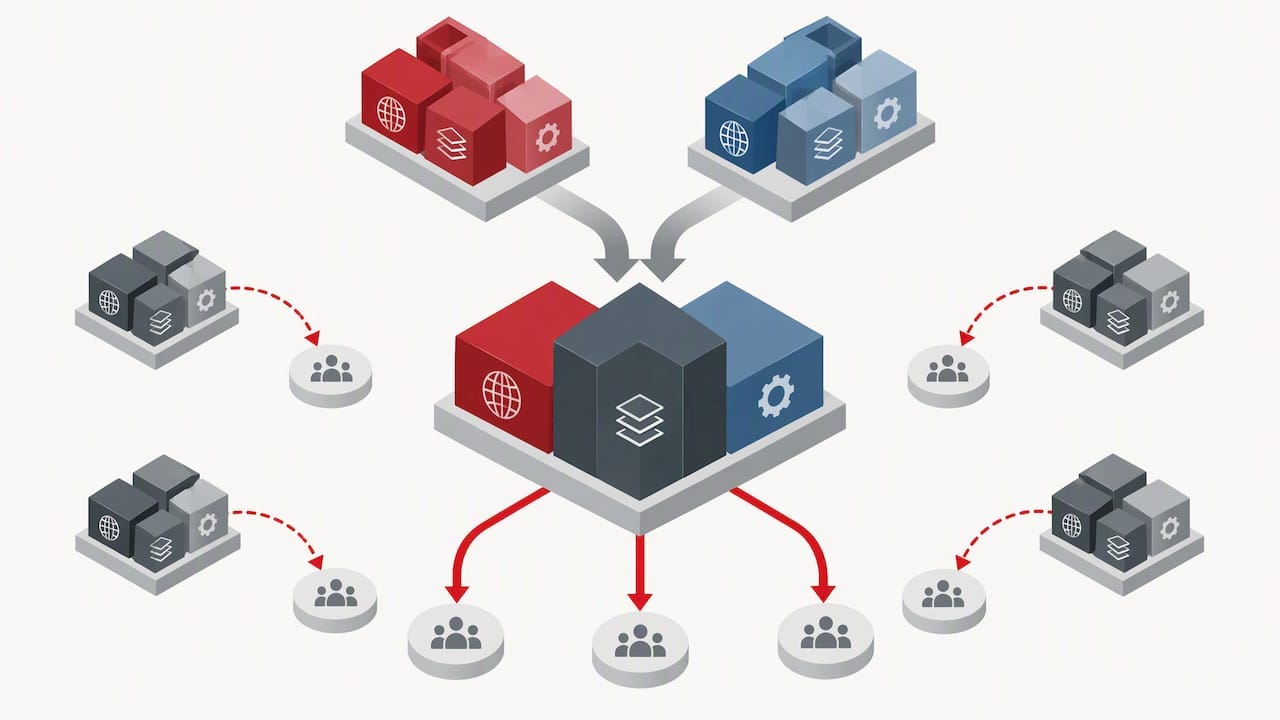
- Days 30 to 90: Design the Unified Revenue Engine
- Day 90 and Beyond: Launch, Inspect, Iterate
- GTM Systems and Tech-Stack Priorities
- Messaging, Brand Architecture, and Customer Communications
- Customer Continuity and Account-Level Retention Plays
- A Practitioner’s View: What Hands-On Execution Looks Like
- Managing the Internal Shift to a Unified GTM Approach
- Reading the Competitive Field After a Merger
- Bringing Marketing and Demand Generation Together
- Legal and Compliance Guardrails for GTM Activity
- Three Priorities I’d Hold Every Leadership Team Accountable For
- How We Help Companies Execute Post-Merger GTM Plans
- FAQ
- Sources
Key Takeaways for Post-Merger GTM Execution
Before diving into the full sequence, here’s what we’d put on the whiteboard on day one.
- Name a single GTM integration lead with real decision rights, reporting directly to the executive sponsoring the deal.
- Audit pipeline health, your top 20 accounts, churn risk, sales comp plans, and who owns which piece of the tech stack.
- Push out quick enablement fixes: battlecards, a cheat sheet for the combined offering, and a fast pass on lead routing so nothing falls through the cracks.
- Lock organizational and compensation decisions by day 60, and aim for a commercial launch by day 90.
Pro Tip: Write the decision rights down. A GTM lead with a title but no authority to approve pricing exceptions or override a stalled org decision will burn the first 30 days in meetings instead of in the field.
Treat this as a living list rather than a one-time memo. The specifics shift by industry and deal size, but the sequence, govern first, then audit, then fix the leaks, rarely does.
Days 0 to 30: Triage, Truth-Finding, and Revenue Protection
The first 30 days exist to answer one question honestly: what do we actually have, and what’s at risk of walking out the door? HBR’s research on post-merger results points to delayed or sloppy commercial integration as a primary reason deals fail to deliver the value promised on the term sheet. Speed matters here, but so does accuracy.
Start with governance. Appoint the GTM integration lead and stand up a small decision committee, ideally five people or fewer, who can approve exceptions without convening a steering committee every time. Then move into the audit:
- Pull the live pipeline for both companies and flag deals at risk of stalling due to ownership confusion.
- Identify your combined top 20 accounts by revenue and assign a single accountable owner to each.
- Map churn exposure, especially contracts with change-of-control clauses or renewal dates inside the next two quarters.
- Inventory sales compensation plans from both sides so no rep is left wondering if they’ll get paid on a deal they’re closing this month.
- Assign clear ownership of the CRM, marketing automation platform, and any customer data systems that both companies currently run in parallel.
Most large M&A deals fail to significantly boost shareholder returns according to Gartner’s commercial strategy research, largely because commercial execution lags behind deal logic. That gap is exactly what the first 30 days are meant to close.
Fix CRM and lead routing issues immediately. Leads generated during the announcement period often get misrouted or duplicated across two systems, and a prospect who emails twice and hears nothing back is a lost deal, not a minor glitch. Build a core battlecard and a one-page seller cheat sheet covering the combined offering, so reps stop improvising answers to basic customer questions.
One more thing belongs on the day-one list: antitrust discipline. The FTC has been explicit that sharing competitively sensitive pricing or strategy data before a deal closes creates real legal exposure. Set up a clean team with narrowly defined access before anyone starts comparing customer lists or pricing sheets across the two organizations.
Days 30 to 90: Design the Unified Revenue Engine
Once the bleeding stops, the real design work starts. This is where org structure, pricing, and compensation get decided, and where a surprising number of integrations stall because nobody wants to make the hard calls.
Org structure comes first. Decide who leads the combined sales and marketing functions, and do it based on who can activate frontline managers, not just who has the longer tenure. Gartner’s research on sales productivity after M&A shows that CSOs who equip managers with centralized resources and direct coaching see faster productivity recovery than those who leave manager activation to chance. The same logic applies to CMOs: someone needs to own the combined go-to-market narrative, not just inherit it by default.
Product and pricing decisions follow close behind:
- Rationalize the combined product portfolio, and be explicit about what gets sunset, bundled, or kept as-is.
- Run small bundling tests with a handful of accounts before committing to a permanent packaging structure.
- Separate transitional pricing (what existing customers see during migration) from the permanent pricing model you’ll use going forward.
- Apply a fairness test to any pricing change: would a reasonable customer feel they got a worse deal without warning?
- Build a single sales compensation plan that rewards cross-sell and portfolio selling, not just whichever product a rep knew best before the merger.
Pro Tip: If your compensation plan still pays out differently depending on which legacy company a product came from, your best reps will quietly keep selling only what they know. Fix the plan before you fix the pitch.
HBR’s analysis of post-merger growth makes a case that’s easy to forget under integration pressure: strengthening sales and marketing should come before cutting costs, because sales performance in the first 100 days tends to predict how the deal performs over the long run. Training and enablement timelines should reflect that priority. Give sellers a full run-through of the combined offering, objection handling for the merger itself, and a clear answer to “why should I stay” for nervous customers, all before the public launch date.
Day 90 and Beyond: Launch, Inspect, Iterate
By day 90, the organization should know what it’s selling, who’s selling it, and how much it costs. The job now shifts from design to execution discipline.
- Run an internal GTM kickoff first, covering every customer-facing employee, before any external announcement goes out.
- Phase the external launch, starting with top accounts and trusted partners before a broader market push.
- Track primary KPIs weekly: gross revenue retention, net revenue retention, pipeline conversion rates, and cross-sell attach rates.
- Hold a weekly tactical review for frontline issues and a monthly commercial review for trend-level course correction.
- Keep a rolling forecast rather than a static one, since integration-phase assumptions change faster than a normal quarter.
Common failure modes show up fast once launch begins. Sellers revert to old talking tracks because new enablement didn’t stick. Customer success teams get blind sided by pricing changes nobody told them about. Reports built on two different data definitions tell two different stories about the same quarter. The corrective action is almost always the same: shorten the feedback loop. A weekly 30-minute review where frontline reps can flag what’s breaking catches most of these problems before they show up in a quarterly business review, by which point the damage is already done.
GTM Systems and Tech-Stack Priorities
Technology decisions either support the commercial plan or quietly sabotage it, and the first priority is figuring out which systems need an owner this week.
- Audit and assign ownership of the CRM, billing system, and customer master record before any data migration begins.
- Keep dual systems running in parallel when the cost of a bad migration (lost records, broken billing) outweighs the cost of temporary duplication.
- Consolidate once ownership, data mapping, and a rollback plan are all in place, not before.
- Fix lead routing and reconcile account ownership across both legacy systems so reps aren’t competing for the same prospect using buyer visibility and discovery strategies.
- Align reporting definitions across teams before publishing a combined dashboard, since mismatched definitions for “qualified lead” or “active customer” will undermine trust in the numbers.
Test every migration against a sample of real customer records before cutting over. A billing error or a dropped renewal reminder during integration does more reputational damage than almost any other operational mistake in this window.
Messaging, Brand Architecture, and Customer Communications
Brand architecture decisions ripple through every customer touchpoint, so they need to happen deliberately rather than by default. Gartner’s guidance for B2B CMOs after M&A is direct on this point: CMOs need to actively lead the brand architecture decision rather than let it get resolved by inertia or legal convenience.
- Decide early whether you’re keeping both brands, merging under one name, or running a house-of-brands structure, and test the decision against how customers actually buy.
- Draft customer communication templates in advance, leading with retention and continuity rather than merger excitement.
- Time those communications to land before customers hear the news from a press release or a competitor’s sales rep.
- Coordinate with agency and partner contacts so external messaging doesn’t contradict what account teams are telling customers directly.
- Pilot the communication plan with a small customer segment and measure sentiment before rolling it out company-wide.
A consistent brand decision gives sales and customer success teams one story to tell, which matters more than which story you pick.
Customer Continuity and Account-Level Retention Plays
Your top accounts will test the integration before your leadership team finishes debating org charts. Build the playbook for them first.
- Create executive outreach templates for your top 20 accounts, personally signed by a named executive sponsor, not a form letter from “the team.”
- Prioritize cross-sell opportunities by account fit and existing relationship strength, not by which legacy product needs a revenue boost.
- Offer transitional service-level agreements that guarantee response times and support continuity through the migration period.
- Set up customer listening posts, quarterly check-ins, support ticket trends, and NPS pulses, so early churn signals surface fast.
Pro Tip: Call your top 20 accounts before they call you. A proactive five-minute conversation from an executive does more for retention than a perfectly worded email ever will.
A Practitioner’s View: What Hands-On Execution Looks Like
Strategy decks rarely save a deal. Execution does. Our work on the OneMarket engagement reflected that reality directly: rather than handing over a set of recommendations, we operated inside the retail and commerce media integration, building the partnership structures and revenue mechanics needed to keep the network generating value through the transition rather than pausing while the org chart settled.
The gap between an advisor-only engagement and an operator-led one shows up fastest in the first 100 days, when someone has to actually make the calls, not just recommend them.
We’ve structured that kind of support a few ways depending on what a company needs: a focused quick-start scope to stabilize the first 30 days, a retained execution model that carries through the full 100-day window, or programmatic support for ongoing retail and commerce media operations once the dust settles. Each model starts from the same premise: someone needs to own execution, not just strategy.
Managing the Internal Shift to a Unified GTM Approach
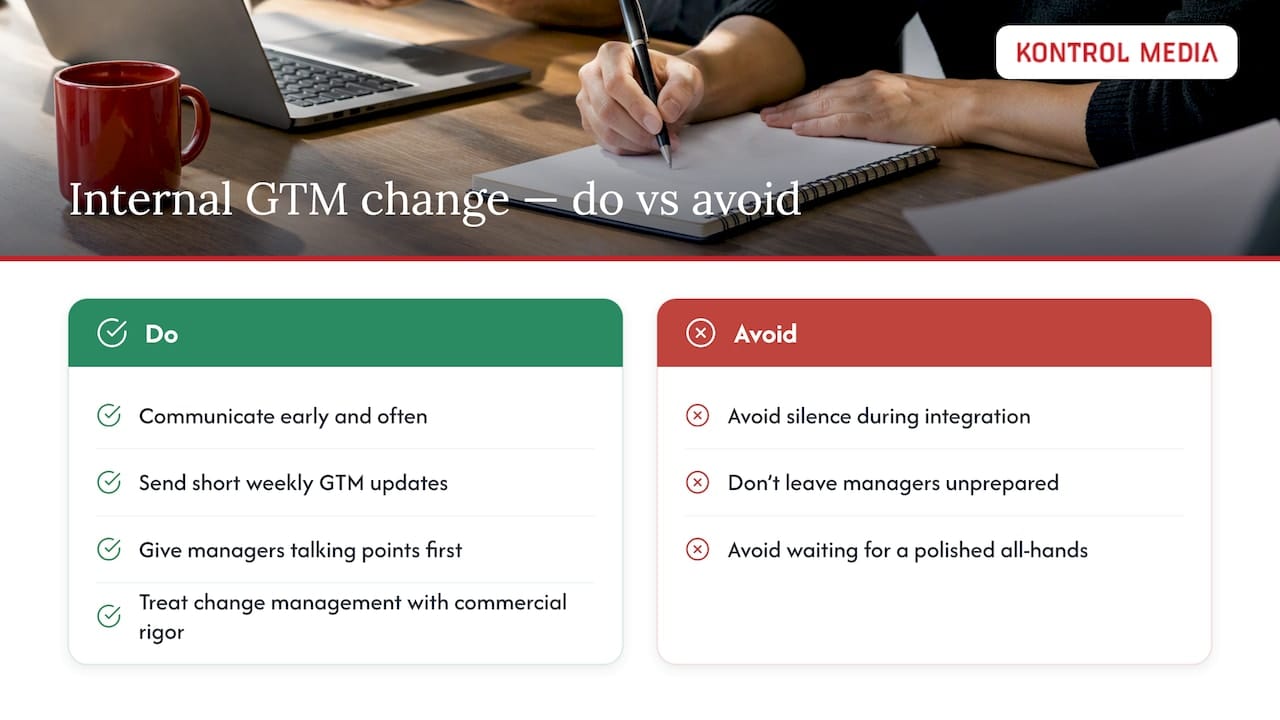
A go-to-market redesign only works if the people executing it believe in it, which means change management deserves the same rigor as the commercial plan itself. Employees on both sides of a merger are absorbing new reporting lines, new product knowledge, and often genuine uncertainty about their own role, all at once.
Communicate early and often, even when you don’t have every answer yet. Silence during an integration gets filled with speculation, and speculation is almost always worse than the truth. A short weekly update from the GTM integration lead, covering what changed, what’s still being decided, and what to expect next, does more to steady a sales team than a single polished all-hands presentation.
Give managers the talking points before the broader team hears the news. Frontline managers field the real questions: will my comp plan change, will I keep my accounts, who do I report to now. A manager caught flat-footed in front of their team erodes trust fast, while one armed with clear answers becomes a stabilizing force.
HBR’s case research on silent value erosion shows how integrations that look fine on paper, governance in place, milestones hit, still lose value through cultural friction and quiet attrition that leadership didn’t catch in time. Internal communication is the early warning system that catches that friction before it shows up in a resignation letter or a missed quota.
Reading the Competitive Field After a Merger
A merger changes your competitive position whether or not you’ve updated the slide deck to reflect it. Competitors will react, sometimes by targeting your top accounts during the uncertainty, sometimes by repositioning their own offering against the combined company’s perceived weaknesses.
Run a fresh competitive analysis within the first 30 days rather than relying on whatever competitive intelligence either company had before the deal closed. The combined entity likely has new strengths worth messaging, broader geographic reach, a fuller product line, deeper technical capability, and those strengths deserve a place in your updated sales narrative.
Watch for opportunistic moves from rivals during the announcement window specifically. Competitors often time outreach to your customers for the exact moment uncertainty peaks, which is usually the weeks between announcement and close. Equip your sales team with a direct, confident response to “I heard you’re being acquired” before a competitor’s rep gets there first.
Combined market opportunities deserve equal attention. Two customer bases often reveal adjacent segments neither company served well alone, and the account mapping exercise from the first 30 days should flag those overlaps as part of the broader audit, not as a separate project months later.
Bringing Marketing and Demand Generation Together
Marketing integration moves slower than sales integration in most deals, largely because campaigns, content libraries, and marketing automation platforms take longer to untangle than a sales territory map. That lag creates risk: prospects in active nurture sequences can receive conflicting messages from both legacy brands simultaneously.
Audit active campaigns from both companies in the first 30 days and pause anything that references a competitor who is now part of the same company, a surprisingly common and easily avoidable error. Consolidate marketing automation platforms on the same timeline as the CRM consolidation discussed earlier, since the two systems typically share data dependencies that make a staggered migration messy.
Demand generation needs a single combined view of the funnel as early as possible, even if the underlying systems haven’t fully merged. A shared reporting layer, even a manual one built in a spreadsheet for the first few months, prevents the two marketing teams from double-counting leads or working at cross purposes on the same accounts. Content and campaign calendars should reflect the unified messaging decisions made in the brand architecture work, so a prospect doesn’t receive one brand’s email and another brand’s retargeting ad in the same week.
Legal and Compliance Guardrails for GTM Activity
Legal and compliance considerations shape GTM decisions more than most commercial teams expect, and the risks don’t disappear once the deal legally closes.
Antitrust exposure is the most immediate concern, and it starts before close, not after. The FTC’s guidance on pre-merger information sharing recommends clean teams and narrowly tailored protocols for any competitively sensitive data exchanged during due diligence and early integration planning. That same discipline should extend into the first 90 days, particularly when two sales teams start comparing customer lists or pricing strategies.
Contract review deserves a dedicated workstream. Many customer agreements contain change-of-control clauses that trigger renegotiation rights, early termination options, or required notifications the moment the deal closes. Flag these during the day 0 to 30 audit, not after a customer’s legal team raises them first.
Data privacy and regulatory requirements vary by industry and jurisdiction, and a combined customer database may trigger new compliance obligations neither company faced independently. Loop legal and compliance teams into the CRM consolidation planning early, since a data migration built without their input can create exposure that’s expensive to unwind later.
Three Priorities I’d Hold Every Leadership Team Accountable For
If I had to narrow a post-merger GTM plan down to three things, they’d be these. First, name one GTM integration lead with real authority, because shared ownership during a chaotic 90 days usually means no ownership at all. Second, protect and grow revenue before you chase cost synergies. The research backs this instinct: sales performance in the first 100 days predicts long-term outcomes far more reliably than early cost cuts do. Third, run three weekly checks without fail: pipeline health on the combined top accounts, comp plan fairness across legacy teams, and any customer complaint that mentions the merger by name.
— Mark Kapczynski
How We Help Companies Execute Post-Merger GTM Plans
We built our practice around the gap this article describes: the distance between a sound integration strategy and a sales team that actually executes it in the first 90 days. Our work spans business strategy, marketing, and sales execution, and for companies integrating retail or commerce media assets, we also stand up and operate retail media networks directly rather than just advising on them.
If you’re heading into a merger integration window and need hands on the controls rather than another deck, here’s where to start:
- A short discovery call to map your specific revenue risks and timeline.
- A quick-start scope focused on the first 30 days of triage and enablement.
- Retained execution support that carries through the full 100-day window and beyond.
Reach out through our services page to talk through which model fits your deal.
FAQ
Do stocks usually go up after a merger?
Stock performance after a merger varies widely and depends heavily on how well commercial integration is executed in the first 100 days. Gartner’s commercial strategy research notes that most large M&A deals fail to meaningfully boost shareholder returns, which points to execution, not deal logic alone, as the deciding factor.
What is GTM vs RTM?
Go-to-market (GTM) refers to the full strategy for how a company reaches and sells to customers, including positioning, pricing, and sales motion. Route-to-market (RTM) is narrower, focusing specifically on the distribution channels and logistics used to get a product into customers’ hands.
What are the best practices for post-merger integration?
The strongest practices start with appointing a single integration lead with real decision authority and prioritizing revenue protection ahead of cost-cutting. HBR’s research found that sales and marketing strength in the first 100 days predicts long-term merger success, which is why audits, enablement, and clear governance belong at the top of the list.
What does “go-to-market” mean?
A go-to-market plan is the combined set of decisions, who you’re selling to, what you’re offering, how it’s priced, and which channels and messaging you’ll use, that gets a product or combined portfolio in front of customers. After a merger, it specifically means reconciling two of these plans into one that sellers can execute without confusion.
How long should a post-merger GTM integration take?
Most of the critical decisions, governance, audits, org design, pricing, and compensation, should be resolved within the first 90 to 100 days, with a commercial launch targeted around day 90. HBR’s analysis of post-merger results ties delayed commercial integration directly to lost deal value, which is why that window matters more than any later cleanup phase.
Sources
- Gartner — Commercial strategy guide
- Avoiding antitrust pitfalls during pre-merger negotiations and due diligence — FTC
- How to get results quickly after a merger or acquisition — HBR