


Offsite retail media means running ads on third-party inventory (social, streaming TV, the open web) using a retailer’s first-party shopper data instead of its own website or app. Its primary value is scale: it lets brands reach shoppers earlier in the funnel while borrowing the accuracy of retailer purchase history. The catch is measurement. Attribution and identity resolution remain the hardest parts to get right.
TL;DR:
- Offsite retail media relies on third-party inventory channels and pseudonymous data, which introduces match-rate loss and measurement challenges.
- Industry forecasts predict US offsite ad spending will reach over 17 billion dollars by 2026, growing faster than onsite spending.
- The most common channel is social media, accounting for 75% of offsite spend, followed by connected TV and video, which are expected to grow rapidly.
- Effective measurement requires data clean rooms, standard attribution windows, holdout groups, and reconciliation tests to accurately gauge offsite impact.
- Risks include audience overlap, attribution mismatch, and privacy concerns, all manageable with proper targeting rules, independent measurement, and lawful data onboarding.
Table of Contents
- What Is Offsite Retail Media, and How Does It Differ From Onsite?
- Why Is Offsite Retail Media Growing So Fast Right Now?
- Which Channels and Formats Should You Use for Offsite Campaigns?
- How Do You Solve Measurement and Attribution for Offsite Campaigns?
- How Do You Implement an Offsite Retail Media Program Step by Step?
- How Should You Split Budget Between Onsite and Offsite?
- What Are the Biggest Risks in Offsite Retail Media, and How Do You Manage Them?
- How Does Kontrol Media Help Retailers Operationalize Offsite Media?
- An Executive’s Take on Getting Offsite Right
- Ready to Scale Offsite? Here’s Where Kontrol Media Fits
- Sources
What Is Offsite Retail Media, and How Does It Differ From Onsite?
Onsite retail media is the banner on a product page or the sponsored listing in search results, all served inside a retailer’s own digital property, with closed-loop reporting tying an impression directly to a cart. Offsite takes that same first-party audience data and activates it somewhere else entirely, on the open web, inside a social feed, on a connected TV app, wherever the shopper happens to be scrolling or streaming.
That shift changes how you measure success. Onsite works off logged-in, deterministic data. Offsite usually relies on onboarded, pseudonymous identifiers matched against a partner’s audience graph, which introduces match-rate loss at every handoff. Industry groups have pushed for standardized reporting windows and clearer disclosure of match rates precisely because offsite reporting doesn’t behave like onsite reporting, and treating the two as interchangeable is where most measurement disputes start.
Why Is Offsite Retail Media Growing So Fast Right Now?
Onsite inventory is running out of room. As more brands compete for the same product-page real estate, CPMs climb and ad density starts to hurt the shopping experience itself. Offsite solves that ceiling problem by opening up nearly unlimited inventory across social, video, and the open web.
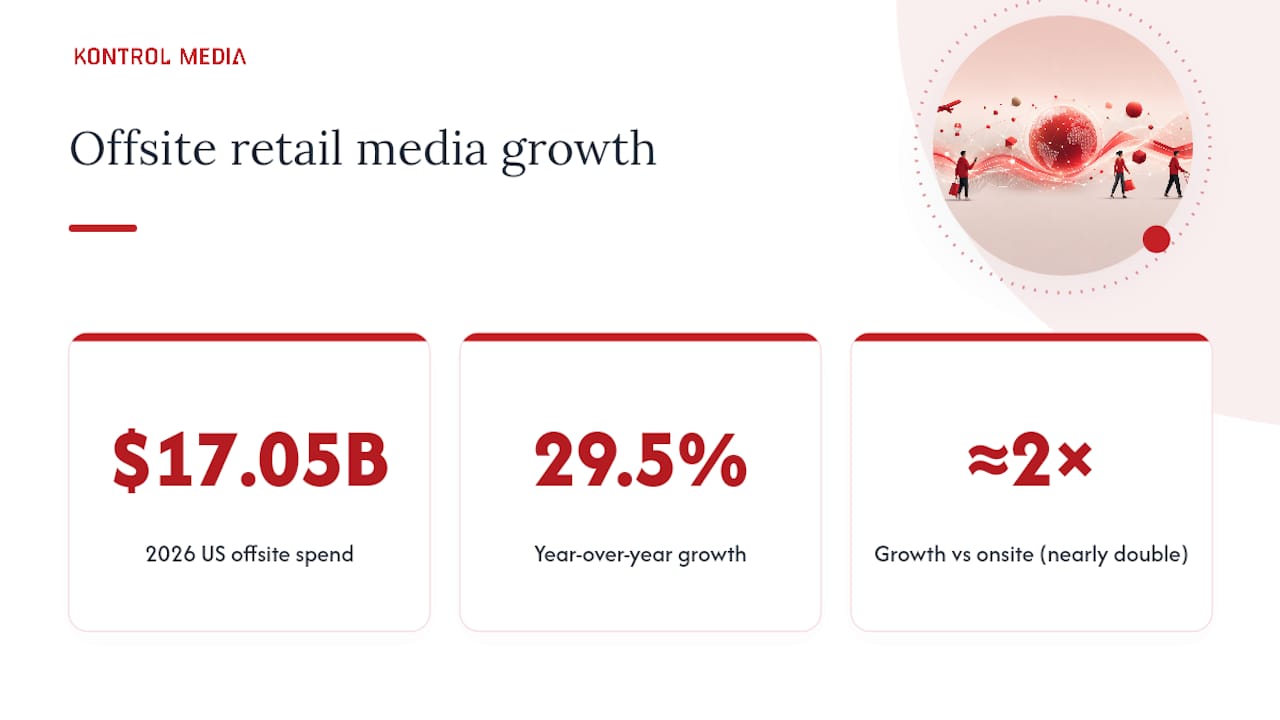
It also solves a budget problem. Retail media has historically captured lower-funnel, intent-driven dollars. Offsite lets retailers compete for the much larger pool of upper-funnel brand and awareness budgets, using retailer-grade purchase data as the differentiator against traditional digital advertising. eMarketer forecasts US offsite retail media ad spending will hit $17.05 billion in 2026, up roughly 29.5% year over year, and offsite spend is growing at nearly double the rate of onsite across the broader category. That gap is the strongest signal in the market that offsite has moved from experiment to core strategy.
Which Channels and Formats Should You Use for Offsite Campaigns?
Not every channel plays the same role, and treating them interchangeably wastes budget. Here’s how the mix typically breaks down:
- Social platforms carry the biggest share of offsite dollars. Survey data from RetailX’s Data Workbench shows 75% of offsite buy-side budget going to social, usually bought on a CPM or CPC basis with fast creative turnaround.
- Connected TV and video account for 73% of offsite spend by the same measure, and 66% of buyers expect video to grow fastest going forward, making it the format to watch heading into 2027 planning cycles.
- Programmatic display and video run through curated deals and DSP partnerships, often priced on CPM with negotiated data-access terms.
- Search and product ad extensions on partner sites extend retailer catalog data into third-party search results, typically on a CPC model.
- Marketplace-style placements sometimes bill on a revenue-share basis rather than a flat CPM, particularly where the retailer takes on more of the conversion risk.
Creative cadence matters more offsite than on. Social and video need frequent refreshes tied to inventory and seasonality, while programmatic and search extensions can run longer without fatigue.
How Do You Solve Measurement and Attribution for Offsite Campaigns?
Measurement is the barrier that keeps CMOs from committing bigger budgets to offsite, and for good reason. Experian and other industry voices point to attribution and identity resolution as the top obstacles brands face when trying to scale beyond onsite placements, and match-rate loss compounds at every step between an ad impression and a recorded sale.
Data clean rooms are the practical fix. A DCR lets a retailer and a media partner match exposure logs to purchase records without either side handing over raw customer data, which solves the trust problem that used to block this kind of reconciliation entirely. Get this working well and you also protect the field-level data quality that audit-grade attribution depends on.
A few operating rules keep the numbers honest:
- Set attribution windows before launch, and use the same window across every offsite partner to avoid comparing incompatible numbers.
- Build in holdout groups from the start. Without them you can’t tell lift from noise.
- Watch for double-counting when a shopper sees both onsite and offsite exposure. Some siloed attribution models miss 36% to 53% of total retail media impact because they never reconcile the two.
Pro Tip: Run your first clean-room reconciliation as a side-by-side test against your existing last-touch model before you retire the old one. The gap between the two numbers tells you exactly how much offsite influence you’ve been missing.
How Do You Implement an Offsite Retail Media Program Step by Step?
Strategy without sequencing turns into a stalled pilot. Here’s the operating order that actually gets programs live:
- Audit first-party data quality and confirm consent basis for onboarding to any partner platform.
- Map SKU-level data to category taxonomy so creative and targeting stay aligned with retailer inventory.
- Decide on a managed versus self-serve activation model based on internal team bandwidth.
- Select clean-room and identity-resolution partners before signing media contracts, not after.
- Design a pilot with a clear hypothesis, a holdout group, and one or two channels, not five.
- Set KPIs by funnel stage: reach and incrementality for brand plays, ROAS for lower-funnel activity.
- Build a creative refresh cadence tied to inventory changes, matched to the audience segments you’re activating.
- Write exclusion rules to prevent audience overlap between onsite and offsite buys.
- Assign governance ownership (a RACI model works) and set the sales or incrementality threshold that triggers scaling beyond the pilot.
Pro Tip: Treat step five as non-negotiable. A pilot without a holdout group produces a number, but not one you can defend to a CFO asking whether the sales were incremental or would have happened anyway.
How Should You Split Budget Between Onsite and Offsite?
Start with category penetration and conversion health onsite. If onsite is already converting well and you’re mostly fighting for the same shoppers, that’s a signal to test offsite for incremental reach rather than pour more into an increasingly crowded page.
Run the shift as a pilot, not a wholesale reallocation. Prove incrementality on a small offsite budget before moving real dollars, since the KPIs that matter shift by funnel stage and a program judged on the wrong metric will look like a failure even when it’s working.
Margin matters too. Onsite retail media commonly runs 70% to 90% margin for the retailer, while offsite, particularly revenue-share marketplace deals, often lands closer to a lower margin range. That trade-off is real, but it buys access to budgets onsite inventory alone could never capture.
What Are the Biggest Risks in Offsite Retail Media, and How Do You Manage Them?
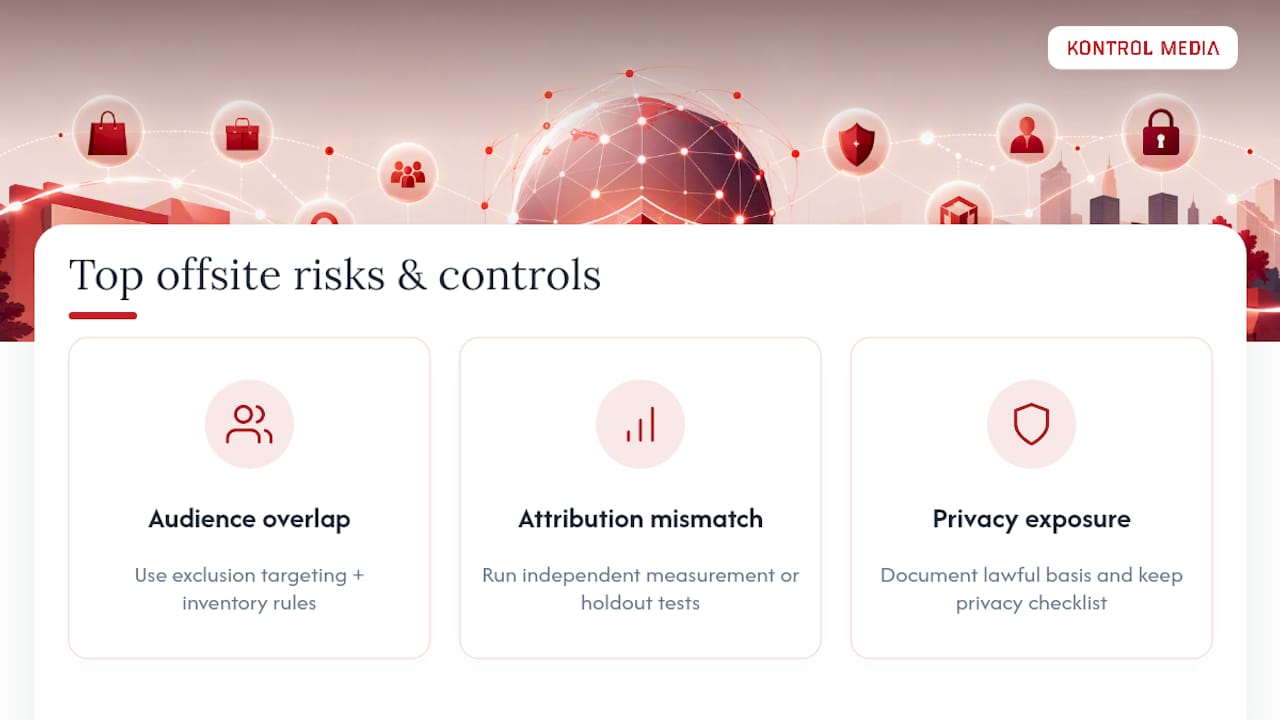
Audience overlap between onsite and offsite buys inflates reported reach and wastes spend; exclusion targeting and clear inventory rules fix most of it. Attribution mismatch between partners is the second failure point, and independent measurement or a holdout test catches it before it becomes a budget argument. Privacy exposure is the third risk. Document the lawful basis for every data-onboarding step and keep a standing privacy checklist, because a clean-room partnership only protects you if the underlying consent was solid to begin with.
How Does Kontrol Media Help Retailers Operationalize Offsite Media?
Most retailers don’t fail at offsite because the strategy is wrong. They fail because nobody owns the build versus buy decision, the data rules, or the advertiser pipeline once the pilot proves out. Kontrol Media works directly inside that gap, helping retail and commerce media teams decide whether to build an in-house network or license the technology, then staffing the network operations that keep advertiser demand and inventory rules aligned.
That work sits alongside the same playbooks referenced throughout this guide, on audience data activation and audit-grade attribution requirements. Various growth and go-to-market engagements with organizations inform the operational detail in this piece.
An Executive’s Take on Getting Offsite Right
The mistake I see most often at the executive level isn’t picking the wrong channel. It’s scaling budget before governance and KPIs are settled, which turns a promising pilot into an attribution argument six months later. Align funnel-stage KPIs and ownership first. Then prove incrementality with a clean-room reconciliation before you commit real dollars. Everything else is sequencing.
— Mark Kapczynski
Ready to Scale Offsite? Here’s Where Kontrol Media Fits
If you’ve read this far, you already know the theory. The harder part is standing up the partnerships, the clean-room reconciliation, and the advertiser pipeline without burning six months on a pilot that never proves incrementality. This differs from a typical agency retainer by operating inside the team on the build versus buy decision itself, not just around it, using the same data-readiness and governance sequence outlined above.
Whether you’re deciding whether to build a network in house or license the technology, or you already have a network live and need help driving advertiser demand, the retail media network setup guide walks through the framework we use with clients. If you’re ready to talk through your specific situation, reach out to Kontrol Media and we’ll map out what a pilot looks like for your data and your team.
Sources
- Retail media’s offsite opportunities require measurement and careful planning
- Why Off-Site Retail Media Is Growing Twice as Fast as On-Site
- The RetailX Data Workbench offsite retail media report
- Retail media networks need to get offsite ASAP | Experian