

Retail media monetization works, and the math behind it is not close. Three levers drive the revenue: onsite ads, offsite audience extension, and in-store and data products. If you are starting from zero, build sponsored products first, pair it with closed-loop measurement from day one, and expand outward once advertisers trust your numbers.
TL;DR:
- Building sponsored products and establishing closed-loop measurement are critical initial steps before expanding into offsite and in-store monetization channels.
- Retail media margins range from 70-90% for onsite sponsored products to 20-40% for offsite programmatic and CTV, with hybrid pricing models gaining popularity.
- Prioritizing small, measurable onsite campaigns with proven incrementality is essential before selling offsite or premium inventory, to build advertiser trust.
- Operational risks include measurement gaps, inventory management, privacy compliance, and organizational alignment, which can stall network growth if not addressed early.
- Success depends on rapid launch, disciplined measurement, and clear advertiser packaging, rather than overly complex infrastructure or delayed proof of results.
Table of Contents
- What Is Retail Media Monetization, and Where Does the Revenue Come From?
- Pricing Models and Margin Benchmarks You Should Expect
- How Do You Turn Loyalty Data Into a Sellable Asset?
- Should You Build, Buy, or Run a Hybrid Retail Media Operation?
- Which In-Store Surfaces Actually Monetize Well?
- How Do You Prove Incrementality to Advertisers?
- How Do You Package and Sell Retail Media to Advertisers?
- What Does a 90-Day Retail Media Launch Actually Look Like?
- Why Kontrol Media’s Retail Media Practice Gets Results
- What Legal and Compliance Rules Govern Retail Media Beyond Privacy?
- What Actually Goes Wrong When Retailers Scale a Media Network?
- Who Are the Major Players, and How Is the Market Positioning Itself?
- What Technology Stack Do You Actually Need?
- How Do You Support Advertisers After the Sale?
- What Do Successful Retail Media Launches Actually Look Like?
- What I’d Prioritize if I Were Building This Right Now
- Ready to Build a Retail Media Network That Actually Pays Off?
- Sources
What Is Retail Media Monetization, and Where Does the Revenue Come From?
Retail media monetization is the practice of turning your owned audience, shelf space, and transaction data into paid advertising inventory that brands buy to reach shoppers. It sits at the intersection of retail advertising strategies and commerce data, and it works because retailers hold something Google and Meta never will: proof of purchase.
The revenue splits into three streams, and each one behaves differently on your income statement.
- Onsite (sponsored products and display): Ads inside your own app or website, placed in search results, product pages, or category grids. This is the highest margin stream because you own the inventory outright.
- Offsite (programmatic and CTV/social audience extension): You take the audience segments you built from loyalty and transaction data and activate them on ad exchanges, connected TV, or social platforms. You are buying third-party inventory, so margins compress.
- In-store and data/insights products: Digital signage, checkout screens, and syndicated shopper insights sold directly to brands, sometimes bundled with media buys.
A common mix for a maturing retail media network includes onsite, offsite, and in-store or data monetization streams in significant proportions, according to industry benchmark data. Most mid-market retailers start onsite because it requires the least third-party infrastructure and delivers the fastest proof of concept. Offsite comes next, once you have six or more months of clean audience signal. In-store and insights products usually arrive last, since they depend on point-of-sale integration and physical hardware.
Pricing Models and Margin Benchmarks You Should Expect
Retailers charge advertisers under four structures: CPC (cost per click), CPM (cost per thousand impressions), CPA (cost per action or sale), and hybrid models that blend a guaranteed floor with a performance kicker.
Sponsored product listings typically run on CPC or CPA, as advertisers prefer to pay for outcomes tied to the funnel’s bottom. Display and video, onsite or off, tend to use CPM pricing because their value lies in impression reach and brand visibility rather than individual clicks.
Margins vary sharply by format. Onsite sponsored products and display generate gross margins of 70 to 90%, since you control the inventory and pay no media cost to a third party. Offsite programmatic and CTV compress that to roughly 20 to 40%, according to the build vs. buy benchmark guide from Osmos, because you are buying inventory on the open market and passing part of the spend through.
Benchmark Callout: Mature retail media networks are increasingly moving to hybrid pricing, a CPM floor layered with a performance component, which gives predictable revenue while still sharing upside with advertisers who want accountability.
- Protect yield with minimum spend commitments and floor pricing in every advertiser contract.
- Build rate cards by surface, not a single blended CPM, so sales teams can defend pricing.
- Reserve a small percentage of premium inventory for guaranteed placements at a markup.
How Do You Turn Loyalty Data Into a Sellable Asset?
Your loyalty and transaction data is the single most valuable asset in this entire business. Retail media networks that skip straight to selling ad space without building segments first are leaving money on the table, because segmentation is what lets you charge a premium over generic reach.
- Build core segments first. Start with purchase frequency, category affinity, basket size, and lapsed-customer cohorts. These four alone cover most advertiser requests.
- Price segments by scarcity and specificity. A broad “grocery shoppers” segment sells cheap. A “repeat premium coffee buyers who lapsed in the last 60 days” segment commands a real premium.
- Use a data clean room for offsite activation. Clean rooms let you match your first-party data against a brand’s customer list without either side exposing raw records, which is the architecture pattern AWS documents for retail media platforms using entity resolution and privacy-preserving matching.
- Govern consent and retention explicitly. Document what loyalty members agreed to, how long you retain identifiers, and how advertisers may or may not combine your data with their own.
Pro Tip: Do not let sales promise custom segments faster than your data team can validate them. A mismatched segment that underperforms damages trust faster than any pricing mistake.
Should You Build, Buy, or Run a Hybrid Retail Media Operation?
The operating model decision shapes your timeline and your margin for years, so get this one right before you commit budget.
- Platform partner or white-label: You license an existing retail media platform and customize branding and inventory rules. Typical launch window runs 3 to 6 months, with lower upfront capital, according to build guidance from The Retail Exec.
- Composable build: You assemble your own stack from a DSP, ad server, and data layer. This takes 6 to 12 months and demands a heavier upfront investment, but you keep more long-term revenue share and full control over roadmap.
- Hybrid: Launch on a partner platform to prove demand, then migrate specific high-value components, like your data clean room or reporting layer, in-house once volume justifies the switch.
Migrate off a partner only when advertiser demand consistently exceeds platform capacity or when the partner’s revenue share starts costing more than a composable build would. Our build vs. buy breakdown walks through the specific readiness signals worth tracking before that decision.
Which In-Store Surfaces Actually Monetize Well?
Digital signage, checkout screens, and app-based in-store offers all carry real advertiser demand, but they monetize unevenly depending on placement and shopper attention span.
- Checkout screens tend to command premium CPMs because they capture attention at the moment of purchase decision.
- Digital signage near category endcaps sits in a middle band, generally $10 to $50 CPM depending on foot traffic and placement, per retail media CPM benchmarks.
- App-based in-store offers, triggered by geofencing or beacon technology, blend digital targeting with physical presence and often price closer to onsite display rates.
Attribution is the hard part. Link every in-store impression to a loyalty account where possible, and run test versus control stores to isolate lift, since foot traffic alone tells you nothing about incremental sales. Sequence your rollout by starting with checkout and signage, where instrumentation is simplest, before tackling beacon-triggered app offers that require more engineering investment.
How Do You Prove Incrementality to Advertisers?
Closed-loop measurement means connecting an ad impression directly to a purchase using your own transaction data, without relying on a third-party cookie or a self-reported survey. It is the single biggest trust factor in this business right now. Forrester’s research on the state of retail media found that measurement and incrementality have become the top priority for retail media decision-makers, with many networks still struggling to deliver proof advertisers actually believe.
- Track exposed versus unexposed shopper cohorts and compare purchase rates within the same time window.
- Run holdout tests where a percentage of eligible shoppers see no ad, giving you a true incremental sales baseline.
- Report ROAS alongside incremental sales lift separately. A high ROAS with weak incrementality tells you the ad reached people who would have bought anyway.
Pro Tip: Advertisers renew based on incrementality, not raw ROAS. Build your reporting cadence around lift from the start, even if it means smaller pilot budgets in month one.
Report weekly during pilots and monthly once campaigns stabilize, and always include reach, frequency, ROAS, and incremental sales in the same dashboard. Our iROAS measurement guide covers experiment design in more depth.
How Do You Package and Sell Retail Media to Advertisers?
Advertisers do not buy inventory. They buy outcomes, packaged clearly enough that a brand’s media buyer can approve the spend in one meeting.
- Bundle inventory, segments, and measurement into named products. A “New Customer Acquisition Package” that includes sponsored search, a lapsed-buyer segment, and a lift report sells easier than raw impressions.
- Tier your offering. Self-serve for small brands who want control, managed service for mid-size advertisers who want a strategist, and premium guaranteed placements for the biggest spenders.
- Structure pilots with a clear success metric agreed upfront, usually incremental sales lift or a target ROAS, so renewal conversations are evidence-based rather than relationship-based.
Our advertiser acquisition playbook breaks down pilot incentives and renewal benchmarks in more detail.
What Does a 90-Day Retail Media Launch Actually Look Like?
- Days 1 to 30: Stand up sponsored product auctions on your top-traffic categories, wire basic click and conversion tracking, and recruit five to ten pilot advertisers from existing vendor relationships.
- Days 31 to 60: Launch onsite display, build your first three audience segments from loyalty data, and deliver the first incrementality report to pilot advertisers.
- Days 61 to 90: Expand to a second onsite format, begin clean room setup for offsite activation, and formalize rate cards and contracts.
- Months 4 to 12: Layer in offsite programmatic, pilot in-store signage, and target measurable Year 1 KPIs: advertiser count, revenue per thousand site visits, and incremental sales lift by category.
Staff this with a media operations lead, a data or analytics owner, and a sales lead from month one. Our RMN operations playbook lays out role definitions and budget bands for each phase.
Why Kontrol Media’s Retail Media Practice Gets Results
Kontrol Media has built and operated revenue engines for organizations spanning Experian, BuzzFeed, HuffPost, RE/MAX, Enthusiast Gaming, and West Monroe, work that spans commerce media, real estate advertising, and enterprise growth strategy. The pattern that repeats across engagements: retailers with real first-party data underprice their audience and undersell their inventory until someone builds the packaging and sales motion around it.
If you want a tailored assessment of your onsite and offsite revenue potential, reach out through Kontrol Media’s services page to scope an engagement.
What Legal and Compliance Rules Govern Retail Media Beyond Privacy?
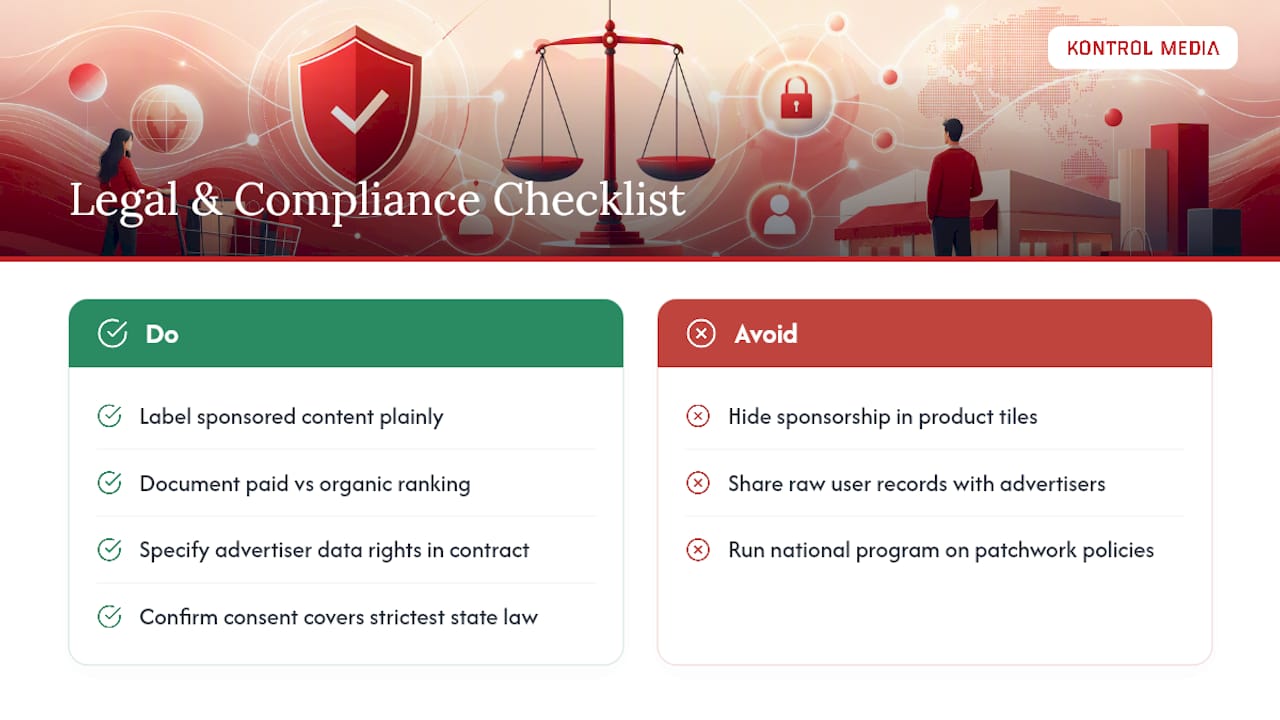
Privacy gets most of the attention, but advertising standards and consumer protection law carry equal risk for a growing retail media network. Sponsored placements that look like organic search results or product recommendations can trigger deceptive advertising complaints if they are not clearly disclosed. The Federal Trade Commission has pursued disclosure enforcement in digital advertising for years, and sponsored product listings are not exempt just because they live inside a retail app rather than a search engine.
Label sponsored content plainly. A small “Sponsored” tag on a product tile is not a suggestion, it is the baseline expectation regulators and advertisers alike now hold for any retail media surface, onsite or in-store.
Consumer protection law also touches pricing transparency. If sponsored placement changes which products surface first, and that placement is paid rather than merit-based, retailers need consistent internal documentation showing the distinction between organic ranking and paid ranking. This matters most when a retailer’s own private-label products compete in the same auction as third-party brands, since regulators and advertisers both watch for self-preferencing.
Data governance policy needs to extend past consent management into contractual language with advertisers. Specify exactly what data an advertiser receives (aggregated segments, never raw records), how long they may retain match keys, and what happens to that data if the advertiser relationship ends. Build this into your master service agreement template before your first pilot, not after your first dispute. Retailers operating loyalty programs across multiple states should also confirm their consent language satisfies the strictest applicable state privacy law, rather than the most lenient one, since a single national program cannot legally run on a patchwork of separate policies.
What Actually Goes Wrong When Retailers Scale a Media Network?
Three operational risks show up in almost every retail media build, and none of them are exotic.
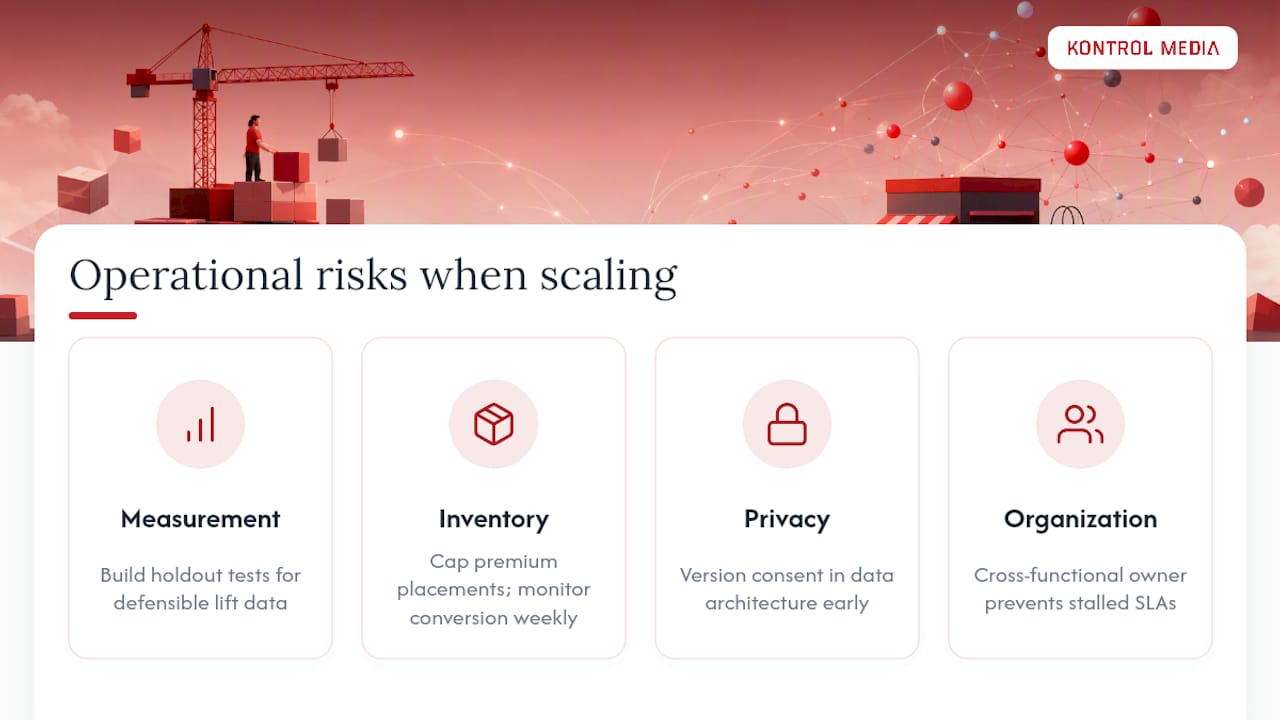
Measurement gaps top the list. Advertisers expect closed-loop proof of incrementality, yet Forrester’s research on retail media found many networks still cannot deliver it convincingly, which erodes renewal rates even when raw ROAS looks strong. The fix is not a better dashboard. It is building holdout testing into your campaign structure from the first pilot, so you have defensible lift data before an advertiser asks for it.
Inventory control is the second risk, and it is mostly a supply and demand problem disguised as a technical one. Sell too much premium placement and you degrade the shopper experience, which hurts conversion for everyone, including unpaid organic results. Sell too little and advertisers hit inventory caps and reduce spend. Cap premium placements at a fixed percentage of total page real estate and monitor conversion rate on ad-heavy pages weekly, not quarterly.
Privacy and consent friction is the third. Every new state privacy law adds a compliance layer, and retail media teams that treat consent as a one-time legal sign-off rather than an ongoing operational process end up rebuilding data pipelines mid-year. Build consent versioning into your data architecture early, so a policy change does not require rearchitecting your segments from scratch.
A fourth, quieter risk is organizational: retail media revenue often gets built by a small team reporting into marketing, while the data it depends on sits with IT or e-commerce. Without a clear cross-functional owner, segment requests stall and advertiser SLAs slip.
Who Are the Major Players, and How Is the Market Positioning Itself?
Retail media has moved past its early land grab phase. The largest retailers already run mature networks with dedicated sales teams, proprietary DSPs, and negotiated upfront commitments from national brands. Mid-market and regional retailers are the fastest-growing segment now, because the technology to launch a network no longer requires the scale of a top-tier grocery or big-box chain.
The category itself is widening. Retail media is evolving into what the industry increasingly calls commerce media, extending first-party commerce data off retailer-owned properties into connected TV, social platforms, and other channels, with IAB frameworks maturing the definition as the space grows. This matters for positioning: a retailer that treats its network as “onsite ads only” is competing on a shrinking slice of a growing pie.
Differentiation increasingly comes from three places. First, data specificity, meaning how granular and how fresh your first-party segments actually are, not just how large your audience is. Second, measurement credibility, since advertisers now compare retail media partners partly on whose incrementality reporting they trust more. Third, ease of doing business, meaning how fast an advertiser can launch a campaign without a six-week onboarding process.
Retailers who lag are typically the ones that built a network purely to check a competitive box, without the segment strategy or measurement infrastructure to back it. That gap shows up fast once an advertiser compares renewal performance across retail partners, and budget follows the network that can prove results, not the one that launched first.
What Technology Stack Do You Actually Need?
A retail media network runs on four core technology layers, and skipping any one of them creates a bottleneck later.
The ad server or DSP handles auction logic, bidding, and creative delivery for sponsored products and display. Some retailers license this from a platform partner; others build custom logic on top of an existing programmatic DSP.
The SSP (supply-side platform) matters most once you extend offsite, since it connects your inventory to programmatic exchanges and CTV marketplaces where advertisers buy audience extension.
The DMP or customer data platform unifies loyalty, transaction, and browsing data into the segments you sell. This is the layer most retailers underinvest in early, and it is the one that determines how sophisticated your audience products can eventually become.
The data clean room is the newest and most important addition for offsite activation. It lets you match segments against an advertiser’s customer list without exposing raw identifiers on either side, the exact pattern AWS documents using entity resolution and privacy-preserving matching techniques.
Integration considerations matter as much as the individual tools. Your point-of-sale system needs to feed transaction data into the DMP in near real time, not overnight batches, or your segments lag behind actual shopper behavior. Budget integration time generously. Most delays in retail media launches come from data pipeline work, not from the advertising technology itself.
How Do You Support Advertisers After the Sale?
Winning an advertiser’s first campaign is the easy part. Retaining their budget for a second and third quarter depends on what happens after launch, and this is where many retail media teams under-invest.
Assign a named account contact for every advertiser above a minimum spend threshold. Self-serve advertisers can operate through a dashboard alone, but managed accounts expect a person who understands their category and can explain a lift report in plain language, not just export a spreadsheet.
Build a standing optimization cadence. Monthly campaign reviews that surface what worked, what underperformed, and one specific adjustment for the next cycle keep advertisers engaged and reduce churn. Advertisers who only hear from you at renewal time rarely renew at the budget level you want.
Training matters more than most retailers expect. Provide advertisers with a short onboarding session covering how your auction works, how your measurement reports should be read, and what a realistic ramp-up curve looks like. Advertisers who misread a slow first month as a failed campaign, rather than normal auction learning behavior, cancel prematurely.
Escalation paths need to be explicit too. When a campaign underperforms, advertisers should know exactly who reviews the data and how quickly they will hear back with a diagnosis, not just an apology. Retail media teams that treat customer success as a reporting function, rather than a relationship function, tend to see the same first-year churn rate regardless of how strong their initial pitch was.
What Do Successful Retail Media Launches Actually Look Like?
Retail media success stories share a pattern more than they share a specific tactic. In-store digital networks, in particular, represent a large and still underexploited growth opportunity, and retailers that instrument them properly with loyalty linkage and test versus control measurement generate material incremental revenue that a simple foot-traffic count would never reveal.
The retailers who move fastest from pilot to sustained revenue tend to follow the same tactical sequence, prioritizing the plays with the shortest path to proof. Sponsored products come first because the auction mechanics are well understood by advertisers already buying similar placements on marketplaces. Premium display and guaranteed inventory come next, once a retailer has enough advertiser trust to sell placement rather than just clicks. Peak demand yield management, adjusting pricing around high-traffic periods like holiday shopping, and AI-assisted monetization of long-tail inventory round out what one industry breakdown calls the seven core retail media plays worth prioritizing in order of ROI.
The common failure mode in networks that stall is the reverse: retailers who try to sell offsite programmatic and premium guaranteed placements before they have a single onsite success story to point to. Advertisers buy the first campaign on trust and the second one on evidence. A retailer without a working measurement story cannot generate that evidence no matter how sophisticated the media plan looks on paper. The lesson holds across every case worth studying: prove the smallest format first, measure it honestly, then expand.
What I’d Prioritize if I Were Building This Right Now
Retail media rewards speed married to discipline, and most teams pick one or the other. The retailers who stall out are the ones who spend a year building a data clean room before running a single sponsored product auction. The ones who burn advertiser trust are the ones who sell offsite programmatic before they can prove a single incremental sale onsite. Launch sponsored products fast, but build your measurement muscle at the same pace, not after. The retailers still standing in two years will be the ones who treated proof, not pitch decks, as the actual product.
— Mark Kapczynski
Ready to Build a Retail Media Network That Actually Pays Off?
Our team offers an alternative to spending a year in vendor evaluations before your first advertiser dollar lands. We provide services to build and operate retail media networks end to end, from sponsored product auction setup through clean room architecture for offsite activation, with measurement infrastructure built in from day one, not added after a renewal crisis.
We collaborate with retail leaders on the build versus buy decision, the 90-day launch sequence, and advertiser packaging that helps turn a pilot into a renewed contract. If your team has first-party data sitting unmonetized, or a retail media pilot that stalled on measurement, visit our retail media network setup page to scope what a working engagement looks like for your business, and book a consultation to get a realistic timeline and investment range specific to your current stack.
Sources
- The state of retail media 2025
- Guidance for Retail and Commerce Media Monetization on AWS
- Retail media networks are a high-margin profit engine; build guidance and timelines