


If you are reading this in mid-October 2026, you are not late, but you are close to the edge. Black Friday lands on November 27 and Cyber Monday on November 30, which leaves roughly six weeks to lock in what is still unlocked. The best holiday media plans this year do four things: they treat the season as three phases instead of one spike, they fund the channels that can prove sales, they protect budget against rising media costs, and they decide up front how every dollar will be measured.
This guide is written for marketing leaders who already have a plan on paper and want to pressure-test it, and for those who are still building one. I will lay out the market backdrop, a phase-by-phase structure, how to split budget, where connected TV and retail media fit, and what to do in the weeks that remain.
TL;DR
- Plan in three phases (early, peak, last-minute), because the season now starts in October rather than November and does not end on Cyber Monday.
- Fund channels that can tie spend to sales: 63% of marketers now name demonstrable sales and revenue as their primary KPI for Performance TV.
- Expect higher costs: 38% of US marketers call rising media costs their top holiday stressor, so hold back flexible budget and cut waste early.
- Decide your measurement method (holdouts, geo tests, matched audiences) before the first impression runs, not after the season closes.
- Clean product data and consistent content now, because AI-assisted shopping tools can only surface what they can read.
Table of Contents
- What the 2026 holiday season looks like
- Plan in three phases, not one season
- How to split your holiday budget
- Where connected TV earns its place
- Retail media and shopper marketing: be present where the basket is built
- Make your catalog readable by AI shopping tools
- Measurement: decide before you spend
- Our perspective: the plan is a set of decisions, not a deck
- A week-by-week checklist for the rest of the season
- Need help executing before November?
- FAQ
- Sources
What the 2026 holiday season looks like
The demand picture is solid, though not explosive. The National Retail Federation forecasts November and December retail sales to grow 4.2% over 2025, reaching $1.013 trillion, compared with 3.1% growth and $972 billion last year. That is healthy growth, but it is not the kind that lifts every brand equally. When the pie grows about four percent and the number of advertisers chasing it grows faster, the winners are the ones who spent smarter, not just more.
Online keeps taking share. Adobe’s forecast says ecommerce will make up one dollar out of every four spent on retail goods this holiday season, driven by shoppers with strong value expectations. Value-first shoppers compare, wait and trade down, which means your creative has to carry a reason to buy now, not just a seasonal mood.
And shoppers start early. Circana reports that nearly half of consumers were browsing before Thanksgiving in 2025, and it points to social commerce, creator influence and AI-assisted discovery as the forces shaping this year. If your plan treats November 1 as the starting gun, you are already behind the shopper.
Plan in three phases, not one season
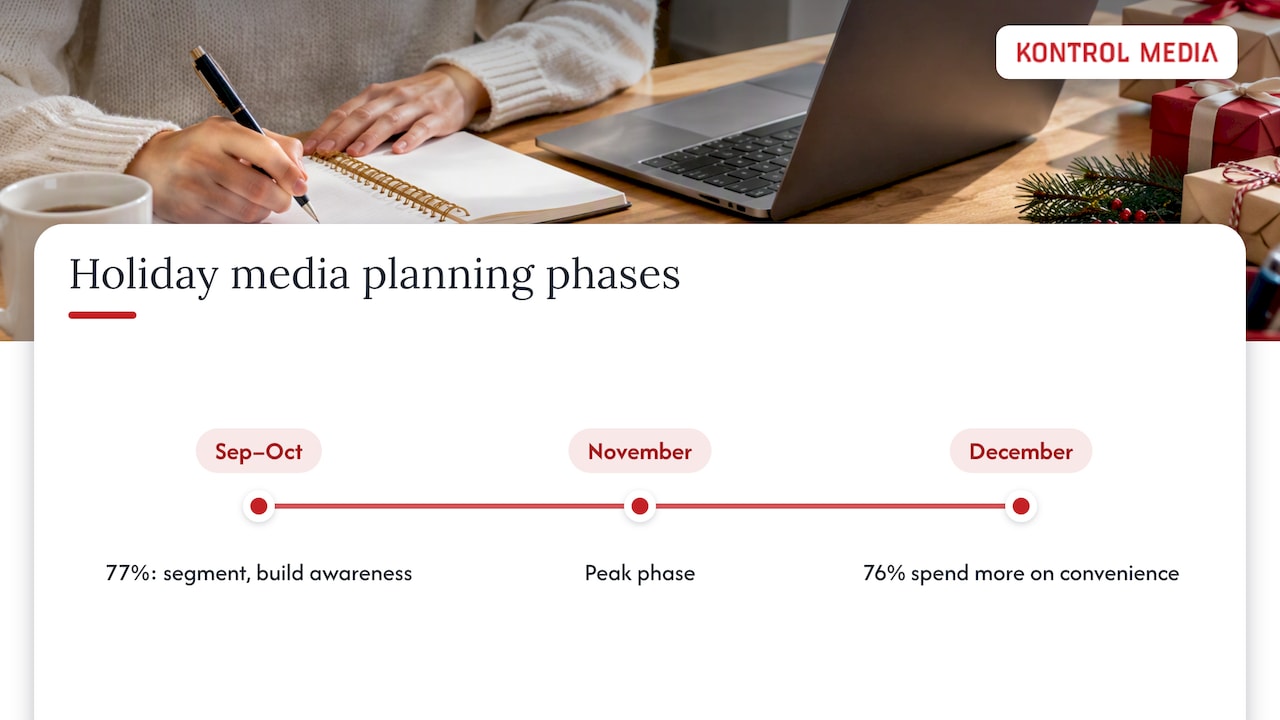
The simplest structural fix for a holiday plan is to stop thinking of it as one flight. A strategic timeline published with TripleLift’s retail media guide splits the season into an early phase (September to October), a peak phase (November) and a last-minute phase (December). The same release reports that 77% of marketers use the early phase for shopper segmentation and awareness, and 76% raise spend in December to emphasize convenience, shipping reliability and click-and-collect.
Here is how I would translate that into planning decisions for the weeks left.
Early phase: build the audience you will harvest later
This is where you are right now. The job is not to push discounts. It is to find the people who will buy and make sure they know you before the noise arrives. That means shopper segmentation, retargeting pools that are large enough to matter in November, and creative that introduces gift ideas or bundles rather than a single hero offer. If your pools are thin on October 18, you can still grow them this month with prospecting on social and video, but every week you wait makes it more expensive.
Peak phase: win on urgency and clarity
November is driven by urgency and competitive pricing around Black Friday and Cyber Monday. Your media plan here should be less about reach and more about frequency control, bid strategy and inventory access. Reserve premium placements early where you can, because the best retail media and CTV inventory tends to sell through before the week itself. Keep your offer message identical across paid, email, onsite and in-store signage so shoppers do not meet three different deals in one day.
Last-minute phase: sell certainty
December rewards brands that answer the shopper’s practical question: will it arrive in time? Shipping cutoffs, click-and-collect and local availability are the message. Hold budget for this phase deliberately. Too many plans burn through 80% of dollars by Cyber Monday and leave nothing for the shoppers who are most ready to buy.
How to split your holiday budget
There is no universal formula, and anyone who hands you one without knowing your margins and inventory is guessing. What I can offer are reference points and a way to think about them.
In tvScientific’s 2026 survey, social media takes the largest share of holiday and peak-moment media budget at 68%, with Performance TV (CTV) next at 54%. Treat those figures as how many marketers are weighting each channel in their mix, not as a recommended split. They tell you where the competition for attention and auction price will be heaviest.
A more useful exercise is to build the budget in three layers.
- Committed layer (about half). Channels where you know the return from last year: search, owned email, retargeting, and your best-performing retail media placements.
- Growth layer. Channels where you are scaling or testing, such as CTV, creators and new retail media partners, each with a stated learning goal and a stop-loss.
- Reserve layer. Money held back for the last-minute phase and for reallocating to whatever is working in the second week of November.
The reserve is the piece most plans lack, and it is the one that protects you from cost inflation. When 38% of marketers say rising media costs are their biggest worry, a plan with no slack is a plan that cannot absorb a bad week.
For a deeper look at how to stretch dollars once the buys are in motion, our guide to media buying in 2026 covers negotiation, pacing and where waste hides.
Where connected TV earns its place
Connected TV has moved from a brand awareness experiment to a line item with a sales target. tvScientific finds that 81% of US marketers plan to run Performance TV during the holidays, and 71% of those are increasing their CTV budget. The shift in how it is judged matters more than the adoption number: if you buy CTV this season, buy it like a performance channel, with a conversion window, a control group and a cost per incremental order, not just completed views.
A few practical rules for CTV in the next six weeks:
- Buy audiences, not just shows. Your early-phase segments should carry over, so the same household can see your message on the TV and your retargeting ad on the phone.
- Rotate creative between phases. A gift-idea spot in October should give way to a deadline-driven spot in late November and a shipping-cutoff spot in December.
- Set frequency caps. Holiday CPMs are high, and repeating one ad to the same household ten times is the quickest way to waste the budget.
If you are weighing whether to handle this in-house or bring in specialists, a directory of media planning and buying agencies can help you compare providers by specialty, budget and client fit before you start conversations.
Retail media and shopper marketing: be present where the basket is built
For consumer brands, retail media is the closest thing to buying at the shelf. Shoppers on a retailer’s site or app are already in buying mode, and the data links ads to actual transactions. The catch during the holidays is that inventory and sponsored-product bids both tighten, and retailers decide their promotional calendars well ahead of you.
Three things to check this week:
- Commitments and deadlines. Confirm your partners’ holiday booking cutoffs and creative specs, and whether sponsorship placements are still available.
- Product readiness. Ads that send shoppers to out-of-stock or thinly described items lose money twice. Sync inventory feeds with campaign pacing.
- Measurement agreement. Ask each retail partner how they report incrementality and what the attribution window is, so you can compare results across networks on the same terms.
If measurement is where your team gets stuck, our guide to key retail media metrics walks through what to demand from every network, and our shopper marketing strategy guide shows how to tie in-store and online efforts together.
Make your catalog readable by AI shopping tools
This is the planning tip that most holiday guides still skip. Adobe’s analysis argues that shoppers are increasingly using AI-assisted tools, so product data quality and content consistency determine whether your items surface. In practice, that is a media-planning issue, not only a merchandising one, because paid and organic discovery now share the same inputs.
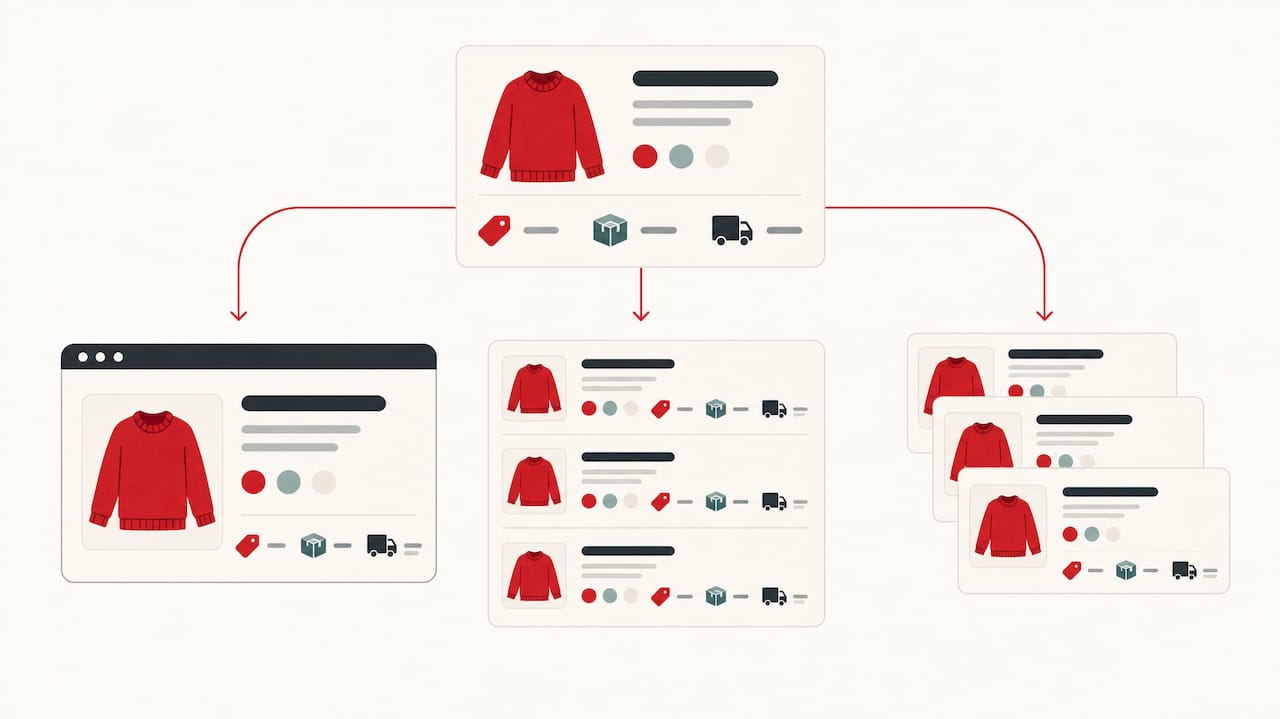
Spend a few hours on the basics before peak: complete titles and attributes, consistent pricing and availability across your site, feeds and retail partners, clear gift-oriented descriptions (who it is for, what it solves), and accurate shipping information. It is unglamorous work, and it pays back in every channel at once.
Measurement: decide before you spend
The most expensive mistake in holiday media is reporting last-click revenue in January and calling it success. Holiday sales are inflated by demand that would have happened anyway, so the question is how many sales your ads caused. That is the idea behind incrementality: comparing exposed and unexposed groups through holdouts, geo tests or matched audiences.
You do not need a perfect testing program in six weeks. You need a few disciplined choices:
- Pick one or two channels, probably CTV and one retail media partner, and hold out a small share of the audience or a few matched markets.
- Write down in advance what result would make you add budget and what would make you cut it.
- Keep a consistent KPI hierarchy: incremental revenue first, then cost per incremental order, then platform-reported ROAS as a supporting number.
Our piece on measuring the ROI of marketing and advertising campaigns goes through the mechanics, and our campaign management guide for marketing leaders covers the weekly rhythm of reviewing and reallocating.
Our perspective: the plan is a set of decisions, not a deck
We work with marketing leaders across retail media, commerce media and go-to-market strategy, and the pattern we see each fall is consistent. The plans that struggle are rarely short on ideas. They are short on decisions made early: who owns the reallocation call in the second week of November, which channel gets cut first if costs spike, and what evidence would change the mix.
There is also a quiet shift in how brands should think about retail and commerce media. A few years ago it was an add-on to the trade budget. Now it is where a large share of holiday purchase intent is captured, and the brands that operate it as a media channel, with clear measurement and sales ownership, tend to have the calmest Decembers. Brands that treat it as a trade negotiation tend to find out in January what they actually bought.
My advice for the weeks ahead is to keep the plan small enough to manage and honest enough to measure. Pick the three or four bets you believe in, give them real money, hold a reserve, and agree on the scoreboard before the first impression. Holiday media is a high-pressure stretch, but it rewards teams who stay clear-headed and a little curious about what the data is telling them.
— Mark Kapczynski
A week-by-week checklist for the rest of the season
Now through October 31. Audit audience pools and retargeting sizes. Confirm booking deadlines with every retail media and CTV partner. Finalize creative for all three phases, including shipping-cutoff versions. Set up holdouts or geo tests. Fix product feed errors.
November 1 to 20. Run early-phase prospecting and gift-idea creative. Watch cost trends weekly and move budget from the weakest layer to the strongest. Lock offer messaging so paid, email, onsite and in-store all match. Pre-brief customer service and fulfillment on expected volume.
November 21 to 30. Peak. Check pacing daily, tighten frequency, and keep your reserve untouched until Cyber Monday data comes in. Review inventory against ad spend so you never promote what you cannot ship.
December 1 to 24. Shift to convenience, delivery dates and click-and-collect. Deploy the reserve toward the audiences closest to purchase. Keep reporting incremental results, not just platform numbers.
Early January. Document what you learned while it is fresh: which channels earned their budget, which did not, and what you would book earlier next year. Your next holiday plan starts with that note.
If your team is a small ecommerce operation, our guide to operations-first holiday ads and gift guides is a lighter version of this process. If gamers are part of your audience, see our playbook for reaching gamers during the holidays.
Need help executing before November?
Kontrol Media pairs strategy with hands-on execution across marketing, sales and media networks. If you run a retailer or consumer business and want to turn your audience into ad revenue, we stand up and operate retail and commerce media networks, and if you need a plan and people to carry it out, our business strategy, marketing and sales services are built for that. Tell us what your holiday plan is missing and we will tell you honestly whether we can help.
FAQ
When should holiday media planning start?
Ideally in the summer, but the practical answer is as soon as you can. eMarketer notes that the holiday marketing season now begins in October, so a plan finalized in mid-October should prioritize locking inventory, creative and measurement over adding new channels.
How much of my budget should go to the last-minute phase?
There is no standard figure, because it depends on your shipping cutoffs and product type. The TripleLift timeline shows that 76% of marketers increase spend in December, so keep a deliberate reserve for it rather than spending everything by Cyber Monday.
Is CTV worth it for a mid-sized brand this holiday?
It can be, if you buy it as a performance channel with a control group and a sales KPI. Costs are rising across the board, so start with a modest test, cap frequency and compare cost per incremental order against your search and retail media results.
How do I measure holiday campaigns without a large analytics team?
Start with one holdout or geo test on your biggest channel and agree on the decision rule before launch. Compare incremental sales rather than platform-reported conversions, then expand the method to other channels in the new year.
Sources
- Black Friday and Cyber Monday 2026 dates
- NRF Winter Holiday FAQ
- Adobe 2026 Holiday Shopping Trends, Statistics & Forecast
- Circana: How Advertisers Should Prepare for Holiday 2026
- TripleLift readiness data via PR Newswire
- tvScientific 2026 Holiday & Seasonal Shopping Trends Report
- eMarketer: Holiday ad budgets climb as marketers demand clearer ties to sales
- eMarketer: FAQ on holiday marketing