


Demand generation is defined as the strategic, multi-channel marketing discipline that creates awareness, preference, and pipeline among B2B buying committees well before direct sales engagement begins. It is not a single campaign or a form on a landing page. It is a coordinated system that spans content, paid media, account-based marketing, intent data, and lifecycle nurturing, all working together to move entire buying committees from unaware to sales-ready. For marketing professionals and business leaders trying to grow revenue in complex B2B markets, understanding demand generation at this level is the difference between filling a CRM with contacts and actually building a pipeline that closes.
What is demand generation and how does it work?
Demand generation is the full-funnel marketing process that creates awareness and preference across a buying committee, not just captures contact information. It encompasses every stage from the moment a potential buyer first encounters your brand to the moment they raise their hand for a sales conversation. That scope is what separates it from narrower lead capture programs.
The discipline covers content marketing, paid media, ABM, intent data, and lifecycle marketing working in concert. Each channel plays a role in a different stage of the buyer’s journey. Content builds authority and educates. Paid media extends reach. ABM focuses resources on high-value accounts. Intent data surfaces who is actively researching. Lifecycle marketing keeps engaged buyers moving forward.

A functional demand generation engine produces something specific: buyers who arrive at a product demo already wanting the product, without ever filling out a form. That outcome, shifting from lead capture to demand creation, is the clearest signal that your program is working. It means your brand has built enough authority and presence that buyers seek you out rather than waiting to be found.
How does demand generation differ from lead generation?
Lead generation is narrower in scope than demand generation. Its primary goal is collecting contact information, typically through form fills, for immediate sales follow-up. Demand generation includes lead generation as one component, but it also covers all the activity that happens before a buyer is ready to identify themselves.
Think of it this way. Lead generation is the harvest. Demand generation is the entire farming operation, from preparing the soil to planting, watering, and cultivating before anything is ready to pick. Skipping the earlier stages and jumping straight to harvest produces thin results.
The timeline difference is significant. B2B sales cycles run 6 to 18 months from initial contact to final order. That duration means a buyer may consume dozens of content pieces, attend webinars, and research competitors for months before ever engaging with your sales team. Lead generation programs that only track form fills miss all of that activity and misattribute pipeline to the last touch before conversion.
Pro Tip: Map your content to the full 6–18 month buying journey. If your content library only covers bottom-of-funnel topics like pricing and demos, you are invisible to buyers in the research phase, which is where most of the journey happens.
The practical implication is that demand generation requires a longer investment horizon and different success metrics. You are not optimizing for cost per lead. You are optimizing for pipeline quality, deal velocity, and annual recurring revenue influenced.
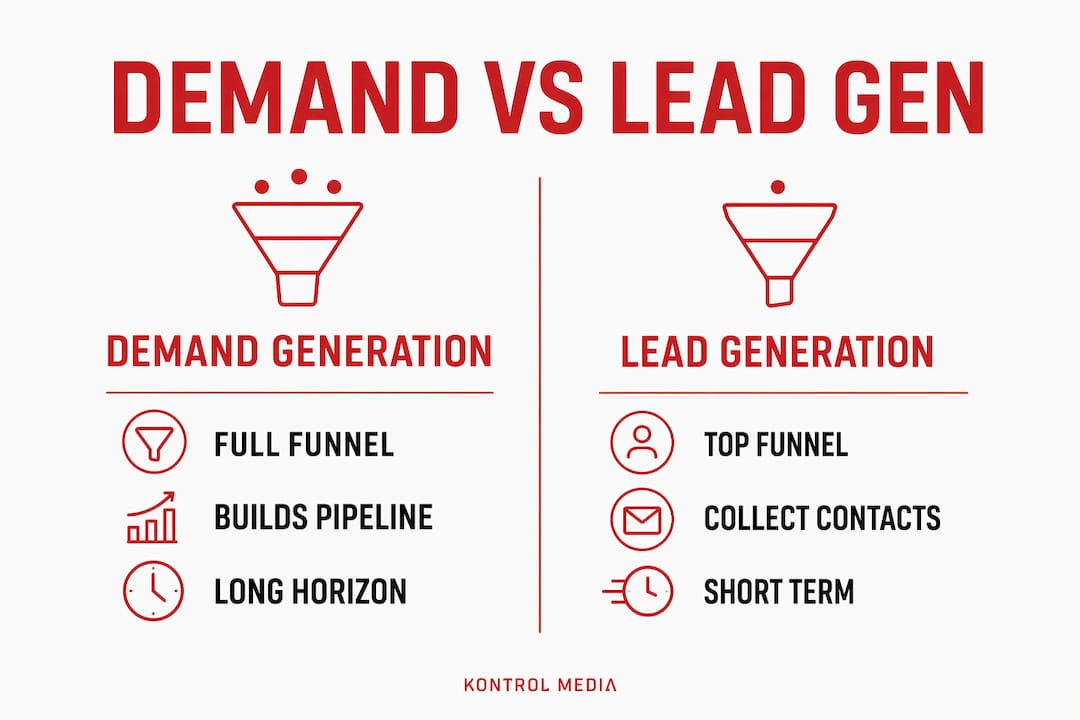
| Dimension | Lead generation | Demand generation |
|---|---|---|
| Primary goal | Collect contact records | Build awareness, preference, and pipeline |
| Timeline | Short, campaign-driven | Long, 6–18 month buyer journey |
| Output | Form fills and contact lists | Qualified pipeline and sales-ready buyers |
| Channels | Landing pages, gated content | Content, ABM, paid media, intent data, nurture |
| Success metric | Cost per lead, volume | Pipeline influenced, deal velocity, ARR |
What are the key stages of a demand generation strategy?
Effective demand generation integrates multiple channels in a cohesive sequence that nurtures buying committees over extended periods. The stages below reflect how the best programs are structured.
Awareness and education. Ungated, value-based content builds brand authority before any buyer signals intent. Blog posts, research reports, podcasts, and video content all serve this stage. The goal is to become the trusted resource buyers turn to when they start researching a problem. Top demand generation programs prioritize educational content and brand authority before lead capture begins.
Intent signal capture. Owned media properties, webinars, and interactive content generate first-party behavioral data. When a buyer watches 80% of a webinar on a specific topic, that engagement signals intent far more reliably than a third-party data provider’s model. This is where your owned channels become a competitive asset.
Engagement and nurturing. Context-aware, multi-channel outreach keeps buyers engaged between intent signals. Email sequences, retargeting, and direct outreach from sales development representatives all play a role here. The key word is context. Generic drip campaigns do not move buyers. Personalized follow-up tied to specific behaviors does.
Qualification. Before handing a buyer to sales, demand generation programs apply BANT criteria: Budget, Authority, Need, and Timeline. Demand gen professionals focus on quality and fit, aligning marketing tightly with sales qualification standards. A lead that fails BANT wastes sales capacity.
Pipeline acceleration. Once a buyer is in active sales conversations, demand generation continues to support the deal through case studies, executive briefings, and competitive content. The buying committee rarely makes decisions based on one person’s research, so marketing must continue influencing multiple stakeholders.
Pro Tip: Run a quarterly audit of your nurture sequences. If your messaging does not change based on what a buyer has already engaged with, you are sending noise, not signals. Behavioral triggers should drive every touchpoint.
How should you use data and technology in demand generation?
First-party data is the foundation of any serious demand generation program. First-party intent signals deliver better lead quality and engagement than third-party intent data providers. The reason is straightforward: when a buyer engages with your webinar or downloads your research, you know exactly what they consumed and when. Third-party intent data tells you someone in a company searched a keyword. That is a much weaker signal.
Owned content and webinar engagement are the most reliable intent detection tools available. A buyer who attends your live webinar on a specific use case and then visits your pricing page twice in the following week is telling you something precise. That behavioral sequence should trigger a coordinated response from both marketing and sales, not a generic email.
Marketing analytics and intent data together inform audience targeting and personalization at scale. Lead scoring models that weight first-party behavioral signals over demographic data produce more accurate predictions of sales readiness. Attribution models in B2B are imperfect, but pipeline tracking tied to specific content programs gives you a workable proxy for measuring contribution.
Common pitfalls in this area include:
- Overreliance on third-party intent data providers, which share signals with your competitors and degrade over time
- Generic messaging that ignores what a buyer has already engaged with
- Lead scoring models built on demographic fit alone, without behavioral signals
- Attribution models that credit only the last touch before a form fill, ignoring months of prior engagement
- Failing to connect marketing analytics to CRM pipeline data, leaving revenue impact invisible
Pro Tip: Build your first-party data strategy around owned media properties and events before investing in third-party intent subscriptions. The data you collect directly is more accurate, more defensible, and not shared with your competitors.
How do you measure demand generation success?
Measuring demand generation is genuinely hard, and anyone who tells you otherwise is selling you something. The core challenge is that demand generation success cannot be cleanly attributed to single campaigns because most B2B buying activity happens anonymously before any form fill. This is the dark funnel, and it is where the majority of your buyers are spending their time.
The practical response is to use a combination of proxy metrics that together paint an accurate picture:
- Pipeline influenced: Total pipeline value where marketing had documented touchpoints, regardless of whether marketing was the first or last touch
- Deal velocity: How quickly opportunities move from first meeting to closed-won, which reflects how well-educated buyers are before sales engagement
- ARR influenced: Annual recurring revenue from accounts where demand generation programs had measurable engagement
- Self-reported attribution: Asking buyers directly how they heard about you, which captures dark funnel activity that analytics cannot track
- Intent signal volume: Growth in behavioral engagement across owned channels, indicating increasing market awareness
“The shift from measuring leads to measuring pipeline quality is the single most important maturity step a demand generation team can take. Volume metrics optimize for the wrong behavior. Pipeline metrics optimize for revenue.”
The multi-quarter horizon for seeing results is a feature of the discipline, not a flaw. Pipeline, ARR influenced, and deal velocity are the core metrics that reflect whether demand generation is working. Expecting meaningful pipeline results within 90 days of launching a demand generation program sets unrealistic expectations and leads to premature program cuts.
Key Takeaways
Demand generation builds qualified pipeline by creating and capturing buyer intent across the full 6–18 month B2B sales cycle, not just collecting contact records at the bottom of the funnel.
| Point | Details |
|---|---|
| Demand gen vs. lead gen | Demand generation includes lead generation but covers the entire buyer journey, from awareness through pipeline acceleration. |
| Sales cycle horizon | B2B sales cycles run 6–18 months, requiring a long-term program commitment before pipeline results appear. |
| First-party data advantage | Owned media and webinar engagement produce more accurate intent signals than third-party data providers. |
| Measurement approach | Use pipeline influenced, deal velocity, and ARR as primary metrics rather than lead volume or cost per lead. |
| Qualification discipline | Apply BANT criteria before sales handoff to protect sales capacity and improve close rates. |
Why most demand generation programs fail before they start
I have watched a lot of demand generation programs get built backward. The team launches a gated ebook, sets up a nurture sequence, hands leads to sales after a form fill, and then wonders why pipeline quality is poor six months later. The problem is not execution. The problem is that the program was designed to capture demand that does not exist yet, rather than create it.
The shift I keep coming back to is this: the best demand generation programs treat brand authority as infrastructure. You build it before you need it, the same way you build a road before you expect traffic. Companies that skip the awareness and education phase and jump straight to lead capture are essentially asking buyers to trust them before they have earned it.
The first-party data conversation is also changing fast. Privacy regulations and the decline of third-party cookies are forcing marketing teams to build owned audiences rather than rent them. That is actually good news for disciplined demand generation programs, because the teams that invested in owned media, webinars, and content engagement already have the data infrastructure they need. The teams that relied on third-party intent subscriptions are scrambling.
Looking ahead, the integration of AI into demand generation is real and accelerating. AI is already improving personalization at scale, identifying intent signals earlier in the buying journey, and helping teams prioritize accounts more accurately. But AI amplifies whatever strategy is underneath it. A weak demand generation strategy with AI tools is still a weak strategy. Get the fundamentals right first.
The advice I give every marketing leader I work with is the same: balance your short-term campaign wins with long-term pipeline building. You need both. Short-term campaigns keep the business moving. Long-term demand creation is what compounds over time and produces the pipeline that closes at higher rates with shorter cycles.
— Mark Kapczynski
How Kontrol Media helps you build a demand generation engine
Kontrol Media works with marketing leaders and business executives who need more than a campaign. They need a program built on comprehensive business strategy that connects demand creation to revenue outcomes. The work spans long-term pipeline planning, first-party data strategy, and hands-on execution across sales, marketing, and business development.
Clients like Experian, BuzzFeed, REMAX, and West Monroe have worked with Kontrol Media to address misaligned marketing strategies and build demand generation programs that produce measurable pipeline growth. If your current approach is generating contacts but not closing revenue, the gap is usually in how demand is being created, not just captured. Kontrol Media’s marketing and consulting services are built to close that gap with clarity and execution.
FAQ
What is demand generation in B2B marketing?
Demand generation is the multi-channel marketing discipline that builds awareness, preference, and pipeline among B2B buying committees across the full sales cycle. It includes content marketing, ABM, paid media, intent data, and lifecycle nurturing working together.
How long does demand generation take to show results?
B2B sales cycles run 6 to 18 months, so demand generation programs typically require a multi-quarter commitment before pipeline results are measurable. Expecting significant pipeline impact within 90 days sets unrealistic expectations.
What metrics should I use to measure demand generation?
Pipeline influenced, deal velocity, and annual recurring revenue influenced are the core metrics for demand generation effectiveness. Lead volume and cost per lead are secondary indicators that do not reflect pipeline quality.
What is the dark funnel in demand generation?
The dark funnel refers to the anonymous B2B buying activity that occurs before any form fill or direct sales contact. Most buyer research, content consumption, and peer conversations happen here, making self-reported attribution and first-party behavioral data the most reliable ways to track it.
How does first-party data improve demand generation?
First-party intent signals from owned media, webinars, and content engagement produce more accurate buyer intent data than third-party providers. They are not shared with competitors and reflect actual engagement with your specific content and brand.
Recommended
- How B2B and B2C Marketing Differ: A Strategic Guide | Kontrol Media Consultancy
- Top Digital Marketing Trends for Manufacturers to Know | Kontrol Media Consultancy
- Retail Media Ad Sales: Strategic Guide for Marketing Pros in 2026 | Kontrol Media Consultancy
- Commerce Media: The 2026 Guide for Marketers | Kontrol Media Consultancy