


Digital PR is defined as the practice of earning authoritative online coverage, brand mentions, and editorial links that build visibility, improve SEO rankings, and increasingly determine how AI search engines cite your brand. Earned media drives 84% of all AI citations, and brands with strong trust signals appear in 75% of AI-generated answers compared to just 1% for lesser-known names. That gap is the real business case for online public relations in 2026. 68.2% of digital PR professionals report increased effectiveness year over year, even as 75% say execution has grown harder. The discipline rewards those who treat it as a long-term authority-building program, not a one-time campaign.
What are the core components of a successful digital PR strategy?
Original research is the single most reliable foundation for high-quality media placements. 95.9% of digital PR professionals pitch data-led content as their primary tactic. That near-universal adoption reflects a simple truth: journalists need something new to write about, and proprietary data gives them exactly that. Commissioning custom market research before a campaign launch gives your pitches a factual hook that generic thought leadership cannot match.
Beyond data, the components that separate effective digital media outreach from noise include:
- Original research and exclusive data. Surveys, industry reports, and first-party data sets give journalists a reason to cover your brand rather than a competitor.
- Long-term journalist relationships. Treating reporters as key accounts, logging their recent story angles, and delivering tailored pitches builds the kind of trust that generates repeat coverage.
- Human-interest storytelling. Storytelling distinguishes digital PR from basic link building by centering media value over transactional link quantity. A compelling narrative about real people or real outcomes earns coverage. A list of product features does not.
- Social media PR strategies. Distributing earned coverage across LinkedIn, X, and industry newsletters amplifies reach and signals credibility to both journalists and AI knowledge engines.
- Targeted digital outreach tools. Journalist query platforms, media database subscriptions, and coverage tracking tools replace the spray-and-pray approach with precision targeting.
Pro Tip: Before you build your media list, read the last five articles each target journalist has published. Your pitch should fit naturally into their existing beat, not interrupt it.
How to plan and execute a digital PR campaign that delivers results
A well-run campaign follows a clear sequence. Skipping steps, especially early goal-setting and journalist research, is the most common reason campaigns underperform.
- Set measurable objectives. Tie every campaign goal to a business outcome: domain authority growth, share of voice in a specific vertical, or AI citation frequency for a target keyword cluster.
- Segment your media targets. Divide outlets by beat, audience size, and publication authority. Tier-one national outlets require different angles than trade publications or regional business press.
- Craft a concise pitch. Pitches under 200 words generate 32% more responses than those over 400 words. Lead with the data hook, explain why it matters to the journalist’s readers, and close with a clear offer.
- Respond to journalist queries fast. Specific, quotable expert commentary delivered quickly outperforms broad press releases in placement success. Platforms that surface real-time journalist queries give you a direct line to active story opportunities.
- Follow up once, then stop. A single follow-up after 48–72 hours is acceptable. Multiple follow-ups damage your sender reputation and reduce future open rates.
- Measure across the full funnel. Track placements, referring domain quality, organic traffic lift, and AI citation gains. Measuring campaign ROI across all four dimensions gives you a complete picture of what the campaign actually delivered.
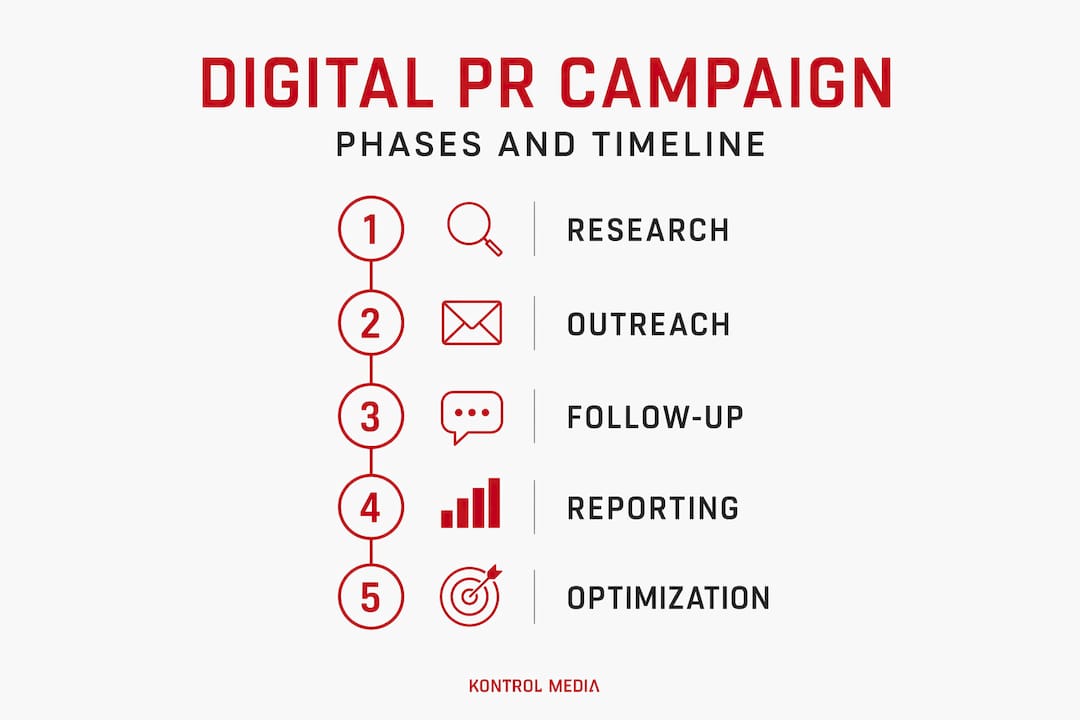
Campaigns typically produce initial results within 4–6 weeks. The first two weeks are research and outreach. Weeks three and four bring responses and placements. Weeks five and six show early SEO and traffic movement.
| Campaign phase | Timeline | Key activity |
|---|---|---|
| Research and planning | Week 1 | Finalize data assets, build media list |
| Outreach | Week 2 | Send personalized pitches, monitor query platforms |
| Placement and follow-up | Weeks 3–4 | Secure coverage, respond to journalist questions |
| Measurement | Weeks 5–6 | Track backlinks, organic lift, AI citation gains |
Pro Tip: Build a shared tracking document where every journalist contact, pitch date, and response is logged. Campaigns that treat journalists as key accounts, not one-time contacts, compound in value over time.
What tools and digital platforms support digital PR outreach and monitoring?
The right tools reduce manual work and surface opportunities that manual monitoring misses entirely. The category has matured significantly, and the platforms marketing teams use now fall into four distinct functions.

Journalist query monitoring platforms surface real-time requests from reporters who need expert sources. Responding promptly with quantifiable insights yields better placements than cold pitching alone. HARO (Help a Reporter Out) is the most widely known service in this category, though specialized vertical-focused alternatives have grown in number.
Media database and list-building tools store journalist profiles, beat information, and contact data. The best platforms in this category update contact records continuously and flag when a journalist changes outlets or beats. Stale media lists are one of the fastest ways to burn sender reputation.
Analytics and SEO measurement tools track backlink quality, domain authority changes, and organic traffic shifts that result from earned coverage. Tools like Ahrefs and Semrush are standard for this function. Neither replaces a human analyst, but both surface data that would take weeks to compile manually.
AI visibility tracking is the newest and least standardized category. Success in digital PR now requires tracking brand mentions that feed AI knowledge engines, a practice called Generative Engine Optimization (GEO). Dedicated GEO monitoring tools are emerging, and the future of AI-driven search visibility will depend on how well brands measure and act on this signal.
When selecting tools, match the platform’s feature depth to your campaign scale. A team running two campaigns per quarter needs different infrastructure than an enterprise team running 20. Prioritize integration with your existing CRM and analytics stack over feature count.
What common pitfalls should you avoid in digital PR campaigns?
Most digital PR failures trace back to a small set of repeatable mistakes. Recognizing them early saves budget and protects journalist relationships that take months to build.
- Volume-based pitching. Sending the same pitch to 500 journalists is not a strategy. Journalists treat irrelevant mass pitches as spam, and a single spam complaint can blacklist your domain with major outlets.
- Over-following up. Excessive follow-up emails reduce open and reply rates. One follow-up is professional. Three is harassment.
- Confusing digital PR with link building. Transactional link acquisition focuses on quantity. Digital PR focuses on editorial quality and media value. Conflating the two leads to campaigns that produce low-authority links and no brand equity.
- Ignoring AI citation as a success metric. Brands that measure only SEO rankings miss the growing share of search behavior happening inside AI-generated answers. GEO tracking belongs in every campaign dashboard in 2026.
- Neglecting brand storytelling. Data without narrative context rarely earns coverage. The story around the data is what makes a journalist’s editor approve the pitch.
“The fundamentals of digital PR have not changed because of AI. What has changed is the measurement standard. Earning a citation in an AI-generated answer now carries the same strategic weight as earning a front-page placement used to. Brands that recognize this shift early will build authority that compounds for years.”
Digital PR fundamentals remain unchanged by AI, but the measurement framework has expanded. Adding AI citation tracking alongside traditional metrics is not optional in 2026. It is the new baseline.
Key Takeaways
Digital PR builds brand authority by earning editorial coverage that improves SEO rankings, drives referral traffic, and secures citations in AI-generated search answers.
| Point | Details |
|---|---|
| Original research drives placements | 95.9% of professionals pitch data-led content because proprietary data gives journalists a reason to cover your brand. |
| Short pitches outperform long ones | Pitches under 200 words generate 32% more responses, so lead with the data hook and cut everything else. |
| AI citation is the new success metric | Earned media accounts for 84% of AI citations, making GEO tracking a required part of every campaign dashboard. |
| Journalist relationships compound | Treating reporters as key accounts and logging their beat angles produces repeat coverage that cold outreach never will. |
| Campaigns deliver results in 4–6 weeks | Plan for a two-week outreach phase followed by placements in weeks three and four, then measure SEO and AI lift in weeks five and six. |
The measurement standard has shifted. Here is what that means for your strategy.
I have watched digital PR evolve from a discipline that lived inside the press release to one that now sits at the intersection of editorial, SEO, and AI visibility. The shift is real, and the brands that have not updated their measurement frameworks are flying blind.
What strikes me most is that the core work has not changed. You still need original research, genuine journalist relationships, and a story worth telling. What has changed is where that work shows up. A placement in a high-authority outlet used to matter primarily because of the backlink. Now it matters because that outlet feeds the AI knowledge bases that power ChatGPT, Perplexity, and Google’s AI Overviews. The backlink is still valuable. The citation signal is now equally important.
The insight storytelling approach, where you build a narrative around a specific data finding rather than a general topic, is the format that earns both journalist coverage and AI citations. Vague thought leadership does neither. Specific, verifiable claims with a clear source do both.
The other thing I have seen consistently is that brands underinvest in the relationship side of digital PR. They run a campaign, earn some placements, and then go quiet until the next campaign. The journalists who covered them move on and forget the brand exists. The teams that win consistently treat their top 20 journalists the way a sales team treats its top 20 accounts. They check in, share relevant data, and show up before they need something. That discipline is what turns a single placement into a sustained media presence.
The complexity of digital PR in 2026 is real. But so is the opportunity. Brands willing to commit to original research, precise targeting, and expanded measurement will build the kind of authority that AI search engines cite by default.
— Mark Kapczynski
How Kontrol Media approaches digital PR as part of a broader growth strategy
Digital PR does not exist in isolation. The brands that earn the most authoritative coverage are the ones with a clear business strategy behind every campaign, not just a media list and a pitch template.

Kontrol Media works with marketing leaders and business executives to build comprehensive business strategies that make digital PR more effective by giving it a foundation of clear positioning, differentiated data assets, and measurable growth goals. The consultancy has worked with organizations including Experian, BuzzFeed, HuffPost, RE/MAX, Enthusiast Gaming, and West Monroe, helping each one connect media visibility to actual revenue outcomes. If you are building or rebuilding your digital PR program and want it tied to real business results, Kontrol Media is worth a conversation.
FAQ
What is digital PR and how does it differ from traditional PR?
Digital PR is the practice of earning online editorial coverage, brand mentions, and authoritative backlinks to build brand visibility and SEO authority. Traditional PR focuses on print and broadcast placements, while digital PR targets online outlets, blogs, and platforms that influence both search rankings and AI citation signals.
How long does a digital PR campaign take to show results?
Most campaigns deliver initial placements within 4–6 weeks. SEO and organic traffic improvements typically appear in weeks five and six, while AI citation gains may take longer to register depending on how frequently AI engines refresh their knowledge sources.
Why do pitches under 200 words perform better?
Shorter pitches respect a journalist’s time and lead with the most relevant information immediately. Pitches under 200 words generate 32% more responses than those over 400 words, because journalists can assess relevance in seconds rather than reading through paragraphs of context.
What is Generative Engine Optimization (GEO) in digital PR?
GEO is the practice of earning brand mentions on authoritative sites that feed AI knowledge engines like ChatGPT and Perplexity. Brands with strong earned media profiles appear in AI-generated answers far more frequently than brands without editorial coverage.
How do you measure the success of a digital PR campaign?
Measure placements by outlet authority, track new referring domains, monitor organic traffic changes, and add AI citation frequency as a fourth metric. Tracking all four gives a complete view of how earned coverage translates into brand authority and business growth.
Recommended
- Campaign Management: A 2026 Guide for Marketing Leaders | Kontrol Media Consultancy
- Media Buying in 2026: Strategies to Maximize Ad Spend | Kontrol Media Consultancy
- Consumer Brand Media Network Best Practices in 2026 | Kontrol Media Consultancy
- Key Takeaways from Possible 2026 in Miami That No Slide Deck Could Have Told Me | Kontrol Media Consultancy