


If you’re building a retail media network, prioritize an API-first SSP with sub-50ms auction decisioning and real-time product sync over any platform that promises the most bells and whistles. That combination determines whether your network can scale without breaking, and how fast you get from contract signature to revenue. Configurable ranking logic and sub-50ms response times separate platforms built for retail media’s volume and speed from ad tech that was repurposed for it.
Before you sign anything, run this checklist:
- Confirm the vendor exposes campaign and inventory APIs, not just a dashboard.
- Ask for latency benchmarks under real auction load, not lab conditions.
- Verify catalog sync frequency against your out-of-stock rate.
- Get two customer references who launched in the last twelve months.
If you’d rather skip the audit and get a direct answer for your specific stack, talk to Kontrol Media about standing up or operating your network.
Key Takeaways
The fastest path to retail media revenue runs through an API-first SSP with sub-50ms auction decisioning, real-time inventory sync, and a partner who can operate it while you focus on advertiser acquisition.
| Point | Details |
|---|---|
| Prioritize API access | Require campaign, catalog, and events APIs before evaluating dashboards or reporting features. |
| Benchmark real auction load | Test latency and throughput at 3 to 5 times projected peak traffic, not average-case demos. |
| Sequence formats deliberately | Launch one high-confidence ad format before adding in-store or CTV complexity. |
| Separate pricing from platform cost | Ask whether decisioning and reporting are bundled or billed as separate line items. |
| Consider a managed partner | Kontrol Media operates retail media networks end to end when internal engineering capacity is limited. |
Table of Contents
- What Capabilities Must a Retail Media SSP Provide?
- How Does an SSP Fit Into the Retail Media Stack?
- What Technical Benchmarks Actually Predict Scale?
- Should You Build, Buy, or Partner for Your SSP?
- How We Evaluate SSP Options and Run Launches
- What Do SSP Pricing Models Actually Cost You?
- How Do SSPs Handle Data Privacy and Compliance?
- What Do Successful SSP Implementations Look Like?
- Author Perspective: Market Direction and Practical Warning
- Ready to Launch or Fix Your Retail Media Network?
- Sources
What Capabilities Must a Retail Media SSP Provide?
An SSP that can’t expose its own functionality through APIs will slow down every integration you attempt later, from your data clean room to your DSP partners. This is the first filter, before you even look at pricing or reporting dashboards. If a vendor’s answer to “can we automate campaign creation” is a promise for next quarter, that’s a real constraint on your roadmap, not a minor gap.
Auction logic matters just as much as access. Retail media inventory behaves differently than open web display: advertisers bid on product visibility tied to purchase intent, so your SSP needs to support second-price auctions with configurable ranking logic, not a rigid first-price default. Retailers running sponsored product placements need the flexibility to weight relevance signals alongside bid price, or they end up showing the highest bidder instead of the most relevant product.
Inventory sync is where a lot of retail media networks quietly fail. If your product catalog changes hourly (stock levels, pricing, promotions) but your SSP syncs once a day, you’ll serve ads for items that sold out six hours ago. That’s a fast way to lose advertiser trust.
Your capability checklist should include:
- API-first architecture with campaign, catalog, and events endpoints exposed for self-service.
- Support for second-price auctions and configurable ranking beyond raw bid amount.
- Real-time or near-real-time inventory sync, not batch updates on a daily cycle.
- Omnichannel format support: onsite display, offsite retargeting, in-store screens, and connected TV, unified in one reporting layer.
Pro Tip: Ask vendors to demo catalog sync with a live feed of your actual SKU volume, not a sample dataset. Sync performance degrades differently at 500,000 SKUs than at 5,000.
How Does an SSP Fit Into the Retail Media Stack?
Not every platform marketed as a retail media solution is actually a supply-side platform. Some are full-stack operating systems that bundle SSP, ad server, and reporting into one product. Others are marketplace-first tools built for a specific format, like sponsored search, and expect you to bring your own demand infrastructure. Knowing which one you’re evaluating changes what “integration” means for your team, since retailer-native destinations and third-party operating systems solve different problems depending on whether you want to be a destination or run your own network.
The data flow in a working stack looks roughly like this:
- Your product catalog feeds the SSP with pricing, stock, and metadata.
- Advertiser bid requests arrive from DSPs or direct-sold campaigns.
- The SSP runs auction decisioning and returns a winning ad in milliseconds.
- Impression and conversion data flows back through your ad server and into reporting.
Demand typically comes from two channels: programmatic buyers routing through DSPs, and direct agency relationships negotiated by your sales team. Retail media networks generally partner with SSPs, DSPs, and data clean rooms rather than building every layer internally, even at large scale. Your contract should spell out data-sharing terms, SLA response times, and who owns first-party audience data once it touches the clean room. Our guide on comparing retail media ad servers breaks down where ad server responsibilities end and SSP responsibilities begin.
What Technical Benchmarks Actually Predict Scale?
Vendor pitch decks throw around latency numbers freely. What you need are benchmarks tied to your actual auction volume, not a best-case demo.
Sub-50ms decisioning is the general target for retail media auctions, since anything slower creates a visible lag on page load or app render. Some marketplace-native platforms advertise even tighter figures, like Topsort’s edge-deployed auction infrastructure claiming sub-5ms p99 latency, though vendor-reported numbers like these deserve independent validation before you build a launch timeline around them.
Beyond raw speed, watch these operational markers:
- p95 and p99 latency under peak concurrent auction load, not average-case numbers.
- Inventory sync cadence measured in minutes, not hours, for high-turnover catalogs.
- Event API reliability, including how the platform handles dropped or delayed impression callbacks.
- Proof-of-play verification for in-store or digital-out-of-home screens, since billing reconciliation depends on accurate playback logs.
Statistic Callout: Configurable ranking logic and sub-50ms auction response are the two technical benchmarks most consistently cited as prerequisites for a retail media auction layer built to handle real advertiser volume.
Pro Tip: Request a load test at 3 to 5 times your projected peak traffic. Auction infrastructure that performs fine at expected volume often buckles the first time a holiday campaign doubles impressions overnight.
Should You Build, Buy, or Partner for Your SSP?
The right path depends on three variables: how much engineering capacity you actually have free (not theoretically available), how fast you need to generate advertiser revenue, and how much control you need over the decisioning logic itself.
Retailers with strong internal engineering teams and a multi-year runway sometimes build custom auction infrastructure to keep full control of ranking logic and data. Most retailers don’t have that luxury. API-first platforms with developer-facing ad servers can compress launch timelines significantly, with some vendors pointing to launches inside two weeks when catalog data is clean and integration scope is narrow. A managed partnership, where a consultancy operates the network on your behalf, is often the fastest realistic path when your team’s bandwidth is already committed elsewhere.
Before you commit to any route, ask vendors and partners:
- Can you show a reference client running comparable SKU volume and traffic?
- What’s your actual SLA for auction uptime, and what’s the penalty if you miss it?
- How long does catalog ingestion take for a feed our size?
- What does the first 90 days after contract signature look like, week by week?
Pro Tip: Treat “time to first dollar of ad revenue” as your primary milestone, not “time to platform live.” A live platform with no advertisers booked isn’t revenue yet.
How We Evaluate SSP Options and Run Launches
Most clients come to Kontrol Media with one of three problems: they need a retail media network stood up from scratch, they have a network that’s technically live but generating little advertiser revenue, or they need help acquiring advertisers once the infrastructure exists.
Our engagements typically start with a technical and commercial audit, then move into a phased build or partner selection process, followed by advertiser outreach once the auction layer is stable. We’ve worked across portfolio companies, mid-market retailers, and enterprise media clients including names like Experian and REMAX, which means the launches we run vary widely by scale but follow the same underlying discipline:
- Validate auction infrastructure before signing any advertiser contracts.
- Sequence platform selection and revenue operations in parallel, not sequentially.
- Build advertiser demand pipelines before the network needs them, not after.
What Do SSP Pricing Models Actually Cost You?
Pricing structures across retail media SSPs generally fall into three buckets, and each one shifts risk differently between you and the vendor.
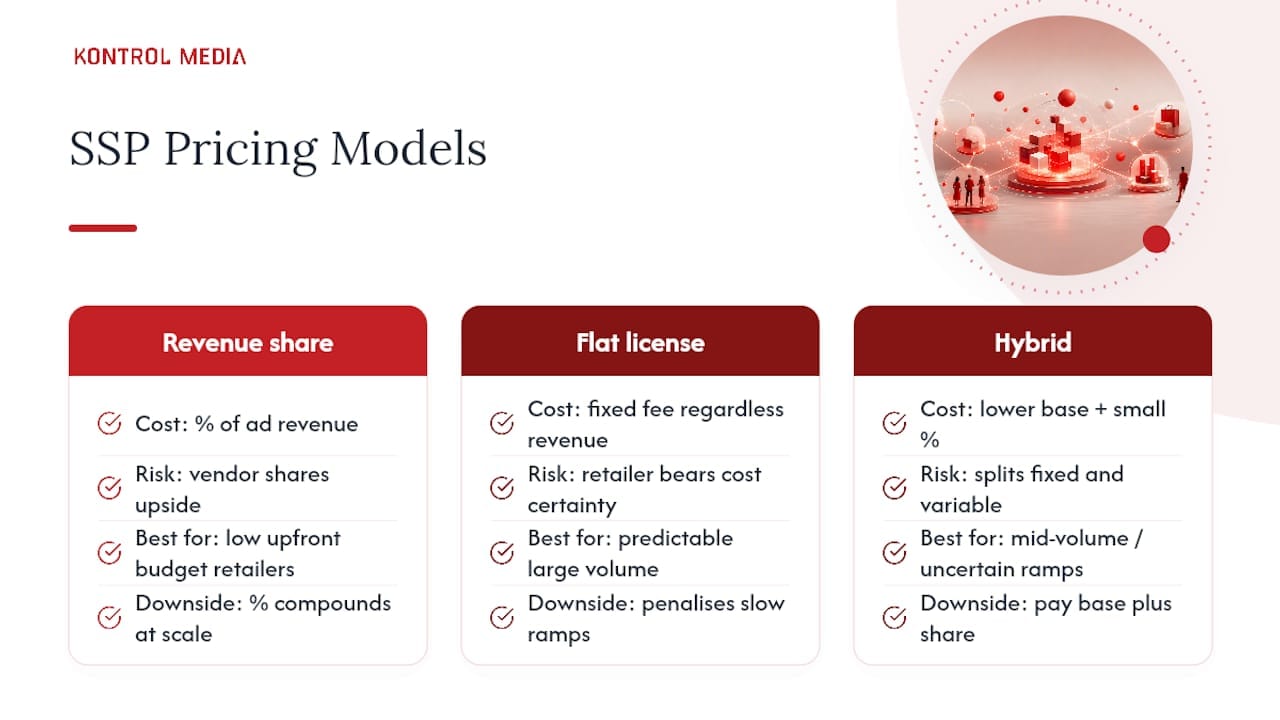
Revenue share is the most common model for retailers without a large upfront budget. The vendor takes a percentage of ad revenue generated through the platform, which means your cost scales with success but also means the vendor has a direct incentive to help you grow. The downside is that revenue share percentages compound at scale, and a network doing millions in annual ad revenue can end up paying far more over time than it would under a flat licensing fee.
Flat platform licensing works better for retailers with predictable, large ad volume who want cost certainty. You pay a fixed fee regardless of revenue, which rewards retailers that scale fast but penalizes slower ramps since you’re paying full price during a soft launch period.
Hybrid models combine a lower base platform fee with a smaller revenue share, splitting the risk between fixed and variable cost. This tends to suit retailers in the middle: enough volume to justify a base fee, not enough certainty yet to commit to pure flat licensing.
Whichever model you’re evaluating, ask about auction infrastructure costs separately. Some vendors bundle decisioning and reporting into one number; others charge extra for advanced reporting tiers or API call volume above a threshold. Our key metrics guide covers which reporting metrics are worth paying extra for and which ones you can build in house.
How Do SSPs Handle Data Privacy and Compliance?
Retail media runs on first-party data, which is exactly why privacy architecture deserves scrutiny before you sign a contract, not after a regulator asks questions.
The core question is where shopper data actually lives and who can query it. A properly built SSP should support data clean room integrations that let advertisers measure campaign performance without your raw shopper data ever leaving your environment. That distinction, aggregated insight versus raw data access, is what keeps a retail media program compliant as privacy rules tighten across states and as third-party cookie deprecation pushes more advertisers toward first-party matching.
Ask vendors directly how they handle data retention windows, whether shopper-level data is ever shared with DSPs during the bidding process, and what happens to that data if you terminate the contract. Some platforms retain aggregated performance data indefinitely for benchmarking purposes even after a client leaves, which is worth flagging in your contract negotiation.
Consent management matters just as much on the technical side. Your SSP needs to respect opt-out signals consistently across onsite, offsite, and in-store touchpoints, since a shopper who opts out on your website shouldn’t still see personalized ads on your in-store screens through the same platform. For a deeper look at how to activate shopper data without crossing privacy lines, our audience data activation playbook walks through the practical guardrails.
What Do Successful SSP Implementations Look Like?
The clearest pattern across successful retail media launches is sequencing: platforms that got the auction infrastructure right before scaling advertiser acquisition outperformed those that sold ad space before their decisioning layer was stress tested.
Retailers that treated their SSP selection as a technical decision first and a commercial decision second tended to avoid the most expensive mistake in this category: discovering under real auction load that the platform can’t handle peak traffic, then having to migrate mid-flight. Migrating a decisioning engine after launch is genuinely difficult and disruptive to live campaigns, since every advertiser contract, targeting rule, and reporting integration has to move at once.
Networks that layered in-store and connected TV formats onto an existing onsite program, rather than launching all channels simultaneously, generally reached advertiser revenue faster. Starting with one high-confidence format lets your team validate the auction layer’s reliability with real dollars at stake before adding the operational complexity of proof-of-play verification for in-store screens or CTV frequency capping.
The retailers that struggled most were the ones that chose a platform primarily on price, then discovered mid-implementation that the vendor’s API documentation didn’t match reality. If you’re weighing options right now, our comparison of retail media strategy approaches for non-retailers is useful even if you are a traditional retailer, since it isolates which capabilities matter regardless of who’s operating the network.
Author Perspective: Market Direction and Practical Warning
Integrated operating systems are winning because fragmented stacks create too many failure points. The one risk I’d flag: weak auction infrastructure. Fix that before anything else, or you’ll rebuild it later under pressure.
— Mark Kapczynski
Ready to Launch or Fix Your Retail Media Network?
If you’ve read this far, you’re probably past the “what is retail media” stage and into “how do we actually make this work.” Kontrol Media handles the parts most internal teams don’t have bandwidth for: platform selection and vendor negotiation, standing up and operating the network day to day, and building the advertiser pipeline that turns a live platform into actual revenue.
Unlike hiring a specialist for each function separately, Kontrol Media runs platform selection, network operations, and advertiser acquisition as one connected engagement, which matters because those three functions constantly inform each other. A first conversation typically covers where your network stands today (built, half built, or not started), what your engineering capacity actually looks like, and what a realistic revenue timeline looks like given your catalog size and advertiser base. From there we scope whether you need full network operation or targeted help on one piece. If you’re ready to move past the audit stage, see how Kontrol Media stands up and operates retail media networks and get a straight answer on what your timeline looks like.
Sources
- Ad tech infrastructure: building the engine behind retail media
- Who are the ad tech platforms powering the retail media ecosystem?
Recommended
- Retail Media Ad Servers Compared: 2026 Buyer’s Guide | Kontrol Media Consultancy
- The Shift in Advertising Spend – How Retail Media Networks Are Changing the Game | Kontrol Media Consultancy
- Commerce Media vs. Traditional Programmatic Advertising | Kontrol Media Consultancy
- Commerce Media Networks: The Next Evolution in eCommerce Advertising | Kontrol Media Consultancy