


Advertising inventory is the total pool of ad space and time a publisher makes available for sale across digital and traditional media properties. Think of it as the shelf space of the media world: publishers stock it, advertisers buy it, and the transaction between the two drives the entire ecosystem of content monetization. At its core, ad inventory encompasses every sellable placement, from a homepage banner on a major news site to a short video ad slot on a streaming platform, and its value flows in two directions simultaneously. Publishers depend on it for revenue. Advertisers depend on it to reach the right people at the right moment.
A few terms anchor every conversation about this topic:
- Premium inventory: High-visibility placements sold directly to advertisers at negotiated rates, typically above the fold or in high-traffic editorial contexts.
- Remnant inventory: Unsold space that flows into programmatic channels, exchanges, and header bidding auctions at discounted rates to recover yield.
- Impressions: The standard unit of measurement, representing one instance of an ad being served to a user.
- Fill rate: The percentage of ad requests that result in a paid impression, a direct indicator of how well a publisher is monetizing available capacity.
- eCPM (effective cost per mille): The blended revenue earned per 1,000 impressions across all demand sources, used to compare yield across channels.
Together, these metrics form the operational language of inventory management in ads, and understanding them is the prerequisite for everything that follows.
How advertising inventory evolved from print to programmatic
The concept of selling ad space predates the internet by well over a century. Newspapers sold column inches to local merchants in the 1800s, and broadcast radio introduced time-based inventory, selling 30-second and 60-second slots to national brands. Television formalized this further, creating daypart pricing, where a prime-time slot commanded a premium over a late-night one. The logic was simple: more eyeballs, higher price.
The internet changed the unit of measurement but not the underlying principle. Early digital publishers in the mid-1990s sold banner placements directly, much like a newspaper sold a print ad of defined size. The problem was scale. As the web grew, publishers accumulated far more inventory than their direct sales teams could move, and unsold impressions became a persistent drain on potential revenue.
Key milestones in the evolution of ad inventory:
- Late 1990s: Ad networks emerge to aggregate unsold inventory across publishers and sell it in bulk to advertisers, creating the first programmatic-adjacent model.
- Early 2000s: Search advertising, led by pay-per-click models, introduces auction-based pricing to digital ad space for the first time.
- 2007–2009: Real-time bidding (RTB) enters the market, allowing individual impressions to be auctioned in milliseconds as a page loads, fundamentally transforming how remnant inventory is priced and sold.
- 2009–2012: Private marketplaces (PMPs) develop as a middle ground, giving premium publishers the control of direct deals with the efficiency of programmatic pipes.
- 2012–2015: Mobile inventory surges as smartphone adoption accelerates, creating entirely new placement formats and audience targeting signals.
- 2015–2017: Header bidding arrives and disrupts the traditional waterfall model, allowing multiple demand partners to bid on the same impression simultaneously rather than sequentially.
- 2018–present: Native advertising, connected TV (CTV), and in-app video formats expand the definition of inventory well beyond the display banner, while first-party data becomes the primary currency for targeting as third-party cookies face deprecation.
Each of these shifts did not just add a new channel. They restructured the power dynamics between publishers, advertisers, and the technology platforms sitting between them.
What types of advertising inventory are available to buyers and sellers?
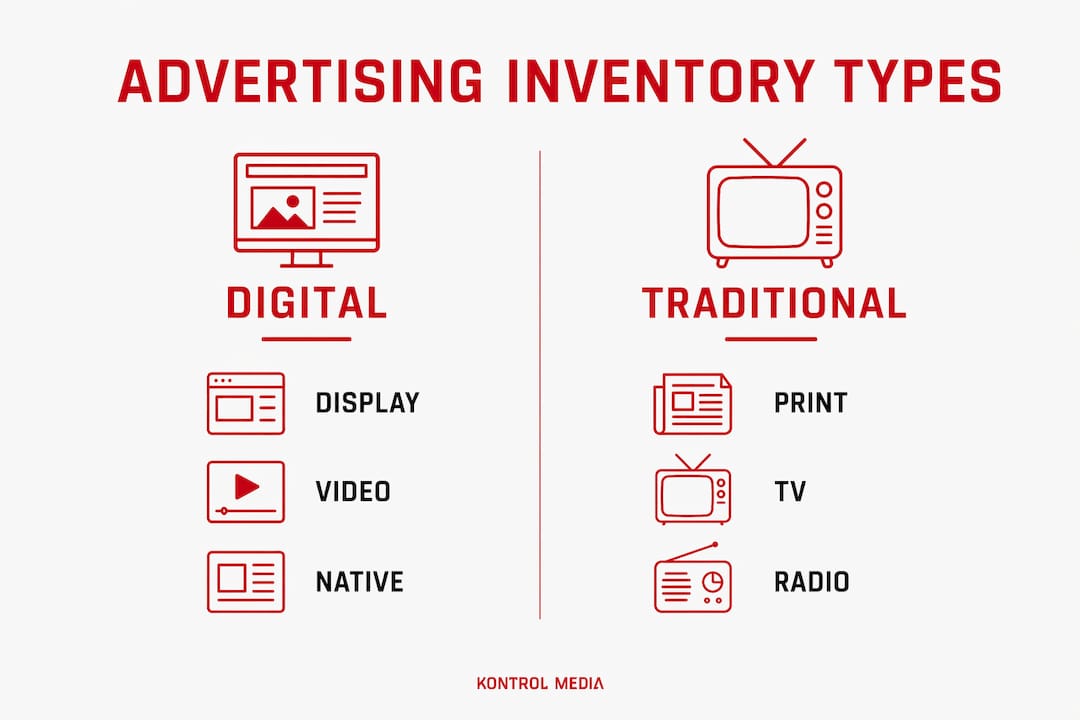
Not all ad space is created equal, and the distinctions between inventory types have real consequences for campaign performance and publisher revenue strategy.
Premium vs. remnant inventory is the most fundamental split. Premium placements carry guaranteed delivery, high-visibility positioning, and direct pricing negotiated between publisher and advertiser. Remnant inventory, by contrast, is what remains after direct sales are exhausted. It sells programmatically, often at a fraction of the premium rate, though header bidding has significantly narrowed that gap by introducing genuine competition for each impression.
By format, inventory breaks into several distinct categories:
- Display banners: The original digital format, ranging from leaderboards (728×90) to medium rectangles (300×250), still widely used for brand awareness and retargeting.
- Video inventory: Pre-roll, mid-roll, and out-stream placements, commanding the highest CPMs in digital media due to engagement rates and production value.
- Native ads: Placements that match the look and feel of surrounding editorial content, reducing ad fatigue and improving click-through rates.
- Mobile app inventory: In-app placements including interstitials, rewarded video, and banner units within mobile applications, a category that has grown substantially as mobile usage has overtaken desktop.
- Connected TV (CTV) and streaming: Non-skippable video inventory served within streaming apps on smart TVs and devices, currently one of the fastest-growing and highest-CPM categories in North America.
By sales method, inventory falls into three programmatic categories:
- Open exchange: Any buyer can bid on any impression in real time. High volume, lower CPMs, and less control over brand adjacency.
- Private marketplace (PMP): Invitation-only auctions where a publisher offers preferred access to specific buyers at negotiated floor prices.
- Programmatic direct: Guaranteed delivery at a fixed price, combining the efficiency of programmatic pipes with the certainty of a direct deal.
By media channel, the universe extends beyond digital. Television inventory, whether linear or streaming, is sold in upfront and scatter markets. Radio inventory follows daypart logic similar to early broadcast TV. Print inventory, while declining in volume, still carries value for certain audience segments and geographic markets. Each channel has its own pricing conventions, measurement standards, and buyer relationships.
Why inventory management determines publisher revenue and advertiser results
Effective management of ad space is the difference between a publisher that captures full market value and one that leaves revenue on the table every single day. The core challenge is balancing supply and demand in real time, across multiple channels, with constantly shifting audience patterns.

Fill rate and eCPM are key metrics that reveal the health of any inventory portfolio. Analyzing fill rates alongside eCPM uncovers monetization gaps that aggregate reporting tends to hide. A publisher might see a healthy network-wide fill rate while a specific ad unit on mobile devices in a particular geography sits chronically underfilled, dragging down total yield without triggering any obvious alarm.
User experience sits at the center of every inventory decision, and the tension is real. Oversaturating pages with ads to chase short-term revenue damages site performance and user engagement, which erodes the long-term value of the inventory itself. Advertisers pay premiums for engaged audiences. A publisher who burns through user attention with excessive ad density can quietly devalue their own asset.
Well-managed inventory also attracts better demand. Many premium advertisers running brand campaigns have strict brand safety and viewability requirements. Publishers who maintain clean, well-structured ad environments with verified traffic and strong viewability scores qualify for higher-tier demand that open-exchange buyers simply cannot access. That access compounds over time, as direct relationships and preferred deals generate more predictable revenue than auction-based channels alone.
Best practices for managing and getting more from your ad inventory
The publishers and media networks that consistently outperform their peers share a few operational habits that are worth examining closely.
Structure inventory to mirror content. Inventory structure should align with content organization to avoid targeting inefficiencies. When ad units are mapped to content categories, sections, and audience segments from the start, automated monetization strategies can operate with the granularity they need. Retrofitting structure onto an existing inventory setup is far harder than building it correctly the first time.
Use all available sales channels in parallel. Publishers maximize revenue by running direct deals, programmatic auctions, and private marketplaces simultaneously, using first-party data to sharpen targeting and yield across each channel. No single channel captures all available demand. The goal is a waterfall-free, unified auction where every impression goes to the highest-value buyer regardless of which pipe they came through.
Manage price floors actively. Setting and adjusting price floors continuously is necessary because too low a floor risks fraud and devalues inventory, while too high a floor leads to unfilled impressions. The target is an optimal balance aligned with top buyers’ eCPM. Static floors set once and forgotten are a revenue leak.
Run segmented inventory audits regularly. Segmented health audits by ad unit, device, and country reveal specific issues masked by network-wide averages. A mobile leaderboard underperforming in Canada might need a different floor, a different demand partner, or a format change entirely. Network averages will never surface that insight.
Treat remnant inventory as a revenue channel, not a fallback. Header bidding has transformed remnant inventory into a meaningful revenue source by enabling multiple demand partners to compete simultaneously in real time. Publishers who treat their programmatic stack as a serious revenue channel, rather than a catch-all for leftovers, consistently generate more incremental yield from the same impressions.
Audit inventory structure and ad operations regularly. Ad inventory management is ongoing and must adapt as site content and audience patterns evolve. Static inventory structures fail to capture revenue over time because the content, the audience, and the demand landscape all shift.
Align ad density with audience quality goals. More ad units per page does not automatically mean more revenue. Beyond a certain threshold, additional placements compete with each other, lower viewability scores, and reduce the CPM of every unit on the page. The right density is the one that maximizes total page yield, not total ad count.
Pro Tip: Before adjusting price floors across your entire inventory, run a segmented analysis by device type and geography first. You will almost always find that mobile and desktop audiences in different markets have meaningfully different eCPM ceilings, and a single blended floor is leaving money on the table in your strongest segments while blocking legitimate demand in weaker ones. Good marketing analytics practices make this kind of segmentation routine rather than reactive.
What industry experts say about getting inventory optimization right
The practitioners who have spent years inside publisher ad operations tend to converge on a few hard-won truths that do not always make it into the standard playbook.
Chasing short-term revenue by packing more ads onto a page is one of the most common and costly mistakes publishers make. The inventory looks fuller on paper, but the audience experience degrades, engagement drops, and within a few quarters you have less valuable inventory than you started with. The publishers who win long-term treat user experience as a revenue variable, not a constraint on revenue.
That tension between short-term yield and long-term inventory value is where most publishers struggle. The math on ad density feels obvious in the moment: more units, more revenue. But the downstream effects on session depth, return visits, and advertiser quality scores tell a different story over a 12-month horizon.
On the programmatic side, the evolution of header bidding has significantly changed what is possible with inventory that used to be considered low-value. Advanced programmatic technologies turn remnant inventory from leftover space into a significant incremental revenue source by enabling competitive demand. Publishers who have fully embraced unified auctions and wrapper-based header bidding consistently report that their “remnant” tier now performs closer to what their direct sales used to generate.
Machine learning forecasting tools have also shifted how sophisticated publishers approach demand planning. Rather than relying on historical averages to predict future fill rates, these tools ingest signals from audience behavior, seasonal demand patterns, and real-time bid density to generate forward-looking inventory projections. That capability matters most during high-demand periods like Q4, when the gap between a well-forecasted publisher and a reactive one can be substantial.
Inventory management requires continuous auditing and adaptation as site traffic and content evolve. Publishers who audit quarterly at minimum, and who segment those audits by ad unit, device, and geography, consistently find demand gaps and technical issues that aggregate reporting never surfaces.
Pro Tip: When setting price floors, anchor them to the eCPM of top demand partners in each segment, not to your overall average. Your average eCPM includes low-quality demand that should not be setting the floor for your best inventory. Aligning floors to top-buyer behavior protects yield without blocking the competitive demand that makes your auction healthy.
Legal and privacy considerations that shape how inventory can be used
Privacy regulation has fundamentally changed the rules of the road for ad inventory, and the pace of change is not slowing down. Publishers and advertisers operating in North America need to understand both the current regulatory environment and the technical shifts it has triggered.
The California Consumer Privacy Act (CCPA) and its amendment, the California Privacy Rights Act (CPRA), give California residents the right to opt out of the sale of their personal data, which includes behavioral data used for ad targeting. For publishers with significant California audiences, this means consent management platforms (CMPs) are not optional. They are a legal requirement, and how they are implemented directly affects the quality and volume of targetable inventory.
At the federal level, the United States does not yet have a single comprehensive privacy law equivalent to the European Union’s General Data Protection Regulation (GDPR), but sector-specific laws like the Children’s Online Privacy Protection Act (COPPA) impose strict limits on inventory targeting for audiences under 13. Publishers running content that attracts younger audiences face significant restrictions on what data they can collect and how that data can be used to monetize placements.
The deprecation of third-party cookies in major browsers has accelerated the shift toward first-party data as the primary targeting signal for premium inventory. Publishers who have built direct audience relationships, email lists, registration walls, and loyalty programs are better positioned to offer targetable inventory as cookie-based signals disappear. Those who have not face a real compression in the addressable portion of their inventory.
Brand safety standards, enforced through tools like the Global Alliance for Responsible Media (GARM) framework and the Interactive Advertising Bureau (IAB) content taxonomy, also shape which inventory qualifies for premium demand. Advertisers running brand campaigns use these standards to exclude content categories that conflict with their brand positioning. Publishers who do not classify their content accurately risk being excluded from demand they would otherwise qualify for.
How market trends and consumer behavior are reshaping inventory value
The value of any given ad placement is not fixed. It moves with audience behavior, platform dynamics, and broader market forces, and the current environment is shifting faster than most planning cycles can accommodate.
Connected TV inventory has emerged as one of the most contested categories in North American media buying. As linear TV viewership continues to decline among younger demographics, advertisers are following audiences into streaming environments. CTV inventory commands premium CPMs because it combines the lean-back engagement of television with the targeting precision of digital. Publishers and media networks that have established CTV inventory are seeing demand that outpaces supply in many categories.
Retail media networks represent another structural shift in how inventory is valued. When a retailer sells ad space on its own properties, that inventory carries purchase-intent signals that general publishers cannot match. A shopper actively browsing a product category is a fundamentally different audience than a general news reader, and advertisers pay accordingly. Kontrol Media works directly with brands building and operating retail media networks, and the demand for this type of inventory has grown sharply as brands recognize the proximity to purchase that retail environments provide.
Consumer attention is also fragmenting across more surfaces simultaneously. The average North American consumer now moves between mobile apps, desktop browsers, streaming platforms, and social feeds within a single session. That fragmentation creates both a challenge and an opportunity for inventory strategy. Publishers who can offer cross-surface audience packages, reaching the same user across multiple placements and devices, command higher CPMs than those selling isolated placements. The ability to unify audience data across surfaces is increasingly what separates premium inventory from commodity inventory.
Seasonality continues to drive dramatic swings in inventory demand and pricing. The fourth calendar quarter often represents a high-demand period in North American advertising, with CPMs in many categories rising compared to earlier periods as retail advertisers compete for holiday shoppers. Publishers who forecast this demand accurately and hold back premium placements for direct deals rather than releasing them to open exchange early capture meaningfully more revenue during the period when their inventory is worth the most.
Kontrol Media helps you build and monetize inventory that actually performs

Knowing how advertising inventory works is one thing. Building a media operation that consistently captures its full value is another challenge entirely. Kontrol Media works with brands, publishers, and media networks at the execution level, not just the strategy level, helping clients structure inventory, attract premium demand, and build the direct advertiser relationships that reduce dependence on open-exchange pricing.
Whether you are standing up a new retail or commerce media network, looking to reach home buyers through the real estate channel, or trying to get more from an existing media property, Kontrol Media brings the operational depth to move from planning to revenue. Clients like Experian, BuzzFeed, HuffPost, RE/MAX, and Enthusiast Gaming have worked with Kontrol Media precisely because the work does not stop at the deck.
If your inventory is underperforming or you are building something new and want to get the structure right from the start, connect with Kontrol Media to talk through what is possible.
Key Takeaways
Advertising inventory is only as valuable as the systems, structures, and demand relationships a publisher builds around it, and getting those fundamentals right determines long-term revenue far more than any single campaign or placement decision.
| Point | Details |
|---|---|
| Fill rate reveals monetization gaps | Analyze fill rate alongside eCPM by ad unit, device, and geography to find hidden revenue leaks. |
| Price floors need active management | Floors set too low invite fraud; floors set too high leave impressions unfilled. Align them to top buyers’ eCPM per segment. |
| Header bidding elevates remnant value | Enabling multiple demand partners to compete simultaneously turns low-priority inventory into a meaningful revenue source. |
| Ad density has a ceiling | Packing more ads onto a page beyond the optimal threshold lowers viewability scores and reduces CPM across all units. |
| Privacy compliance shapes inventory quality | CCPA, COPPA, and cookie deprecation directly affect how much of your inventory is targetable and at what price. |
Recommended
- Advertiser Acquisition Strategies for Media Networks in 2026 | Kontrol Media Consultancy
- Retail Media Ad Sales: Strategic Guide for Marketing Pros in 2026 | Kontrol Media Consultancy
- Advertising Sales Strategies for Media Networks in 2026 | Kontrol Media Consultancy
- Advertising on Huffpost.com: A Brand Safety Guide | Kontrol Media Consultancy