
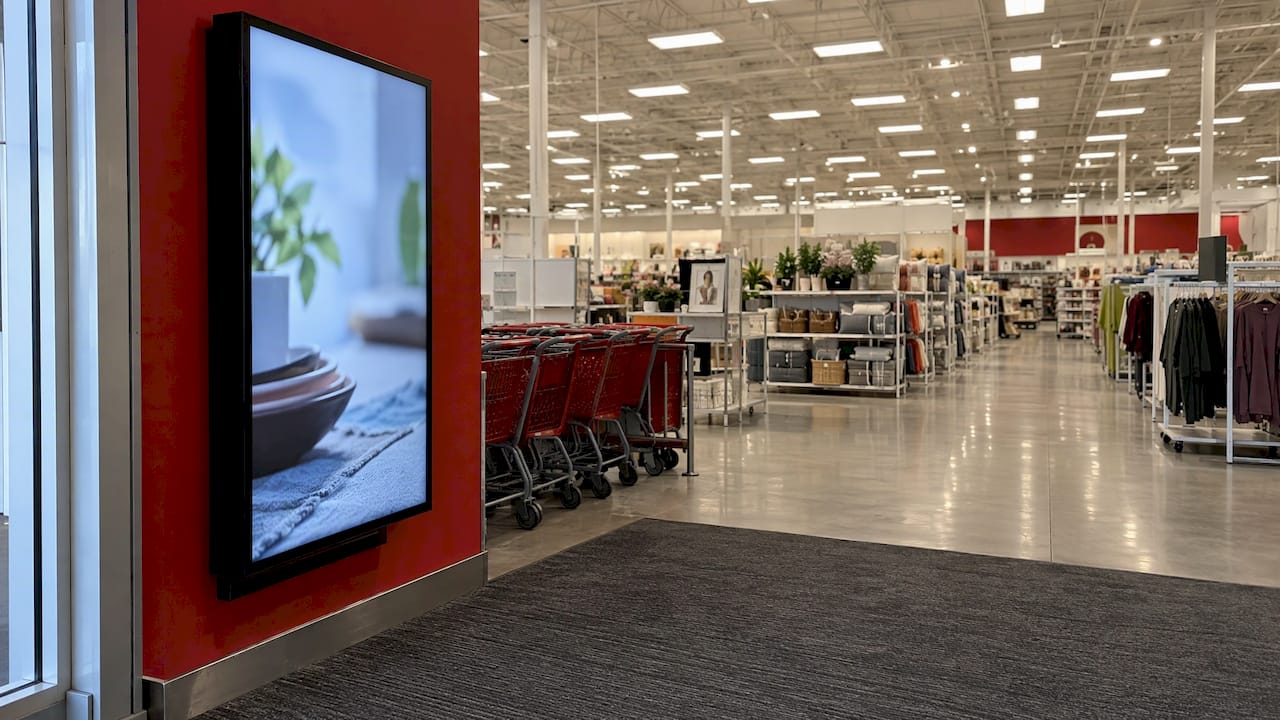

Physical retail works as a media channel when a store’s screens, shelves, carts, receipts and aisles are sold as advertising inventory and measured against real sales data. The idea is simple. The execution is where most programs stall: unclear inventory, thin measurement and nobody inside the organization owning the channel. We build and operate retail and commerce media networks, and this guide covers what the channel is, what it can deliver, how to measure it and how to get started whether you are a retailer, a brand or a company that owns physical footfall.
TL;DR
- In-store retail media is advertising inventory inside a store that uses retailer data for planning, execution and measurement. It is retail media’s physical arm, not a separate discipline.
- The audience is already there. In 2022, eMarketer noted that 212.4 million consumers visited a Walmart store in a single month, against 125.3 million who visited its online properties.
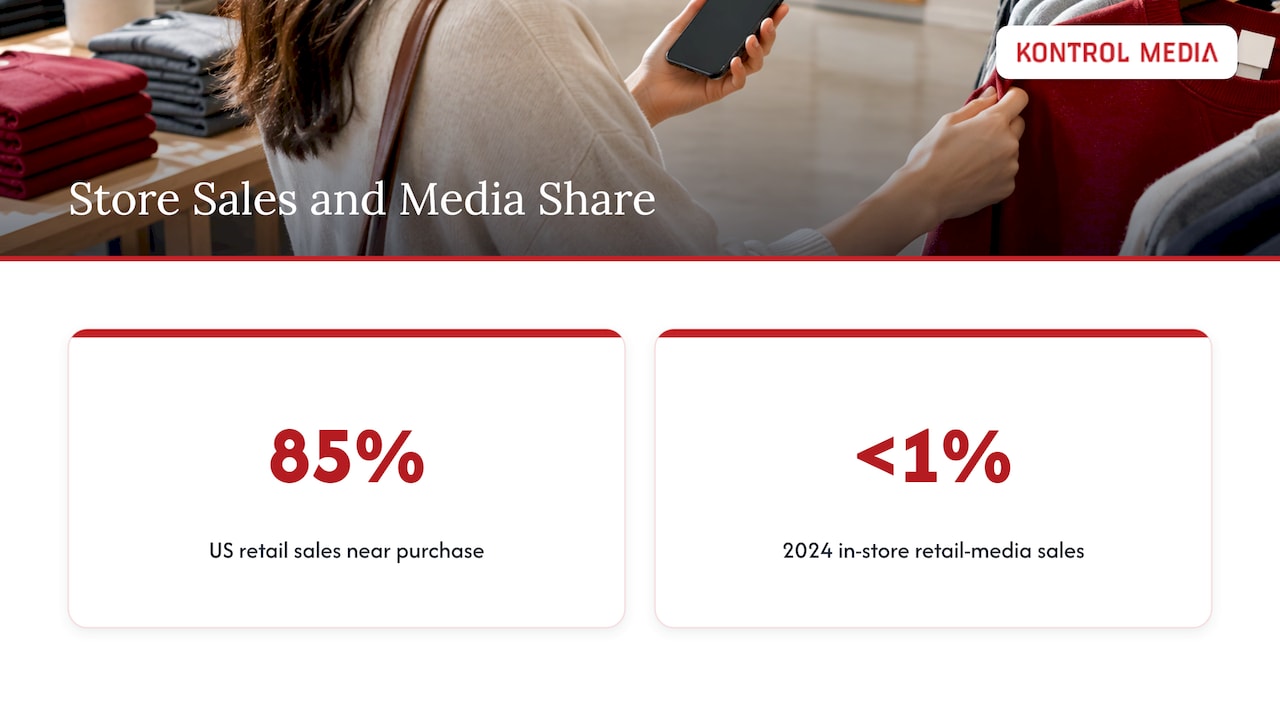
- The channel is still small. eMarketer put it at under 1% of US retail media sales in 2024, which means early movers set the standards.
- Proof is the whole game. Matched-market tests, store-level holdouts and transaction data separate real incremental sales from impressions that merely ran.
- Start with the measurement design and one or two zones of the store, then scale.
Table of Contents
- What it means to treat a store as a media channel
- The five zones and the formats inside them
- Why the store is worth the effort
- What proof looks like: three real programs
- How to measure it without fooling yourself
- The honest operating questions
- Who this is for and how to start
- Where Kontrol Media fits
- Perspective
- FAQ
- Sources
What it means to treat a store as a media channel
For decades the store was where media spending ended: the place a campaign hoped to pay off. In-store retail media flips that. The store itself becomes a place where brands buy attention, and the retailer sells it using the one asset digital publishers envy, which is knowing what people actually bought.
The Interactive Advertising Bureau (IAB), the industry body that sets digital advertising standards, gave this a formal definition in its December 2024 standards document. It describes in-store retail media as advertising inventory that uses retail data for planning, execution and measurement within a store, available to brands in digital formats (video, display, audio) or static ones (print and physical activations).
Two parts of that definition matter. The first is “retail data.” A poster in a lobby is out-of-home advertising. The same poster bought against loyalty-card audiences and measured against sales is retail media. The second is “available to brands.” The channel is built to be sold, which means it needs packaging, pricing, reporting and a sales team, not just screens on walls.
If you are new to the wider category, our overview of retail media sales channels across onsite, offsite and in-store shows where the store sits next to a retailer’s website and app.
The five zones and the formats inside them
The IAB organizes in-store placements into five zones: exterior, entrance and out-of-category, checkout, in-aisles, and an “other and connected store” zone. The same standards cover digital screens, audio, connected shopping, print and static media, and experiential formats. Each zone carries a different job.
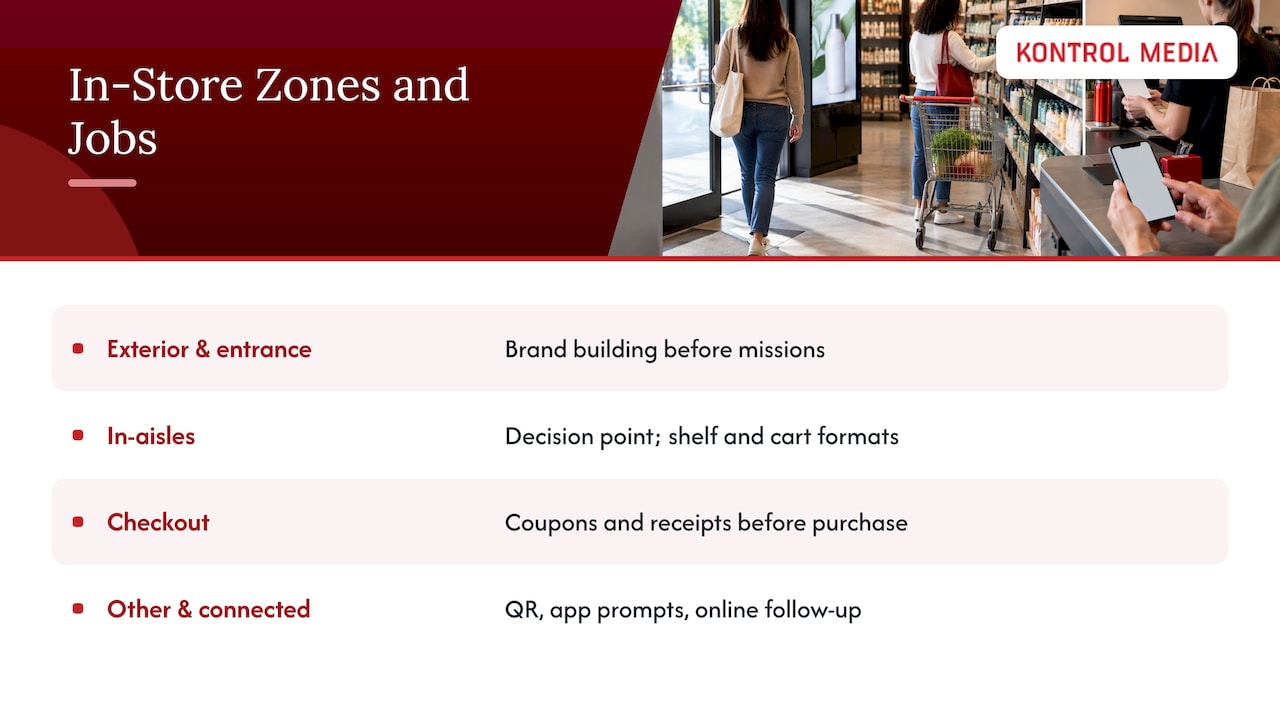
Exterior and entrance. These zones reach shoppers before they have started a mission. They suit brand building, launches and seasonal moments, because the audience is broad and unhurried.
In-aisles. This is where the shopper is deciding. The IAB’s 2024 DOOH and in-store playbook lists the physical formats that live here: at-shelf signs, cart and basket liners, coupon machines, floor signs and checkout lane dividers. It also covers digital displays, interactive and shoppable video, audio, receipt advertising (digital and printed), social, and onsite sponsored search that connects to the store.
Checkout. The last moment before purchase. Short messages, coupons and receipt placements work here because the shopper has time and a basket full of intent.
Connected store. This is the bridge to digital: QR codes, app prompts, and the loop that lets a store impression become an online follow-up. It is also where retailers and brands think hardest about consent and data use. Brands extending a cross-channel plan beyond their own stores can see how marketplace expansion for brands handles the online side of that connected picture.
The practical lesson: do not buy or sell “the store.” Buy or sell a zone, against a mission, with a measurement plan attached.
Why the store is worth the effort
Three arguments carry the case, and they are strongest together.
The sales still happen there. Writing for eMarketer in October 2022, analyst Andrew Lipsman noted that roughly 85% of retail sales occur close to the point of purchase, and that US retail media measured online alone would pass $40 billion that year and reach $61 billion by 2024. The physical store as the next major media channel followed from that gap: online retail media was growing fast while most of the transactions remained in stores.
The store can do brand work, not just performance work. In the same piece, Lipsman argued the larger prize for in-store digital media may be brand advertising: reaching consumers at scale during opportune moments, in brand-safe and contextually relevant environments, in a way he compared to traditional TV, potentially better. That matters for a CMO because it points to national brand budgets, not just trade spend moving from one line to another. In a later conversation with the Path to Purchase Institute, he described the store as a stage for creativity, with viewability and proximity to the point of sale as selling points.
The channel is early. eMarketer’s December 2024 outlook found in-store retail media was less than 1% of all US retail media sales in 2024. The Path to Purchase Institute reported that eMarketer’s forecast had retail media tripling by 2028 to $129.9 billion, with in-store at only $1.1 billion, a figure Lipsman called conservative. The same coverage observed that most brands have no organization, or even a single person, focused on in-store retail media.
That last point is the opening for a growth-minded marketer. When a channel is small and under-owned, the team that builds the playbook first earns terms, inventory and learnings that late arrivals pay more for.
What proof looks like: three real programs
Good in-store results share a pattern: a defined store set, a control group and a sales metric, not an impression count. Three published examples show how it works.
Albertsons screens and Sargento Cheese Bakes. A Path to Purchase Institute case study reports that an in-store screen activation at Albertsons, measured with a Matched Market Incrementality method that pairs test and control stores on nearly 60 variables, delivered a $2.41 incremental return on ad spend (ROAS), a 1.5% lift in conversion rate, more than 5.5 million impressions and a 14% in-store sales lift.
Chobani at Walmart. In a May 2026 case study, The Drum reported that an integrated in-store media strategy lifted yogurt sales 146% and creamer 96%. A pop-up recorded 10,023 visits, about 442 a day, and a geo-targeted display campaign returned $12.72 ROAS, with 44% of purchasers new to Chobani. Deli screens across 1,000 stores, compared against matched control locations, returned over $1 in incremental ROI.
Notice what these have in common. None of them leads with impressions. They lead with sales lift against a control, and they say how the control was built. That is the standard a buyer should expect and a seller should be ready to meet.
How to measure it without fooling yourself
The IAB playbook lists the metrics that matter: foot traffic, sales uplift, consumer uplift, new-to-brand and new-to-category buyers, and conversion rates, compared against previous periods or against stores with no activity. It adds engagement and dwell time, and digital interaction rates where a connected format is used.
The discipline is separating what the media caused from what would have happened anyway. Albertsons has described its approach: store-level holdout groups plus low-energy RFID beacons on carts and baskets to understand anonymous movement and exposure. According to The Drum’s reporting, it was live in 80 stores with plans to expand to roughly 800 more locations that year. Its leadership also framed retail media as collective growth rather than a tollbooth, because the retailer and the advertiser want to sell the same product, and said measurement is moving beyond ROAS toward new-to-category growth and predicted lifetime value.
For a CMO planning a test, five rules hold up:
- Decide the question first. Are you after sales lift, new buyers or trial? The metric follows.
- Build the control before launch. Matched stores or holdout stores must be chosen before the campaign runs, not after you see results.
- Run long enough to read. Short bursts produce noise. Plan a window that covers several purchase cycles for your category.
- Report outcomes, not plays. Screen loops that ran tell you the media happened. Sales against control tell you it worked. Our guide to tracking outcomes versus ad impressions goes deeper on this.
- Connect to digital. Store exposure becomes more valuable when it feeds the same measurement as your online campaigns. Our guide to incrementality and our list of key retail media metrics cover the definitions.
Our own view on sequencing is laid out in Measure First to Scale In Store Retail Media.
The honest operating questions
Every in-store program runs into the same practical questions, and a plan that answers them early moves faster.
Data and consent. eMarketer’s outlook found that 76% of consumers are uncomfortable with AI tools using their personal information to improve shopping experiences. That is a design constraint for any connected-store feature: use first-party data clearly, minimize what you collect and be transparent. Our guide to privacy-first retailer data partnerships explains how brands and retailers can structure this well.
Awareness of formats. The same outlook found that 27.7% of US adults had encountered ads on smart shopping cart screens, the lowest of the in-store formats surveyed. Format familiarity is still building, so creative should be simple and the offer obvious.
Infrastructure. Digital screens need installation, content management and maintenance. Static and physical formats start faster and cost less to deploy, which makes them a sensible first layer while a screen network is planned.
Packaging and selling. Inventory has to be defined, priced and sold to brands that may never have bought in-store media. Our piece on advertising inventory and the one on advertiser acquisition for media networks cover that.
Who this is for and how to start
If you are a retailer or a property owner with footfall, you hold the inventory and, ideally, the data. The first decisions are which zones to open, which first-party data you can use responsibly and how you will report results to advertisers. Whether to build the stack or buy it is the next question, and our build versus buy verdict sets out the trade-offs.
If you are a brand, start with one retailer, one zone and one measurable question. Pair the in-store activation with an online component so you can see the connected effect. If you are not a retailer but own an audience or a place, our guide to retail media strategy for non-retailers shows how the model carries over.
If you want to reach home buyers and homeowners, the physical world is not only the aisle. Real estate agents sit at the moment a household is moving and buying for a new home. Our walkthrough of advertising to home buyers through real estate agents explains how brands can build revenue-generating partnerships there.
Where Kontrol Media fits
We help retailers and consumer businesses stand up a retail or commerce media network, and our team also runs retail media network operations for the revenue and sales side once the network is live. For brands and agencies that want to reach home buyers and homeowners, we build marketing partnerships through real estate agents. Our clients have included Experian, BuzzFeed, HuffPost, REMAX, Enthusiast Gaming and West Monroe.
If a store, a portfolio of locations or a physical audience is sitting underused in your growth plan, talk to us about strategy and execution.
Perspective
We keep returning to one idea when people ask us about physical retail as a media channel: the store is not a billboard, it is a relationship that already exists. Shoppers walk in with a list, a budget and a reason. The best in-store media respects that and helps them, and it only becomes a business when a brand can see what it did.
The mistake we see most often is starting with hardware. A team buys screens, then goes looking for advertisers and a story to tell them. We would rather start from the other end: what will an advertiser need to believe, and what evidence will convince them? Once you answer that, the zones, formats and data follow.
That is also why we pair strategy with execution. A network needs a sales motion, a measurement design and operators who will do the unglamorous work of reporting week after week. In a channel this young, being the team that proves outcomes is a bigger advantage than having the most inventory.
And we think the physical world is bigger than the aisle. Agents, homes and moments of change are media too, and brands that treat them with the same discipline will find them very productive.
Mark Kapczynski
FAQ
What is in-store retail media?
It is advertising inventory inside a physical store that uses retailer data for planning, execution and measurement. It can be digital, such as screens and audio, or static, such as shelf signs and cart liners. The IAB’s 2024 standards group placements into five store zones.
How is it different from ordinary out-of-home advertising?
Out-of-home buys a location and an estimated audience. In-store retail media ties placements to retailer data, so audiences can be selected from shopper behavior and results can be measured against sales. That link to transactions is what makes it a retail media channel.
How big is in-store retail media today?
It is still small but growing. eMarketer put it at under 1% of US retail media sales in 2024, and its forecast, reported by the Path to Purchase Institute, had in-store reaching about $1.1 billion by 2028 within a total retail media market of $129.9 billion.
How do you prove in-store ads work?
Compare exposed stores or shoppers with a control group chosen before the campaign, and measure sales lift or incremental ROAS. Published examples use matched test and control stores or store-level holdouts, with retailer transaction data as the outcome.
Sources
- IAB In-Store Retail Media Standards, December 2024
- IAB DOOH and In-Store Retail Media Playbook, 2024
- eMarketer: Why physical stores are the next major media channel
- eMarketer: Retail media 2025 insights on innovation, growth and standardization
- Path to Purchase Institute: The Store Is Now a Stage
- Path to Purchase Institute: Mondelez case study on in-store activation
- The Drum: Albertsons on proving what happens in store
- The Drum: How Chobani transformed Walmart aisles into an integrated media channel