

College students are one of the most valuable audiences a consumer brand can win and one of the hardest to reach. They resist traditional ads, they guard their campus communities, and the places where they gather are controlled by institutions with their own approval rules. The brands that get through stop treating campus as a media buy. They plan it as a retail and partnership program, with a clear path from a first sample to a repeat purchase. That is how we approach it at Kontrol Media, and it is the lens for everything below.
TL;DR
- Students are skeptical of display and social ads, so attention has to be earned through peers, community and relevance.
- Campus access is gated: schools typically require written approval, advance notice and a sponsoring campus organization.
- On-campus and off-campus students live different days, so one plan rarely covers both.
- Activations that end at a sample are a cost. Tie them to a place where students can buy, and you can measure sales.
- Plan the full path from awareness to trial to purchase before the first booth goes up.
Table of Contents
- Why college students are hard for CPG brands to reach
- The five challenges CPG teams run into most
- What the brands that win do differently
- On-campus and off-campus: one program, two playbooks
- Measuring a student campaign without fooling yourself
- Where Kontrol Media fits
- A practical sequence for your first campus program
- Promo: build the campus program with us
- Perspective
- FAQ
- Sources
Why college students are hard for CPG brands to reach
The challenge is not that students are unreachable. It is that the usual playbook was built for someone else. A study by AMP Agency with ARAMARK Higher Education, which surveyed more than 2,500 students aged 18 to 24 and ran discussion groups on seven campuses, concluded that students are increasingly difficult to reach because their brand expectations are high, their needs are evolving and they are protective of their college community. Protective is the word to sit with. A campus is a small society with its own norms, and a brand that arrives like an advertiser is treated like an outsider.
The resistance to paid messaging is well documented. An academic study of 141 respondents aged 18 to 25 found that nearly all of them found Facebook advertising annoying, intrusive and peripheral to their interests. The platform has changed since 2012, but the lesson has held: if the message is not about the student, it is easy to ignore.
Attention is not scarce in a quantitative sense. Campaign US reported in 2023 that 84% of college students spend four to seven hours a day on their phones, and 39% spend more than seven. What is scarce is trust, and the feed is where students are most practiced at filtering. A UNiDAYS survey of restaurant behavior, from 2017, found that only 8% of students learn about new menu items from TV and 4% from display advertising, while the largest share, 41%, learn in the restaurant itself, and friends and social media account for most of the rest. The data is dated and from one category, but the direction fits what we see across consumer categories: discovery happens in context and through people.
The five challenges CPG teams run into most
1. Reach without relevance
Buying impressions against an 18-to-24 audience is easy. Getting a student to care is not. Generic creative reads as an ad, and students scroll past ads at speed. The brands that break through give students something to do, use or share that fits a moment they are already in: move-in week, game day, finals, a late night in the library.
2. Campus access and approvals
This is the challenge that catches new teams off guard. Universities are not open marketplaces. As one example, Virginia Tech requires prior written authorization for sales or solicitation of products, food and beverages on campus, asks for requests at least 10 calendar days before the planned date, and requires that commercial activity be sponsored by a university-affiliated organization. Every school writes its own policy, so treat that one as an illustration, not a template. The practical consequence is that a national sampling tour planned three weeks out will not run on most campuses the way the slide deck says it will.
The fix is structural. Work with a sanctioned channel, such as a student organization, a campus retailer or an approved media program, and build the calendar around approval lead times rather than around your launch date.
3. Two audiences hiding in one demographic
Students who live in residence halls and students who live off campus or commute are not the same target. The National Multifamily Housing Council’s student housing research, using federal enrollment data from 2015-16, found that 60% of students live off campus and not with parents, and that the share is higher for graduate students. The figure comes from a particular school year, but the point stands: a large part of your audience never walks past a dorm lobby table.
Resident students can be reached through the campus environment: events, student-run channels, the campus store, dining. Off-campus students are reached in the surrounding neighborhood, in grocery and convenience stores, on transit and, above all, on their phones. A plan that funds only the first group leaves most of the demographic untouched, and a plan that funds only the second gives up the one environment where you can show up in person with permission.
4. Peer influence you cannot buy directly
Students weigh what friends think more than what brands say. UNiDAYS research on Gen Z reached the same conclusion: efforts are best spent on community-based platforms that build brand affinity, since peers and family play a big part in decisions. That is why ambassador programs are popular. Digiday’s research found that 16 of 21 startup CPG brands in its sample have ambassador programs for athletes or college students, including 45% of beverage startups with college ambassador programs. The challenge is operational: recruiting, briefing, supplying and measuring a dozen student ambassadors across a dozen campuses is a part-time business of its own.
5. Proving it sold something
A sampling event produces photos and social tags. A CMO needs to know whether it produced buyers. Without a path from the activation to a place and moment of purchase, results stay at the level of reach and engagement, which is hard to defend at budget time.
What the brands that win do differently
The Drum noted in December 2024 that roughly 3.4 million new students step onto US campuses each year, and that brands such as Celsius, Urban Outfitters and Bubble won back-to-school by showing up at tailgates, study sessions and game day celebrations. The common thread is presence in a moment, not interruption of one.
Digiday adds the long view: Gen Z will make up 30% of the workforce by 2030, which is why brands invest in loyalty and awareness before students graduate. A student who picks your product in a dorm room in year one is forming a habit you may keep for a decade, and that habit is worth planning for beyond a single semester.
Four practices follow from the evidence.
Lead with the moment, not the message. Pick two or three campus moments that make sense for the product: move-in, game day, midterms, finals. Build a single idea around each one.
Use people students already trust. Student creators, ambassadors and organizations carry credibility that a brand account does not. Give them a reason to talk, such as product that fits their routine, rather than a script.
Respect the calendar. Build approval lead times and sponsoring organizations into the plan from day one. If a school needs weeks of notice, an on-campus event is a quarter-long project, not a week-long one.
Close the loop at retail. Every awareness moment should point to a shelf, a cart or a campus store where the student can buy the same week. This is where a program stops being a marketing expense and starts producing numbers you can read.
On-campus and off-campus: one program, two playbooks
A useful way to organize the work is to split it by where the student is when they decide.
| On-campus students | Off-campus and commuter students | |
|---|---|---|
| Where they are | Residence halls, dining, campus stores, events | Apartments, nearby grocery and convenience, transit |
| What reaches them | Events, student organizations, campus retail and media programs | Social and creator content, local retail, delivery |
| Main constraint | Campus approvals and sponsorship | Fewer shared touchpoints |
| Best conversion point | Campus store or on-campus retail | Nearby retailer or an online cart |
The split matters for budget. Residential campuses justify heavier investment in events and ambassadors, while commuter schools lean more on digital and off-campus placements. If you are not sure which type of school you are working with, look at its housing capacity versus enrollment before you commit.
Measuring a student campaign without fooling yourself
Good measurement starts before the campaign does. Decide which of three questions you are answering: did students notice us (awareness), did they try us (trial) or did they buy (sales).
There is a useful reference point from outside campus. When Folgers ran a TikTok ecommerce campaign tied to Gopuff in 2023, 72% of buyers who clicked through were under 30, recall rose 3.5% in a brand lift study and sales of Folgers products on Gopuff lifted 12%. The lesson is not the platform. It is that the campaign was built so that attention, a click and a purchase could be connected, which is exactly what a campus program needs.
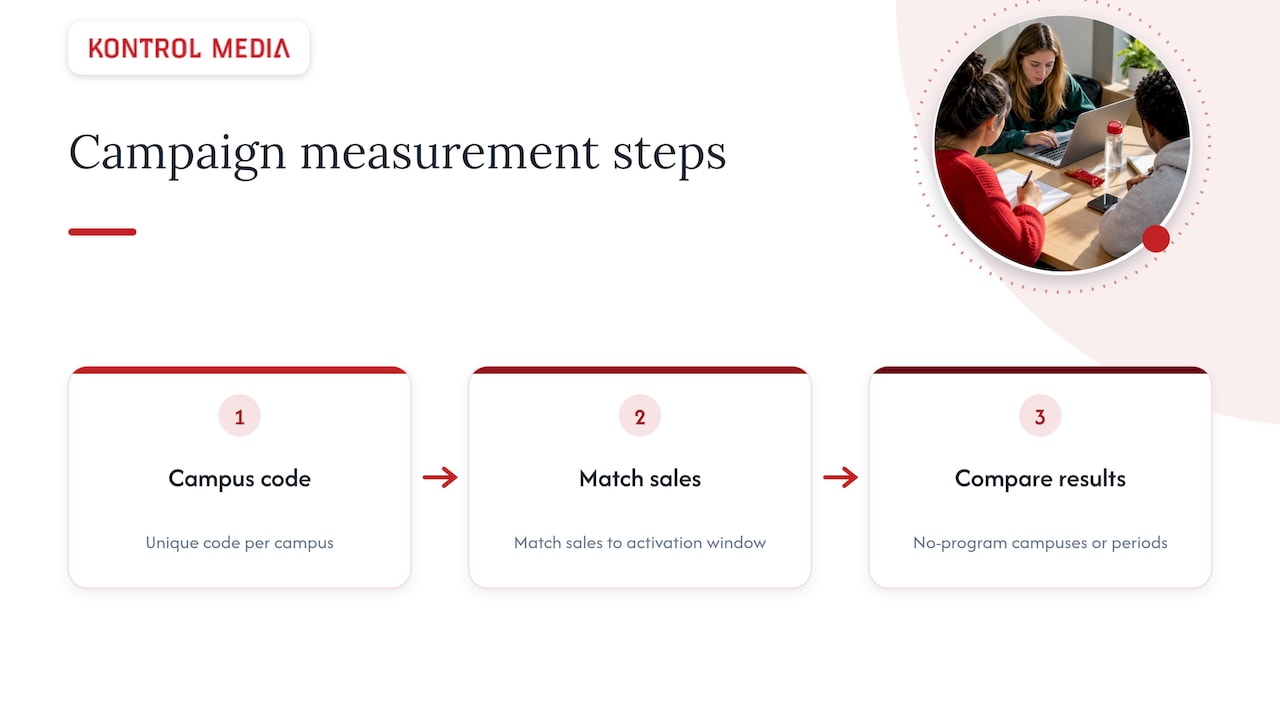
In practice, that means a unique offer or code per campus, a purchase point where sales can be matched to the activation window, and a comparison against campuses or periods without the program. Report all three questions side by side so that one strong number does not hide a weak one.
Where Kontrol Media fits
Our work sits at the intersection of retail media, partnerships and hands-on execution, which is where most CPG campus problems are actually solved. We help brands and their agencies build media and retail media programs that connect marketing to sales, and we have written about how that applies to students in our guides on reaching college students on campus, turning campus activations into store sales and campus advertising. If you are weighing paid placements against a longer relationship, our comparison of media campaigns and strategic partnerships walks through what drives sales.
A beauty or personal care brand has its own set of questions, which we cover in our piece on makeup and skincare brands on campus.
A practical sequence for your first campus program
- Choose the schools by audience type. Sort targets into residential and commuter, then decide which behavior you are trying to change.
- Work back from approval lead times. Ask each school for its solicitation and sponsorship rules before you set dates.
- Pick one purchase point per campus. A campus store, a nearby grocer or an online cart: one place students are pointed to every time.
- Recruit students, then give them a role. Ambassadors and creators need product, a clear brief and room to speak in their own voice.
- Run a pilot, then scale. One semester at a handful of schools teaches you more than a national rollout, and gives you data to take to finance.
Promo: build the campus program with us
If your team wants to reach students through a channel where attention and purchase sit close together, we can design and run it with you. Kontrol Media builds and operates retail and commerce media programs and supports brands with business strategy, marketing and sales execution. You can see how we work on our services page, or learn how we stand up a retail or commerce media network.
For a look at how a campus retail media partnership can work in practice, read our guide to connecting with students where they shop.
Perspective
The mistake I see most often is treating college students as an audience to be bought rather than a community to be joined. A brand hires an agency, buys impressions against 18-to-24 and then wonders why nothing moves. Students are not hard to reach. They are hard to impress.
What works, in our experience, is the unglamorous part: choosing the right partner on campus, planning around how institutions actually approve things and connecting every moment of attention to a place where a student can buy. That is retail media thinking applied to a young audience, and it is where we spend our time. We would rather help a brand run a smaller program that produces numbers than a big one that produces photos.
The optimistic part is that the brands willing to do that work build something that compounds. A student who tries your product at nineteen and finds it easy to buy at twenty is not a campaign result. That student is a customer.
Mark Kapczynski
FAQ
Why are college students hard for CPG brands to reach?
They are heavy mobile users who are practiced at ignoring display and social advertising, and they protect their campus communities from outside brands. Research from AMP Agency and ARAMARK Higher Education points to high expectations of brands and a strong sense of ownership over campus life. The way through is relevance, peers and presence in real moments.
Do I need university approval to sample or sell on campus?
In most cases, yes. Policies differ by school, but many require written authorization, advance notice and sponsorship by a campus organization. Virginia Tech, for example, asks for requests at least 10 calendar days ahead. Check the policy of each school you plan to work with before setting dates.
How do I reach students who live off campus?
Off-campus and commuter students are reached through the places they shop and the channels they use daily: nearby retailers, delivery, creator content and social. A retail media approach that links content to a purchase point works better here than events alone.
How do I measure whether a campus campaign worked?
Decide up front whether you are measuring awareness, trial or sales. Use campus-specific offers, a defined purchase point and a comparison group of schools or weeks without the program. Reporting all three levels together shows where students drop off.
Are student ambassador programs worth it?
They are common among CPG startups. Digiday found that 45% of beverage startups in its sample had set up college ambassador programs. They work best when students get product, a clear brief and a defined role, and when their activity points to somewhere students can buy.
Sources
- College AMPlified: Decoding the Campus Experience
- Targeting college students on Facebook? How to stop wasting your money
- Inside the buying habits and lifestyles of college students
- UNiDAYS Gen Z Insights: What Restaurants Need to Know
- Sales, Solicitation and Advertising on Campus, Virginia Tech
- Student housing research report, National Multifamily Housing Council
- Connect with students and make customers for life
- Digiday+ Research: For startup CPG brands, in-person brand activations bring much-needed exposure
- To Reach Gen Z, Folgers Brews Up TikTok Ecommerce Campaign