


A marketplace media network is an advertising business built on top of a marketplace. Sellers or brands pay for visibility in front of shoppers who are already browsing and buying, and the marketplace uses its own first-party data to place and measure those ads. In industry terms, it is a retail or commerce media network whose inventory happens to live inside a multi-seller environment. If you run a marketplace, or sell into one, this guide explains how the model works, what it can sell, and what it takes to operate well.
TL;DR
- “Marketplace media network” is not a formal category. It describes a marketplace that sells advertising, which makes it a retail or commerce media network by another name.
- The asset that matters is first-party data tied to real transactions, plus a shopper audience with buying intent.
- Revenue typically starts with on-site placements such as sponsored listings and display, then extends off-site and into data and service partnerships.
- Measurement is the product: advertisers return when they can connect ad exposure to purchases and tell attributed sales from incremental ones.
- Start with a few focused placements, one clear advertiser promise, and an operating plan before adding formats.
Table of Contents
- What a marketplace media network actually is
- How it differs from retail media and commerce media
- What a marketplace media network can sell
- Why advertisers pay for it
- Real estate shows the model beyond shopping carts
- How to build one: a sequence that holds up
- Perspective
- Where Kontrol Media fits
- Common mistakes we see
- FAQ
- Sources
What a marketplace media network actually is
The phrase shows up in search because there is no single agreed term. Some people mean a paid media marketplace where publishers sell newsletter or podcast placements. Others mean an ad exchange. The meaning that matters for most growth leaders is the third: a marketplace, retailer, or other commerce business that turns its audience and data into a media channel.
The Interactive Advertising Bureau frames this under commerce media. In its July 2025 explainer, commerce media is what happens when retailers, travel firms, financial institutions, and other companies turn their physical assets, digital properties, first-party data, and proximity to customer journeys into integrated media opportunities. A marketplace fits that description cleanly, because it sits at the exact moment a shopper compares products and decides.
We use the working definition this way: a marketplace media network is the advertising layer of a marketplace. The marketplace is the publisher, the sellers and brands are the advertisers, and the shopper is the audience whose behavior makes the whole thing valuable.
How it differs from retail media and commerce media
These terms nest inside each other, and people mix them up constantly.
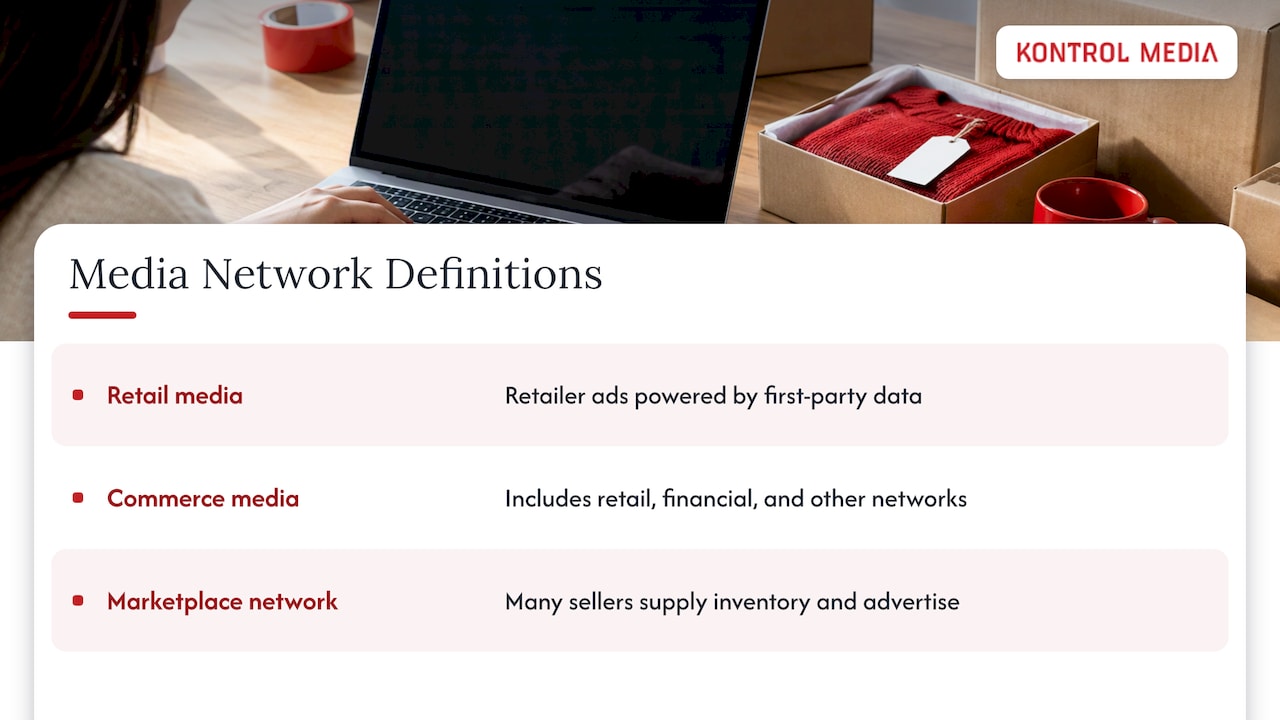
Retail media is the narrowest. eMarketer describes retail media as digital advertising powered by first-party data and run by retailers acting as media channels. Sponsored products on a retailer’s site are the classic example.
Commerce media is the umbrella. The same eMarketer piece treats it as the broader category that includes retail media, financial media, and other networks that use transactional data to power advertising. McKinsey’s March 2026 analysis names Amazon, Instacart, Kroger, Target, and Walmart as large providers and notes that travel, finance, delivery, and other sectors have entered the market too.
A marketplace media network is a commerce media network where the inventory sits in a marketplace with many sellers. That structure changes the economics in one important way: the sellers are both the supply on the shelf and the most natural advertisers. When they compete for visibility, the marketplace can sell that visibility. We cover that dynamic in more depth in our marketplace retail media strategy playbook.
If you want a fuller grounding in the category, our explainer on what a commerce media network is and our guide to commerce media for marketers start from the basics.
Not the same as an ad exchange
An ad exchange is a different animal. Amazon Ads explains that an exchange is a programmatic marketplace where advertisers, agencies, publishers, and platforms bid on digital inventory in real time, and that an ad network typically buys publisher inventory and resells it as an intermediary. A marketplace media network is neither. It sells its own inventory, informed by its own customer data, rather than brokering other people’s. That difference is why it behaves less like traditional programmatic, a contrast we explore in commerce media vs. traditional programmatic advertising.
What a marketplace media network can sell
The range of placements is wider than most operators expect when they start. McKinsey says on-site activation includes sponsored search, display ads, and in-store kiosks, while off-site activation can reach the open web, social media, connected television, and email.
Real networks show how deep the menu can go. Macy’s investor materials state that Macy’s Media Network offers more than 60 ad placements across Macy’s and Bloomingdale’s, including sponsored product listings, on-site display, off-site digital media, branded experiences, and email. Albertsons’ network lists homepage, department, category, subcategory, email, search, app, pharmacy, and off-site opportunities.
For a marketplace, the practical inventory map tends to look like this:
| Inventory type | Where it lives | Typical advertiser goal |
|---|---|---|
| Sponsored listings | Search results and category pages | Capture shoppers who are already comparing |
| On-site display | Homepage, category, and product pages | Awareness and consideration |
| Email and app placements | Owned messaging channels | Reach known, consented customers |
| Off-site media | Open web, social, connected TV | Extend reach using marketplace audiences |
| Sponsored content and experiences | Editorial and branded modules | Storytelling around a product or season |
Our advertising inventory guide for publishers walks through how to inventory and package placements like these.
Why advertisers pay for it
Advertisers are not buying impressions. They are buying proximity to purchase and proof. McKinsey’s view is that the strongest commerce media proposition is the ability to connect media exposure directly to online, mobile, or in-store purchases, which improves accountability for the advertiser.
That is also why first-party data sits at the center of the model. The IAB points to consented, authenticated customer relationships and first-party data as the basis for targeting, personalization, and measurement, and it stresses balancing monetization with customer trust. A marketplace that treats the shopper’s trust as an asset, not a resource to drain, builds a network advertisers can rely on for years. We go deeper in two pieces on first-party data as the cornerstone of commerce media and the fuel behind these networks.
Real estate shows the model beyond shopping carts
Marketplaces do not have to sell physical goods. Housing is a strong example, because the audience is defined by a life event and the purchase is large.
In August 2025, Magnite and RE/MAX announced a partnership under which RE/MAX would monetize onsite inventory and activate first-party homebuyer data offsite through curated audience packages. Those packages are built on attributes such as income, age, and homebuying stage, and offered through programmatic workflows.
Zillow has moved the same way. Its announcement about bringing housing intent to Pinterest says brands can target 34 consumer segments, including buyers, renters, sellers, homeowners, and recent homeowners, using more than 200 housing-related signals based on user behavior.
The lesson for any marketplace operator is that audience definition drives value. A home buyer in the middle of a search is worth more to a mortgage lender, a furniture brand, or a home-services company than an anonymous visitor. If that is your world, see how we approach advertising to home buyers through real estate agents and how brands can reach active buyers through RE/MAX.
How to build one: a sequence that holds up
We have watched enough launches to say the order of operations matters more than the technology choice. Here is the sequence we recommend.
1. Decide what you are selling, and to whom
A network without an advertiser promise is a collection of banner slots. Define the audience you can deliver, the outcome advertisers care about, and the first three placements that deliver it. Our overview of types of commerce media network models helps you choose between on-site only, hybrid, and full-stack approaches.
2. Get the data house in order
Network infrastructure has to connect product catalogs, seller and brand data, campaigns, placements, impressions, clicks, add-to-cart events, purchases, and orders. If those streams do not join up, you cannot target well, report cleanly, or optimize. This is the unglamorous work that decides whether advertisers renew.
3. Launch focused, then expand
Start with the placements closest to purchase, usually sponsored listings and a handful of display positions on high-traffic pages. Add email, off-site, and sponsored content once you have performance to point to. Mirakl’s overview of retail media revenue says on-site advertising is the main approach and an easier path to profitability, which matches what we see. Off-site and data or service partnerships come after.
4. Build the advertiser pipeline before you need it
Seller-advertisers already on your marketplace are the first audience, but the larger budgets often sit with brands and their agencies. We cover that in how to attract advertiser partners, advertiser acquisition strategies, and advertising sales strategies for media networks.
5. Make measurement credible
Closed-loop attribution links an ad exposure to downstream orders and revenue, but attributed sales are not the same as incremental sales. Define your attribution windows and credit rules up front, say them plainly in advertiser materials, and plan for incrementality testing as the network matures. Advertisers who see you being straight about measurement tend to trust the rest of the numbers.
Perspective
Most marketplaces we meet already have the hard part. They have traffic, transactions, and sellers who care deeply about being seen. What they lack is the operating muscle to turn that into a media business.
That is where we spend our time. Our work spans strategy and hands-on execution across sales, marketing, and business development, and our experience running retail and commerce media networks means we are not drawing the plan from a distance. We have sat on the advertiser side of the table and the network side, and the lessons carry both ways.
Our view is that a marketplace media network succeeds when three things move together: a data asset worth paying for, an advertiser story that is easy to repeat, and a team that actually sells. Skip any one and the network stalls. Get all three and the advertising layer becomes the spine of the business model, not a side project.
We are optimistic about this space because the playbook is no longer theoretical. The formats, the measurement standards, and the buyer expectations are clearer than they were even two years ago. The opportunity belongs to operators willing to be disciplined about it.
Mark Kapczynski
Where Kontrol Media fits
If you are weighing a launch, the first decision is whether to build in-house, buy a platform, or bring in a partner. Our retail media network setup verdict on build versus buy lays out how we think about it.
When you are ready to move, we help in two ways. We stand up a retail or commerce media network, covering strategy, partnerships, and launch. We also run retail media network operations so that advertiser sales, campaign delivery, and reporting have an owner after day one.
If you are a consumer business or retailer not sure you qualify, our guide to retail media strategy for non-retailers shows how businesses outside traditional retail enter the space. To talk through your situation, start at our services page.
Common mistakes we see
The same few errors repeat across launches, and all are avoidable.
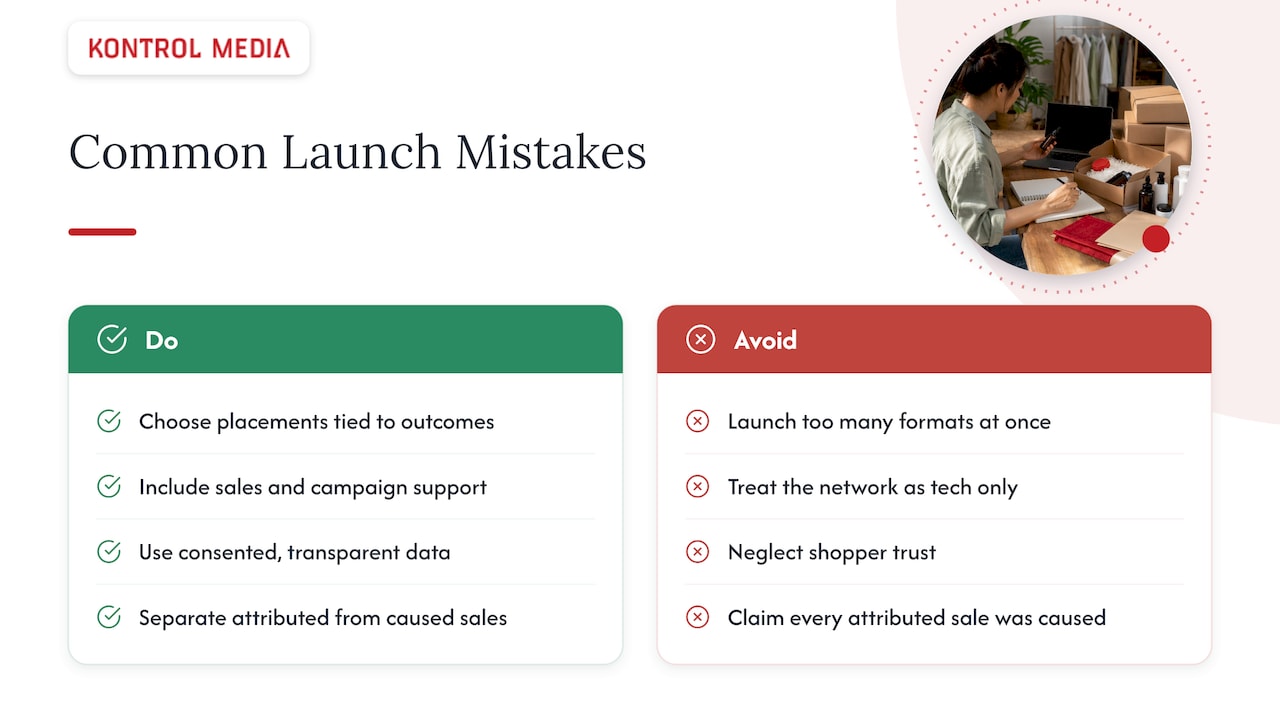
The first is launching too many formats at once. A long menu looks impressive in a deck, but it dilutes your inventory story and overloads a small team. Pick the few placements that map to a clear advertiser outcome.
The second is treating the network as a technology project. Platforms matter, but advertisers do not renew because of an ad server. They renew because someone helped them plan, launch, and read results. Sales and campaign support are part of the product.
The third is neglecting shopper trust. Using consented data and being transparent about how it is used protects the very asset the network depends on.
The fourth is overselling attribution. If a report treats every attributed sale as a sale the ad caused, a sharp buyer will notice. Separate the two and your credibility improves.
Finally, many operators ignore data partnerships. Our guide to retail media data partnerships explains how third parties can extend reach and measurement without giving up control of your audience. And for consumer brands building their own network, our best practices for consumer brand media networks cover the operating details.
FAQ
What is the meaning of media network?
A media network is an advertising business run by a company that owns a valuable audience and first-party data. LiveRamp’s explainer on media networks says it lets those companies create new revenue through personalized advertising and closed-loop measurement, while advertisers gain reach, performance measurement, and insights.
Is a marketplace media network the same as a retail media network?
In practice, they overlap heavily. A retail media network is advertising operated by a retailer, and a marketplace media network applies the same idea where many sellers share one platform. Both sit under the broader commerce media umbrella.
What do advertisers buy from a marketplace media network?
They buy placements near the point of purchase, such as sponsored listings, on-site display, email, and off-site media built from marketplace audiences. What they value most is the ability to link those placements to sales results.
Do we need a large audience to start?
You need a first-party data asset rich enough to be useful to advertisers, not necessarily a huge one. A focused audience with clear intent, such as active home buyers, can be more attractive to the right advertisers than broad reach. Start with a few placements and grow from there.
Sources
- IAB: Commerce Media and its Ecosystem Explainer, July 2025
- McKinsey: Commerce media, the ecosystem at an inflection point
- eMarketer: Commerce media, financial media, retail media
- Amazon Ads: What is an Ad Exchange?
- Macy’s, Inc.: Macy’s Media Network
- Chain Store Age: Albertsons adds new channel to retail media network
- Magnite and RE/MAX announcement, August 2025
- Zillow: Brands can now reach Zillow’s home shoppers on Pinterest
- Mirakl: How do retail media networks make money?
- LiveRamp: What Is a Media Network?