


A retail media go-to-market plan is the sequence that turns shopper data and audience reach into a business advertisers actually buy from. It has five parts: a data and measurement foundation, a small set of ad products, a sales model, a first-advertiser launch, and a feedback loop that proves incremental sales. Get the order right and the network earns trust early. Get it wrong and you end up with impressive inventory and nobody buying it.
We work on both sides of this table, helping retailers and consumer businesses stand up and run networks, and helping brands reach buyers through channels like real estate. What follows is how we think about the launch.
TL;DR
- Retail media go-to-market starts with advertiser needs (first-party data, closed-loop measurement, proximity to purchase), not with the ad formats you want to sell.
- U.S. retail media spend is forecast to reach $74.4 billion in 2026, so the demand is real, but it is concentrated among a few giants, which makes focus and differentiation essential.
- Treat advertisers as clients, not as suppliers who owe you promotional dollars. That one mindset shift changes your sales model, reporting and service.
- Launch with a few ad products, a hands-on service model and standardized reporting, then add self-service and formats as the advertiser base matures.
- Non-retailers can build commerce media networks too, but data permissions and consumer comfort need to be designed in from day one.
Table of Contents
- What a retail media go-to-market actually covers
- Why the timing still favors a launch
- Build the foundation before the pitch
- Design what you sell
- Choose the sales model that fits your stage
- A phased go-to-market plan
- Landing your first advertisers
- Beyond retail: commerce media networks
- If you are a brand, your go-to-market looks different
- Our perspective
- Work with a team that builds and operates
- FAQ
- Sources
What a retail media go-to-market actually covers
Retail media is the practice of retailers using their systems, infrastructure, data and shopper access to help advertisers reach consumers, and a retail media network is the platform that makes it work, according to Retail TouchPoints. The same source notes that “commerce media” is a broader label that can include non-retailers, social commerce and in-game purchasing.
A go-to-market plan answers four questions that the technology alone never will:
- Who is the advertiser, and what do they need to see to move budget?
- What do we sell them, in what order, and at what price?
- Who sells it, and how do they sound when they walk into a brand’s office?
- How do we prove the money worked?
Most failed launches skip question one. A team buys or builds the ad server, lights up a few banner placements and then discovers that brand marketers ask about incrementality before they ask about placements.
Why the timing still favors a launch
Businesses launch networks to earn additional revenue from the customer relationships and data they already have. EMARKETER forecasts U.S. retail media spending to rise 22.6% in 2026 to $74.4 billion. An earlier December 2025 EMARKETER forecast put 2025 spend at $60.32 billion. Looking further out, EMARKETER expects commerce media ad spending to reach $118.4 billion by 2029, a 15.3% compound annual growth rate.
The same analysts name four reasons advertisers keep investing: first-party data access, closed-loop measurement, proximity to purchase and full-funnel capabilities. Read those as your go-to-market checklist. If your network cannot credibly offer all four, you know what to build first.
There is a sober side to the picture too. EMARKETER expects Amazon and Walmart to account for a combined 81% of U.S. off-site retail media ad spending in 2027. That does not close the door on everyone else. It tells you that a newer network wins by being specific: a distinct audience, a category brands cannot reach elsewhere, a simpler way to buy, or a better way to prove results. Being a smaller copy of the biggest networks is not a plan.
Build the foundation before the pitch
Audience and first-party data
Your audience is the product. Before anyone writes a media kit, you need to know how many identifiable, consented shoppers you reach, how often they return, what they buy and which segments you can responsibly offer. Our view is that first-party data is the fuel of any network, and we go deeper in our guide to first-party data for commerce media networks.
The 2026 IDC guide for retailers lists first-party data access for precise targeting as a core capability. If your data is scattered across loyalty, ecommerce and point-of-sale systems, a data unification step belongs at the front of the plan, not the back.
Technology that advertisers can work with
The same IDC guide describes the technology need as self-service platforms, API integrations and ad-tech that connects digital and physical assets into one advertising experience. You do not need all of it on day one. You do need to know which pieces your first advertisers will insist on, and whether to build or buy them. We lay out that decision in our build versus buy verdict.
Measurement you can defend
Measurement is where brand and agency teams decide whether you are a serious partner. IDC advises offering real-time performance tracking, closed-loop attribution and standardized reporting across campaigns. It also says metrics such as incremental return on ad spend (iROAS) and incremental lift are what link campaigns to sales and growth. The IAB’s 2023 retail media guidance recommends that retailers allow raw data feeds and APIs so ad buyers can run their own measurement and attribution.
Standardization is still an industry-wide challenge, per the IDC guide, so pick your reporting definitions early and write them down. Brand teams comparing five networks will reward the one whose numbers they can reconcile. For the data hygiene behind this, see our field-level data rules for audit-grade attribution, and for the metrics themselves, our marketer’s guide to key retail media metrics.
Design what you sell
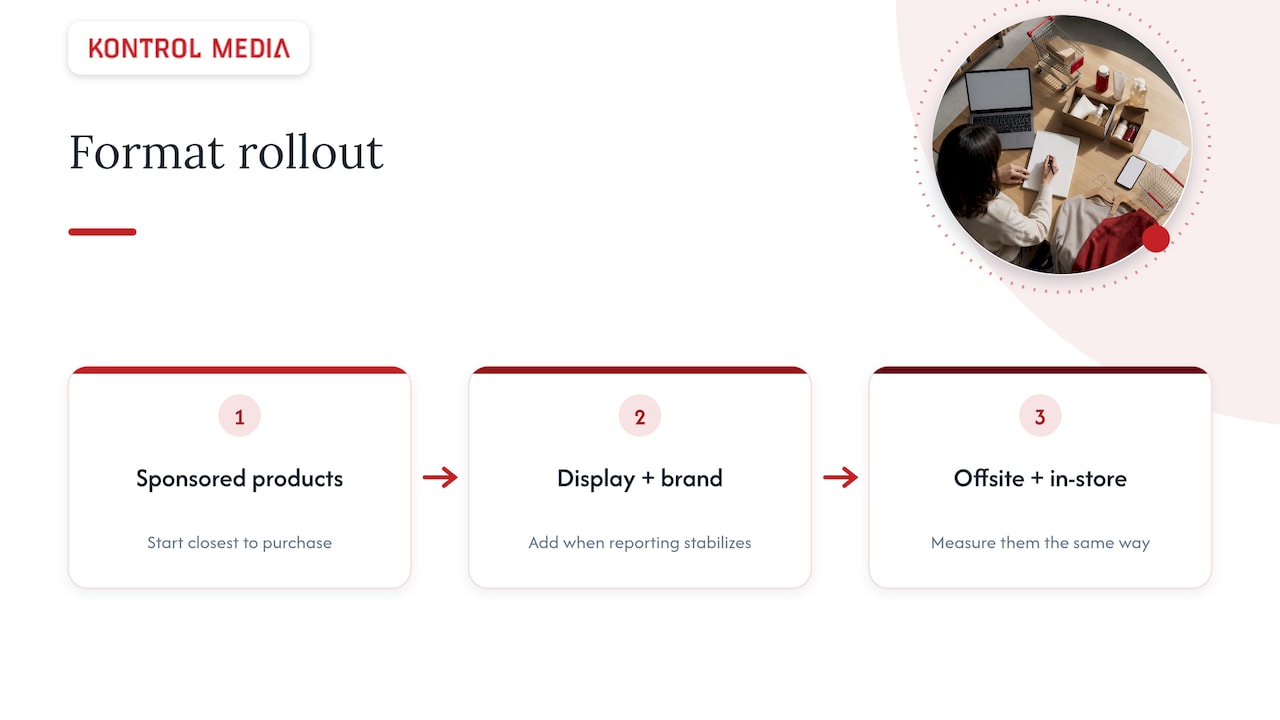
The temptation is to launch every format at once. Resist it. Our approach is to begin with the formats closest to purchase, usually sponsored product placements on your own site or app, add onsite display and brand placements once reporting is stable, and move to offsite and in-store only when you can measure them the same way. Each new format is a new promise to advertisers, and each promise needs a measurement story.
Pricing follows the same logic. Keep the early rate card simple enough that a media planner can explain it in one sentence. Complexity can come later, when you have enough advertisers to justify it.
The value proposition for the advertiser should come down to three things you can honestly say: who the shoppers are, how close to the point of purchase the ad appears, and how you will show results. If you own an app or other owned surface, the thinking in this overview of monetizing a mobile app applies directly to how you frame that inventory’s value.
Choose the sales model that fits your stage
The biggest shift in a go-to-market, according to the IDC guide, is moving from viewing suppliers as partners to treating advertisers as clients. A supplier relationship is built around trade terms and promotions. A client relationship is built around outcomes, service levels and reporting. Merchants and ad sellers have to learn to work side by side, and the brand’s merchandising conversation and media conversation need to stop being two separate meetings.
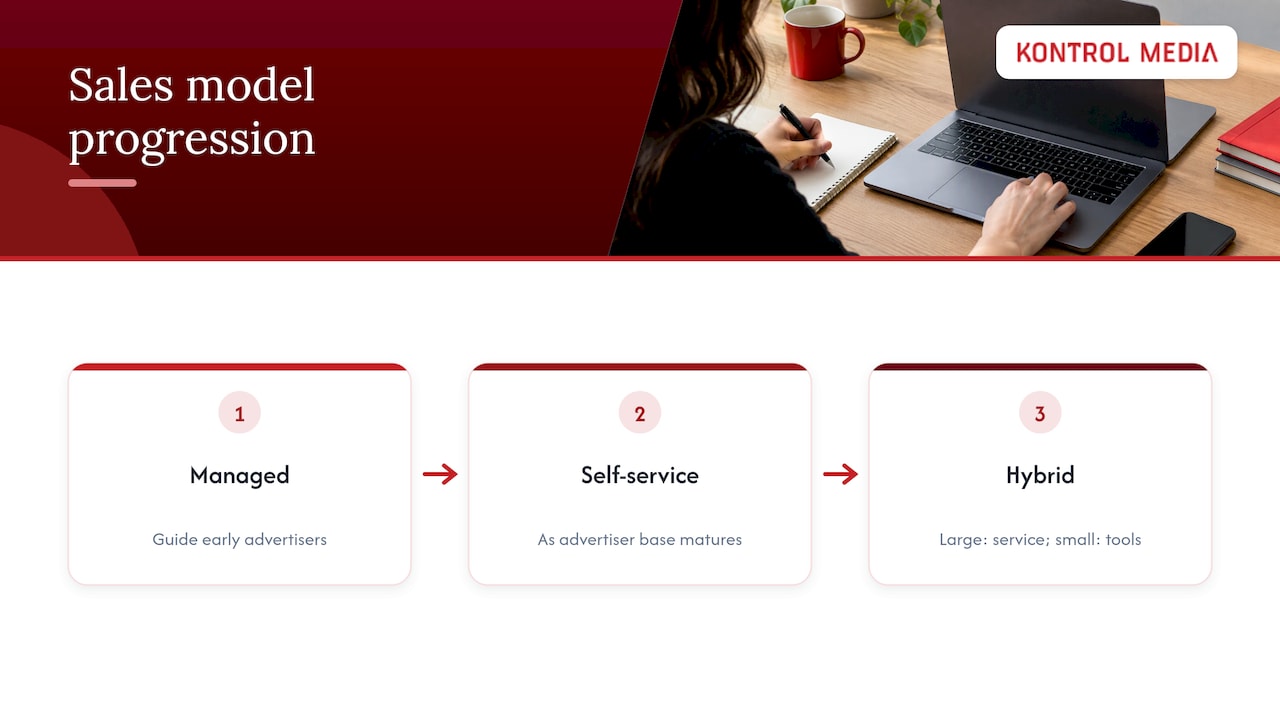
In practice we recommend launching with a hands-on, managed approach. Early advertisers need a guide: someone to help choose audiences, set up campaigns, read the results and adjust. Self-service tools can come as your advertiser base matures, and mature networks usually end up with a hybrid, where the largest brand partners get dedicated service and smaller advertisers use tools. The operating details are in our execution-first playbook for retail media network operations.
A phased go-to-market plan
The table below is the shape we use as a starting point. Timelines vary with your data readiness and team size, so treat it as an order of operations, not a promise.
| Phase | Focus | What you need to have at the end |
|---|---|---|
| 1. Foundation | Audience, consent, data unification, measurement definitions | A segment catalog and a reporting standard you can explain |
| 2. Packaging | Two or three ad products, simple rate card, media kit | One-page value proposition per advertiser category |
| 3. Pilot | Handpicked anchor advertisers, managed service | Case-ready results with incrementality evidence |
| 4. Scale | More advertisers, more formats, agency relationships | Repeatable sales process and onboarding |
| 5. Optimize | Self-service layer, offsite or in-store expansion | Consistent measurement across every format |
If you want a tighter timeline with a monetization focus, our 90-day retail media monetization plan walks through the build-versus-buy tradeoffs week by week.
Landing your first advertisers
Your first five advertisers are not a revenue line. They are your proof. Choose them for fit: brands that already sell strongly through you, have a measurable goal and will give you honest feedback. Offer them clear, narrow campaigns and a commitment to share results, including what did not work.
Three habits separate networks that gain momentum from those that stall:
Lead with the outcome. Walk in with the sales question the brand is trying to answer, then show how your data and placements address it.
Report like a partner. Send results on a consistent schedule, in the same format, with incremental sales front and center.
Turn each win into a reference. Agencies talk to each other. A clean case study with real measurement is worth more than any media kit.
Beyond retail: commerce media networks
The go-to-market logic travels. EMARKETER expects non-retail networks to account for 14.2% of U.S. commerce media ad spending in 2028, nearly $16 billion. Banks, travel companies, marketplaces and media owners all sit on valuable data. EMARKETER analysts also point out that these businesses must monetize data without provoking regulatory concern or consumer discomfort.
That is a go-to-market issue, not just a legal one. Advertisers will ask how audiences are built, and consumers will notice how they are treated. If you are not a traditional retailer, our guides to retail media strategy for non-retailers and the types of commerce media network models help you pick a model before you invest. When the goal is to extend capabilities across channels, the principles behind building cross-channel strategies are a useful frame for deciding where a network should show up next.
If you are a brand, your go-to-market looks different
Brands face the mirror image of the problem. Budgets are scattered across dozens of networks, each with its own reporting, and the question is where incremental growth is most likely. Plan by outcome first, then pick networks. Use the same four criteria advertisers use to judge networks: data access, measurement, proximity to purchase and full-funnel reach.
For categories tied to a big life event, such as a home purchase, the best audience may sit outside a conventional retailer’s walls. That is why we built a practice around reaching home buyers and homeowners through real estate agents and the partnerships around them. Our pages on advertising to home buyers through real estate agents and real estate agent partnerships show how that channel works for brand teams.
Our perspective
Here is what we see from the inside. Most retail media launches do not fail on technology. They fail because the strategy and the execution live in two different rooms. One team writes a beautiful plan, another team is handed a platform, and nobody owns the moment when a brand marketer asks, “How do I know this worked?”
That is why we pair strategy with hands-on operation. We help retailers and consumer businesses stand up networks, and we help run them, including the sales and partnership work that fills them. The strategy is only as good as the first campaign it produces, and the first campaign is only as good as the relationship with the advertiser behind it.
We are optimistic about this market, and we say so with some realism. The giants will keep growing, yet there is plenty of room for networks with a distinct audience and an honest measurement story. The winners will be the ones who treat advertisers as clients from the first meeting, and who do the unglamorous operational work consistently. That is the work we enjoy, and we try to make it enjoyable for the teams we work with too.
Mark Kapczynski
Work with a team that builds and operates
If you are a retailer, a consumer business or a PE portfolio company weighing a network, we can help you set the strategy and run the launch. Our service for standing up a retail or commerce media network covers the planning and build, and retail media network operations covers the day-to-day selling, campaign management and reporting after launch.
Brands and agencies that want to reach home buyers and homeowners can start with our real estate channel programs, or explore everything we do on the services page.
FAQ
What is a retail media go-to-market strategy?
It is the plan for how a retail media network reaches market: which audiences and data it offers, which ad products it sells first, how it prices and sells them, and how it proves results. It covers both launching a new network and growing an existing one.
How is a retail media network different from a commerce media network?
A retail media network is run by a retailer using its shopper data and sales channels. Commerce media is the broader term and can include non-retailers, social commerce and in-game purchasing, according to Retail TouchPoints. Our guide to what a commerce media network is goes further.
Which metrics matter most to advertisers?
Advertisers look for metrics that tie spend to sales, such as iROAS and incremental lift, supported by closed-loop attribution and standardized reporting, according to the IDC guide. Agree on definitions with advertisers before the first campaign launches.
Should we build or buy the technology?
It depends on your data readiness, team and timeline. Many teams start with a partner for speed and decide later what to own. We cover the tradeoffs in our build versus buy verdict.
Sources
- Retail Media: Everything You Need to Know, Retail TouchPoints
- Retail and commerce media networks keep sprouting, EMARKETER
- FAQ on retail media networks, EMARKETER
- Why commerce media networks have grown so quickly, EMARKETER
- US Retail Media Ad Spending Forecast H2 2026, EMARKETER
- The Race to Build an Advertiser-Centric Retail Media Network, IDC
- Retail Media 2023: Operational Strategies for Growth, IAB
- Building Cross-Channel Strategies for Smarter Growth
- How to Monetize Your Mobile App