


A retail media rate card is the document where a retailer states what advertising it sells, what each placement costs and the terms attached. It is the first thing a brand or agency asks for, and in our experience, the thing most new retail media networks put off until a buyer is already waiting. Done well, it is a short, consistent product catalog. Done badly, it becomes a pile of one-off quotes that no one on your team can defend.
This guide walks through what belongs on the card, how to value each format, how CPM, CPC and flat-fee pricing compare, and how to keep the card honest as your network grows.
TL;DR
- A rate card lists your paid placements, their prices and the special requirements, so advertisers can start a conversation with real numbers.
- Each line should name the placement, the chargeable unit (CPM, CPC, CPA or flat fee), the rate, the minimum commitment, availability and the terms around creative, cancellation and makegoods.
- Group inventory into a few tiers and price conservatively at first, then raise rates with performance evidence at renewal.
- Only promise the measurement you can deliver today, and describe your methodology in line with IAB/MRC guidance.
- A rate card is not a media kit: the kit tells your story, the card tells buyers what it costs.
Table of Contents
- What a retail media rate card is
- Rate card or media kit: what is the difference?
- What to put on every line
- Define the campaign terms before a buyer asks
- How to value each format
- CPM, CPC, CPA and tenancy: choosing the unit
- A real-world example
- Measurement and reporting belong on the card
- Price conservatively, then earn the increase
- Perspective
- Let us help you build and run the card
- FAQ
- Sources
What a retail media rate card is
The plainest definition comes from Rakuten Advertising’s publisher help center: a rate card is a document that showcases available paid placements and their related costs, and it works as a quick starting point for conversations with advertiser partners. It can also carry information about the publisher’s business model, audience, reach and capabilities, plus suggested pricing and any special requirements.
In retail media, that translates into a menu. Sponsored product listings on your site search, homepage banners, category-page takeovers, email and newsletter slots, app placements, offsite extensions, in-store screens. Each item has a price logic and a set of conditions.
The card does three jobs at once. It tells buyers what exists. It tells your own sales team what they are allowed to sell, and at what price. And it tells finance what a unit of inventory is worth, which is the part people forget until the first discount request lands.
Rate card or media kit: what is the difference?
The two documents get mixed up because they often travel together. A media kit is your pitch. It describes your audience, your traffic, your shopper data, your formats and the results you have delivered. A rate card is the price list. It is short, specific and transactional: placement, unit, rate, minimums, terms.
A practical way to keep them straight: the media kit answers “why should I advertise with you?” and the rate card answers “what will it cost me, and what exactly do I get?” Many retailers publish the card as the last page or an appendix of the kit, which works as long as the pricing page can stand alone when a buyer forwards it to a colleague or an agency trading desk.
If you only have time to build one, build the rate card first. A media kit without prices creates a conversation that stalls at the first budget question.
What to put on every line
The temptation with a first card is to list formats and a price and call it done. Buyers will then ask twenty follow-up questions, and every answer you improvise becomes a precedent. The research we rely on suggests a line item that can answer those questions in advance should identify these fields:
| Field | What it tells the buyer |
|---|---|
| Placement and page type | Where the ad appears: homepage, search results, category page, product detail page, email, app, offsite, in-store |
| Device coverage | Desktop, mobile web, app or screen network |
| Eligible products | Whether the placement is open to all items or restricted by category or vendor |
| Format | Sponsored product, display banner, video, custom unit |
| Booking period | Weekly, monthly, seasonal or evergreen |
| Inventory status | Always on, limited, or sold out for peak periods |
| Chargeable unit | CPM, CPC, CPA or flat fee |
| Rate or auction floor | The price, or the minimum bid in an auction |
| Minimum commitment | The smallest budget or flight you will accept |
| Included services | Creative help, targeting, reporting, managed service |
| Creative rules | Specs, approval process, restrictions |
| Cancellation, underdelivery and makegoods | What happens if a campaign is cut or misses its volume |
That field list follows a published retail media rate-card template, and we find it a useful checklist even if your card ends up simpler. The rate-card guidance from Rakuten also points to the placement types worth cataloguing: homepage, site-wide, category-page, site-banner, email or newsletter, social, app, editorial, guide and promotion placements.
The last two rows in that table are where first-time cards fall short. Underdelivery and makegood language is not glamorous, but it is the difference between a smooth renewal and a billing dispute.
Define the campaign terms before a buyer asks
Beyond the line items, the card needs a short terms section. Minimum and maximum flight lengths, lead times for creative and booking, and seasonal blackout windows should all be stated, so there is nothing to negotiate on the basis of a misunderstanding. Q4 is the obvious blackout candidate for many retailers, because inventory is scarce and demand is at its highest.
Also state who bills. If you run a managed-service model for some buyers and self-serve for others, the card should say which tier carries which service level, and whether fees for creative production or data activation are included or extra.
How to value each format
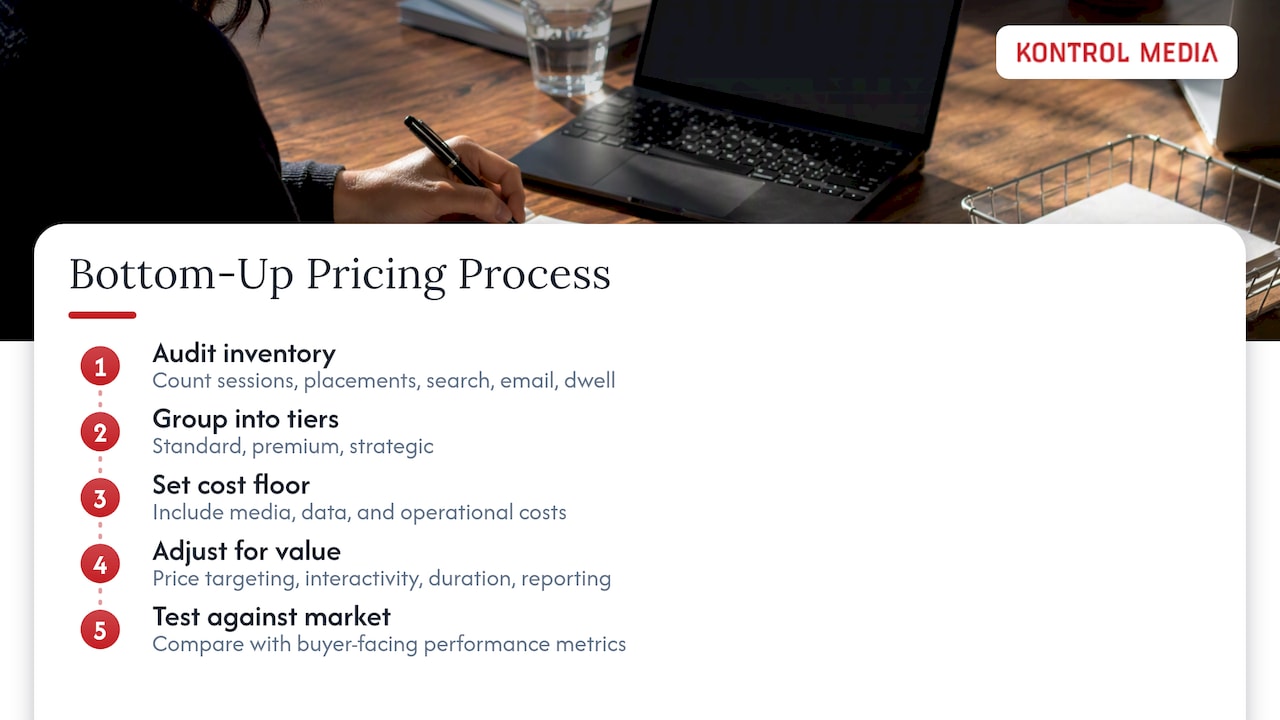
Pricing from the top down, by copying what a large marketplace charges, usually fails because your traffic, shopper intent and measurement are not theirs. We prefer a bottom-up approach in four moves.
Audit the inventory. Count what you really have: monthly sessions by page type, impressions per placement, search volume, email list size, screen dwell time. Mark which placements are scarce and which are abundant.
Group the inventory into tiers. Many networks settle on standard, premium and strategic. Standard is self-serve, high volume and rules-based. Premium is managed, with tighter targeting and more reporting. Strategic is custom work built around a joint business plan with a major brand. The tiering protects margin and keeps pricing consistent across buyer types, which is the reason published rate card architecture guidance gives for separating them. Keep the first version coarse. Overly granular tiers confuse buyers rather than clarify.
Set a floor from your costs. For each format, work out the minimum viable price after media costs, data costs and the operational effort of running the campaign. Content-heavy and long-flight campaigns take more commercial effort, and the card should reflect that.
Adjust for value delivered. A placement near the point of purchase, with strong targeting and closed-loop reporting, is worth more than a generic awareness banner. Interactivity, duration and the depth of reporting you provide are all legitimate reasons to charge more.
Then test the result against the market. Our guide to key retail media metrics covers the numbers buyers will compare your card against, and what they mean for performance.
CPM, CPC, CPA and tenancy: choosing the unit
Most cards use four chargeable units, and they behave differently.
CPM charges per thousand impressions. It suits display banners, video and screens, where the value is exposure. CPC charges per click and is the standard for sponsored product ads in search and category listings, where the click signals intent. CPA charges for a defined action such as a purchase or lead, which shifts risk to you, so it needs trustworthy attribution. Flat fee or tenancy sells a placement for a period regardless of impressions, which is common for homepage takeovers, email sponsorships and bundled packages.
To compare them, convert everything to a common yardstick. A flat fee divided by expected impressions gives an effective CPM. A CPC multiplied by the expected click-through rate gives another. Retail media pricing guidance from Hello Retail recommends exactly this conversion, plus a check on how impressions are counted, since two screens with the same CPM can deliver very different value if one counts a pass-by and the other counts a verified view.
Which format your buyers will accept also depends on where they sit in the market. The IAB and PwC Internet Advertising Revenue Report describes retail media network advertising as promotions or sponsorships of a retailer’s own or vendor products on its e-commerce site or other sites, and notes private-marketplace, preferred-deal and automated-guaranteed buying. Your card should say which of those routes you support, because agencies will ask.
A real-world example
It helps to see an actual card, not a template. A 2024 media kit from Newegg itemizes products such as Commercials at $40,000, Unbox This! at $7,000 and Newegg Live at $1,500, alongside annual packages priced at $100,000 or $200,000.
Two lessons stand out. First, a rate card does not have to be only sponsored search and banners. Video production, creator content and live streams can all be priced as discrete products. Second, annual packages sit next to a la carte items, which gives a buyer a clear path from a first test to a committed program. Your own numbers will differ with your traffic and category, so treat this as a structural reference, not a price target.
Measurement and reporting belong on the card
Buyers do not only compare price. They compare what you can prove. The IAB/MRC Retail Media Measurement Guidelines, published in January 2024, recommend client-side counting and ask retailers to follow industry standards on transparency, accuracy, privacy and invalid traffic exclusion. Transparency is the stated priority, so retailers should describe their measurement methodologies in enough detail to make networks comparable.
On the card, that means a short statement of what you report for each tier: impressions, clicks, sales attributed, and the attribution window. IAB Europe’s guide to retail and commerce media lists viewability, ROAS and incremental sales lift among the metrics to consider. If you are not ready to offer incrementality testing, do not list it. Commit only to the reporting you can deliver this quarter, and expand as your data foundation matures. Our posts on iROAS measurement and the field-level data rules behind audit-grade attribution explain what that foundation looks like.
Price conservatively, then earn the increase
A first rate card is a hypothesis. Price a little conservatively, run trial campaigns, and use the play logs and performance results to justify higher rates at renewal. Evidence beats confidence in a negotiation: “your campaign delivered this lift, and the rate moves to this level” is a sentence advertisers can take to their own finance teams.
Rates will also move with traffic, click-through rates, advertiser return on investment, scale, format and targeting. Review the card on a fixed rhythm, for instance quarterly, and change it in one controlled release rather than quietly adjusting individual quotes.
The discipline underneath all of this is consistency. The same product should cost the same for every buyer, adjusted only by transparent volume incentives. Once a salesperson gives one brand a private discount, every other brand eventually hears about it, and the card stops being a price list and becomes an opening bid.
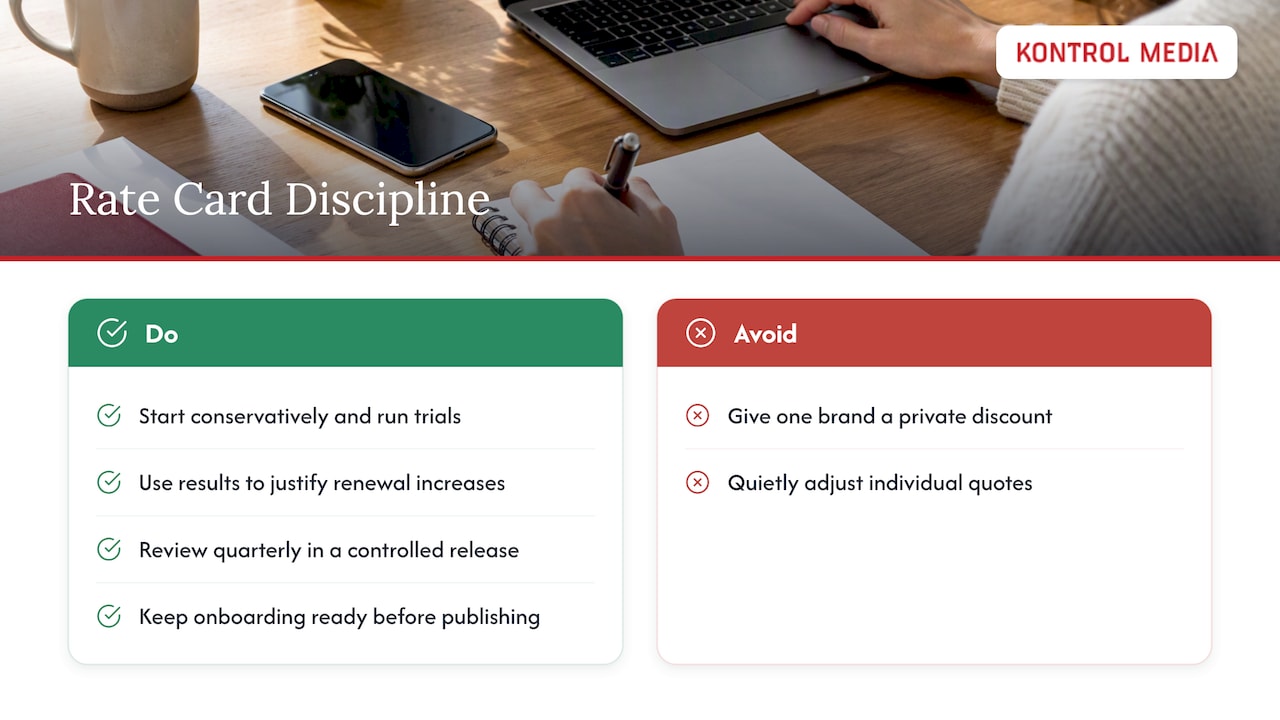
Before you publish, it also pays to have your onboarding ready. If a buyer signs on the strength of your card but then waits weeks for setup, the card has overpromised. Our advertiser onboarding guide covers the roles and standards that make a launch smooth.
Perspective
We have sat on both sides of this document, and the pattern is consistent: the rate card is where a retail media network’s strategy becomes visible. If the card is vague, the strategy usually is too.
When we help retailers and consumer businesses stand up a network, we push for a card that reads like a product line, not a favor list. A small set of tiers, honest minimums, and reporting commitments the team can keep on a Tuesday afternoon in the middle of a busy quarter. The brands that trust you most are rarely the ones who got the lowest price. They are the ones who understood what they were buying and saw it delivered.
We are optimistic about where the category is going, precisely because the basics are getting better. Buyers expect transparency, standards are maturing, and the networks that treat pricing as a system, not a negotiation, are taking up space together with the brands that fund them.
Mark Kapczynski
Let us help you build and run the card
A rate card is only as good as the network behind it: the ad server, the data, the sales motion and the operations that deliver what you priced. Kontrol Media builds and operates retail and commerce media networks, from first design to day-to-day revenue work. If you are deciding what to sell and how to price it, our retail or commerce media network setup service is the place to start, and our network operations team can run the program once it is live.
If you are still weighing whether to build in-house or bring in outside help, read our build versus buy verdict first, and compare tools in our ad server buyer’s guide.
FAQ
What is a media rate card?
A media rate card is a document in which a publisher states the price of its ad inventory, along with placements and specifications. In retail media it lists each placement a retailer sells, the chargeable unit, the rate and the conditions. Buyers use it as the starting point for planning and negotiation.
What is the difference between a media kit and a rate card?
A media kit presents the audience, reach, capabilities and past results, so it sells the opportunity. A rate card sets out prices, minimums and terms, so it sells the product. Many retailers publish both together, but the rate card should be readable on its own.
Can you provide an example of a rate card?
Yes. The 2024 Newegg media kit lists itemized products, including Commercials at $40,000, Unbox This! at $7,000 and Newegg Live at $1,500, plus annual packages at $100,000 and $200,000. Your card should follow the same logic of discrete products plus packages, with prices based on your own traffic and costs.
Should my first retail media rate card be public?
That is a business choice, but whichever way you go, keep the pricing logic consistent. A shareable card that every buyer sees reinforces the same-product, same-price principle, while custom strategic deals can sit outside it as clearly labeled joint business plans.
How often should I update a retail media rate card?
Review it on a regular schedule, such as quarterly, and use trial-campaign results to justify changes. Release updates together and tell buyers when they take effect, instead of repricing line by line in individual quotes.
Sources
- Rate Card for Paid Placements, Rakuten Advertising Publisher Help Center
- Retail media rate-card template: CPC, CPM, CPA and tenancy
- Rate Card Architecture
- Retail media pricing: CPM and CPC benchmarks
- IAB/PwC Internet Advertising Revenue Report
- 2024 Newegg Media Kit (US)
- IAB/MRC Retail Media Measurement Guidelines, January 2024
- IAB Europe 101 Guide to Retail and Commerce Media, July 2025