


If you are reading this in late October or November and your holiday media plan still has holes, you can still win the season, but not by copying what the early spenders did. The best last-minute ad buys are narrow, high-intent and built around certainty (will it arrive, can I pick it up today) rather than discounts. They sit on top of a steady baseline, they reach people who already showed interest, and they are measured for incremental lift rather than for whatever the platform dashboard claims.
Below is how we think about it when a CMO or head of growth calls us with a gap in the calendar: what a late buy can realistically deliver, who to target, what to say, how to split the budget, what to check legally, and how to know afterward whether it worked.
TL;DR
- Late buys work best on people who already raised a hand: recent cart abandoners, high-intent browsers, wish-list users and your VIPs. Suppress recent purchasers.
- Sell certainty, not just price: arrival dates, same-day pickup, instant delivery and gift cards beat another 10% off banner.
- Hold a steady base, then reserve a small, capped pool for guaranteed placements and opportunistic inventory. Reallocate daily on CPA and ROAS.
- Check the rules before launch: urgency claims, shipping promises and influencer disclosures all fall under FTC oversight.
- Measure with a holdout set before launch, because platform attribution tends to flatter reactive spend.
Table of Contents
- What a last-minute holiday buy can and cannot do
- Start with the audiences that already know you
- Sell certainty, not just discounts
- How to split a late budget
- Where to buy: channels that work when you launch late
- The rules to check before you launch
- Measure whether it was incremental
- A seven-day launch sequence
- Our perspective
- Where we can help
- FAQ
- Sources
What a last-minute holiday buy can and cannot do
A late buy is not a brand campaign. You do not have the time to build awareness, and the shoppers you reach are no longer browsing for inspiration. They are racing a deadline. Microsoft Advertising points to several late-season opportunities: digital gift cards, buy online pick up in store (BOPIS) convenience, post-holiday bargain hunters and self-gifters. Those four buckets are a useful map, because each one needs a different message and a different landing page.
What a late buy cannot do is rescue a weak offer or a broken fulfillment chain. If your inventory is thin or your shipping cutoff has already passed, the honest move is to change the promise (pickup, gift card, e-delivery) rather than buy more impressions for a promise you cannot keep.
The competitive picture also matters. In its late-November 2025 analysis, eMarketer argued that late entrants should differentiate with sharp value propositions, category expertise, in-person experiences, streaming reach and tactical value messaging, rather than imitating the early-season brand spend that has already crowded the window. In plain terms: the window is compressed, so be specific and be useful.
Start with the audiences that already know you
The fastest way to waste a late budget is broad prospecting. With days, not weeks, left, the economics favor people who have already shown intent. Blueshift’s guidance on last-minute B2C marketing recommends prioritizing recent cart abandoners, high-intent browsers, wish-list users, VIPs and promotion-engaged shoppers, while suppressing recent purchasers and low-intent audiences.
Microsoft’s guidance points the same way: late campaigns can retarget lists built from product views, abandoned carts, site visits or email clicks, including through impression-based remarketing. If your lists are already built, you can launch quickly. If they are not, the first job is to get the pixel and list logic live, not to write more creative.
A simple tiering works well in practice:
The first tier is cart abandoners and wish-list users from the past seven to fourteen days, who get your most direct message and the largest share of the late pool. The second tier is product viewers and email clickers, who get gift-guide or bundle creative. The third tier is lapsed buyers and VIPs, who get an early-access or guaranteed-delivery message. Everyone who bought in the last few days gets excluded so you are not paying to remind a customer of something they already did.
If you want a deeper look at how these tiers connect to onsite performance, our piece on proving onsite ROAS before scaling offsite covers the logic from the retailer side.
Sell certainty, not just discounts
The late-season shopper is anxious. Mailchimp’s 2025 Holiday Shopping Unwrapped report says last-minute shoppers increasingly need practical help as delivery concerns rise, and it recommends express delivery, gift wrapping, money-back delivery guarantees and messaging built around speed, reliability and stress relief. The experts quoted there frame the shift as moving from inspiration to intervention: reduce the cognitive load, and the sale follows.
That has direct consequences for creative:
- Lead with the promise. Arrival dates, pickup today, instant delivery and gift cards belong in the first line and the first frame.
- Shrink the decision. Short gift guides, bundles, budget-based collections and “best gift for” groupings do more than a sprawling catalog.
- Keep discounts as a supporting actor. A free-shipping threshold or a modest code can help, but a late shopper who doubts delivery will not be rescued by a deeper markdown.
If you are running local or pickup ads, get the feed right first. Google’s documentation says that “pickup today” requires local inventory marked as in stock and an effective pickup SLA of same day. If your feed does not say it, the ad cannot promise it. This is the kind of operational detail that decides whether a late campaign is eligible at all, and we go deeper on it in our guide to operations-first holiday ads and gift guides.
Creative for the final days
For campaigns that run through Christmas Eve and Christmas Day, Tatari’s TV guidance suggests extreme urgency in the copy, manually capped budgets and narrow, high-intent audiences. We would add one caution: urgency has to be true. A countdown that resets or a “last chance” that never ends is not just poor craft, it is a legal exposure (more on that below).
How to split a late budget
The instinct under pressure is to throw money at whatever is working. The data argues for restraint. Measured’s analysis of 114 brands during Prime Day 2026 found that steady investment often beat reactive spikes, because extra spend in high-demand windows frequently produced little incremental revenue and worse efficiency. The same source notes that platform attribution can overstate the impact of reactive spending in those windows.
That does not mean never adding money. It means separating two pools. Tatari’s playbook suggests setting aside spend for guaranteed placements and for opportunistic last-minute deals, focusing on high-intent segments, and reallocating daily to the best publishers or creatives based on CPA and ROAS. Amazon Ads recommends splitting each event into lead-up, peak and lead-out phases, staying visible throughout and re-engaging shoppers who browsed but did not buy.
Here is how we would frame it for a mid-market brand with a late decision:
| Pool | Purpose | How to manage it |
|---|---|---|
| Steady base | Keep existing winners live through the season | Do not spike; protect efficiency |
| Guaranteed placements | Secure reach in the final stretch where you need certainty | Book early in the window, cap by day |
| Opportunistic pool | Take discounted late inventory or test new creative | Small, capped, reviewed daily on CPA and ROAS |
| Lead-out reserve | Post-holiday bargain hunters, gift-card redeemers, self-gifters | Hold back a share so you are not dark on December 26 |
We deliberately do not put percentages in that table. The right split depends on your margins, your inventory and what your baseline already looks like. If you want a broader frame, our media planning tips for the holidays go through the planning side step by step.
Where to buy: channels that work when you launch late
No single channel wins on its own, but some are easier to turn on quickly than others.
Retargeting and email-list-based audiences are the quickest to deploy because the data is yours. Search and shopping ads, especially with pickup and local inventory, capture people who are already looking for a specific gift. Social and short-form video can carry gift-guide creative to warm audiences. Connected TV and streaming give reach when you need it and can be bought with tight caps, though they work best when paired with a measurement plan. Retail media, where you advertise on a retailer’s own site and app, puts your product in front of people at the moment of purchase, which is why it matters so much for late-season buyers.
For brands with products in retail, our overview of how retail media networks are changing ad spend explains why that shelf-adjacent placement is increasingly where budgets go. Retailers feel the same pull from the other side, which is why we help them stand up and run their own networks.
The rules to check before you launch
Speed is no excuse for a compliance miss, and holiday campaigns are exactly where shortcuts happen. Three areas deserve a quick review by your marketing lead and, for anything unusual, your legal counsel.
Shipping promises. The FTC’s Mail, Internet, or Telephone Order Merchandise Rule requires sellers to have a reasonable basis to expect they can ship within the advertised time frame, or within 30 days if none is stated. If you cannot ship in time, you must get the buyer’s consent to the delay or refund the payment. So a “arrives by Christmas” ad needs real fulfillment data behind it.
Reviews and testimonials. The FTC’s rule on consumer reviews and testimonials took effect on October 21, 2024 and addresses deceptive practices such as fake reviews. If your late creative leans on social proof, make sure every quote and star rating is real and attributable.
Influencer and creator content. If you rush a few creators into the mix, the FTC’s endorsement guidance expects clear disclosure of any material connection between the creator and the brand. Build the disclosure into the brief, not into a follow-up email.
For urgency claims such as countdown timers and limited-time offers, the safest rule is simple: if you say it ends, it must end. Get a final read on the specific wording from counsel.
Measure whether it was incremental
A late buy is the hardest kind to measure and the easiest to misread. Retargeting in particular tends to claim credit for purchases that were going to happen anyway. The cure is incrementality: compare people who saw the ads with a comparable group who did not.
A few practical rules from the measurement literature:
- A guide to CTV incrementality testing says tests typically withhold ads from 10 to 20 percent of the eligible audience, and the holdout should be in place before the campaign goes live. You cannot bolt it on afterward.
- Trackingplan advises updating incrementality multipliers at least quarterly, by channel and audience segment, since a single company-wide multiplier misses seasonal swings. It also warns that oversized holdouts waste conversions and that testing during holiday weeks can distort baseline conversion rates.
- Connexity notes that tests need stable, baseline-level campaigns to avoid noise from events like Black Friday, and that Google Shopping campaigns need time to learn before a test is valid.
The tension is obvious: you are launching late, in the noisiest weeks of the year, and the literature says holiday weeks distort tests. Our practical answer is to use a small, clean holdout on the late pool, read the result as directional rather than final, and run a proper test in a quieter period to set the multiplier you will use next year. For the fundamentals, see our explainers on incrementality in retail media and iROAS measurement, and our guide to the key retail media metrics.
A seven-day launch sequence
When the clock is short, order of operations matters more than ambition.
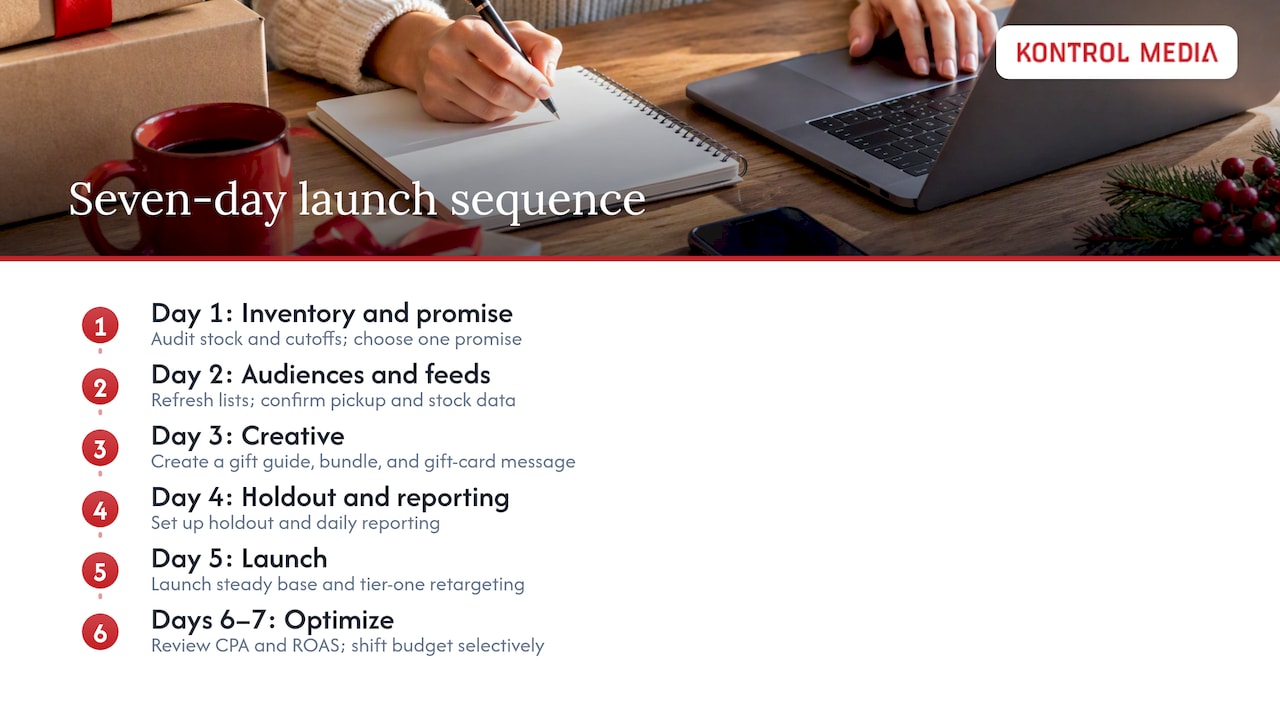
On day one, audit inventory and shipping cutoffs and decide the single promise you can keep. On day two, build or refresh your audience lists and exclusions, and confirm feeds carry pickup and stock data. On day three, produce a small set of creative built on the promise: one gift guide, one bundle, one gift card message. On day four, set up the holdout and the daily reporting view. On day five, launch the steady base plus the tier-one retargeting. On days six and seven, review CPA and ROAS, move budget between publishers and creatives, and release the opportunistic pool only where results justify it.
Notice what is absent: a brand film, a new landing site, a new channel you have never run. Late is for sharpening, not for inventing.
Our perspective
We have sat in enough December war rooms to know the pattern. A brand looks at a soft week, panics, and doubles spend on the channel with the prettiest dashboard. Two weeks later the finance team asks what the extra money bought, and nobody can say.
Our view is that the most valuable thing a late buy can do is force clarity. What is the one promise we can keep? Who is most likely to say yes? What would we do with the next dollar if the first one underperformed? Those questions are the same ones we ask in retail media and commerce media, where we build and run networks and where incrementality is the currency of trust. The retailers and brands that earn repeat budgets are not the ones with the loudest holiday push, they are the ones who can show, with a holdout and an honest baseline, what the push added.
We also believe the work should be a little bit fun. A tight deadline is a creative constraint, and constraints tend to produce sharper ideas than open calendars do. Hold the base steady, spend the late pool with discipline, and write down what you learned before January erases it.
— Mark Kapczynski
Where we can help
If your holiday gap is really a sign of a bigger one, such as no retail media presence, an unproven measurement approach or a team stretched across too many channels, we work alongside you on both strategy and execution. That includes retail media network operations for retailers and consumer businesses that want to turn their audiences into ad revenue, and broader marketing, sales and business strategy through our consulting services.
If you are a brand or agency trying to reach home buyers and homeowners during the season, our real estate channel programs put you in front of them through agents and in-market audiences. Reach out through the site and tell us what your calendar looks like.
FAQ
Is it too late to buy holiday ads in late October or November?
No. Late buys can still work, especially against warm audiences such as cart abandoners and wish-list users. The window is compressed, so focus on specific promises, narrow targeting and a clean holdout rather than broad reach.
What should a last-minute holiday ad say?
Lead with certainty: delivery dates, pickup availability, instant delivery or gift cards. Mailchimp’s research on late shoppers points to speed, reliability and stress relief as the themes that resonate, so keep discounts in a supporting role.
Should I increase my budget in the final week?
Only in a controlled way. Measured’s analysis of Prime Day 2026 suggests steady spend often beats reactive spikes, so reserve a small, capped pool for guaranteed and opportunistic placements and move it daily based on CPA and ROAS.
What legal issues should I check?
Check that shipping promises are supportable under the FTC’s mail, internet or telephone order rule, that reviews are genuine under the FTC’s reviews rule, and that creators disclose their relationship to your brand. Have counsel review any urgency language you are unsure about.
How do I know whether the ads drove extra sales?
Use a holdout group set before launch, commonly 10 to 20 percent of the eligible audience in CTV tests, and compare outcomes against exposed shoppers. Treat holiday-week results as directional and calibrate with a cleaner test later.
Sources
- Capture Last-Minute Shoppers with AI, Microsoft Advertising
- Last-minute ways retailers can win the Cyber Five, eMarketer
- Last-Minute Christmas Marketing Ideas for B2C Brands, Blueshift
- Holiday Shopping Unwrapped, Mailchimp
- Pickup SLAs for in-store products, Google Merchant Center Help
- How Retailers Are Sharpening TV Strategies for BFCM, Tatari
- Trends for 2025 holiday marketing strategies, Amazon Ads
- Prime Day Results Confirm Measured’s Call to Hold Spend Steady
- CTV Incrementality Testing for Agency Client Campaigns, Vibe
- Incrementality Testing: A 2026 Guide for Marketers, Trackingplan
- Proving CSS incrementality to the C-Suite, Connexity
- Mail, Internet, or Telephone Order Merchandise Rule, FTC
- The Consumer Reviews and Testimonials Rule: Questions and Answers, FTC