


If you have to choose between a media campaign and a strategic partnership to drive sales, choose based on the job. Campaigns buy attention quickly and are easy to measure. Partnerships borrow trust and audiences that you could not buy at any price, but they take longer to pay back. The strongest growth plans we see stop treating them as rivals and build partnerships that carry media, so every dollar of exposure sits on top of a relationship that keeps working.
Below is how we think about the choice, a practical way to structure a partnership so it behaves like a revenue channel, and how to prove the sales are real and not just a nice-looking dashboard.
TL;DR
- Use a media campaign when you need speed, control and a clean read on cost per result. Use a partnership when you need access to an audience, a data set or a trusted voice you cannot rent.
- The best programs fuse the two: a partner supplies the audience and credibility, and paid or owned media amplifies it.
- Commerce media is the clearest proof of this blend. IAB reported U.S. commerce media revenue of $63.4 billion in 2025, up 18.0% year over year.
- Measure incrementality, not just attribution. Ask what sold because of the program, versus what would have sold anyway.
- If a partner recommends your product, disclosure rules apply to you as well as to them.
Table of Contents
- Two tools, two different jobs
- When a media campaign is the right call
- When a strategic partnership is the right call
- Why the best answer is usually both
- How to structure a partnership so it produces sales
- Proving the sales are real
- The compliance point most teams miss
- Our perspective
- Where we can help
- FAQ
- Sources
Two tools, two different jobs
A media campaign is a bounded effort: a message, a budget, a set of placements and a window of time. You control the creative, the targeting and the pause button. That control is its greatest strength and its limit, because you are always renting attention, and the rent resets when you stop paying.
A strategic partnership is a standing arrangement with another company that already has the audience, data, distribution or credibility you want. Think of a brand and a retailer sharing customer insight, a software company bundled into a larger platform, or a consumer brand working through trusted local professionals. It is slower to set up and harder to control. In return, it compounds. The audience keeps seeing you after the launch week ends.
So the question is rarely which one is better. It is which constraint is binding for you right now. If you have a good offer and no reach, a campaign is the faster fix. If you have reach and no trust, or you keep hitting rising acquisition costs in saturated channels, a partnership is where the leverage sits.
When a media campaign is the right call
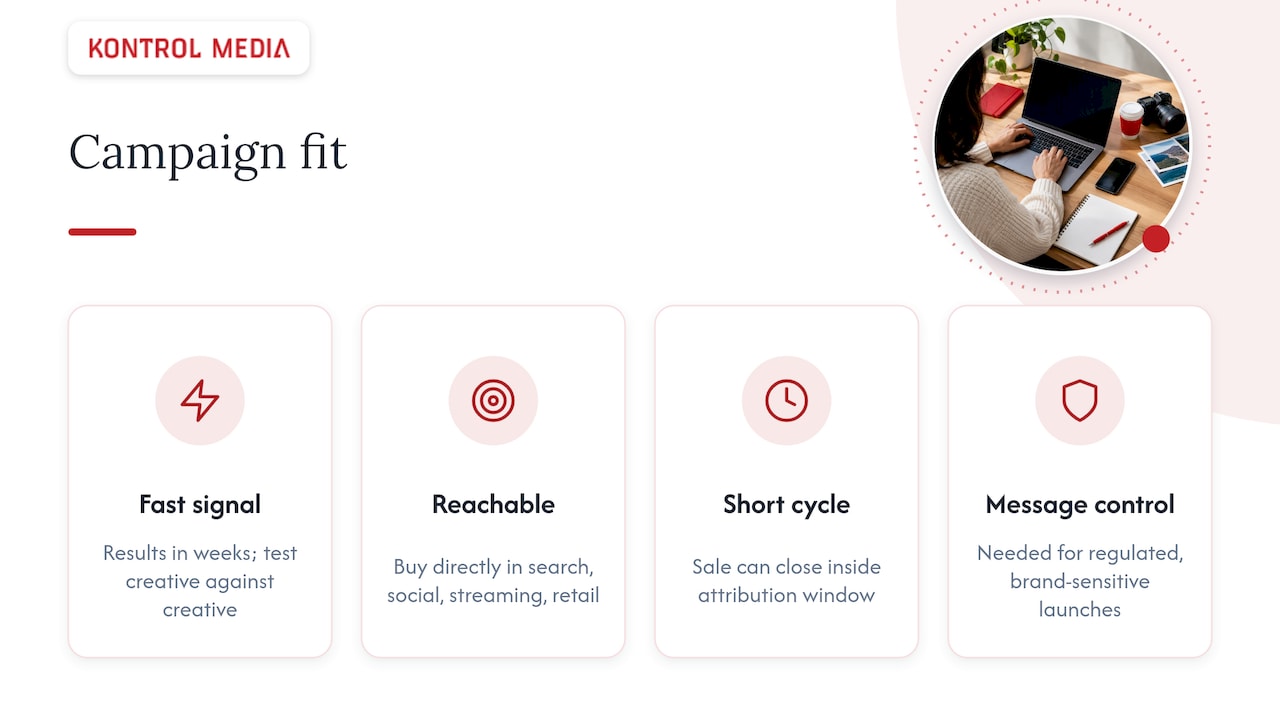
Campaigns win in four situations.
You need a fast signal. A new product, a new region or a new message needs evidence quickly. A campaign gives you results in weeks, and you can test creative against creative.
The audience is already reachable. If the people you want sit in channels you can buy directly, such as search, social, streaming or retail media placements, there is little reason to negotiate a relationship first.
Your sales cycle is short. Consumer purchases and low-consideration B2B offers respond to direct response media. You can often see the sale close inside the attribution window.
You want precise control over the message. Regulated categories and brand-sensitive launches often need that control.
The weakness is that campaign results decay. The market is also moving. In the same IAB report, social media ad revenue reached $117.7 billion, up 32.6%, which tells you how crowded the attention auction is. More money chasing the same eyes means your cost to win a customer tends to drift up unless something else, like a partnership, lowers it.
When a strategic partnership is the right call
Partnerships earn their place when the thing you are missing cannot be bought on an ad exchange.
Trust. A recommendation from someone the customer already relies on converts differently than an ad. In real estate, for example, the agent is often the first professional a home buyer or new owner talks to, and that relationship is the spine of the purchase journey. Brands that want to reach people at the moment of a move are better off working with that channel than shouting at it.
Data and context. Retailers sit on transaction-level intelligence that tells you who actually bought. Partnering with them lets you reach shoppers with far more relevance than a generic audience segment. We cover the mechanics in our piece on 90-day privacy-first retailer data partnerships.
Inventory you cannot reach alone. Gaming environments, for instance, offer high-attention placements that are best accessed through a real relationship. Our view on that is in how brands win at gaming media partnerships, and the short version is to stop buying one-off sponsorships and start building something both sides are invested in.
Lower long-run acquisition cost. A partnership that works keeps producing leads without a fresh media buy each month.
The cost is time. You will spend weeks aligning on goals, data sharing, creative approvals and reporting before a dollar of revenue shows up. That is why we recommend a defined first phase, which we describe below.
Why the best answer is usually both
Look at where the money is moving. IAB’s full-year 2025 report puts total U.S. digital advertising revenue at $294.6 billion, up 13.9%, with commerce media as a major growth pillar. Commerce media is a partnership business at heart: a retailer or marketplace lends its audience and purchase data to a brand, and media is the delivery vehicle. The report’s analysis points to growth coming from off-site, in-store and cross-partner data ecosystems, not just on-site sponsored placements.
The demand underneath is steady. The Census Bureau estimated U.S. retail e-commerce sales at $310.3 billion in the third quarter of 2025, or 16.4% of total retail sales. When that much buying happens online, the retailers hosting it become media companies in their own right, and brands that treat them as partners rather than just a line on a media plan get more out of the relationship.
A practical way to fuse the two is to give every partnership a media layer from day one. A co-marketing agreement becomes a co-funded campaign. A data partnership becomes an audience that you activate in channels both sides trust. A retailer relationship becomes an onsite program first and then an offsite one. If you are deciding how to sequence that, our guide to proving onsite ROAS and then scaling offsite retail media walks through it.
How to structure a partnership so it produces sales
Most partnerships fail quietly. Both sides are enthusiastic in the kickoff meeting, and six months later nobody can say what it produced. The fix is to treat the partnership like a sales channel with an owner, a funnel and a scoreboard.
Start with one revenue question
Write down the single outcome you expect: new customers in a segment, a lift in basket size, qualified pipeline for a sales team. Partnerships with three goals deliver none of them.
Define the unit of exchange
What does each side give and get? Audience access, data, content, co-funded media, a sales introduction, an exclusive offer. If you cannot state it in a sentence, the partner will not be able to either, and the relationship will drift.
Run a 90-day proof
Pick one audience, one offer and one or two activations. Decide in advance what result earns a second phase. We lay out how to do this in proving media partnership impact in 90 days. A short, scored first phase protects both parties from a long, vague commitment.
Give it an owner on your side
Someone senior enough to unblock approvals and close enough to the numbers to read them. A partnership managed as a side project behaves like one.
Plan the renewal conversation at the start
Sponsorships and placements should earn renewal with evidence. Our note on retail media sponsorships that must prove impact before renewal covers how to write that expectation into the deal.
Proving the sales are real
This is where most comparisons of campaigns and partnerships go soft. A dashboard shows conversions, so everyone assumes the program works. But attribution only describes what happened. It does not tell you what would have happened without you. Shoppers who were already going to buy get counted as wins.
Incrementality closes that gap. The IAB’s Guidelines for Incremental Measurement in Commerce Media set out three requirements for a credible read: a believable counterfactual such as randomized control groups or geo-randomization, explicit control for bias such as seasonality, pricing or competitor activity, and a way to separate true signal from noise. The guidance also says to match the rigor of the method to the decision. Lightweight proxies are fine for tactical optimization, but budget decisions at the executive level deserve stronger causal evidence.
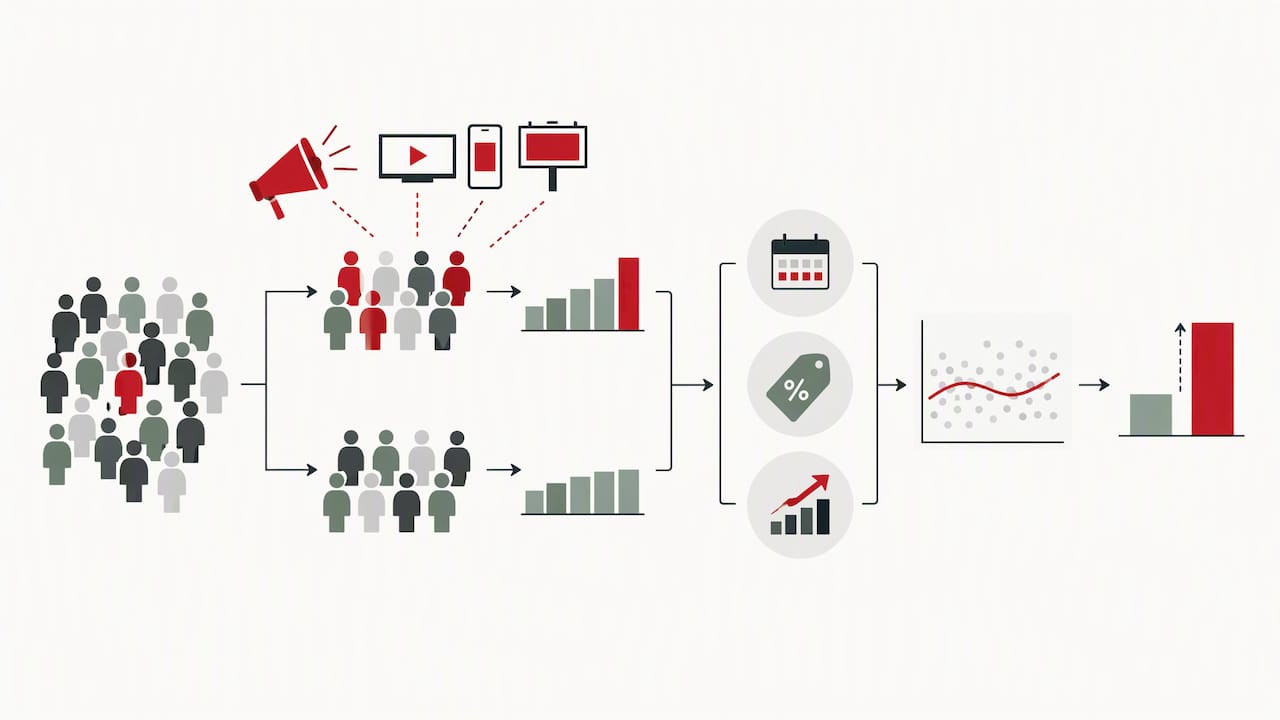
In practice, that means building the test into the partnership before launch. Hold out a comparable group that does not see the campaign. Agree with the partner on how results will be read. Write down the seasonal factors you will correct for. If you want a deeper grounding in the reasoning behind this kind of analysis, this overview of ROI and growth strategies in digital marketing is a good complement, and our own pieces on incrementality in retail media and measuring the ROI of marketing and advertising campaigns get into the mechanics. For the metrics themselves, see our 2026 guide to key retail media metrics.
One more warning from the same IAB report’s commentary: traditional measurement models can undervalue newer channels such as commerce media and gaming. If your framework only credits the last click, you will starve exactly the programs that build demand where people spend their time.
The compliance point most teams miss
Partnerships often rely on someone else’s voice: an influencer, an agent, an affiliate. That voice is covered by advertising law, and so are you.
The FTC’s Disclosures 101 guidance explains that anyone recommending a product needs to clearly disclose the relationship to the brand. The agency’s endorsement rules, published as 16 CFR Part 255, include examples showing that a disclosure that consumers must click through to see is not enough. If you pay, gift or otherwise reward partners for talking about you, build disclosure language into the agreement and check the live posts. For anything specific to your category, talk to your counsel before launch, not after a complaint.
Our perspective
We have spent years on both sides of this question: running revenue programs for media networks, building partnerships that put brands in front of home buyers through real estate agents, and helping retailers stand up commerce media. What we keep seeing is that companies do not lack ideas. They lack operationalization. A partnership gets announced, a campaign gets briefed, and then nobody owns the unglamorous middle where data gets connected, offers get packaged and sales teams get trained to sell it.
That is why we do not draw a hard line between strategy and execution. A partnership that sits in a slide deck is a press release. A campaign that has no relationship behind it is rented attention. The work that moves revenue is the work in between, and it is better done with a bit of fun in it, because partners who enjoy working with you send you more introductions.
If we had to give one piece of advice, it would be this: before you choose, decide how you will prove it worked. The answer to that question usually reveals which path fits.
— Mark Kapczynski
Where we can help
We build and run the partnerships and media programs described above. If you are a brand or agency that wants to reach home buyers and owners through the real estate channel, see our real estate media partnership programs. If you are a retailer or consumer business weighing a network of your own, start with how we stand up a retail or commerce media network, or view our full strategy, marketing and sales services.
FAQ
Are strategic partnerships better than media campaigns for driving sales?
Neither wins everywhere. Campaigns are faster and easier to control, while partnerships offer trust and access that ads cannot buy. Most growth programs perform best when a partnership supplies the audience and media amplifies it.
How long does a strategic partnership take to produce sales?
It depends on the partner and your sales cycle, but plan on a defined first phase rather than an open-ended commitment. We recommend a 90-day proof with a pre-agreed result that earns a second phase. That keeps both sides honest and gives you data to decide with.
How do I know a partnership drove sales and did not just take credit for them?
Test for incrementality. Use a control group or matched markets, correct for seasonality and pricing, and compare against what would have sold anyway. The IAB’s commerce media guidelines describe this approach in detail.
Do I have to disclose paid partner recommendations?
Yes, in the U.S., material connections between a brand and the person endorsing it should be clearly disclosed, according to the FTC. Put the requirement in your contract and review live content, rather than assuming a platform tag is enough.
Sources
- IAB/PwC Internet Advertising Revenue Report, Full Year 2025
- U.S. Census Bureau, Quarterly Retail E-Commerce Sales, Q3 2025
- IAB, Guidelines for Incremental Measurement in Commerce Media
- FTC, Disclosures 101 for Social Media Influencers
- eCFR, 16 CFR Part 255, Guides Concerning Use of Endorsements and Testimonials in Advertising