


A media sales pipeline is the staged path every advertiser, agency or sponsor travels with you, from first conversation to signed insertion order to renewal. What makes it different from a generic sales pipeline is the product. You are not selling software seats. You are selling access to an audience, and the proof that the audience acts. A pipeline that does not build that proof into every stage fills up quickly and then stalls.
I have spent years on both sides of this table, building media partnerships and running the sales function behind retail and commerce media networks. What follows is the version of the pipeline I would hand a new head of media sales, with the stages, the exit criteria and the measurement conversations that decide whether a deal closes or drifts.
TL;DR
- A media sales pipeline needs stages that reflect how brands buy: discovery, audience and data fit, proposal, measurement plan, close and renewal. The last two are where most networks leak revenue.
- Buyers are leaning toward performance. Pipeline conversations that lead with ROAS and incremental sales beat those that lead with impressions and reach.
- Selling inventory is now secondary to proving the media caused sales that would not otherwise have happened.
- Set data governance and measurement terms before the proposal, not after the brand’s legal team raises them.
- Track pipeline health with a few honest numbers: stage conversion, deal velocity, coverage against target and renewal rate.
Table of Contents
- What a media sales pipeline actually is
- Why the pipeline has to change in 2026
- The stages of a media sales pipeline
- Measurement is the stage that closes deals
- Prove value beyond the walls of your own site
- Settle data governance before the proposal
- Pipeline numbers worth tracking
- What media sellers earn, and why it matters to your design
- Our perspective: the pipeline is a trust-building machine
- Where we can help
- A 30-day plan to rebuild your pipeline
- FAQ
- Sources
What a media sales pipeline actually is
The general definition holds: a sales pipeline is a visualization of where each prospect sits in the sales process, so you know the next step for every deal. In media, I would add two things. First, there are usually several buyers inside one account: the brand’s growth lead, the agency planner and sometimes a trade marketing team that controls co-op funds. Second, the sale is rarely finished at signature, because a campaign that underdelivers on outcomes ends the relationship at renewal.
That is why I treat a media pipeline as a loop rather than a funnel. The renewal conversation is simply the discovery call for next year’s budget, and it is won or lost on the results report you wrote months earlier.
Why the pipeline has to change in 2026
Three shifts are reshaping what buyers expect from a media seller.
Growth is real but slower. The IAB’s 2025 outlook put retail media growth at a projected 13.2% in 2025, down from 25.1% in 2024. It is still one of the fastest-growing channels, but you can no longer count on a rising tide to hide a weak pitch.
Buyers want the bottom of the funnel. The same outlook describes buyers focusing on immediate customer acquisition while inflation squeezes margins. In practice, a brand’s growth lead opens with ROAS and incremental sales. Reach is a footnote.
Sales teams are professionalizing. In a 2025 IAB Europe survey, 58% of retailers reported a dedicated retail media sales team, up from 36% the year before. That survey covers European retailers, but the direction matches what we see in the US: brands now sit across from specialists, so the generalist pitch loses.
The stages of a media sales pipeline
Here is the structure I use. Every stage has an exit criterion, meaning something that must be true before a deal moves forward. Without exit criteria, a pipeline is a hopeful list.
Stage 1: Target and first outreach
This is where you decide which brands deserve your time. For a retail or commerce network, the best early targets are brands already selling through your shelves or digital storefront, because you can speak to their actual sales data. For a media partnership play, such as reaching home buyers through real estate agents, the best targets are brands whose purchase moment follows a move.
Exit criterion: you have a named contact with budget authority, or a credible route to one, and a reason to talk that is specific to their category.
Stage 2: Discovery
Ask what the brand is trying to change. New customers, share in a category, a launch, a margin problem? A brand that cannot answer is not ready to buy, and a proposal sent too early becomes a price comparison.
Exit criterion: you can state the brand’s goal, the budget range it is considering, who else weighs in and when the decision happens.
Stage 3: Audience and data fit
This is the stage generic pipelines skip. You show the audience you can reach, the first-party data behind it and the formats available, then test whether it fits the brand’s goal. If your audience does not overlap with their buyer, say so. A candid no here protects your reputation and your renewal rate.
Exit criterion: the brand agrees the audience is relevant, and both sides understand what data can be used for targeting and measurement.
Stage 4: Proposal and measurement plan
The proposal is not a rate card. It pairs inventory and budget with the way success will be judged. I want the measurement plan agreed before the order is signed, including the attribution window, the reporting cadence and whether an incrementality test will run.
Exit criterion: the brand has seen a plan with a defined outcome, not only a list of placements.
Stage 5: Negotiation and close
By now, price should be the smaller conversation. Legal and data terms tend to surface here, which is why Stage 3 matters. Close with a clear start date, creative deadline and reporting date on the calendar.
Exit criterion: signed order, creative timeline and named reporting owner on both sides.
Stage 6: Activation and reporting
Most pipelines stop at the close. Ours does not. A campaign that launches late or reports vaguely is a lost renewal. Build a mid-flight check-in so you can optimize while the money is still moving.
Exit criterion: a results readout delivered on time, with a clear statement of what worked and what you would change.
Stage 7: Renewal and expansion
The renewal conversation should start before the campaign ends. If the readout was strong, propose the next step, whether that is a longer commitment, another channel or a wider test. If it was mixed, say so first and bring the fix.
Measurement is the stage that closes deals
This is where the pipeline is won or lost. The IAB and IAB Europe’s November 2025 incremental measurement guidelines point to the same pressure I hear on calls: marketers must justify growing spend with retail and commerce partners by showing how it drove outcomes.
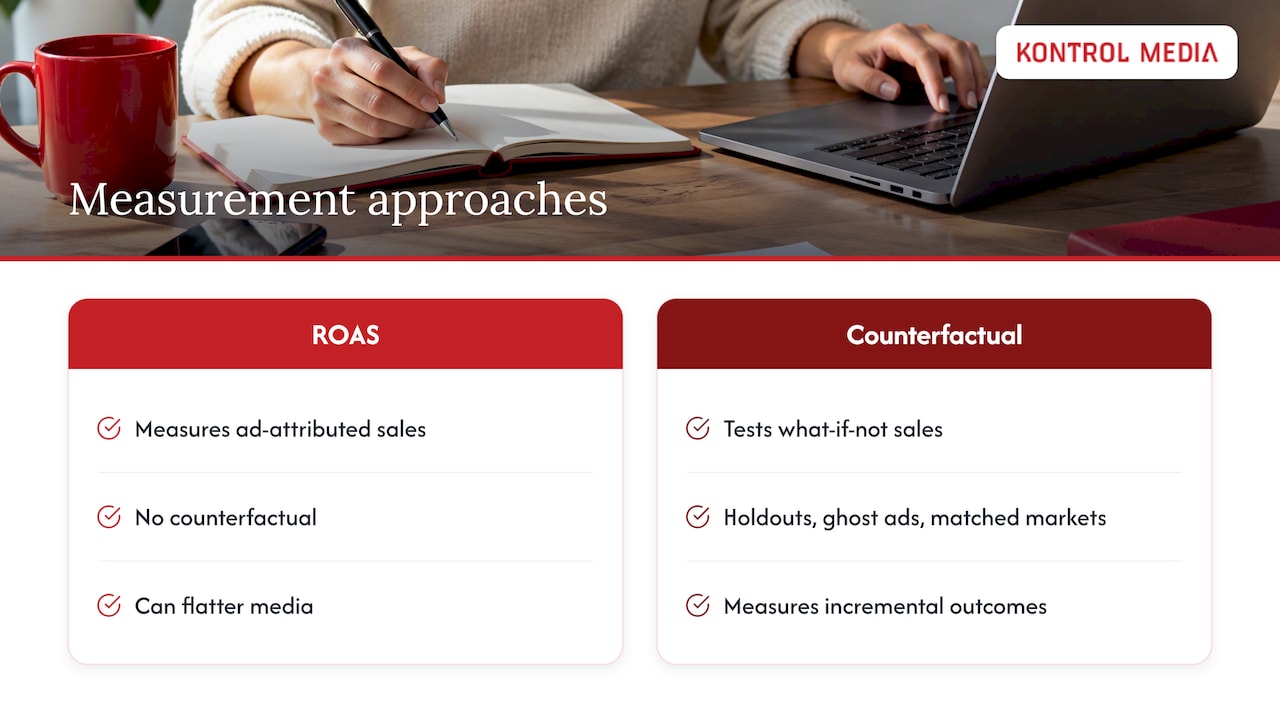
ROAS alone is the common trap. It tells a brand what sales were attributed to the ad, not what sales would have happened anyway. If a loyal customer was going to buy the product regardless, a high ROAS flatters the media and misleads the buyer. The more rigorous approach uses a counterfactual: holdout groups, ghost ads or matched-market tests that answer the “what if not” question. If you cannot explain that scenario to a brand’s growth lead, you will struggle to hold larger budgets.
This does not mean every deal needs a randomized trial. A small test budget does not justify one. It means you decide, per stage, which level of proof the deal deserves, and you say so in the proposal. For a deeper explanation, we cover what incrementality really means in retail media and how to measure iROAS on our site.
If the metric itself is still fuzzy for your team, a plain-language explainer on understanding ROAS is a useful refresher before you build pitch decks around it.
Prove value beyond the walls of your own site
Brands increasingly look at retail media through the lens of fragmentation and rising cost. The IAB’s January 2025 outlook release reflects a market where buyers want evidence that spend works across channels, not just on one property. A network that only reports on-site traffic is giving buyers half the story.
The IAB Europe survey makes a related point: mature teams have moved past simple on-site inventory. They combine first-party data activation, cross-channel reach including CTV and audio, and stronger measurement. If you sell offsite or cross-channel media, your pipeline needs a stage where you show how the on-site proof carries over. We lay out that sequence in proving onsite ROAS before scaling offsite, and the thinking behind a broader cross-channel strategy applies here too.
Settle data governance before the proposal
This is the unglamorous part that stalls deals. The IAB’s paper on issues in commerce media networks describes the prevailing legal construct: the network sets up a service provider or processor relationship with its ad tech providers for closed-loop activation and measurement. If that relationship is not clear, sharing individual-level data for attribution can be treated as a sale of personal information under privacy rules, which means excluding opted-out users and shrinking the audience you can sell.
I am not a lawyer, and you should not treat this as legal advice. Your counsel should confirm how the rules apply to your network and states. As a seller, though, the lesson is practical: raise data terms at Stage 3 and bring your legal contact into the conversation early. A deal that pauses for three weeks over a data clause is a deal that may not close in the quarter.
Pipeline numbers worth tracking
I like a short list of metrics because a long dashboard becomes decoration. These are the ones I would look at weekly.
| Metric | What it tells you | What to do when it slips |
|---|---|---|
| Stage-to-stage conversion | Where deals leak | Tighten the exit criterion at the stage before the drop |
| Deal velocity | How long deals sit at each stage | Look for missing decision makers or an unclear measurement plan |
| Pipeline coverage vs. target | Whether you have enough opportunities | Rebuild the target list, not the pitch |
| Win rate by deal type | Which offers fit your audience | Stop chasing the segments where you rarely win |
| Renewal and expansion rate | Whether your proof convinces | Review readouts and measurement terms |
A “full pipeline” is a vanity measure. A pipeline in which each deal has a named buyer, a next step with a date and an agreed measurement plan is a forecast.
What media sellers earn, and why it matters to your design
If you are staffing the function, compensation shapes behavior. The U.S. Bureau of Labor Statistics reports that the median annual wage for advertising sales agents was $64,820 in May 2025, with the lowest 10 percent earning under $35,240 and the top 10 percent above $146,010. That spread tells you something: the top of the range goes to people who can sell outcomes, not slots. If you pay purely on volume of insertion orders, you will get volume that does not renew. Consider tying part of the incentive to renewal or to campaigns that meet their measurement plan.
Our perspective: the pipeline is a trust-building machine
We have watched a lot of media sales teams stall, and the cause is rarely a lack of leads. It is that the pipeline was designed around the seller’s needs instead of the buyer’s decision. Brands today carry pressure from their finance teams to justify every dollar, and they are looking for a partner who will tell them honestly what worked.
That is why we build the strategy and the execution together. We have helped brands and agencies reach home buyers and homeowners through the real estate channel, and we build, operate and drive revenue for retail and commerce media networks. In both, the lesson repeats: the sale you make in January is only as strong as the readout you deliver in April. We also push clients to be candid when a brand is a poor fit. It feels like losing a deal, and it is actually protecting the next five.
The optimistic part is that the bar is clear. Networks that make measurement the center of the pitch, settle data terms early and treat renewal as a stage rather than an afterthought are the ones earning bigger, longer budgets, even as growth moderates.
— Mark Kapczynski
Where we can help
If you are standing up a network, we can help you stand up a retail or commerce media network, including the sales motion, packaging and measurement. If the network exists but revenue is flat, our retail media network operations work covers the day-to-day selling and execution. Brands and agencies who want to reach homeowners through real estate agents can start with our real estate channel programs. For the sales function more broadly, see our services.
For more on the selling side, our guides to retail media ad sales and advertising sales strategies for media networks go deeper on pitch and packaging.
A 30-day plan to rebuild your pipeline
If you want to start now, here is the sequence I would follow.
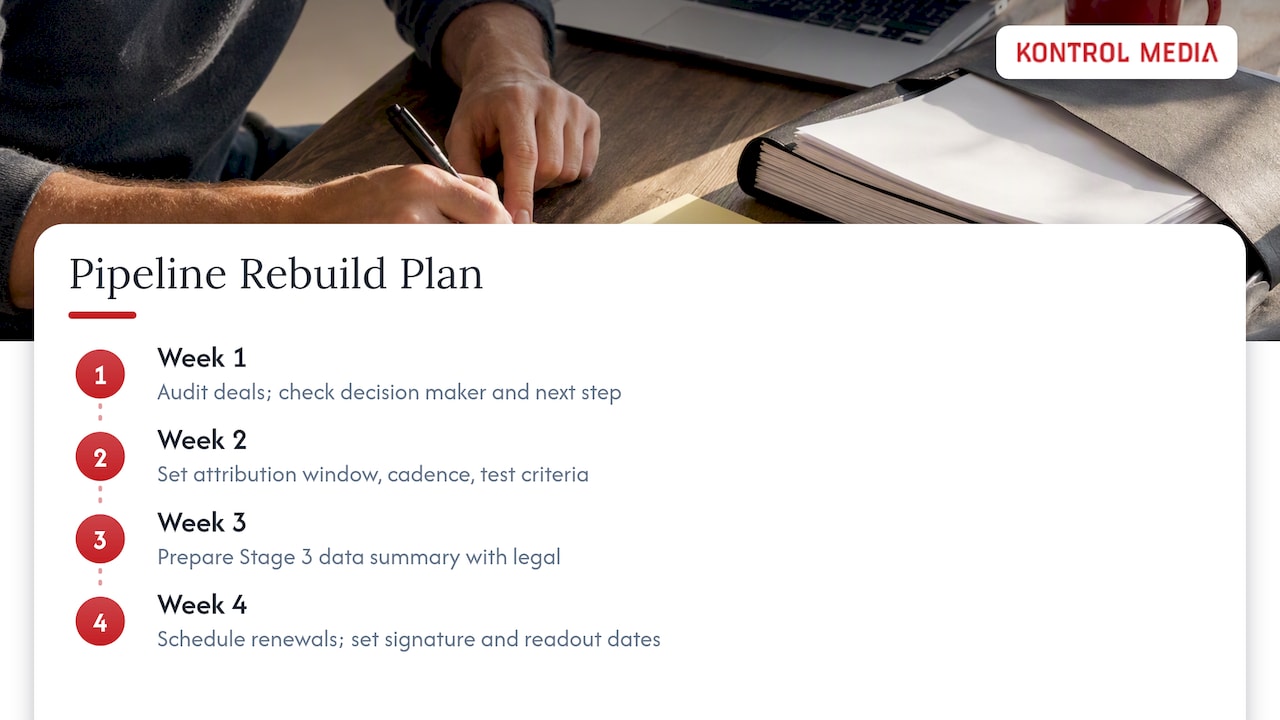
In the first week, audit every open deal against the exit criteria above. Anything with no named decision maker or no next step gets moved back a stage or closed out. You will probably lose a third of your pipeline on paper, and your forecast will get more honest.
In the second week, write a one-page measurement standard: your default attribution window, your reporting cadence and the conditions under which you recommend an incrementality test. Give every seller the same page.
In the third week, work with legal on a plain-language data summary you can share at Stage 3. It should explain what data is used, under what relationship and how opted-out users are handled.
In the fourth week, schedule renewal conversations for every live campaign, including the ones that just started. Put the date on the calendar at signature, and tell the brand when they will see the first readout. Buyers remember sellers who tell them the date and then keep it.
FAQ
What are the stages of a media sales pipeline?
Most media pipelines run through target and outreach, discovery, audience and data fit, proposal with a measurement plan, negotiation and close, activation and reporting, and renewal. The last three matter most in media, because repeat budgets depend on proven results. Give each stage an exit criterion so deals do not advance on optimism.
How is a media sales pipeline different from a standard B2B pipeline?
The product is audience access and proof of outcomes, and several buyers often weigh in, such as the brand, the agency and trade marketing. Measurement and data terms also have to be settled before the deal closes, not after. And the sale does not end at signature, since results drive renewal.
How much do media salespeople make?
The BLS reports a median of $64,820 for advertising sales agents as of May 2025, with the top 10 percent earning more than $146,010. Pay varies widely by employer, market and whether a role includes management duties. Marketing and sales managers had a higher median of $169,490 on the same BLS page’s data.
What is the 30-60-90 rule in sales?
It is a ramp plan, usually for a new seller or a new initiative: learn the product and accounts in the first 30 days, start running deals in the next 30 and own a full pipeline by day 90. For media sales, I would add a measurement checkpoint at each milestone, so the seller can explain how outcomes are proved before they pitch alone.
Sources
- Salesforce: What is a sales pipeline
- IAB 2025 Outlook Study, September 2025
- IAB Europe: Attitudes to Retail Media Report, July 2025
- IAB and IAB Europe: Guidelines for Incremental Measurement in Commerce Media, November 2025
- IAB: Untangling the Issues in Commerce Media Networks, June 2025
- U.S. Bureau of Labor Statistics: Advertising Sales Agents