


Audience extension in retail media uses a retailer’s first-party shopper data to reach that retailer’s customers on third-party sites, connected TV, and programmatic channels. You get known shoppers at scale beyond the store. The tradeoff is lower in-the-moment purchase intent than onsite impressions, and four levers narrow that gap: data quality, inventory and context, measurement, and creative.
TL;DR:
- Use behavioral segments built from loyalty, receipt, CRM, or point of sale records for conversion goals; verify refresh cadence and matching rates before activation.
- Buy placements near commerce content rather than relying on broad category labels, and request specific inventory lists from partners before launch.
- Set the KPI and incrementality question before buying, then require holdout groups, disclosed matching methods, and reporting on reach, viewability, and sales outcomes.
- Before signing, confirm shopper notice and consent, CCPA coverage, clean room privacy standards, auditable matching methods, and contractual data processing and retention terms.
- Match measurement windows to buying cycles: grocery shoppers return weekly, while apparel purchases may take days or weeks after browsing.
Table of Contents
- What is the difference between audience extension and onsite retail media?
- Why do marketers buy audience extension?
- How does retail audience data and segmentation work in practice?
- Why does audience extension underperform onsite, and how do you fix it?
- What should you check on measurement, attribution, and privacy before buying?
- How do you plan and run an audience extension campaign step by step?
- What do successful audience extension campaigns look like?
- What technology and platforms make audience extension possible?
- How does audience extension differ across retail verticals?
- How does audience extension fit into your wider marketing and sales plan?
- What does making audience extension work look like from the operator’s seat?
- How can Kontrol Media help you plan and run audience extension?
- FAQ
- Sources
What is the difference between audience extension and onsite retail media?
Think of audience extension as the retailer’s customer list taken on the road. Instead of showing an ad on the retailer’s own site or app, the retailer’s segments are activated across offsite display, social, connected TV, and programmatic deals. The shopper is the same person. The setting is not.
That setting matters. Onsite placements sit inside retailer properties, where a shopper is already browsing or buying. Offsite placements reach people while they read news, watch video, or scroll a feed, so the ad has to create the intent rather than catch it. We lay out the tradeoffs in more depth in our piece on proving onsite ROAS before scaling offsite.
You will typically see several activation paths, including direct matching of retailer IDs to a platform, secure clean room collaborations, and onboarding segments to a demand-side platform (DSP). Each carries different privacy, scale, and transparency tradeoffs.
Why do marketers buy audience extension?
The appeal starts with a belief that first-party data works. A 2025 BCG analysis reports that 86% of brand respondents find targeting through commerce and retail media powered by first-party data more effective than other digital advertising. BCG’s experts also argue the shift away from cookies lets retailers and brands stay relevant across the whole customer journey, not just at the point of sale.
In practice, audience extension can support several goals:
- Prospecting buyers who look like your best customers
- Cross-selling to shoppers who already buy from the retailer
- Running full-funnel campaigns where creative reflects what is actually in stock
The commercial logic is simple. Retailers monetize the data they own, and brands pay a premium for customer-level targeting and closed-loop measurement that cookie-based buying rarely offers.
How does retail audience data and segmentation work in practice?
Retail audiences are built from what shoppers actually do. The common first-party sources are:
- Loyalty program transactions
- Digital receipts
- CRM records
- In-store point-of-sale data
From there, the IAB/MRC guidelines describe audience measurement techniques that include demographic, geographic, behavioral, psychographic, and third-party segmentation. Behavioral segments tend to be the most useful for conversion goals, because they reflect real purchases. Demographic and geographic segments help with reach planning and local campaigns. Psychographic and third-party segments extend scale, though you should ask how they were matched.
Activation then happens in one of three ways. Direct matching ties retailer identifiers to platform IDs. Clean room analysis lets two parties compare cohorts without exposing raw data. Onboarding pushes a segment to a DSP or social platform for buying. Amazon describes one such pattern in its write-up on privacy-safe clean room collaboration, where data is analyzed without moving the underlying records.
Why does audience extension underperform onsite, and how do you fix it?
Industry reporting notes that audience extension often yields lower response than onsite impressions. The reason is intent. A shopper looking at a product page is close to buying. A shopper reading an article is not. Practitioner guidance in the IAB/MRC explainer makes the same point: offsite creative has to justify a shopping trip to the retailer.
The same Adweek analysis names four ways to raise performance. Here is what we ask partners for against each one:
- Data: How fresh are the segments, and how were they enriched or matched? Ask for refresh cadence and match-rate disclosure.
- Inventory and context: Can you buy placements that sit near commerce-relevant content rather than run-of-network? Ask for placement lists, not just category labels.
- Measurement: Will the buy include holdouts or incrementality tests? Ask how the control group is built.
- Creative: Does the message tie to a product, offer, or store action? Ask for versions that vary by availability.
Pro Tip: Before you approve a plan, ask each partner which of the four levers they control and which they only resell. The answer tells you where performance will actually come from.
What should you check on measurement, attribution, and privacy before buying?
Treat measurement as a purchase requirement, not a reporting afterthought. The IAB/MRC guidance stresses transparency in third-party matching and recommends disclosing measurement methodologies and privacy-safe clean room processes. A companion version of the guidelines recommends metrics such as unique visitors, viewable impressions, and dwell time, alongside conversion outcomes.
Before you sign, confirm the following:
- The partner discloses how third-party matching works and can support an audit
- Clean room data processing meets legal and privacy standards
- Reporting covers unique reach, viewable impressions, and outcomes, not impressions alone
- Shoppers received clear notice and consent, with CCPA considerations addressed
- The contract includes data processing terms and a retention limit
Attribution deserves extra skepticism. RetailX research flags it as a leading challenge for offsite buys. For a fuller look at what to demand, see our guide to retail media clean rooms and our rundown of key retail media metrics.
How do you plan and run an audience extension campaign step by step?
Work through the plan in order. Skipping ahead is how budgets get spent before anyone agrees on what success means.
- Define the business KPI and the incrementality question: sales lift, store trips, or awareness.
- Pick segments, and document where the data came from and how it will be matched.
- Choose inventory, and negotiate context and price together instead of price alone.
- Set the measurement framework, including holdout groups or incrementality tests.
- Design creative that connects offsite messaging to the retailer and a clear shopping action.
- Lock in reporting timelines, privacy clauses, and data retention terms.
Step four is the one teams skip most often, and it is the one that tells you whether the campaign worked or merely reached people who would have bought anyway. For more tactical depth on scaling beyond a pilot, our offsite retail media checklist walks retail leaders through the process.
What do successful audience extension campaigns look like?
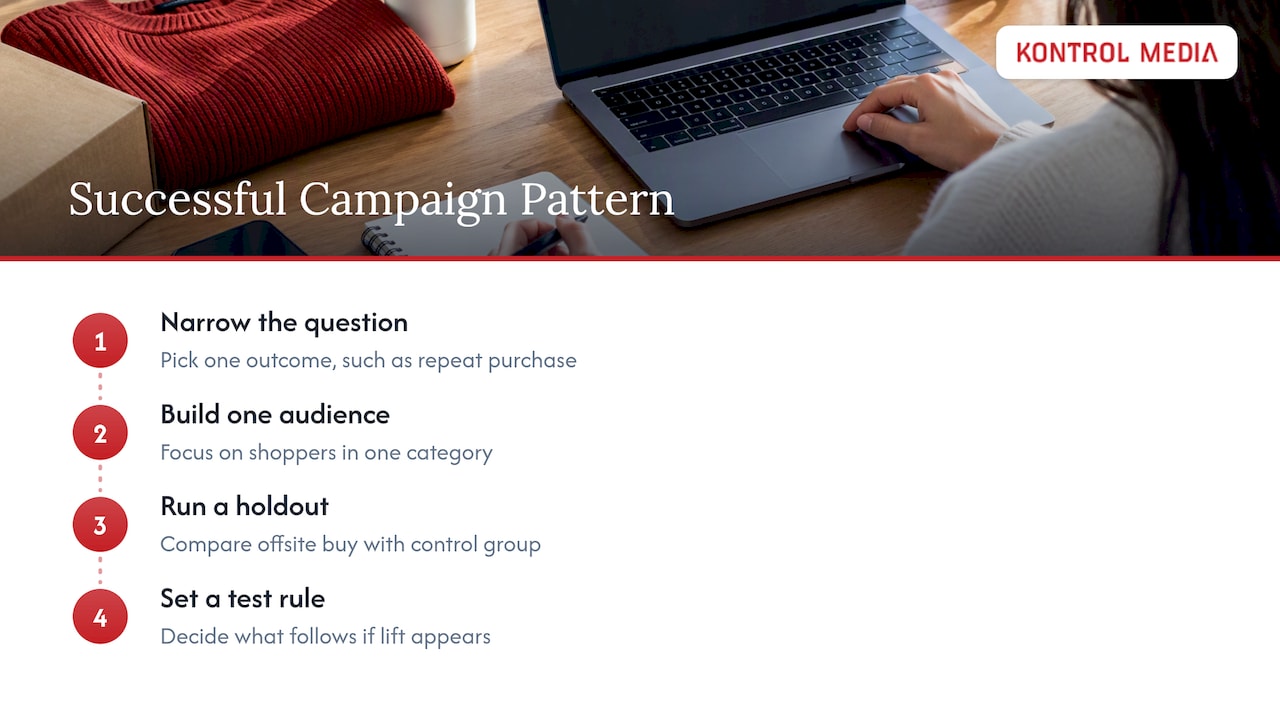
We will not point to a named campaign or a result we cannot source. What we can describe is the pattern behind the programs that hold up under scrutiny, because it repeats.
They start with a narrow question. A retailer or brand picks one outcome, such as lifting repeat purchase among existing shoppers in a category, and builds a single audience around it. They run the offsite buy against a holdout group so the lift is visible rather than assumed. And they treat the first campaign as a test, with a clear rule for what happens next if the lift shows up or does not.
Creative does real work in these programs. The weaker campaigns repeat an onsite banner on a news site and hope. The stronger ones change the message for the setting: a video spot on connected TV that shows the product in use, or a social placement that points to a specific offer or store location. That is the intent gap from earlier, closed on purpose.
Cross-channel planning helps too. If you are weighing how offsite activation fits alongside other channels, this cross-channel strategy guide offers useful background on building omnichannel plans.
When you evaluate case studies from any vendor, ask three things. What was the control? How long did the test run? And did the result hold when measured against sales rather than clicks? A case study that cannot answer those is a story, not evidence.
What technology and platforms make audience extension possible?
Several infrastructure layers sit behind a typical buy.
The first is the data layer: a retailer’s loyalty, receipt, and point-of-sale records, unified into customer profiles. The second is the collaboration layer, often a clean room, where a retailer and a brand compare audiences without exchanging raw data. The third is the activation layer, usually a DSP or a social platform, where segments become ad buys. The fourth is measurement, which ties exposure back to sales.
RetailX research identifies DSPs and video and social channels as key offsite routes, which matches what we see in the market. The practical question for you is not which logo is on the platform. It is which layer is the weak link. A strong DSP cannot fix thin data, and a rich dataset cannot help if the measurement layer cannot read outcomes.
Place-based screens add another option on the inventory side. Retailers extending beyond the web can also look at in-store and venue screens, and this look at digital signage as retail media covers how those placements work as an ad channel.
If a retailer is still deciding whether to build this stack or rent it, we cover that tradeoff in our retail media network setup guide.
How does audience extension differ across retail verticals?
The same tactic behaves differently depending on what the shopper buys and how often.
Grocery is high frequency and low consideration. Shoppers return weekly, so loyalty data is deep and segments refresh constantly. Audience extension here leans on repeat purchase and cross-sell: reaching a household that usually buys one brand and offering another, or reminding lapsed shoppers. The creative can be simple, because the decision is quick.
Apparel runs the other way. Purchases are less frequent, browsing is long, and style and price drive the choice. Behavioral and psychographic segments carry more weight, and offsite video or social creative often does the heavy lifting by building desire before the shopper returns. Measurement windows need to be longer, since a shopper may take days or weeks to buy.
A few differences are worth planning around:
- Purchase cycle: Short in grocery, longer in apparel, which changes how you set holdout and attribution windows
- Segment depth: Grocery has more transaction history per shopper; apparel often has more browsing signals
- Creative role: Reminder and offer in grocery, inspiration and consideration in apparel
We keep these as qualitative patterns because the sources we rely on do not publish vertical-by-vertical benchmarks, and we would rather say so than invent a comparison. The practical takeaway is to set expectations against your own category’s buying rhythm, not against a general retail average.
How does audience extension fit into your wider marketing and sales plan?
Audience extension works best when it is not a standalone line item. Treat it as one connector in a larger plan.
Start with the brand and sales link. Offsite reach builds familiarity among shoppers, and onsite placements, promotions, and in-store execution capture the demand it creates. If the offsite message promises something the shelf or product page does not deliver, you have paid for a disappointment. Aligning inventory feeds, promotions, and creative closes that loop.
Next, connect it to the rest of your media. Search, social, and email each touch the same shopper, so shared audiences and consistent frequency caps keep you from over-serving the same people. Dentsu frames retail media as driven by data and shopper experiences informed by customer insights, which is a useful reminder that the data should inform the whole experience, not only the ad buy.
Finally, connect it to sales. Share audience learnings with merchandising and category teams: which segments responded, which products pulled them back, and which offers moved them. Retail media spend keeps growing, as eMarketer’s spending forecast tracks, which only raises the stakes for tying it to commercial results.
For brands that are not retailers themselves, our retail media strategy for non-retailers shows how the same ideas apply.
What does making audience extension work look like from the operator’s seat?
The pattern we see is that audience extension rarely fails on the idea. It fails on the handoffs. Strategy lives in one team, data in another, creative in a third, and nobody owns whether the whole thing produced incremental sales. We have deep experience operating in retail and commerce media, and the lesson holds: pair measurement with creative and operations from day one.
If you have one clear question and a modest budget, run a pilot in-house. If you need networks, partners, and reporting stood up at once, bring in someone who has done it.
— Mark Kapczynski
How can Kontrol Media help you plan and run audience extension?
If you are a CMO or head of retail media who wants hands-on support, we can help you build the program and run it. We stand up retail and commerce media networks for retailers that want to monetize their data, and we handle retail media network operations day to day, from partner management to reporting. Our broader business strategy, marketing, and sales services cover the work around it.
Tell us what you want to prove and by when, and we will map the next step. Contact our team to start the conversation.
FAQ
What is audience extension in retail media?
Audience extension uses a retailer’s first-party shopper data to target that retailer’s customers on third-party sites, connected TV, and programmatic channels. It extends reach beyond the retailer’s own properties while keeping the targeting tied to real purchase and loyalty data.
Why does audience extension often underperform onsite ads?
Offsite audiences are usually not in a shopping mindset, so response tends to be lower than onsite impressions, as industry reporting notes. The recommended fixes are better data, inventory and context, measurement, and creative.
How should I measure audience extension performance?
Use incrementality tests or holdout groups, and report unique reach, viewable impressions, and conversions, following the IAB/MRC guidance. Ask partners to disclose their matching and measurement methods so the results can be audited.
What privacy checks matter before buying audience extension?
Confirm that shoppers received clear notice and consent, that CCPA obligations are addressed, and that your contract includes data processing and retention terms. Also ask how any clean room handles data, since transparency is a core theme of the IAB/MRC guidance.
Sources
- IAB/MRC Retail Media Measurement Guidelines Explainer
- Yes, Retailers Can Get Value From Audience Extension Ad Buys