


A channel partner strategy works when it produces partner-sourced revenue and proves itself with a real deal inside roughly 90 days. Before anything else, finalize your channel thesis, recruit a small cohort of ideal partners, and build an onboarding path aimed squarely at that first deal. Everything else, tiers, portals, certifications, comes after that proof point, not before it.
TL;DR:
- A channel partner strategy should prove itself with a real deal within 90 days, focusing on a small cohort and the first validated agreement.
- Program tiers must be based on validated performance, with clear support and incentives for each level, and formal deal registration and escalation processes are non-negotiable.
- Recruiting should follow a disciplined outbound approach, filtering prospects through reach, revenue potential, and reputation before investing onboarding resources.
- Onboarding must be fast and targeted, with clear tasks, simple collateral, and a structured 30/60/90-day cadence to ensure deal closure and partner engagement.
- Tracking only four key metrics—partner-sourced revenue, pipeline influence, activation rate, and cost per dollar—avoids overwhelm and supports rapid executive decision-making.
Table of Contents
- What Is a Channel Partner Strategy, and Which Partner Types Fit?
- Step 1: Set Your Channel Thesis and Program Goals
- Step 2: Design Your Partner Program Structure
- Step 3: Recruit Partners With a Real Outbound Playbook
- Step 4: Onboard Partners Toward a First Deal, Fast
- Step 5: Build Operations and Attribution That Survive a CFO’s Questions
- Step 6: Track the KPIs That Actually Matter to Executives
- Step 7: Govern the Program So It Scales Without Breaking Trust
- How Kontrol Media Approaches Channel Partner Execution
- Budgeting and Financial Planning for Channel Partner Programs
- Training and Certification Programs for Partners
- Effective Communication and Relationship Management Techniques
- Legal and Contractual Considerations in Channel Partnerships
- Co-Marketing and Joint Marketing Strategies With Partners
- The Mistakes That Quietly Kill Most Channel Programs
- Get Hands-On Help Building Your Channel Program
- Sources
- FAQ
What Is a Channel Partner Strategy, and Which Partner Types Fit?
A channel partner strategy is the deliberate plan for how outside organizations sell, service, or influence sales of your product instead of, or alongside, your direct team. A partner ecosystem is the broader web of relationships that plan operates inside, vendors, alliances, affiliates, all interacting under some shared set of rules. The strategy is the blueprint; the ecosystem is the neighborhood it gets built in.
Not every partner type solves the same problem. Match the model to the job:
- Value-added resellers (VARs) carry your product to market with their own services layered on top, good for complex sales requiring local presence.
- Managed service providers (MSPs) embed your product into ongoing service contracts, ideal for recurring revenue and low-touch retention.
- Systems integrators (SIs) handle large, technical implementations where deal size justifies deep enablement investment.
- Referral and affiliate partners send leads for a fee, low commitment, useful for expanding reach cheaply.
- Technology and ISV alliances integrate your product with theirs, expanding functionality rather than headcount.
- Strategic alliances pool resources toward a shared market opportunity, often the slowest to activate but the highest ceiling.
Step 1: Set Your Channel Thesis and Program Goals
Every strong channel program starts with a written thesis: which coverage gaps the channel fills, which segments it serves, and which buyer persona it reaches better through a partner than through your own sales team. Without that thesis, recruiting turns into a popularity contest, you sign whoever says yes, and many of them never produce a deal.
Once the thesis is clear, convert it into numbers finance will actually accept. That means defining partner-sourced ARR, partner-influenced pipeline, and cost per partner-sourced dollar in terms specific enough to survive a budget review, not just directionally “the channel is working.” Partnerships notes that keeping “sourced” and “influenced” revenue definitions defensible, backed by a deal registration process, is what earns continued executive buy-in.
Build the goal-setting sequence in this order:
- Write the thesis: name the segment, persona, and coverage gap the channel exists to close.
- Set an activation target for your first cohort aiming for one validated deal per partner within a few months.
- Set a medium-term target for partner-sourced revenue as a percentage of new bookings.
- Revisit both targets regularly against actual cohort performance, not against the original plan.
Step 2: Design Your Partner Program Structure
Program structure is where most channel partner strategies quietly fail. Leaders build elaborate tier systems before they have proof the model works, then wonder why partners disengage. Structure should follow validated performance, not precede it.
A three or four tier system, Core, Active, Affiliate, or the more familiar Silver, Gold, Platinum, works because it lets you allocate enablement resources where they earn a return. BDA’s partner ecosystem architecture frames this layered approach as a governance tool as much as an incentive one: higher tiers get more co-marketing dollars and faster support response, but only after they prove volume and reliability.
- Core tier: highest-volume, highest-trust partners get dedicated support, deal registration priority, and the richest margin or referral rate.
- Active tier: partners with a track record but lower volume get standard enablement and moderate incentives.
- Affiliate tier: low-commitment referral partners get self-serve tools and a flat referral fee.
Test your economics before you publish them. Model whether a referral fee, a margin split, or a co-sell revenue share actually leaves the partner with a profit worth their sales team’s time, not just worth yours.
Three non-negotiables protect the whole system from collapsing into conflict: deal registration for every opportunity, written clarity on who owns which part of a co-sell motion, and a named escalation path when two partners claim the same account.
Pro Tip: Publish your deal registration rules on one page. If a partner has to ask what counts as a “registered” deal, the rule is too complicated to survive contact with reality.
Step 3: Recruit Partners With a Real Outbound Playbook
Recruiting a channel partner is a sales motion, not a networking exercise, and it should be run with the same discipline as a sales pipeline. Alex Berman’s guide to strategic partner management recommends treating outreach as a short, partner-first pitch centered on what the partner earns, not on your product’s feature list.
Score every candidate against a simple filter before you invest a single hour:
- Reach: does this partner already sit in front of your target buyer?
- Revenue potential: could this relationship plausibly produce a deal size worth the enablement cost?
- Reputation: would this partner’s name attached to yours help or hurt you with buyers?
Salesforce calls this the 3R model, and it holds up because it filters out the enthusiastic-but-wrong partners before they eat your onboarding bandwidth.
Build your outreach list, send a short pitch focused on partner economics, ask for one low-friction next step, a 20-minute call, not a signed agreement, and follow up on a set cadence. Start with five to ten partners. Practitioner guides on B2B channel programs consistently recommend proving the model with three to five active partners before scaling recruitment further.
Step 4: Onboard Partners Toward a First Deal, Fast
Time-to-first-deal is the single number that predicts whether a partner relationship survives its first year. Design onboarding around it explicitly: a clear first task, a named internal contact the partner can actually reach, and a registration form that takes minutes, not days.
Enablement collateral needs to be built for speed, not comprehensiveness:
- A one-page value proposition the partner’s sales team can memorize.
- A short pitch script and objection-handling battlecard.
- A demo checklist so a partner rep can run a credible walkthrough without your team in the room.
- Co-marketing templates ready to customize, not build from scratch.
Microsoft’s partner training programs illustrate how larger ecosystems formalize this with structured cloud solution provider tracks, but the underlying principle scales down fine: training exists to get a partner to a deal faster, not to check a box.
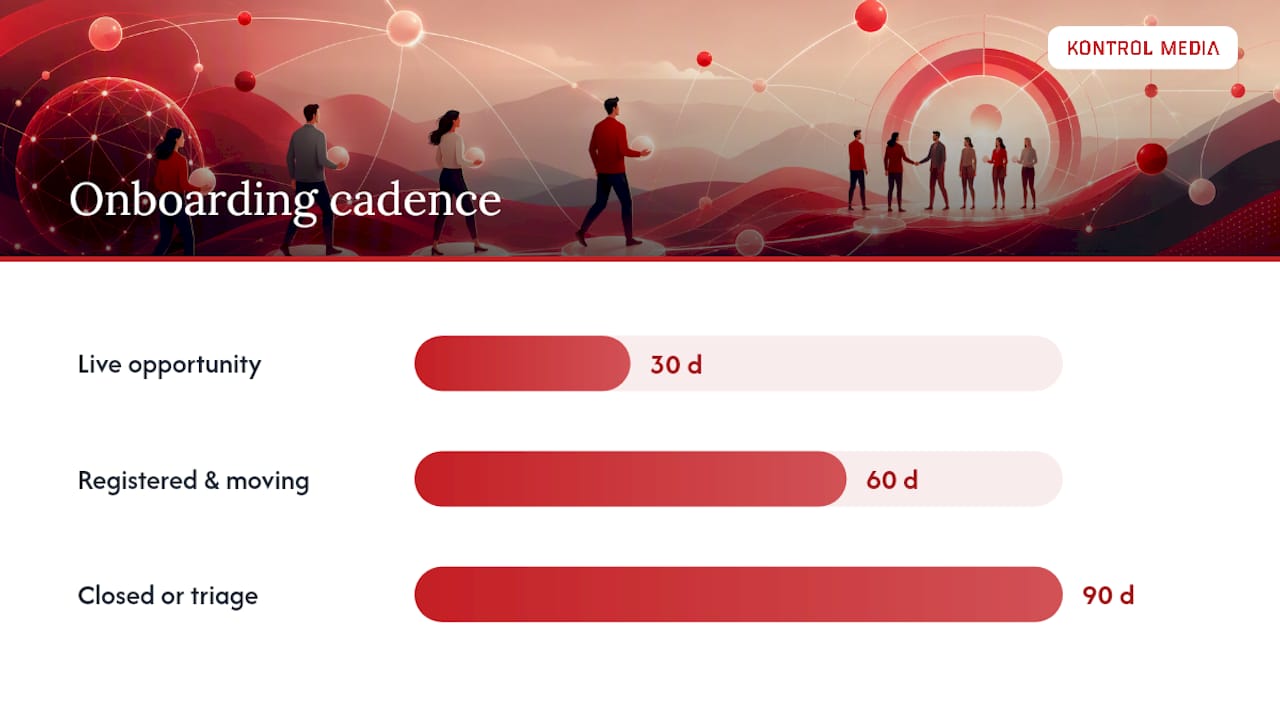
Run a 30/60/90 touchpoint cadence. At 30 days, confirm the partner has a live opportunity in the pipeline. At 60, confirm it’s registered and progressing. At 90, either it closed, and you have proof, or it didn’t, and that’s your signal to triage. Deep-knowledge patterns among experienced partner teams show that onboarding built specifically to produce one concrete joint deal drives materially better activation and retention than generic training.
Pro Tip: If a partner hasn’t touched a real opportunity by day 45, don’t wait for day 90 to intervene. Call them.
Step 5: Build Operations and Attribution That Survive a CFO’s Questions
Partner data scattered across spreadsheets, email threads, and a partner’s own CRM guarantees an attribution fight the moment finance asks where partner revenue actually came from. Keep partner records, deal registrations, and revenue outcomes inside one integrated CRM and partner relationship management (PRM) data model from day one.
The operational definition of “partner-sourced” revenue needs to survive scrutiny: it should mean a deal that was registered before your sales team engaged, with a timestamp and an audit trail, not a retroactive claim made after the deal closed. “Partner-influenced” is looser by design, but it still needs a documented touchpoint.
When evaluating tooling, focus less on brand names and more on functional fit:
- Native CRM integration so partner activity doesn’t live in a separate silo.
- Support for both high-touch enterprise motions and scaled, self-serve affiliate motions in the same system.
- Built-in deal registration workflows with approval routing and conflict flags.
G2’s research on sales enablement points to the same conclusion from the practitioner side: lifecycle support and integration matter more to program outcomes than any single platform’s feature list.
Step 6: Track the KPIs That Actually Matter to Executives
Executives don’t need a dashboard with forty metrics. They need four numbers that tell them whether the channel is worth the investment: partner-sourced revenue, partner-influenced pipeline coverage, active partner activation rate, and cost per partner-sourced dollar. Partnerships.ai’s KPI guide identifies these as the headline set that survives executive review, alongside supporting metrics like time-to-first-deal, revenue per active partner, and recruitment throughput.
Forrester’s research on partner ecosystems found that many organizations now expect meaningful year-over-year growth in indirect revenue, a signal that the channel is no longer a side motion for most B2B companies but a core growth lever.
Report on a cadence that matches the metric’s volatility:
- Weekly: deal registration approval rate, new opportunities logged.
- Monthly: activation rate by cohort, time-to-first-deal averages.
- Quarterly: partner-sourced revenue against target, cost per partner-sourced dollar, tier movement.
Present it as a one-page scorecard, not a report. If a metric needs a paragraph of explanation, it doesn’t belong on the executive version.
Step 7: Govern the Program So It Scales Without Breaking Trust
Growth without governance is how channel programs collapse under their own weight. Deal conflicts multiply, top partners get the same generic treatment as inactive ones, and margin erodes because nobody revisited who deserves which tier.
Run quarterly business reviews (QBRs) as genuinely two-way conversations: review actual numbers together, set joint goals for the next quarter, and agree explicitly on what support each side owes the other. A QBR that’s just your team presenting a dashboard isn’t a review, it’s a status update.
- Convene a small partner advisory council to surface friction before it becomes churn.
- Re-qualify tier placement annually against measurable criteria, not tenure or goodwill.
- Sunset partners with sustained low activity and reallocate that enablement budget toward partners actually producing deals.
BDA’s governance framework treats this kind of structured prequalification as what protects program economics as headcount and partner count both grow.
How Kontrol Media Approaches Channel Partner Execution
Most channel strategy documents die in a slide deck. The gap between a smart plan and a working program is almost always execution: who actually calls the first ten prospective partners, who builds the onboarding checklist, who chases the first deal to close. Kontrol Media’s work with brands entering the real estate agent channel follows the same sequence outlined above, thesis first, small cohort second, first-deal proof third, before ever discussing scale.
Various clients have relied on hands-on approaches because strategy alone does not move revenue; active efforts like running recruiting calls and building enablement kits are necessary.
Two checklists worth copying directly:
- Recruiting checklist: thesis defined, target list built, 3R score applied, pitch drafted around partner economics, follow-up cadence set.
- 90-day activation checklist: first task assigned, named contact confirmed, deal registered by day 30, progress checked by day 60, outcome logged by day 90.
Pro Tip: Treat the first cohort as a pilot you’re allowed to fail fast on. A partner that produces nothing in 90 days tells you as much as one that closes a deal.
Budgeting and Financial Planning for Channel Partner Programs
Channel programs get underfunded in year one and overfunded in year two, almost always because nobody built a budget tied to cohort outcomes. Start with the cost categories that actually drive activation rather than optics: recruiting time, onboarding collateral production, co-marketing funds, and whatever margin or referral spend your economic model requires.
Recruiting costs are mostly labor, someone’s time spent building lists, pitching, and following up, so budget it as a headcount fraction, not a line item that disappears into “marketing.” Enablement collateral (battlecards, demo scripts, portal content) is largely a one-time build cost with periodic refresh cycles, cheaper than most leaders assume once the first version exists.
Co-marketing and incentive dollars should scale with tier, not be spread evenly. A Core-tier partner producing consistent deals deserves a bigger joint marketing allocation than an Affiliate partner who has sent two leads all year. Flat-rate incentive pools across every partner regardless of output are one of the most common ways programs quietly burn budget on relationships that never convert.
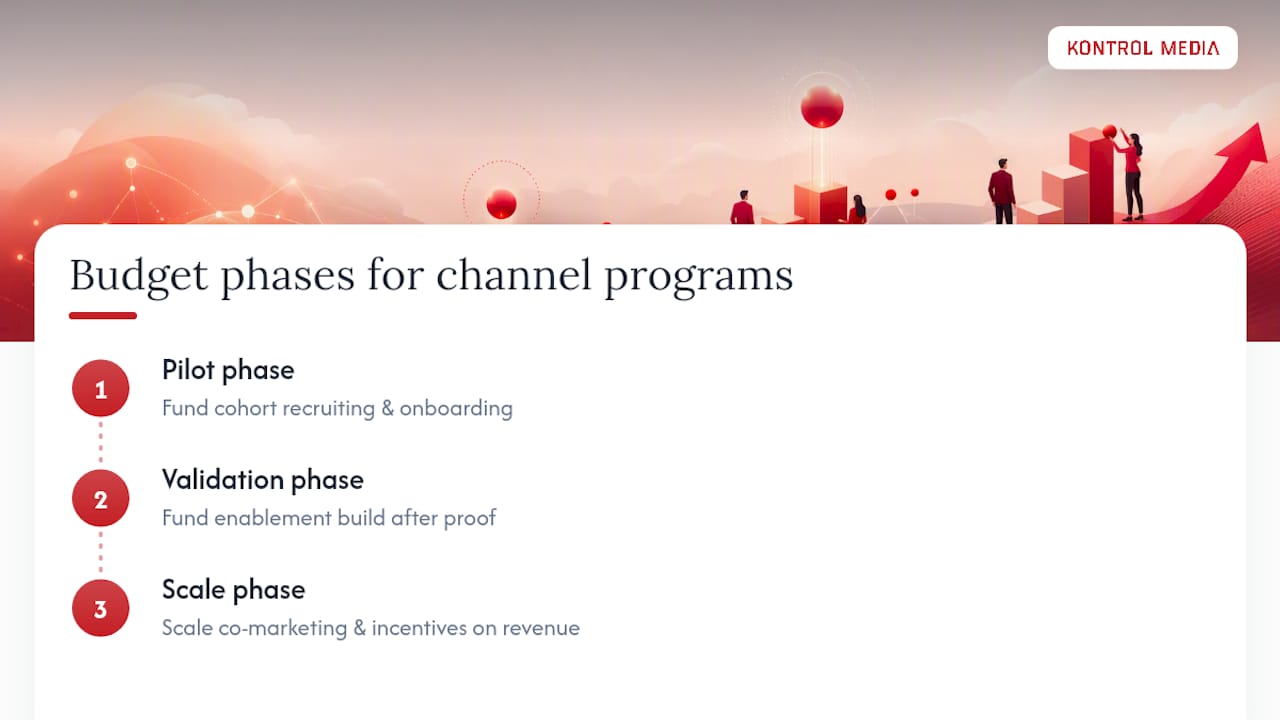
Build the budget around three phases rather than one annual number: a pilot phase covering your first cohort’s recruiting and onboarding costs, a validation phase where you fund the enablement build-out once a handful of partners prove the model, and a scale phase where co-marketing and tier incentives grow in proportion to partner-sourced revenue. Tie every phase’s spend to a specific metric threshold, don’t move to scale-phase budgeting until the pilot cohort has produced verified first deals.
Finance will ask for cost per partner-sourced dollar early and often. Have that number ready before you ask for a bigger budget, not after.
Training and Certification Programs for Partners
Training exists to shorten time-to-first-deal, not to demonstrate program sophistication. A certification track that takes a partner rep six hours to complete before they’ve sold a single deal is a filter against activation, not a support for it.
Structure training in layers matched to what a partner actually needs at each stage. New partners need a lightweight orientation, product basics, your ideal customer profile, and how deal registration works, deliverable in under an hour. Active partners producing deals earn access to deeper technical or vertical-specific training, the kind that helps them win larger or more complex opportunities. Core-tier partners might justify a formal certification, useful for partners whose own sales teams rotate staff and need a repeatable onboarding path for new hires.
Certification only pays off when it’s tied to something the partner values, priority deal registration, a better margin tier, or featured placement in a partner directory. Certification with no attached benefit becomes a compliance exercise partners quietly ignore.
Keep the format practical: short video modules, a live Q&A option for complex products, and a simple test that confirms comprehension rather than memorization. Larger partner ecosystems formalize this into structured tracks, similar in spirit to how cloud solution provider programs handle partner training at scale, but the underlying goal stays the same regardless of program size: get the partner competent enough to sell confidently, fast.
Effective Communication and Relationship Management Techniques
Partner relationships erode less often from bad economics than from silence. A partner who submits a deal registration and hears nothing for two weeks assumes you don’t care, whether or not that’s true.
Set a communication cadence and hold it. Weekly or biweekly check-ins for high-touch Core partners, monthly for Active tier, and a simple automated digest for Affiliate partners who need visibility without a standing meeting. The cadence matters more than the format, predictability builds trust faster than any single well-crafted email.
Give partners a single point of contact on your side who owns the relationship end to end. Partners who get bounced between sales, marketing, and support for different questions disengage faster than partners with an imperfect but consistent contact.
Communicate honestly about deal status, including bad news. A partner who hears “this opportunity stalled, here’s why” trusts you more than one who hears nothing until the deal quietly disappears from the pipeline. That honesty is also what makes your QBRs productive instead of adversarial, nobody is surprised by numbers they’ve already been told about.
Finally, ask partners what they need before assuming you know. A five-minute conversation at the 60-day touchpoint about what’s slowing their sales process usually surfaces a fix your team can make faster than any formal survey would.
Legal and Contractual Considerations in Channel Partnerships
Every channel partnership needs a written agreement, even with partners you trust completely, because verbal understandings collapse under pressure the moment a disputed deal or a departing employee is involved.
Core contract elements to get right from the start include a clear definition of the partner relationship type (reseller, referral, integration), payment terms tied to specific triggers (closed deal, invoiced revenue, verified registration), territory or account protections that prevent overlap disputes, and termination clauses that specify notice periods and what happens to in-flight deals when a relationship ends.
Deal registration terms belong in the contract itself, not just in a portal’s help documentation, because that’s what gives you standing if a dispute over a claimed opportunity ever escalates. Intellectual property and confidentiality clauses matter more than most leaders initially assume, particularly for technology alliance and co-sell relationships where product roadmaps or customer data might be shared.
Non-solicitation and non-compete language needs care. Overly aggressive restrictions discourage otherwise strong partners from signing, while language that’s too loose leaves you exposed if a partner starts favoring a competitor’s product mid-relationship.
Have legal counsel review your master partner agreement template once, then reuse it consistently rather than negotiating bespoke terms with every new partner. Bespoke contracts slow recruiting to a crawl and create inconsistent obligations across your partner base that are difficult to manage at scale.
Co-Marketing and Joint Marketing Strategies With Partners
Co-marketing works when it’s built around what the partner’s audience actually wants, not around your product launch calendar. A joint webinar, a co-branded case study, or a shared email campaign only performs well if the partner’s audience sees genuine value, not a thinly disguised sales pitch for your product.
Build a simple menu of co-marketing options tied to tier, so partners know what’s available without a custom negotiation every time. Core-tier partners might get co-funded campaigns and joint sales collateral; Active-tier partners might get access to templated co-branded assets they customize themselves; Affiliate partners might get a shared social post template and nothing more resource-intensive.
Joint content performs best when it leads with a customer problem rather than either brand’s positioning. A co-authored guide solving a specific buyer challenge earns more engagement than a press-release-style announcement of the partnership itself.
Track co-marketing performance the same way you track sales KPIs, leads generated, pipeline influenced, and ideally revenue attributed, so budget renewal decisions are based on results rather than partner tenure or relationship warmth. A tool like a unified marketing dashboard can help consolidate that reporting across multiple partner campaigns instead of tracking each one in a separate spreadsheet.
Set expectations upfront about who approves messaging, who owns the creative assets afterward, and how leads generated from joint campaigns get split or routed. Ambiguity here creates friction fast, especially once a co-marketing campaign actually generates leads both sides want credit for.
The Mistakes That Quietly Kill Most Channel Programs
Four mistakes show up in nearly every stalled channel program I’ve studied. Leaders chase vanity metrics, partner count, signed agreements, instead of partner-sourced revenue. They recruit before writing a thesis, so nobody can explain why a given partner should work. Rules of engagement stay vague until the first deal conflict forces a scramble. And time-to-first-deal gets ignored until a partner has already quietly disengaged.
Fix three things first: write the thesis before recruiting anyone, launch a small cohort instead of a broad push, and build onboarding around getting one real deal fast. Everything else in a channel partner strategy is refinement. Those three decisions are the ones that determine whether the program survives its first year.
— Mark Kapczynski
Get Hands-On Help Building Your Channel Program
Some consultancies offer leadership teams more than just strategy decks by building the thesis, managing recruiting calls, and supporting through the first-deal proof point rather than handing off a plan and walking away. That hands-on execution model comes from the same playbook used across real estate agent channel partnerships, retail media network operations, and go-to-market work for brands ranging from PE portfolio companies to enterprise marketers.
If your channel program has a plan but no first deal yet, or no plan at all, that’s exactly the gap Kontrol Media closes. The team runs program audits, designs the pilot cohort, and operates onboarding through that critical 90-day window so the proof point actually lands. Start with a business strategy consulting engagement built around your specific channel thesis, cohort size, and revenue targets, then scale once the first deals are real.
Sources
For deeper reading on the frameworks referenced above: Forrester’s state of partner ecosystems research covers indirect revenue growth trends; Salesforce’s partner ecosystem blueprint details the 3R partner evaluation model; BDA’s partner ecosystem architecture explains tiered governance; and Partnerships.ai’s KPI guide breaks down the metrics executives expect.
FAQ
What Are the Six C’s of Channel Strategy?
Definitions vary across practitioners, but common versions include customer, category, capability, channel conflict, cost, and control, the factors leaders weigh when deciding how a product should reach the market through partners.
Can You Give an Example of a Channel Partner?
A managed service provider that bundles your software into its own client contracts is a classic channel partner. So is a real estate agent who refers a home buyer to a brand’s product as part of a marketing partnership, a model Kontrol Media builds directly for clients.
Can You Give an Example of a Channel Strategy?
A software company might build a channel strategy around regional systems integrators who handle complex implementations the vendor’s own sales team can’t cover profitably, combined with a lighter referral-affiliate tier for smaller accounts.
What Are the Disadvantages of Channel Partners?
Channel partners introduce less direct control over the customer experience, create potential for deal conflict between partners and internal sales teams, and require sustained enablement investment before they produce reliable revenue. Poorly governed programs can also dilute margin faster than direct sales would.
How Long Should It Take to See a Result From a New Partner?
A well-run onboarding process should produce a validated first deal within about 90 days; partners who haven’t touched a real opportunity by that point usually need direct intervention or reassignment to a lower tier.