


The campaign that works is a direct-mail-led, three-touch sequence launched inside the 30 to 90 day window after a home purchase closes, backed by email, SMS, and targeted display for reinforcement. Every mail piece should carry one offer and one call to action, not three. If you want a proof of execution rather than a theory, that’s a model agencies build and run for clients.
TL;DR:
- React quickly within 30 to 90 days after a move, using a three-touch direct mail sequence supported by email, SMS, and display retargeting.
- Combine NCOA change-of-address and county deed records to capture movers faster and more reliably, minimizing lag and missed households.
- Use personalized messaging with neighborhood references and single offers, focusing on urgent services or inspections tailored to the housing type.
- Match creative, offers, and timing across channels with a strict three-week schedule and frequency cap to maximize response rates.
- Collaborate with real estate agents and local businesses for broader reach and streamlined access to new homeowners before competitors can.
Table of Contents
- New Homeowner Marketing Starts With the Right Sequence
- When Should You Mail to New Homeowners?
- Where Should You Source New Homeowner Lists?
- What Creative and Offer Actually Convert New Homeowners?
- How Do You Measure a New Homeowner Campaign?
- How Kontrol Media Runs New Homeowner Programs
- Compliance and Privacy Considerations in Homeowner Marketing
- Cross-Promoting With Local Businesses Multiplies Reach
- Author Perspective: Timing Beats Perfection
- Build and Run Your Program With Kontrol Media
- Sources
- FAQ
New Homeowner Marketing Starts With the Right Sequence
Most campaigns fail before the creative ever gets tested, because the sequence itself is wrong. New movers overwhelmingly choose whichever vendor reaches them first in a given category, according to industry data compiled by Town Hall Guide, which puts that figure between 80% and 85%. Speed to first contact is the whole game.
Here is the priority order for building a program that actually converts:
- Lock the timing window. Plan around three touches landing between day 30 and day 90 post move, not spread across six months. Waiting past 90 days means a competitor already got there.
- Build the list from two sources, not one. Combine NCOA change-of-address data with county deed records so you catch movers who show up in one feed before the other.
- Personalize below the household level. Reference the neighborhood by name and, where the print run allows, the housing type or build era using variable data printing.
- Design one offer, one CTA. A dollar-off service, a free inspection, or a first-visit discount, with a single validity window and a single phone number or code.
- Layer in digital reinforcement. Email and SMS follow-up, plus IP-matched display retargeting, should echo the mail piece’s message rather than introduce a new one.
- Segment before you print. First-time buyers, repeat buyers, and new-build residents respond to different offer framing, and lumping them together dilutes response.
- Test one variable at a time. Run a creative A/B test in one wave and an offer-value split in the next, never both simultaneously.
New buyers also spend heavily in that first year, averaging close to $26,882 on appliances, furnishings, and remodeling for newly built homes, against roughly $18,673 for existing-home buyers. That gap is the reason new-build residents deserve their own creative track.
When Should You Mail to New Homeowners?
List source determines your starting line. NCOA change-of-address records typically populate within 7 to 21 days of a move, while county deed recordings often lag 14 to 45 days depending on the jurisdiction’s processing speed. Combining both feeds closes the gap that either one leaves open on its own.
A workable three-touch schedule looks like this:
- Week 2 to 4: Welcome postcard introducing the business and a low-friction offer, sourced from the earliest NCOA hit.
- Week 6 to 8: Reinforcement mailer with a stronger, time-boxed incentive, cross-referenced against deed records to catch anyone missed in wave one.
- Week 10 to 12: Conversion piece with a final deadline and a clear next step, paired with a matching email and SMS send.
Multi-touch sequences inside this window lift response rates 40% to 60% over a single drop, based on production data from the Mail Production Association. Email and SMS should never carry a separate message; they exist to remind the household that the mail piece is real and the offer is live. Display retargeting matched to the mailing IP range extends reach without adding a new creative concept. Cap frequency at two to three exposures per channel per wave, and rotate creative every cycle so the same household never sees an identical piece twice.
Where Should You Source New Homeowner Lists?
List quality decides whether the rest of the campaign even has a chance. Three sources dominate this category, and each has a different tradeoff between size, freshness, and cost.
- NCOA data gives you the fastest signal, often within three weeks of a move, but it can miss homeowners who file changes late or not at all.
- County deed records are the most reliable confirmation of an actual sale, though the recording lag varies by county and can run past a month.
- Proprietary new-homeowner lists, often built by combining both feeds with additional enrichment, tend to run smaller than general mover lists but convert at a noticeably higher rate because every record is verified against an actual transaction.
Enrichment should focus on phone number, email, and property attributes like square footage or build year, since those three fields drive both segmentation and match rates for digital retargeting. Expect match rates to vary by vendor and region, so test a sample file before committing to a full list buy.
Suppression matters as much as sourcing. Strip existing customers, anyone contacted in the last 90 days through another campaign, and any do-not-mail flags before the file goes to print. Deduplicate across NCOA and deed sources every cycle, because the same household frequently appears in both.
Pro Tip: Automating the deed and NCOA monitoring process, rather than pulling lists manually once a month, is often what separates a campaign that reaches homeowners first from one that arrives after a competitor already booked the job. Practitioner data on this exact gap comes from Shovld’s analysis of homeowner outreach timing.
What Creative and Offer Actually Convert New Homeowners?
The welcome message template matters less than the specificity inside it. “Welcome to Oakwood Park” beats “Welcome to your new home” every time, and pairing that neighborhood reference with a relevant offer for the housing stock in that area (an HVAC inspection for ranch homes built between 1998 and 2004, for instance) raises perceived relevance without any added production cost.
Offer type should track the mood of the market. Homeowners in 2026 are prioritizing necessary repairs and preventative maintenance over discretionary upgrades, according to Angi’s state of home spending pulse report, which means framing a service as solving a real problem outperforms framing it as a luxury add-on.
- Dollar-off service offers work best with a 14 to 30 day validity window that creates urgency without feeling arbitrary.
- Free inspections perform well as a first-touch offer, since they carry no perceived risk for a household still unpacking boxes.
- First-service discounts suit the reinforcement or conversion touch, once the household already recognizes the brand name.
Design rules stay simple: one CTA, one phone number or code, and a visible trust signal like a local address or years in business. Use photo creative when showcasing an actual finished job; use illustration only when no real photo exists, since stock imagery reads as generic to a household that just toured a dozen real properties.
How Do You Measure a New Homeowner Campaign?
Single-drop mail campaigns to new movers typically post lower response than a properly sequenced three-touch program, which is the whole argument for cadence over volume. Track these four numbers on every wave:
- Response rate, measured by unique code or landing page visits against pieces mailed.
- Booking conversion, the share of responders who actually schedule a service or make a purchase.
- Cost per acquisition, factoring in list cost, print, postage, and digital reinforcement spend combined.
- Projected lifetime value uplift, since new homeowner spending patterns in the first year suggest a higher long-term value than average acquisition cohorts.
Attribution gets easier with promo codes unique to each wave, dedicated landing page URLs per mail drop, call tracking numbers tied to each creative version, and IP-matched digital impressions cross-referenced against the mail file. When response underperforms, check list freshness first, then message, then offer value, then cadence, in that order. Freshness problems mimic creative problems more often than marketers expect.
How Kontrol Media Runs New Homeowner Programs
Some consultancies build and operate new-mover programs end to end, combining strategy work with hands-on execution and real estate agent partnerships that extend reach beyond a standalone mail drop. That combination matters because most in-house teams can design a good postcard but struggle to keep list ingestion fast enough to win the first-touch race.
A practical way to decide whether to run this in-house or bring in outside help:
- Run it in-house if you have fewer than a few hundred new-mover records a month and an existing CRM that already ingests NCOA or deed feeds automatically.
- Bring in a specialist if speed to first touch is inconsistent, if list volume is scaling past what a marketing coordinator can manage manually, or if you need agent-channel partnerships to widen the funnel.
Case results and specific client benchmarks vary by market and category, and providers can discuss comparable engagement outcomes during a scoping conversation.
Compliance and Privacy Considerations in Homeowner Marketing
Direct mail carries fewer restrictions than digital channels, but that doesn’t mean anything goes. Deed records and NCOA data are public or licensed data sources, so using them for mail targeting is standard industry practice. The moment you layer in email or SMS, though, different rules apply.
Email sends require compliance with the CAN-SPAM Act, meaning every message needs a working unsubscribe link, accurate sender information, and no deceptive subject lines. SMS marketing falls under the Telephone Consumer Protection Act, which generally requires prior express consent before you text a new homeowner, even if you obtained their name and address through a public deed record. That consent gap is where a lot of well-intentioned campaigns get into trouble: owning an address is not the same as having permission to text that household.
Display retargeting matched to a mailing address or IP range should stay within the platform’s own data-use policies, since most major ad networks restrict how offline data can be onboarded for targeting. Keep a clean suppression list for anyone who opts out of any channel, and honor that opt-out across mail, email, and SMS simultaneously rather than channel by channel.
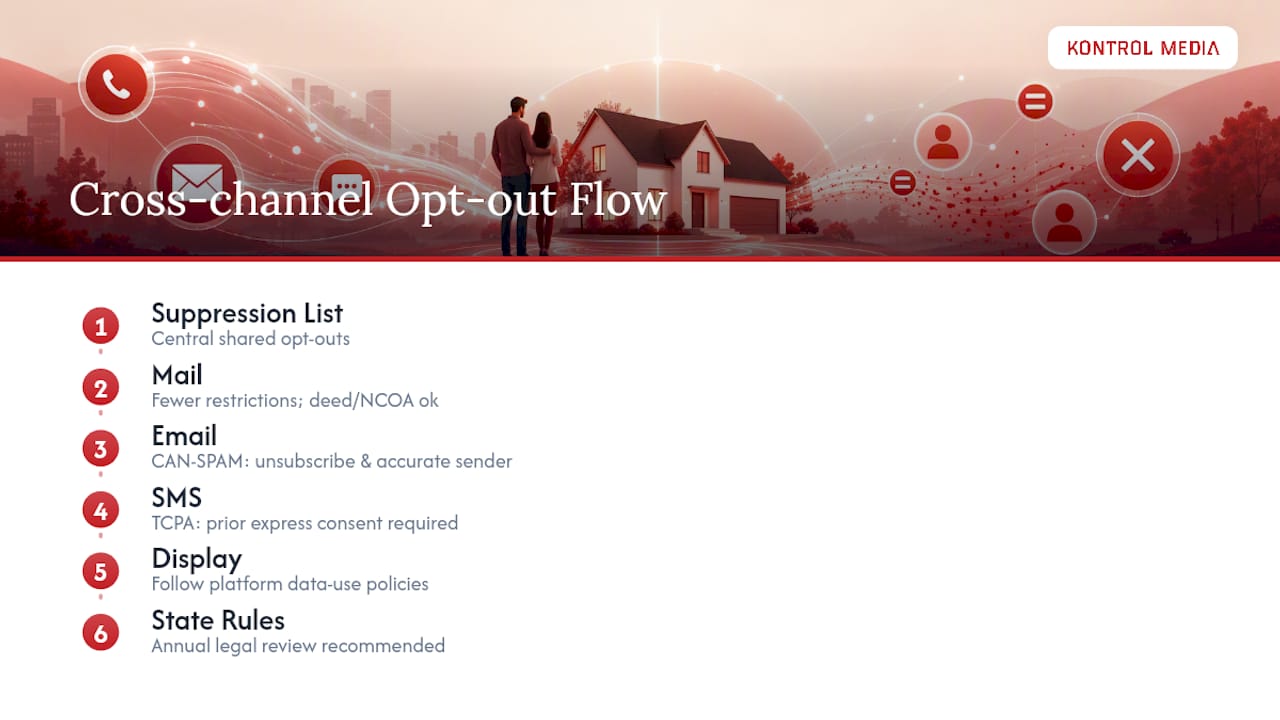
State-level rules add another layer. A handful of states have their own consumer privacy statutes that affect how personal data, including property records used for marketing, can be stored and shared. If your program pulls in county-level data across multiple states, it’s worth having legal counsel review your data handling process at least once a year, since the regulatory landscape shifts faster than most marketing calendars account for.
Cross-Promoting With Local Businesses Multiplies Reach
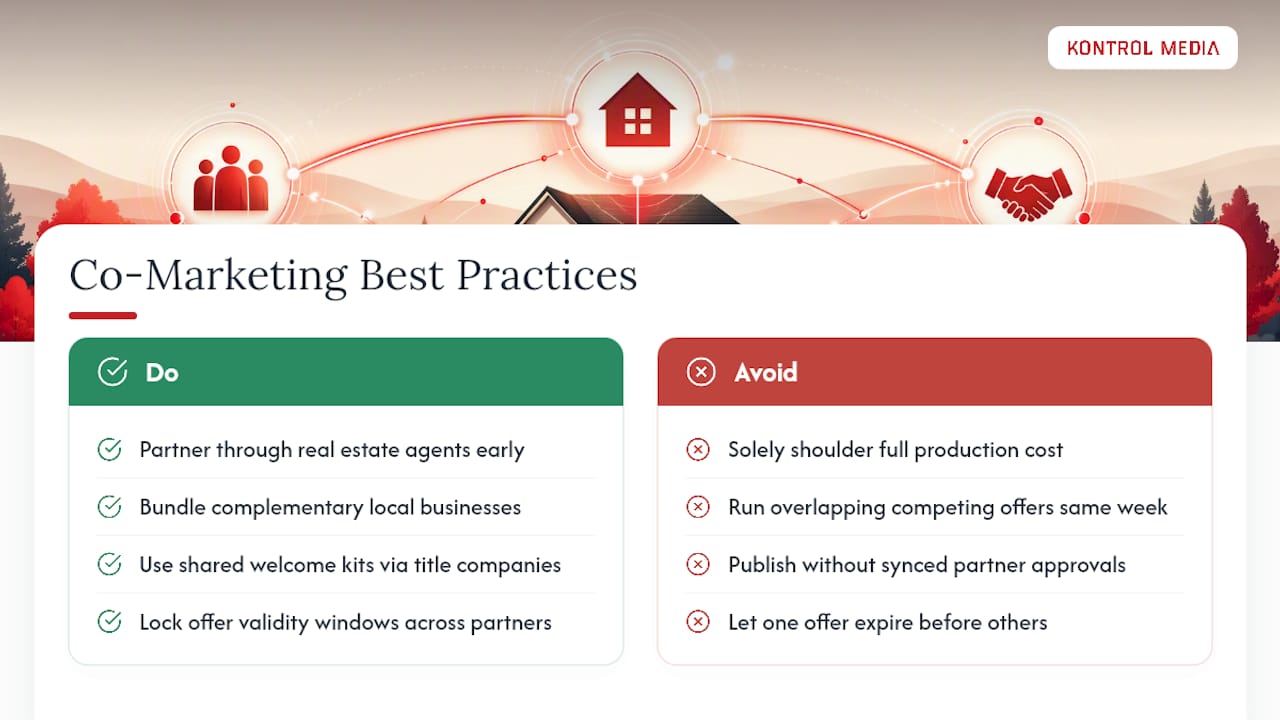
New homeowner spending doesn’t stay in one category. A household that just closed on a house is simultaneously shopping for movers, painters, landscapers, and furniture, which makes co-marketing one of the most underused tactics in this space. A single welcome mailer can carry offers from two or three complementary local businesses, splitting the print and postage cost while giving each recipient more reason to keep the piece instead of tossing it.
Real estate agents sit at the center of this network, since they already have a relationship with the buyer before the deed even records. Structuring a partnership through the agent channel gives a business earlier access to new movers than any public list can provide, because the agent knows about the sale before it becomes public record.
Beyond agents, local HVAC companies, landscapers, moving services, and home security providers make natural bundling partners because their offers rarely compete for the same wallet share in the same week. A shared welcome kit distributed through a title company or closing attorney can reach every new homeowner in a coverage area without either partner shouldering the full production cost. The tradeoff is coordination. Co-branded creative takes longer to approve, and one partner’s offer expiring before another’s can confuse the recipient, so lock validity windows to match across every logo on the piece before it goes to print.
Author Perspective: Timing Beats Perfection
Run a pilot before hiring outside help if your list volume is small and your team can act within a week of a new deed hitting your feed. Bring in help the moment speed becomes the bottleneck, not the creative.
The most common mistake I see is building a beautiful mailer with three competing offers, then mailing it 120 days after the sale closes when the competition already won the job. List sourcing gets treated as an afterthought when it should be the first decision made. Fix that timing gap this week, before touching the creative at all.
— Mark Kapczynski
Build and Run Your Program With Kontrol Media
There are alternatives to hiring a traditional agency for new-mover acquisition: instead of a strategy deck that someone else has to execute, some firms offer teams that design the sequence, source the lists, and run real estate agent partnerships that get buyers contacted early.

A typical engagement starts as a pilot in one market, three touches, one offer, clean measurement, then scales into a standing program once the numbers hold up across a full quarter. If you’re weighing whether to build this in-house or hand it to a team that already runs it, request a scoping conversation and ask specifically about agent-channel partnerships for reaching new home buyers. That’s the fastest way to see whether a managed program beats what your team can build alone this quarter.
Sources
- Direct Mail for New Homeowners: 2026 Guide to the 90-Day Window | MPA
- What Do Home Buyers Purchase After They Move In – Eye On Housing
- ANGI 2026 state of home spending pulse report
- How to Contact Homeowners Before Competitors Win Them | Shovld Blog
FAQ
What makes a house sell quickly?
Pricing accurately for the local market, strong curb appeal, and professional photography drive faster sales, but for marketers targeting the buyers on the other side of that transaction, speed to first contact after closing matters just as much.
What is the first thing a new homeowner marketing campaign should do?
Confirm the move date through NCOA or deed records, then get a welcome mailer in the mail within the first 30 days, since multi-touch sequences in this window lift response 40% to 60% over waiting longer.
What are the main marketing strategies for reaching new homeowners?
The five that matter most are direct mail targeting the 30 to 90 day window, email and SMS reinforcement, display retargeting matched to the mail file, neighborhood-level personalization, and cross-promotion with real estate agents or local service partners.
How do you get more people to notice a new homeowner offer?
Combine a single, clear call to action with neighborhood-specific personalization and a validity deadline. Kontrol Media builds these sequences alongside real estate agent partnerships that put an offer in front of buyers earlier than a public-record list alone can reach.