


For holiday sales outreach, gamers respond best to game-native events, not banner ads. Prioritize in-game activations like limited cosmetics and quests, layer in rewarded ad placements, and pair both with creator tie-ins. Support that with targeted mobile ads and CRM follow-up once you’ve captured intent. The payoff is real: engagement and conversion both climb during the holiday window, when players have more time and more willingness to spend. The tactics that make this work, and the timeline for pulling it off, follow below.
TL;DR:
- Gamers are more receptive to holiday-themed offers and spend more time playing during December, leading to potential revenue uplifts of 16% to 45% with proper planning.
- In-game activations, rewarded ads, creator partnerships, and targeted CRM outreach are essential channels, requiring careful integration and timing for effective results.
- Measuring success relies on KPIs like conversion rate, ARPU, retention, and pass uptake, using holdout groups and multivariate pricing tests to isolate campaign impact.
- Operational coordination and expert support are critical, especially in the final weeks, to ensure campaign timing, creative alignment, and compliance, avoiding last-minute failures.
Table of Contents
- Why Targeting Gamers for Your Holiday Sales Outreach Works Right Now
- Core Channels for Engaging Gamers During Holidays
- Planning Your Holiday Gaming Campaign Timeline
- Measuring Whether Your Holiday Gamer Outreach Actually Worked
- A 7-Step Playbook for Reaching Gamers This Holiday Season
- What Coordinating Holiday Gamer Campaigns Actually Requires
- How Help Is Provided to Execute Holiday Gamer Campaigns
- Sources
- FAQ
Why Targeting Gamers for Your Holiday Sales Outreach Works Right Now
Gamers change their behavior in December in ways most marketers underestimate. Playtime rises, spending intent rises with it, and receptivity to holiday-themed offers goes up alongside both. Gameloft’s own in-game research found that nearly half of gamers spend more time playing during the holidays, and that a large share become more open to rewarded ad formats during that stretch.
Statistic Callout: Well-timed LiveOps events tied to holiday windows have driven revenue uplifts of roughly 16% to 45% for titles that treat seasonal planning as a system rather than an afterthought.
That uplift range matters because it separates disciplined holiday marketing for gamers from campaigns bolted on at the last minute. More free time and more discretionary spend widen the funnel, but they also widen the field of competitors chasing the same eyeballs. Every publisher and every brand is running a holiday push at once, which means fair monetization, no pay-to-win mechanics, no predatory pricing, isn’t optional. Burn goodwill in December and you’ll pay for it in January retention.
Core Channels for Engaging Gamers During Holidays
Four channels do most of the work in gaming holiday promotions: in-game activations, rewarded ad placements, creator partnerships, and CRM-driven outreach. Each has a distinct job, and mixing them badly is the most common mistake brands make.
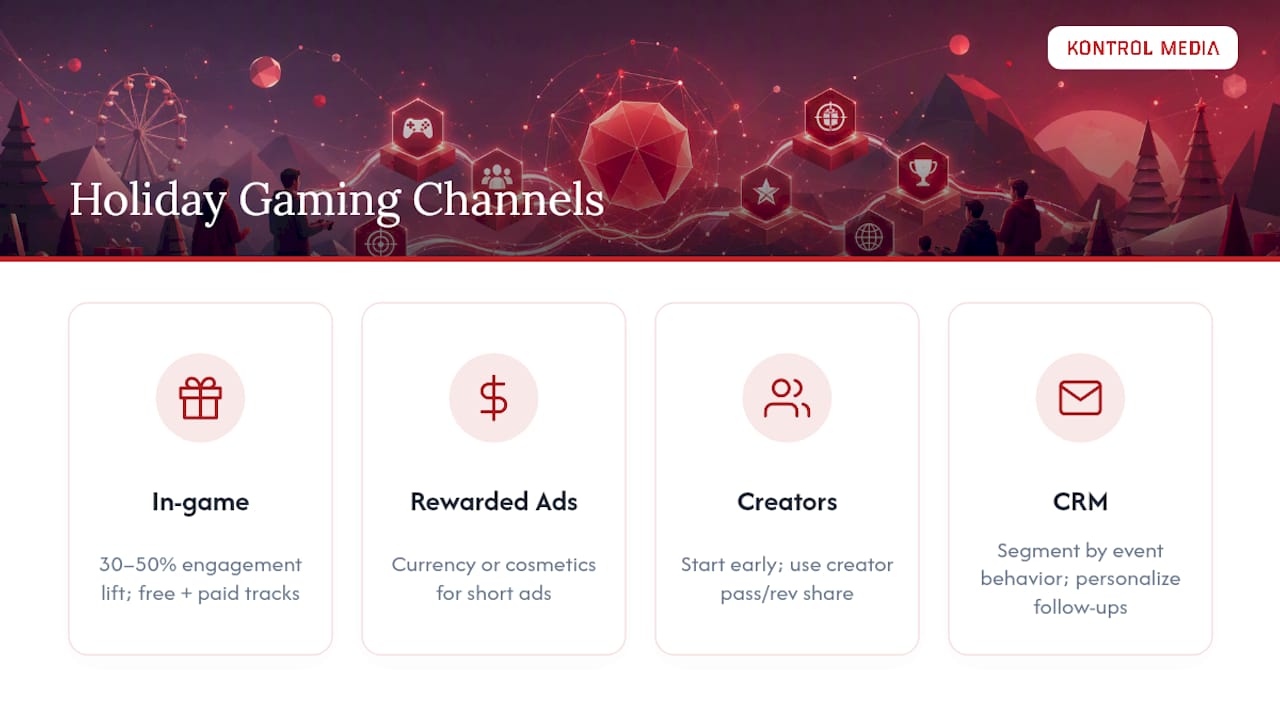
In-game activations should combine limited-time cosmetics, short quests, event currency, and a dedicated storefront. Developer guidance on holiday event design points to 30% to 50% additional engagement among players who participate in a well-balanced event, one that offers a free track alongside a paid one so nobody feels priced out of the fun. Pace your giveaways so the biggest rewards land near the event’s finale, not the opening days; that structure keeps players logging in daily instead of front-loading their engagement and disappearing.
Rewarded placements work best for players already inside a session, offering currency or cosmetics in exchange for watching a short ad. Save native audio and video plus programmatic mobile buys for reaching players outside the app, especially during discovery moments like app-store browsing or social scrolling. Retail media networks pair well with mobile gaming inventory here, letting retail-focused brands extend an existing campaign into gaming environments without building a separate media plan from scratch.
Creator partnerships need to start early, not the week before launch. Recruiting creators before your event goes live lets them build anticipation content, and paying them through a creator pass or revenue share tends to produce better long-term alignment than a flat one-time fee. Track referral codes or unique links so you can measure conversion per creator, not just impressions.
CRM and email outreach should feed off in-game signals. A player who just claimed an event reward is a different message target than one who’s lapsed for two weeks. Segment your push notifications and emails by recency and event participation, not just by generic holiday timing.
Pro Tip: Build your CRM segments around behavior inside the event itself, players who finished the free track versus those who bought the premium pass need entirely different follow-up messages.
Planning Your Holiday Gaming Campaign Timeline
Holiday campaigns fail more often from bad timing than bad creative. The teams that win start planning months out and treat the final two weeks before Christmas as execution, not ideation.
- Ninety to sixty days out: Lock your event concept, negotiate creator contracts, and scope your creative asset list.
- Sixty to thirty days out: Build creative variants and start early testing. Unity’s guidance on holiday mobile advertising recommends testing well before peak season since ad prices spike hard during Black Friday and Cyber Week.
- Thirty to fourteen days out: Finalize your analytics instrumentation, moderation plan for user-generated content or chat, and partner service-level agreements.
- Two weeks out: Roll out holiday mood assets and warm up your audience segments. Seasonal marketing guidance for mobile games puts this two-week mark as the minimum runway for building anticipation before peak days hit.
- Launch week: Confirm payment processing and compliance checks are live before your storefront opens.
Skipping the compliance and moderation checklist is the most common last-minute failure. Nothing kills a holiday event faster than a payment bug on day one.
Measuring Whether Your Holiday Gamer Outreach Actually Worked
Track the right metrics or you’ll mistake a short-term spike for real progress. The core KPIs are conversion rate, ARPU or ARPDAU, D1/D7/D30 retention, event pass conversion rate, and creator pass uptake.
- Set up a holdout cohort that doesn’t see the event, so you can isolate the uplift the campaign actually caused.
- Run multivariate pricing tests on your event pass to find the price point that maximizes revenue without tanking conversion.
- Measure retention at the cohort level, not just in aggregate, since a spike in new players can mask flat retention among your existing base.
Statistic Callout: Titles that measure holiday uplift against a true holdout, rather than a year-over-year comparison, tend to catch the 16% to 45% uplift range more reliably, since that range already accounts for typical seasonal noise.
If retention holds and pass conversion clears your target, scale the mechanic next quarter. If engagement spiked but retention cratered after the event ended, that’s a signal to iterate on pacing, not to declare victory.
A 7-Step Playbook for Reaching Gamers This Holiday Season
- Define your audience segments and goals. Separate gifting behavior, self-gift purchases, and retention targets, which you can do effectively by using methods to unlock audience needs to boost content marketing success, as they need different messages.
- Select your formats and partners. Match rewarded ads, in-game events, and creator tie-ins to the segments you just defined.
- Scope creative assets and message variants for each platform and genre you’re targeting.
- Set your timeline, budget, and test windows, then instrument analytics and holdout cohorts before anything goes live.
- Launch on schedule and monitor performance daily during the first week.
- Adjust pacing or pricing based on early signals, not gut feeling.
- Document post-event learnings while the data is fresh, next year’s planning starts here.
Pro Tip: Write your post-event debrief the same week the event ends. Waiting until January means losing the specific details that make next year’s campaign better instead of a repeat of this year’s.
What Coordinating Holiday Gamer Campaigns Actually Requires
Most holiday campaigns don’t fail on strategy, they fail on coordination. Getting creative, creator contracts, ad buys, and CRM segmentation to land in the same week takes real operational discipline, not just a good plan on a slide.
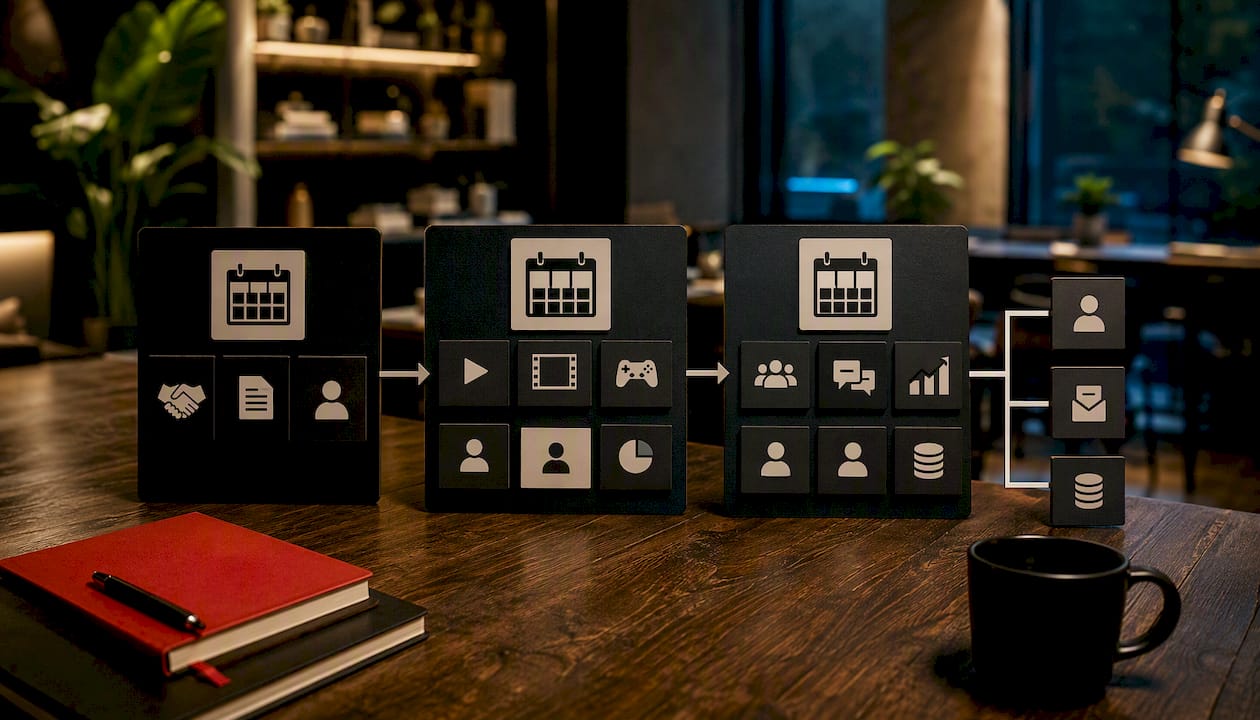
At Kontrol Media, our priorities on these engagements are partner orchestration, creative production timelines, and tying gaming media into a broader retail or commerce media stack where it makes sense. We typically phase resourcing in three waves: strategy and contracts early, creative and testing in the middle window, and a dedicated team watching moderation and revenue operations once the event goes live. That third wave is where most brands are understaffed, and where the actual holiday goodwill either gets protected or gets lost.
How Help Is Provided to Execute Holiday Gamer Campaigns
An experienced consultancy can build the operational backbone that turns a holiday gaming strategy into a live campaign, handling partner orchestration, creator deal structuring, and retail media integration work that most internal teams don’t have bandwidth for during peak season.
If you’re weighing whether to build this holiday push in-house or bring in hands-on execution support, our retail media network operations playbook breaks down how strategy and execution fit together across gaming and commerce channels. For brands specifically weighing creator deals and event pacing against a hard December deadline, reach out through our services page to scope a holiday outreach plan before your ninety-day window closes.
Sources
- Unlocking Gamer Engagement: Why the Holidays Are the Ultimate Opportunity for Brands
- Designing engaging holiday events
- Why mobile gaming belongs in every retail media plan
- How to prepare your LiveOps for the holiday season
- Mobile Advertising Strategies for 2024 Holiday Season
FAQ
What Is the 3-3-3 Rule for Marketing?
The 3-3-3 rule generally refers to testing three audiences, three creative variants, and three messages simultaneously to find a winning combination fast, a useful framework when warming up holiday creative ahead of peak pricing.
What Are Some Creative Ideas for Holiday Marketing Campaigns Aimed at Gamers?
Limited-time cosmetics tied to a holiday theme, short daily-login quests with escalating rewards, and creator-hosted in-game events tend to outperform static banner promotions because they give players a reason to return daily.
What Are Effective Marketing Campaigns for Video Games During the Holidays?
The most effective campaigns combine a LiveOps event (cosmetics, quests, event currency) with rewarded ad placements and early creator recruitment, an approach that Meta’s developer guidance and LiveOps analysis both point to for sustained engagement gains.
How Do I Segment Gamers for Holiday Outreach by Platform and Genre?
Segment first by platform, since mobile, console, and PC audiences respond to different ad formats, then by genre, since a mobile puzzle player and a competitive shooter player expect very different reward structures and messaging tones.
Does Kontrol Media Help With Holiday Campaigns That Combine Retail Media and Gaming?
Yes, Kontrol Media works with brands to integrate retail and commerce media networks alongside gaming ad partnerships, handling the partner coordination and execution work that holiday timelines demand.