


The fastest route to predictable revenue for most mid-market retail media networks in 2026 is outsourcing executional sales and ad operations to a specialist partner, not building an in-house team from scratch. Most retailers see their first booked campaign within months when they partner, which is faster than the typical timeline for building in-house. The trade-off is real: you give up a slice of margin for speed, and you accept some dependency on someone else’s process until your volume justifies bringing it in-house.
TL;DR:
- Outsourcing retail media sales typically results in campaign bookings within six months, whereas building in-house can take 18 months or more.
- A specialized partner handles four key roles: prospecting and proposals, campaign building, billing and reporting, and measurement, to accelerate revenue.
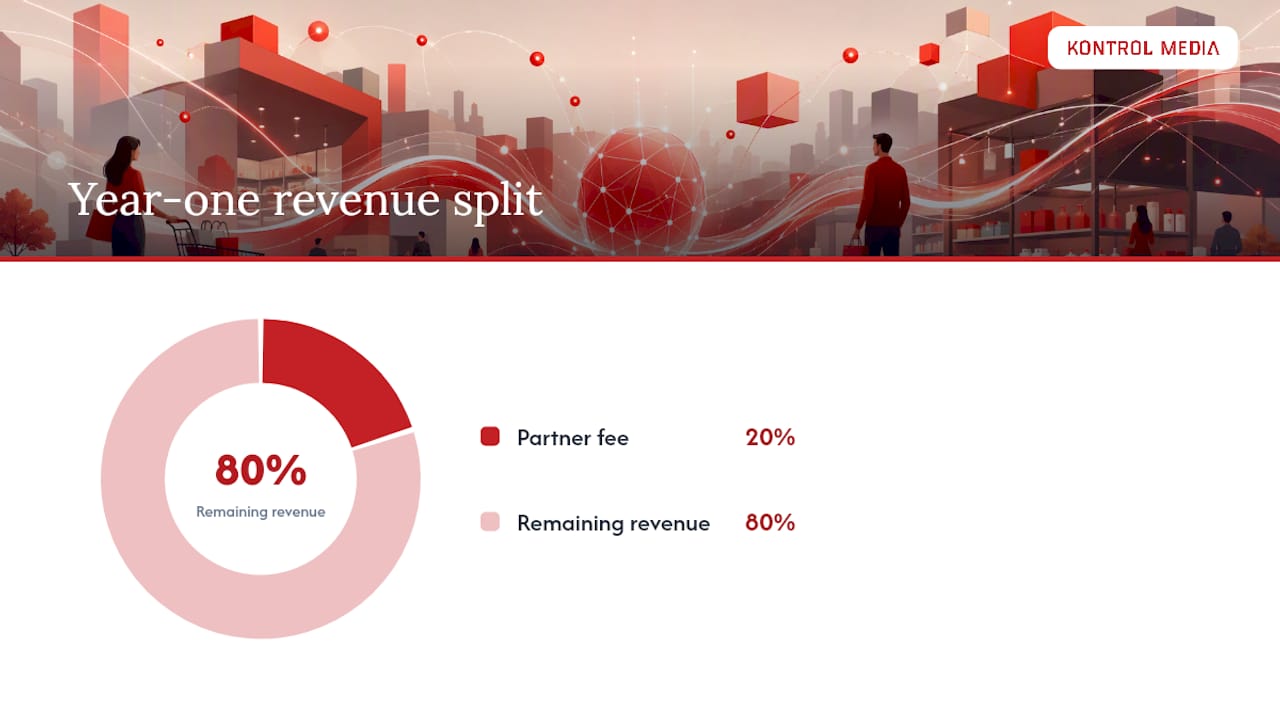
- Most retail media networks start with a revenue share model around 20%, which should be compared to internal staffing costs before proceeding.
- Clear governance, such as onboarding timelines, fill-rate SLAs, data ownership, and exit clauses, are critical to manage risks effectively.
- Most retailers should consider outsourcing if their revenue is below $500 million or they lack internal ad-sales talent, reserving in-house development for larger, data-rich companies.
Table of Contents
- Why Outsource Retail Media Sales? Benefits and Trade-Offs
- What Does Outsourced Retail Media Sales Actually Include?
- Should You Build, Partner, or Go Hybrid?
- How Do You Evaluate an Outsourced Sales Partner?
- How Does an Outsourced Team Integrate With Your Ad Stack?
- Evidence That Execution-First Outsourcing Works
- Your 90-Day Checklist to Start Outsourcing Sales
- What Training Do Outsourced Sales Teams Actually Need?
- How Do You Manage Risk When Outsourcing Sales Functions?
- Why Execution-First Outsourcing Usually Wins
- How Kontrol Media Can Help You Start Generating Revenue
- Sources
- FAQ
Why Outsource Retail Media Sales? Benefits and Trade-Offs
Retail media is a sales business before it’s a technology business, and most retailers simply don’t have that muscle sitting idle. Outsourcing sales for retail media gets you in front of advertisers and agencies who already have budget lines open, because a specialized partner brings existing relationships rather than starting from a cold list.
The financial case is straightforward. You avoid the fixed cost of hiring an ad ops team, a sales director, and a billing analyst before you’ve booked a single dollar. Specialized partners also carry packaging expertise, meaning your inventory gets priced and bundled the way agencies actually expect to buy it.
The trade-offs deserve equal attention:
- You’ll share margin, typically through a percentage-of-spend or revenue-share arrangement rather than a flat fee.
- You give up some direct control over first-party data handling until contract terms specify otherwise.
- You take on vendor dependency, which becomes a real risk if the partner underperforms or exits.
Retailers who bring optimization and forecasting in-house eventually see a 20 to 30% lift in ROAS and 50% faster planning cycles compared to those who stay fully outsourced. That’s the long game. The short game is getting revenue moving now, and outsourcing does that faster than almost anything else.
What Does Outsourced Retail Media Sales Actually Include?
“Outsourcing sales” undersells what a competent partner actually delivers. It’s not lead generation bolted onto your existing team. It’s an operational function spanning four distinct roles, and you should scope an RFP against all four or you’ll end up with gaps nobody notices until Q3.
- Sales motion: prospecting brand and agency contacts, building proposals, maintaining rate cards, and running outreach to holding companies and independent agencies.
- Campaign operations: building campaigns in your ad server, trafficking creative, enforcing creative specs, and managing pacing and mid-flight optimization.
- Revenue operations: billing, invoicing, contract management, and generating proof-of-performance reports advertisers actually trust.
- Measurement: running incrementality tests, managing clean-room queries where retailers require them, and delivering ROAS reporting advertisers can act on.
A retailer’s biggest blind spot going into this is assuming sales is the hard part. In reality, sales is usually the longest lead-time item in launching a network, because brands expect account teams and media kits before they’ll commit budget.
Should You Build, Partner, or Go Hybrid?
The decision hinges on scale, data ownership, and how fast you need revenue moving. Here’s the framework that holds up across most retail categories:
- Build in-house if you have proprietary first-party data at meaningful scale and your retail revenue sits above roughly $500 million with strong loyalty program penetration. Below that threshold, the fixed cost of a sales, ad ops, and revenue ops team rarely pencils out against what it generates.
- Partner with a specialist if your revenue sits under $300 to 500 million, you need bookable revenue inside a couple of quarters, or you simply don’t have ad-sales talent on staff. Time-to-revenue under six months is achievable through partnering; building rarely gets you there before 18 months.
- Go hybrid when you want brand control over the buyer-facing experience but need speed. This usually means white-label ad tech paired with a retained outsourced sales team that operates under your branding.
Most networks launching in 2026 sit in category two. That’s not a compromise. It’s the pragmatic starting point that lets you prove the model before committing capital to a permanent team.
How Do You Evaluate an Outsourced Sales Partner?
The RFP is where most retailers get sloppy, either because they’ve never scoped one for retail media or because they assume all managed-service providers work the same way. They don’t, and the differences show up in your margin within the first year.
Start with the commercial model. Expect a percentage-of-spend fee, a straight revenue share, a retainer, or some blend. If a partner proposes 20% of gross spend and you’re projecting $2 million in booked revenue in year one, that’s $400,000 in fees against a business you didn’t have to staff yourself. Run that math against the cost of three full-time hires plus benefits and tooling before you flinch at the percentage.
Then push on operational service-level agreements:
- Onboarding window: how fast can they go from signed contract to first live campaign?
- Fill-rate commitments and how they’re measured week over week.
- Reporting cadence, including whether proof-of-performance reports are automated or manually assembled.
- API access and clean-room arrangements, plus explicit data ownership and portability clauses in the contract.
Pro Tip: Ask every finalist for their exit terms before you ask about pricing. A partner confident in their results will happily put audit rights, termination notice, and data return clauses in writing without pushback.
Governance matters just as much as price. Set pilot KPIs up front, retain audit rights, and confirm what happens to your advertiser relationships and campaign data if the contract ends.
How Does an Outsourced Team Integrate With Your Ad Stack?
Handing off sales doesn’t mean losing visibility into your own operation, and any partner worth hiring will plug into your systems rather than build a parallel black box.
The integration points that matter most are product feed normalization, retailer API connections, links into your ad server or DSP, and reporting pipelines that dump data somewhere you can see it in near real time. On measurement, the strongest setups combine clean-room testing for incrementality with a blend of multi-touch attribution and marketing mix modeling for governance, since no single method tells the whole story.
Organizationally, insist on one single point of contact on the partner side and a standing steering committee that meets often enough to catch problems before they compound. Weekly ops rituals with clear exception handling beat a monthly check-in every time.
Data guardrails aren’t optional. PII handling, access controls, and alignment with IAB and MRC measurement guidance need to be written into the contract, not assumed.
- Standardizing data feeds and templating campaign builds can cut repetitive operational work by roughly 80%, which is exactly the kind of efficiency a good partner should be passing back to you in lower supervision overhead.
Evidence That Execution-First Outsourcing Works
Retail media revenue rarely stalls because retailers lack demand. It stalls because nobody owns the intersection of sales, ad ops, and revenue ops well enough to close the loop from advertiser interest to booked, billed, reported revenue.
Kontrol Media approaches this as an execution problem first. Retailers launching a pilot with a specialist partner typically see:
- First bookable campaign inside a single quarter rather than a full year of internal hiring and tooling.
- Fill-rate improvements within the first two pilot cycles as rate cards and packaging get tightened.
- Lower internal headcount burden since sales, trafficking, and billing sit with the partner instead of three separate new hires.
The approach is deliberately unglamorous: get inventory mapped, get advertisers signed, get campaigns live, and get invoices out the door correctly the first time. Revenue follows execution, not the reverse.
Your 90-Day Checklist to Start Outsourcing Sales
Before you sign anything, prepare an inventory map, an anchor advertiser list, data access permissions, and a pilot rate card.
- Days 1 to 30: finalize partner selection, sign pilot terms, and get technical integration underway.
- Days 31 to 60: launch with five to 10 anchor advertisers at scaled but affordable price points, tracking fill-rate and POAS weekly.
- Days 61 to 90: review results against revenue and margin thresholds before deciding on broader rollout.
Avoid overcommitting inventory before you have measurement in place, and never accept vague SLAs on reporting cadence.
What Training Do Outsourced Sales Teams Actually Need?
Handing sales to an outside partner doesn’t mean handing over your product knowledge and walking away. The partner’s team still needs to sell your specific inventory, your category strengths, and your audience data as if they’d been in the building for years, and that only happens with deliberate enablement.
Start with a structured onboarding package: category performance data, historical campaign results if you have them, your customer demographic profile, and a clear breakdown of onsite versus offsite inventory. Offsite retail media carries compressed margins of roughly 20 to 40% compared to 70 to 90% for onsite sponsored placements, and your sales team needs to understand that math cold before they’re pitching packages to agencies.
Beyond the initial handoff, build a recurring rhythm. Monthly category deep-dives keep the outsourced team current as your assortment shifts. Quarterly advertiser feedback sessions tell you whether the pitch is landing or whether rate cards need adjusting. Give the partner’s account leads direct access to your merchandising team, not just a static spec sheet, because retail media pricing and positioning change faster than any document can keep up with.
Don’t skip the reverse training either. Your internal team needs enough fluency in what the outsourced group is doing that you can ask sharp questions in a quarterly business review instead of nodding along. A steering committee with real subject-matter input on both sides is what separates a productive partnership from a vendor relationship you’re quietly worried about.
How Do You Manage Risk When Outsourcing Sales Functions?
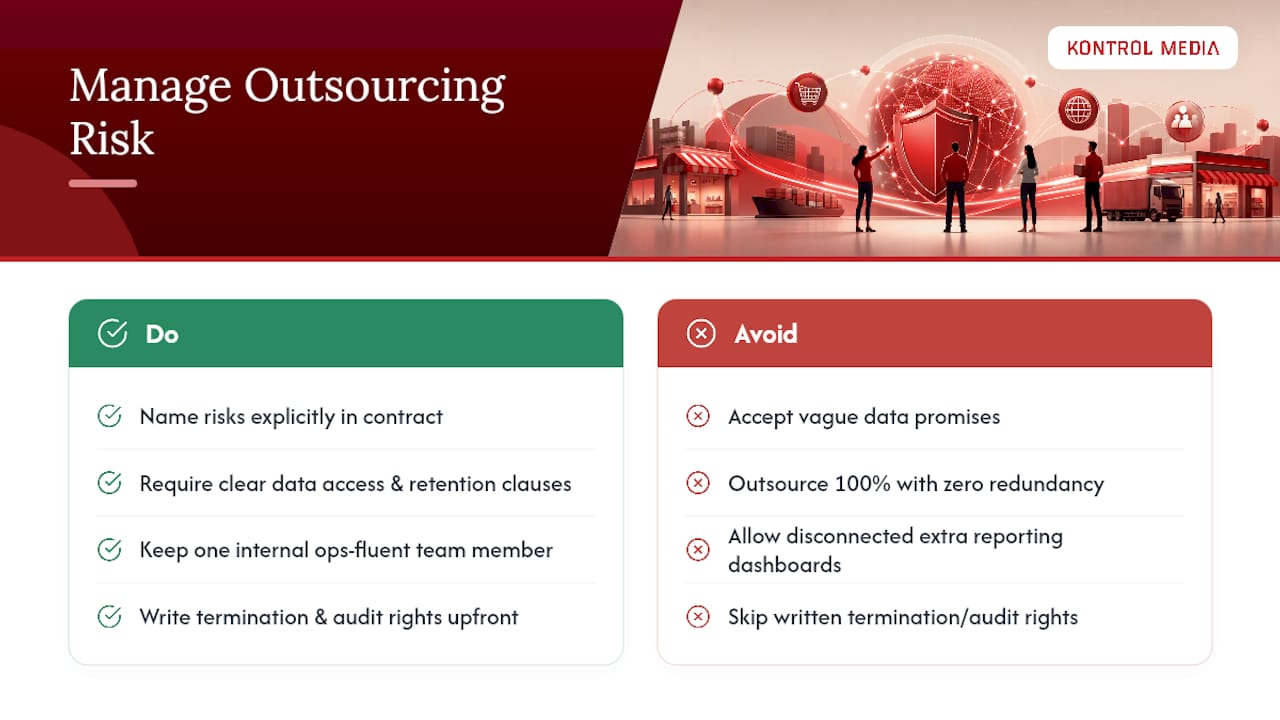
Every outsourcing decision trades one set of risks for another, and pretending otherwise sets you up for an unpleasant renewal conversation. The retailers who manage this well name the risks explicitly instead of discovering them mid-contract.
Data risk sits at the top of the list. Advertisers hand over budget expecting their targeting and performance data to stay contained, so your contract needs explicit language on data access, retention, and what happens to that data if the relationship ends. Don’t accept a partner who’s vague about this, no matter how strong their sales pitch sounds.
Concentration risk is the second concern. If one partner controls 100% of your ad sales and ad ops with no internal redundancy, you have no fallback if they underperform or if the relationship sours. Keep at least one internal team member fluent enough in the operational details that a transition, if it ever becomes necessary, doesn’t start from zero.
Reputational risk matters more in retail media than in most outsourced functions, because advertisers are dealing with your brand even when a third party is doing the selling. Set clear brand guidelines and require sign-off on outward-facing materials like media kits and proposal decks.
Finally, fragmentation across networks means advertisers already juggle roughly six retail media relationships on average, often through coordinating platforms. That reality should shape how you set fill-rate and SLA expectations. A partner who understands this landscape will build reporting that fits into an advertiser’s existing workflow instead of adding one more disconnected dashboard to their pile.
Mitigate all of this with staged commitments: start with a 90-day pilot, gate expansion on hitting both revenue and margin thresholds, and keep termination and audit rights in writing from day one.
Why Execution-First Outsourcing Usually Wins
Most retailers underestimate how rare it is to find one person, let alone a team, who’s fluent in sales, ad ops, and revenue ops simultaneously. That combination is the actual bottleneck, not demand from advertisers. Outsourcing solves for it directly. The moment you’re generating enough proprietary data and volume to justify a dedicated in-house build, that’s the signal to revisit the decision, not before.
— Mark Kapczynski
How Kontrol Media Can Help You Start Generating Revenue
A direct alternative to spending a year hiring a sales director, an ad ops lead, and a billing analyst before you’ve booked a single campaign is to work with a partner who sets up the network, runs the full sales motion, and takes on ad operations, campaign management, and billing so revenue starts moving in months, not quarters.
If you already have a retail media network that isn’t converting inventory into revenue fast enough, or you’re starting one from zero, our execution-first playbook for retail media operations shows exactly how we structure a pilot. For retailers still weighing build versus partner, our retail media network setup guide walks through the same decision framework covered here, applied to your specific inventory and category.
The next step is simple: book a pilot scoping call and let’s map your anchor advertisers, your inventory, and a realistic 90-day path to your first booked campaign.
Sources
For deeper detail on the build-versus-partner math, the Cotswold Outdoor retail media build vs. partner decision guide covers timing thresholds in depth. On automation and operational efficiency, the retail media automation playbook breaks down the 90-day path to cutting repetitive work. For margin and market-scale context, see the 2026 retail media network market analysis.
- Retail Media Network: Build vs Partner Decision Guide
- Retail Media Automation Playbook: 90-Day Plan to Cut Work 80% – inforsome
- Retail Media Network Market Analysis 2026
FAQ
What Does It Mean to Outsource Retail Media Sales?
It means handing the sales motion, campaign operations, billing, and measurement work to a specialized partner instead of building that function with internal hires, letting your network go live faster.
How Long Does It Take to See Revenue After Outsourcing?
Most retailers who partner see their first booked campaign inside six months, compared to 18 to 24 months for a full in-house build.
Is Outsourcing Cheaper Than Hiring an In-House Team?
Usually yes in year one, since you avoid fixed salary and tooling costs, though you’ll pay a percentage-of-spend or revenue-share fee that grows with your network’s success.
When Should a Retailer Build Instead of Partner?
Building makes sense mainly once a retailer has proprietary first-party data at scale and revenue above roughly $500 million with strong loyalty penetration; below that, partnering gets to revenue faster.
What Should Be in an Outsourced Sales Contract?
Look for clear commercial terms, onboarding timelines, fill-rate SLAs, data ownership and portability clauses, and explicit audit and termination rights before signing.