


Start planning by late August or September, and build your entire Q4 around three distinct phases: lead-up, peak, and lead-out. Retailers who phase their budgets and creative across the full quarter instead of dumping everything into Black Friday week waste less ad spend and recover more revenue after Cyber Monday. Before you spend a serious dollar on ads, lock inventory readiness, test your creative, and stand up a minimum viable way to measure what’s working.
TL;DR:
- Focus on segmenting your audience and testing creative with small budgets during the lead-up from late August to early November to avoid higher costs later.
- Scale only proven ad sets during peak from mid-November through Cyber Monday, ensuring all campaigns, especially automated ones, are prepared in advance.
- Ensure inventory, shipping cutoffs, and customer service policies are locked in before Black Friday to prevent operational failures during peak sales periods.
- Implement a post-peak plan that includes targeted promotions in late December and January, such as gift-card reactivation and clearance sales, to extend holiday ROI.
- Benchmark your competitor’s timing, offers, and discount strategies early to identify untapped opportunities and avoid over-discounting during the season.
Table of Contents
- Mapping the Holiday Calendar: Lead-Up, Peak, and Lead-Out
- Your Operational Checklist Before You Spend a Dollar on Ads
- Building Your Channel Playbook: Email, Social, Ads, and Search
- Designing Offers and Gift Guides That Actually Convert
- Setting Up Measurement That Actually Tells You Something
- Extending ROI After Cyber Weekend
- How Kontrol Media Approaches Holiday Execution
- What Competitors Are Doing (and How to Benchmark Against Them)
- Staying Compliant: Promotions, Disclaimers, and Advertising Rules
- Planning for What Goes Wrong
- What I’d Prioritize If I Had Limited Time and Budget
- Get Hands-On Help Preparing Your Holiday Sales and Advertising
- Useful Resources for Holiday Readiness
- Sources
- FAQ
Mapping the Holiday Calendar: Lead-Up, Peak, and Lead-Out
Most small teams treat the holidays as one long sprint that starts the week before Thanksgiving. That’s backwards. The businesses that come out of Q4 ahead treat it as three separate campaigns stitched together, each with its own goals, creative, and budget logic.
Lead-up (late August through early November) is where the invisible work happens. This is when you build the audiences you’ll retarget in December, when you test which product photos and headlines actually convert, and when you clean up your feed and email list so nothing chokes later. Industry playbooks consistently recommend starting in August or September specifically so creative testing and audience warm-up finish before the ad platforms get crowded and expensive.
During lead-up, your task list should include:
- Segmenting your email list by past purchase behavior and engagement so VIP and gift-guide sends land with the right people
- Running small-budget creative tests across three to five ad variants per product line before committing real spend
- Auditing your product feed for consistent titles, pricing, and images across every channel
- Uploading and getting approval on your top holiday creative assets well before November, since ad platforms slow down review during peak weeks
- Building or refreshing your gift-guide landing pages so they’re live and indexable before shoppers start searching
Peak (mid-November through Cyber Monday, then again in the two weeks before Christmas) is when you scale what worked in lead-up. This is not the time to launch untested offers. You’re optimizing conversion rate, scaling budget on the ad sets that proved themselves, and running aggressive retargeting against everyone who visited but didn’t buy. Microsoft Advertising’s holiday playbook recommends having Performance Max or an equivalent automated campaign type already running by this point, precisely because manual optimization during peak week eats time you don’t have.
Lead-out (December 26 through mid-January) is the phase almost everyone skips, and it’s a mistake. Gift cards get redeemed, people shop post-Christmas clearance, and January brings a wave of “new year, new me” buyers. Treat this as its own campaign with its own creative and budget, not an afterthought.
Watch your platform-specific deadlines closely. Carrier shipping cutoffs (typically mid-December for ground shipping, later for express) determine your last-order-date messaging. Marketplace listing deadlines for holiday programs often close in October. And ad approval lag on any platform stretches longer in November, so anything you plan to run during peak needs to be submitted at least a week ahead, ideally two.
Your Operational Checklist Before You Spend a Dollar on Ads
Ads amplify whatever is true about your operations. If your inventory or fulfillment isn’t ready, more ad spend just means more angry customers, faster.
Start with inventory sizing. Pull your Q4 sales data from last year, then adjust for growth, discontinued SKUs, and anything trending in your category this season. Apply a margin filter: any product where a modest discount would push you below profitability shouldn’t be part of your promotional push, no matter how well it sold last year. Flag “risky SKUs,” meaning anything with a single supplier, a long lead time, or a history of stockouts, and either build a buffer or drop them from featured promotions entirely.
Here’s a sequence that works for most small teams:
- Pull last year’s Q4 sales by SKU and cross-reference against current stock and reorder lead times.
- Confirm buy-online-pickup-in-store (BOPIS) and local delivery capacity if you offer either, since these become critical in the final week before Christmas.
- Identify backup suppliers for your top five sellers in case your primary source runs short.
- Lock your shipping cutoff dates with your carriers and publish them clearly on your site before Black Friday, not during it.
- Write or update your returns and gift-receipt policy so customer service isn’t improvising answers on December 26.
- Set a temporary staffing plan for customer service and fulfillment during the two heaviest weeks, even if that just means extending a current employee’s hours.
- Establish a budget guardrail: a minimum cash reserve you won’t dip below, and a plan for short-term financing or a reorder buffer if a hot product sells out mid-season.
Gift support deserves its own line item. Gift receipts, gift wrapping options, and a clear FAQ about exchanges reduce the volume of frantic customer service messages you’ll get between December 20 and January 2. The SBA’s small-business readiness guidance points to exactly this kind of groundwork, securing working capital, upgrading checkout technology, and stocking selectively rather than broadly, as the difference between a profitable Q4 and a stressful one.
Pro Tip: Build your reorder buffer around your two or three best-selling SKUs only. Spreading a small inventory budget across twenty products to “be safe” usually means you run out of your bestseller and sit on dead stock of everything else.
Building Your Channel Playbook: Email, Social, Ads, and Search
Every channel has a different job during the holidays, and trying to run all of them at full intensity all quarter is how small teams burn out by December 10.
Email is your highest-margin channel, and it should carry your VIP early-access offers first. Segment your list into past purchasers, high engagement non-purchasers, and everyone else, then stagger your gift-guide email series so your best customers see it two or three days before your general list. Keep a last-minute flow ready for December 18 through 23 that emphasizes shipping cutoffs and digital gift card options.
Paid ads follow the phased logic from the calendar above: warm audiences during lead-up with low-budget awareness and retargeting-list-building campaigns, then scale spend during peak on the creative and audiences that already converted.
Social performs best when it feels native to the platform rather than like a repurposed banner ad. Short-form video showing a product in use outperforms static product shots for most categories, and shoppable posts with in-feed checkout reduce the friction that kills mobile conversions. If you’re working with creators, lock your holiday content calendar in October, since good creators book out fast in November.
Search and your product feed matter more than most small teams realize, especially as AI shopping assistants increasingly pull structured product data directly into their answers. Consistent titles, accurate pricing, and clean structured data across your feed aren’t just an SEO nicety anymore. They’re what determines whether your products show up in AI-driven discovery at all.
Marketplaces need their own checklist item: sync your inventory and creative assets early, and reserve a slice of your promotional inventory specifically for Black Friday and Cyber Monday rather than letting your regular listings absorb the demand spike unprepared.
Designing Offers and Gift Guides That Actually Convert
Not every offer type fits every product. Bundles work well when you have complementary items with different margins, letting a high-margin add-on offset a discount on the anchor product. Threshold free shipping (spend $50, ship free) lifts average order value more reliably than a flat percentage-off discount. Gift cards solve the last-minute shopper’s problem and often get spent above their face value. Limited-time discounts create urgency but should be reserved for peak week, not stretched across all of November, or shoppers stop believing the deadline is real.
Gift guides deserve real editorial thought, not a hastily assembled product list. Effective gift guides target a specific recipient, think “gifts for the home cook” rather than “gifts for everyone”, and curate somewhere between 7 and 15 items. Mixing your own products with a few well-chosen complementary picks from other brands builds more trust than a guide that reads like a catalog page, and it mirrors exactly how editorial partners like HuffPost approach curated gift content: recipient-first, credible, and genuinely useful rather than purely promotional.
A few practices worth building into your process:
- Publish gift guides as live, editable pages rather than static PDFs, so you can swap out sold-out items without losing the page’s search ranking or momentum
- Pre-approve two or three creative templates in October so your team can react to a trending product within hours during peak week, instead of waiting on a design review
- Set pricing guardrails ahead of time: know your floor margin before a manager gets pressured into an on-the-spot discount during a live sale
- Add small attach items (a $12 accessory alongside a $60 anchor product) to lift average order value without touching your headline price
- Keep a last-minute promo ready for December 20 to 23: local pickup, digital gift cards, or express shipping upgrades for procrastinating shoppers
Pro Tip: If you’re pitching a gift guide to an editorial outlet, send a hyper-specific pitch, one product, one sentence, a high-resolution image, the price, and a live purchase link, in July or August. Vague “check out our holiday collection” pitches rarely get picked up.
Setting Up Measurement That Actually Tells You Something
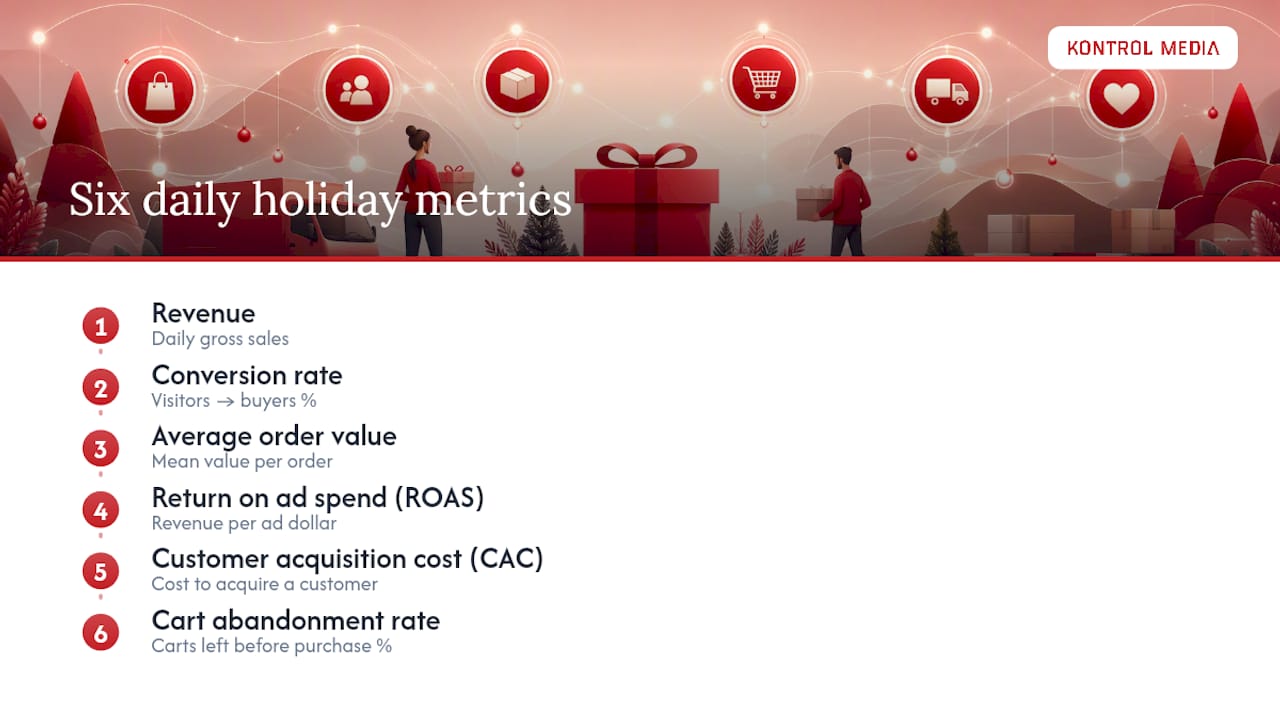
You don’t need an enterprise analytics stack for the holidays. You need six numbers you check daily and trust.
Track revenue, conversion rate, average order value (AOV), return on ad spend (ROAS), customer acquisition cost (CAC), and cart abandonment rate. That’s the full list. Everything else is detail underneath these six.
Attribution gets messier during a phased campaign because a customer might see a lead-up ad, ignore a peak retargeting hit, and finally convert during lead-out. Don’t chase perfect attribution. Instead, set simple attribution windows tied to each phase and measure retargeting lift by comparing conversion rates between people who saw your retargeting sequence and a small holdout group who didn’t.
Use lead-up specifically to run quick experiments: two headline variants, two hero images, two offer framings. Whatever wins gets scaled in peak. This is also the point to double check your return on advertising investment tracking so budget decisions during peak week are based on real numbers, not gut feel under pressure.
Data hygiene matters more than it used to. Clean, consistent product data across your feed and site isn’t just good practice anymore. It determines whether AI shopping tools can find and recommend your catalog at all. After peak, report on post-purchase lifetime value and retention uplift, not just the topline revenue number, since a strong Black Friday with weak retention is a worse outcome than a modest Black Friday that builds repeat customers.
Extending ROI After Cyber Weekend
The week after Cyber Monday is where most small businesses quietly leave money on the table. Treat late December and early January as their own revenue opportunity rather than a cooldown period, and a few specific moves make the difference:
- Push local pickup and same-day delivery promotions hard between December 20 and 23 for shoppers who missed shipping cutoffs.
- Send a gift-card reactivation sequence in early January targeting anyone who received one, since unredeemed balances represent buyers who haven’t come back yet.
- Trigger a post-purchase flow immediately after each order: a thank-you message, a review request a week later, and a small next-purchase incentive.
- Run margin-conscious clearance on excess holiday stock in January to free up cash rather than letting it sit through Q1.
- Keep a light retargeting budget running through mid-January aimed at cart abandoners from December, since post-peak ad costs typically drop and make this cheap to run.
How Kontrol Media Approaches Holiday Execution
Planning a phased calendar is one thing. Coordinating operations, creative, and sales teams to actually hit those dates under real-world pressure is another. Kontrol Media builds holiday readiness around the same lead-up, peak, lead-out framework, but with the execution layer that keeps a small team from missing its own deadlines.
That execution layer includes a campaign gating checklist (nothing launches without inventory, creative, and tracking signed off), a creative approval standard operating procedure so trending-topic content can go live within hours instead of days, and a structured post-mortem template used after peak week to capture what actually drove revenue versus what just felt busy.
For clients running retail media or commerce media networks, the holidays are also a channel lever in themselves: brands actively look for placements inside retailer ecosystems during Q4, and a properly operated network can capture that demand rather than losing it to a competing retailer’s ad inventory. The same logic applies to real-estate-channel activations, where brands reach home buyers and homeowners through agent partnerships timed around seasonal buying behavior.
What Competitors Are Doing (and How to Benchmark Against Them)
Before you finalize your own promotional calendar, spend an afternoon looking at what direct competitors did last holiday season. Check their email cadence using a free inbox tracker, note when their site showed Black Friday banners, and screenshot their gift guide structure if they have one.
Benchmarking isn’t about copying. It’s about spotting gaps. If every competitor in your category runs the same 20%-off Black Friday deal, a bundle or gift-card promotion stands out precisely because it’s different. If nobody in your space has a gift guide, that’s a low-competition opportunity to own search traffic and editorial placement before anyone else claims it.
Pay attention to timing as much as tactics. If competitors consistently launch their holiday push in early November, launching your lead-up campaign three weeks earlier lets you build retargeting audiences before the ad marketplace gets crowded and expensive. Pricing benchmarks matter too: know whether your category typically discounts 15% or 40% during peak week, since pricing far outside that range either signals a weak margin position or an unbelievable deal shoppers will distrust.
Revisit this benchmarking after the season ends, not just before it starts. The gap between what you planned and what a competitor executed tells you more about next year’s opportunity than any pre-season guess.
Staying Compliant: Promotions, Disclaimers, and Advertising Rules
Holiday promotions move fast, and that speed is exactly when compliance mistakes happen. The Federal Trade Commission requires that any “original price” used in a percentage-off claim reflect a price you actually charged recently, not an inflated number invented to make a discount look bigger. If you advertise “50% off,” be prepared to show that the pre-sale price was real.
Limited-time offers need to mean what they say. If your countdown timer resets or the “one day only” sale runs for a week, that’s a deceptive practice under FTC guidelines, and it erodes the urgency that makes future promotions work at all.
Gift cards carry their own rules. Federal law under the CARD Act generally prohibits expiration dates earlier than five years from purchase and restricts most inactivity fees, so any small print on your gift card terms needs to match that floor.
If you run sweepstakes or contests as part of a holiday promotion, clear official rules, eligibility, odds, and no-purchase-necessary language where required, protect you from both legal exposure and customer complaints. And if influencers or creators post about your holiday deals, Federal Trade Commission disclosure rules require a clear, unambiguous disclosure of the paid or gifted relationship, not a buried hashtag. None of this needs a legal team to get right. It needs a five-minute review before anything goes live.
Planning for What Goes Wrong
Something will break during your holiday campaigns. A supplier will miss a shipment, a site will crash during a traffic spike, or a promotion will get misconfigured and apply the wrong discount. The businesses that recover fastest aren’t the ones with no problems. They’re the ones with a plan already written before the problem happens.
Build a simple contingency file before peak week starts. It should name who has authority to pause a broken promotion immediately, who monitors site uptime during traffic spikes, and who drafts a customer-facing message if a shipping delay or stockout affects a large order batch. Having these decisions made in advance turns a crisis into a checklist.

Stockouts on featured products are the most common fire drill. Decide now whether your policy is to pull the product from ads immediately, offer a substitute, or issue a rain check, so nobody’s improvising an answer to an angry customer at 11 p.m. on Black Friday.
Website performance issues deserve the same advance planning. Know your hosting provider’s peak-traffic support line, and have a lightweight, low-image fallback version of your top landing pages ready to deploy if your main site slows under load. A five-minute outage during peak hours can cost more revenue than a week of normal traffic, so the fastest fix beats the perfect fix every time.
What I’d Prioritize If I Had Limited Time and Budget
The three failure modes I see most often: creative submitted too late for platform approval, inventory decisions made on gut feel instead of last year’s data, and total reliance on one channel that happens to have a bad week.
The fastest wins are usually the smallest fixes: pre-approve creative in October, add one attach item to your bestseller, and build a lead-out email sequence before you even launch Black Friday.
On the in-house versus outsourced question, it comes down to speed and capability. If your team can execute the phased calendar above without missing deadlines, keep it in-house. If you’re already stretched thin on retail media setup or channel strategy, that’s when bringing in outside execution support closes the gap faster than hiring and training internally during your busiest quarter.
— Mark Kapczynski
Get Hands-On Help Preparing Your Holiday Sales and Advertising
An alternative to hiring a traditional agency retainer for holiday season is execution built around the specific phase, timeline, and channel mix a business actually needs, whether that’s retail media setup, campaign operations, or measurement during peak week.
If your gap this season is retail media, Kontrol Media builds and operates commerce media networks so brands can capture holiday ad demand instead of losing it to competitors already running inside retailer ecosystems. If your gap is campaign execution across email, paid, and social, the strategy and execution consulting team plugs directly into your existing calendar rather than starting from scratch. And if you’re a brand trying to reach home buyers specifically, the real estate advertising channel turns agent partnerships into a seasonal acquisition lever most competitors aren’t using yet.
Some organizations have applied a phased, execution-first approach to holiday readiness that this article outlines. If you want a quick read on where your current plan has gaps, reach out through Kontrol Media’s contact page and describe your current timeline. That single conversation usually surfaces the one or two fixes worth prioritizing before your lead-up phase even starts.
Useful Resources for Holiday Readiness
A few external resources are worth bookmarking alongside this guide. Microsoft Advertising’s holiday playbook backs the channel execution section with platform-specific creative and Performance Max guidance. The SBA’s small-business resources support the operational checklist, particularly around working capital and inventory planning. And Cassandra’s Q4 media planning guide offers a deeper look at the attribution approach referenced in the measurement section.
Sources
- How retailers can de-risk the 2025 holiday shopping season — BCG
- Holiday season with Microsoft Advertising — Microsoft
- Holiday & Seasonal Advertising Guide 2026 — Adbid
- How to create a retail gift guide — Fit Small Business
- U.S. Small Business Administration — SBA
FAQ
What Is the 3-3-3 Rule for Marketing?
The 3-3-3 rule generally refers to testing three audiences, three creative variations, and three offers before scaling a campaign, a lightweight framework that fits naturally into the lead-up phase of a holiday calendar described above.
What Sells the Most During the Holidays?
Gift cards, electronics, apparel, and home goods consistently top holiday sales categories, but the products that convert best for any individual business are usually last year’s proven sellers with a fresh bundle or attach item added.
What Are Some Effective Marketing Ideas for the Holidays?
Curated gift guides, VIP early-access email sends, threshold free shipping, and pre-approved creative templates for fast trend reactions all rank among the most reliable holiday marketing tactics for small teams.
What Are the 4 Ps of Sales Strategy?
The 4 Ps, product, price, place, and promotion, map directly onto holiday planning: choosing which products to feature, setting margin-safe pricing, picking the right channels, and timing promotions across the lead-up, peak, and lead-out phases.
When Should I Start Preparing for Holiday Sales and Advertising?
Start in August or September so creative testing, audience building, and inventory planning finish before ad approval slowdowns and shopper demand both spike in November.