

Most mid-market retailers should partner first, then hybridize once the data proves itself. Enterprise retailers with deep ad-tech benches can build from day one, but that path takes longer than most executive teams expect.
A partner-led pilot can launch in a few weeks to a few months. A full in-house build runs between several months to over a year before the first dollar of ad revenue lands. If you’re leading marketing or commerce at a retailer weighing a retail media network setup right now, here’s the first move:
- Assign an executive sponsor this week
- Launch a 90-day first-party data audit
- Recruit 5 to 10 pilot advertisers in parallel, not after the audit finishes
Everything below explains why that sequence works and how to execute it.
TL;DR:
- Most mid-market retailers should partner first and only hybridize after data proves itself, as building an in-house solution typically takes over a year before generating revenue.
- A successful pilot requires an executive sponsor, a 90-day first-party data audit, and recruiting 5 to 10 pilot advertisers simultaneously, not sequentially.
- Governance and cross-functional collaboration are critical, with merchant-media incentive conflicts often causing pilots to fail without clear resolution workflows.
- Monitoring the first 72 hours post-launch with automated alerts for match rates and pacing is vital to prevent advertiser churn during the pilot phase.
- Building and managing retail media networks is complex; outsourcing to experienced providers like Kontrol Media can ensure proper execution within a 90-day window.
Table of Contents
- Setting up a retail media network: objectives and team structure
- Auditing first-party data and identity resolution for retail media
- Should you build, buy, or hybridize your ad tech stack?
- Which ad formats should you launch first?
- How should you price retail media network inventory?
- What KPIs prove a retail media network is working?
- How do you run a 90-day retail media network pilot?
- Scaling from pilot to a self-serve retail media network
- What most retail media playbooks get wrong
- Get Kontrol Media’s Help Launching Your Network
- Key Takeaways
- Sources
Setting up a retail media network: objectives and team structure
Before you touch a single ad server, decide what winning looks like. A retail media network built to maximize direct ad revenue prices differently than one built to deepen supplier partnerships or improve customer experience through relevant placements. Pick one primary objective. Trying to optimize for all three at once is how pilots stall.
Once the objective is set, staff it. The retailers that move fastest assemble a specific team before writing any technical requirements:
- An executive sponsor who can break ties between merchandising and media
- A retail media manager who owns the roadmap day to day
- A sales lead focused on advertiser recruitment
- An ad ops person who runs campaigns and creative review
- A technical lead who owns integrations
- A legal or privacy contact who signs off on data use
- A merchant liaison who represents category teams
That last role gets skipped constantly, and it’s usually the reason pilots fizzle. Merchandising and media teams have competing incentives almost by default. Merchants want shelf space and search results that move product; media teams want inventory to sell to advertisers. Without a documented resolution workflow and a single source of truth for revenue reporting, that tension turns into a standoff by month three.
Pro Tip: Give the merchant liaison a small shared incentive pool tied to combined media and category performance. It turns a potential blocker into a collaborator.
Auditing first-party data and identity resolution for retail media
Your retail media network architecture is only as good as the data feeding it. Start with an inventory, not a platform search.
- Ecommerce transaction data (SKU-level purchase history)
- Point-of-sale data from physical stores
- Loyalty program identifiers and enrollment status
- CRM records and email opt-in status
- App logs and on-site behavioral signals
Map consent status against each source before you promise advertisers anything. A retailer that can’t show which records carry valid consent for ad targeting has a legal problem, not a data problem.
Identity resolution comes next. Deterministic matching through loyalty IDs gives you the cleanest signal, but most retailers only have loyalty coverage for a fraction of transactions. Probabilistic stitching fills gaps using device and behavioral signals, with lower confidence. Retailers that extend beyond sales data into loyalty and behavioral signals build stronger advertiser value and better closed-loop attribution.
Aim for match rates that let you report sales lift with confidence, not just impressions. Data clean rooms are where this gets operationalized: they let you share aggregated, privacy-compliant audience segments with advertisers without exposing raw customer records. Our guide on first-party data as the fuel behind commerce media networks walks through the clean room setup in more depth.
Should you build, buy, or hybridize your ad tech stack?
This is the decision that determines your timeline more than any other. Three variables drive the answer: engineering capacity, time horizon, and how much control you need over data ownership.
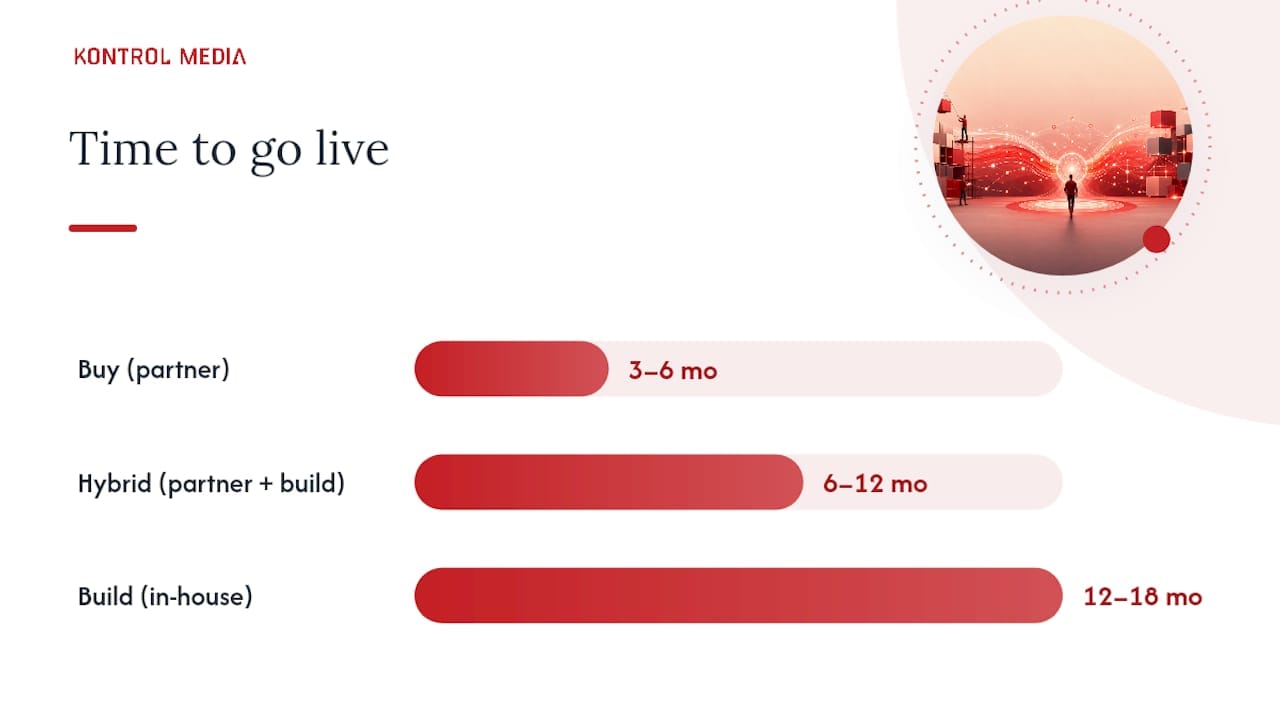
Buying (partnering with an ad-tech vendor) gets you live in roughly 3 to 6 months at the lowest upfront cost. Hybrid approaches, where you partner for ad serving but build proprietary measurement and reporting layers over time, typically take 6 to 12 months and cost more but give you long-term flexibility. A hybrid model is the pragmatic path for most retailers who want control without a multi-year engineering commitment. Full in-house builds run 12 to 18 months or longer and only make sense if you already have a mature ad-tech team.
Whichever path you choose, the integration checklist looks similar:
- Product catalog and order management system connectors
- POS integration for closed-loop, in-store attribution
- Ad server and SSP/DSP connections
- Identity resolution APIs
- Reporting and dashboard exports
Pro Tip: Negotiate data ownership and latency SLAs into the vendor contract before signing, not after. Retailers that skip this often discover their own transaction data is licensed back to them at a cost.
Our comparison of retail media ad servers breaks down integration complexity by vendor category if you’re at this decision point.
Which ad formats should you launch first?
Sponsored product and sponsored brand placements come first, always. They’re the most predictable ad format in retail advertising because they sit directly in the purchase path, and advertisers already understand how to buy them.
Sequence the rest deliberately:
- Phase 1: Sponsored product listings, sponsored brand banners on search and category pages
- Phase 2: Off-site programmatic extending your first-party audiences to open web and CTV inventory
- Phase 3: In-store digital placements once you have the hardware and staffing to support them
Off-site and in-store expansion increases revenue but requires additional operational capability you likely don’t have on day one. Set ad density rules before launch, capping the number of sponsored placements per page and per search result. Shopper experience erosion shows up in conversion rate before it shows up in complaints, and by the time you notice, advertisers have already noticed the performance drop too.
How should you price retail media network inventory?
CPM pricing suits brand awareness campaigns where advertisers want guaranteed impressions. CPC fits performance-driven advertisers who only want to pay for clicks. Most mature networks run both, letting advertisers choose based on campaign goal.
Set floor prices conservatively by category, then raise them once you have pilot data showing performance. A common approach:
- Start floors at the low end of comparable category benchmarks
- Review pricing every two to three weeks against actual fill rate and advertiser bids
- Raise floors only after you have evidence, not projections
For your first cohort of advertisers, package pilot incentives deliberately: a discounted introductory rate, bundled placements across sponsored product and sponsored brand, and a measurement guarantee that you’ll report incremental lift, not just impressions. That guarantee alone closes deals that pure CPM pitches don’t.
What KPIs prove a retail media network is working?
Incremental return on ad spend, or iROAS, is the metric that separates a real retail media network from a glorified banner rotation. It measures sales lift attributable to the ad, not sales that would have happened anyway. Alongside iROAS, track incremental sales volume, effective CPM (eCPM), and conversion rate by placement.

Incrementality testing is how you calculate iROAS credibly. Run holdout tests, where a control group of shoppers doesn’t see the ad, and compare purchase behavior against the exposed group. Pilots need enough volume to make the comparison statistically meaningful, so plan test cadence around your traffic, not an arbitrary calendar date.
Retailers consistently report more confidence in strategy than in execution, and measurement is where that gap shows up hardest. Build your reporting checklist now:
- Advertiser-facing dashboards with near real-time data
- API exports for advertisers who want to pull data into their own systems
- Defined SLAs for reporting turnaround
- Automated alerting before manual reporting becomes your bottleneck
Our breakdown of incrementality in retail media covers test design in more detail, and our key metrics guide maps out dashboard requirements.
How do you run a 90-day retail media network pilot?
A staged, time-boxed pilot beats an open-ended soft launch every time. Here’s the sequence:
- Weeks 1 to 4: Finalize governance, complete the data audit, and secure consent mapping across your data sources.
- Weeks 5 to 8: Integrate ad server and reporting connections, and onboard your first advertiser cohort with contracts signed.
- Weeks 9 to 12: Launch live campaigns, monitor intensively, and iterate weekly based on performance data.
A pilot of 5 to 10 advertisers with spend bands between $5,000 and $20,000 each gives you enough signal without overextending your ad ops team. Offer early advertisers a discounted rate in exchange for participating in incrementality testing.
The first 48 to 72 hours after launch matter more than the rest of the pilot combined. Automated alerts for match-rate drops, latency spikes, and pacing anomalies catch problems before they become advertiser churn. Check campaign pacing daily during that window, not weekly.
Pro Tip: Set your success criteria before launch, not after. Define the specific iROAS and fill-rate thresholds that mean “keep going” versus “fix this before onboarding more advertisers.”
Scaling from pilot to a self-serve retail media network
Pilot advertisers need hands-on account management. Once you’ve proven the model, you’ll need rules for graduating advertisers into self-serve tools, freeing your team to onboard the next wave instead of babysitting the last one.

Teams that defer reporting automation and self-serve tooling struggle to scale past a handful of advertisers. Build that infrastructure during the pilot, not after it.
Staffing follows demand: add account management as advertiser count grows, add data engineering before you expand into off-site or in-store formats, and cross-train ad ops on both. Set clear readiness triggers for channel expansion, sustained fill rates above your floor, iROAS that consistently clears your threshold, and integration bandwidth to support new inventory, before greenlighting the next phase. Our operational playbook for standing up a retail or commerce media network covers staffing ratios in more detail.
What most retail media playbooks get wrong
The retail media network strategy conversation has gotten stuck on inventory and ad formats, when the real differentiator is operating discipline. Every retailer I talk to already understands that sponsored product listings work. Fewer have built the governance and measurement muscle to prove it, scale it, and defend the budget against a marketing leader’s next quarterly review.
The conventional advice treats build versus buy as a technology decision. It’s actually a talent and timeline decision disguised as one. A retailer with strong data engineering and no ad ops discipline will build a beautiful platform that no advertiser trusts, because nobody can produce a credible incrementality report. A retailer with modest tech capacity but tight cross-functional governance will out-earn them within two quarters.
Prioritize the data audit and the merchant-media governance rules before you evaluate a single vendor. Everything downstream, pricing, formats, self-serve transition, depends on whether your identity resolution is solid and whether merchandising trusts the media team’s numbers. Skip that groundwork and you’ll spend your first year fixing disputes that a documented workflow would have prevented on day one.
— Mark Kapczynski
Get Kontrol Media’s Help Launching Your Network
Building the team, governance, and pilot roadmap described above is where most retail media launches lose momentum, not because the strategy is wrong, but because execution takes a dedicated operator. Kontrol Media builds, staffs, and runs retail and commerce media networks end to end, so your marketing leadership doesn’t have to pull ad ops and data engineering resources from other priorities to hit a 90-day launch window.
We’ve done this for retailers who needed a pilot live in weeks, not quarters, handling advertiser recruitment, technology integration, and measurement setup as one coordinated engagement instead of a patchwork of vendors. If your team is weighing build versus buy right now, talk to us about standing up your retail or commerce media network and get a pilot timeline scoped to your current data maturity and team capacity.
Key Takeaways
A retail media network setup succeeds when governance, first-party data readiness, and a disciplined 90-day pilot come before any technology purchase.
| Point | Details |
|---|---|
| Choose your path by scale | Most mid-market retailers should partner first; enterprise retailers with deep ad-tech teams can build in-house. |
| Time-to-launch varies sharply | Partner pilots launch in 8 to 12 weeks; full builds take 6 to 18 months. |
| Governance prevents the real failure mode | Merchant-media incentive conflicts, not technology gaps, derail most pilots without a documented resolution workflow. |
| Monitor the first 72 hours closely | Automated alerts for match-rate drops and pacing anomalies during launch prevent advertiser churn. |
| Kontrol Media runs the execution | Kontrol Media builds and operates retail and commerce media networks end to end, from data audit through pilot launch and scaling. |
Sources
- Retail media’s growth problem isn’t strategy, it’s execution
- How to Launch a High‑Margin Retail Media Network in 90 Days
- What is a retail media network? 2026 strategy guide
- Retail media evolution: the complete guide