

Make operational design, not ad tech, the center of your retail media network: launch fast with a partner, lock governance and measurement, then migrate to a hybrid owned stack. Most retailers already have the strategy right. Where they stumble is execution: the operating model, the data plumbing, the reporting cadence that makes an advertiser renew instead of walk. Retail media leaders report high confidence in strategy but real weakness in operating models, technology, and measurement, precisely where retail media network operations either compound or collapse.
Here’s what to do in the next 30 to 90 days:
- Audit your first-party data and identity resolution capability before you sign any contract.
- Assemble a cross-functional team spanning merchandising, media, and IT with one shared P&L.
- Pick 5 to 10 pilot advertisers at $5,000 to $20,000 in spend each, targeting 3 to 5x ROAS.
Key Takeaways
Retail media network operations succeed when governance, identity resolution, and measurement are locked before scale, not after.
| Point | Details |
|---|---|
| Partner first, build later | Launch in 3 to 6 months with a partner platform, then migrate high-value functions in-house as scale justifies it. |
| Fix governance before tech | Reserve inventory, publish a sellable calendar, and lock IO dates to end merchant-media friction. |
| Prove incrementality quarterly | Run holdout testing and deterministic Campaign ID to Order ID attribution before advertisers ask for it. |
| Sequence revenue channels | Expect on-site placements to lead Year 1 revenue, with off-site and in-store monetization following. |
| Bring in operational help | Kontrol Media designs pilots, recruits advertisers, and engineers measurement for retailers who need revenue moving fast. |
Table of Contents
- How Do You Choose an Operating Model for Retail Media Networks?
- What Technology and Vendor Criteria Actually Matter?
- Why Do Merchant and Media Teams Clash, and How Do You Fix It?
- What Should Your Measurement Stack Prove to Advertisers?
- What Does a Realistic Rollout Timeline Look Like?
- How Does Kontrol Media Operationalize Retail Media Networks?
- What’s the Real Bottleneck in Retail Media Right Now?
- Ready to Turn Retail Media Strategy Into Revenue?
- Sources
How Do You Choose an Operating Model for Retail Media Networks?
Three paths exist: build it yourself, partner with an established platform, or run a hybrid that migrates from one to the other, with the choice hinging on speed, capital, and how much you value owning the data.
Building in-house takes 12 to 18 months or longer and demands real engineering investment, but you keep every byte of first-party data and the long-term valuation upside that comes with it. Partnering compresses launch time to 3 to 6 months, gets you a working ad server and reporting portal almost immediately, and lets you start generating advertiser revenue while your internal team is still learning the category.
For most mid-market retailers, the sequence looks like this:
- Launch with a partner platform to prove demand and generate revenue within two quarters.
- Renegotiate data ownership terms once advertiser spend and category insight prove the network’s value.
- Migrate high-margin, high-data-value functions (identity, measurement, reporting) in-house while keeping ad serving on the partner rail.
- Reassess build economics annually as scale changes the cost equation.
Pro Tip: Negotiate a data portability clause into your partner contract from day one. The retailers who get stuck are the ones who signed a two-year deal without an exit path for their own first-party data.
What Technology and Vendor Criteria Actually Matter?
A retail media network needs five technical building blocks: an ad server, a self-serve advertiser portal, identity resolution, a data clean room, and a reporting layer that ties campaigns back to sales. Skip any one of these and you’ll hit a wall within two quarters.
Integration priority matters more than feature count. Your ad server has to talk to POS, ecommerce, loyalty, and ERP systems with latency low enough that inventory and pricing data don’t go stale mid-campaign. Fragmented tech stacks and data silos are the most common reason retail media networks stall out after a promising pilot.
Watch for these red flags before you sign:
- Vendor contracts that don’t specify who owns campaign and outcome data after termination.
- No documented SLA for uptime or reporting latency.
- No clean-room option, which limits privacy-safe targeting and measurement as CCPA-style rules tighten.
- Manual-only advertiser onboarding, which caps you at your top 20 accounts and locks out the long tail.
Pro Tip: Ask any vendor finalist for a reference retailer at your revenue size, not their biggest logo. Enterprise case studies rarely reflect mid-market implementation reality.
Why Do Merchant and Media Teams Clash, and How Do You Fix It?
The single biggest operational failure in retail media isn’t technology. It’s the standoff between merchants who see ad placements as shelf space they control and media teams who see the same placements as inventory to sell. Retailers that reduce friction between insight and action consistently outperform peers who don’t.
Fixing it takes structural change, not a memo. Build a cross-functional team that includes a media operations lead, a category merchant, a data/analytics owner, and IT, reporting into a single executive sponsor rather than two competing VPs. Then set shared KPIs so a media placement’s performance is measured against category sales lift, not just click-through rate.
Governance rules that actually hold:
- Reserve a fixed percentage of inventory for media before merchandising claims it for promotions.
- Publish a sellable calendar 90 days out so sales reps aren’t overselling placements that don’t exist yet.
- Set IO (insertion order) lock dates that prevent last-minute campaign changes from breaking measurement.
- Require joint sign-off from media and merchandising on any placement above a defined revenue threshold.
What Should Your Measurement Stack Prove to Advertisers?
Advertisers renew based on proof, not promises, and that proof requires two things: incrementality testing and closed-loop attribution that ties a specific campaign to a specific order.
Incrementality testing means running holdout groups so you can show a campaign generated sales that wouldn’t have happened anyway, not just sales that were coming regardless. Run it quarterly at minimum for your top 10 advertisers, and read the mechanics closely in Kontrol Media’s breakdown of incrementality in retail media before you promise results you can’t defend.
Closed-loop attribution requires a deterministic link from Campaign ID to Order ID, which means your ad server and your commerce platform need to share a common identifier at the transaction level, not a probabilistic match weeks later.
Your dashboard needs, at minimum:
- Impressions, clicks, and conversion rate by placement.
- ROAS and cost per acquisition, updated daily during active campaigns.
- Incrementality lift, reported quarterly.
- Share of voice by category, useful for renewal conversations.
Analytics-driven measurement discipline is why marketing teams using structured analytics frameworks consistently report stronger ROI outcomes than those relying on vanity metrics. For a fuller KPI framework, Kontrol Media’s guide to retail media metrics walks through dashboard cadence in more depth.
What Does a Realistic Rollout Timeline Look Like?
Retail media network operations succeed or fail based on sequencing. Rushing to scale before governance and measurement are locked is the single most common self-inflicted wound.
Weeks 1 to 12 (Pilot): Select 5 to 10 endemic advertisers, set budgets at $5,000 to $20,000 each, and get dashboards live before the first campaign ships. Target very high platform uptime and treat any significant dip as a launch blocker, not a footnote.
Months 4 to 12 (Operational Scale): Introduce self-serve advertiser portals so mid-tier vendors can launch campaigns without a sales rep on every call. Automate ad ops workflows: campaign approval, billing, and reporting delivery. This is also when advertiser acquisition strategy shifts from manual outreach to a repeatable pipeline.
Months 12 to 36 (Build-to-Own): Begin migrating identity resolution and measurement in-house while keeping ad serving on the partner rail, if that’s still the more economical choice. Composable architecture, where you own the pieces that generate the most data value and rent the rest, tends to outperform an all-or-nothing rebuild.
| Phase | Timeline | Primary Owner | Key Milestone |
|---|---|---|---|
| Pilot | Weeks 1 to 12 | Media ops lead | 5 to 10 advertisers live, dashboards operational |
| Scale | Months 4 to 12 | Cross-functional team | Self-serve portal launched, ad ops automated |
| Build-to-own | Months 12 to 36 | Executive sponsor + IT | Identity and measurement migrated in-house |
| Maturity | Ongoing | Full RMN team | Composable stack, quarterly incrementality testing |
Revenue sequencing follows a predictable pattern too: on-site placements (sponsored search, display) typically generate the bulk of Year 1 revenue, with off-site programmatic and in-store data monetization following at a roughly 40/35/25 split as the network matures. For the full standup sequence, Kontrol Media’s playbook on launching a commerce media network covers each phase in more operational detail.
How Does Kontrol Media Operationalize Retail Media Networks?
Kontrol Media builds and operates retail and commerce media networks for retailers who need revenue moving before their internal team is fully staffed. That means pilot design, advertiser acquisition, and measurement engineering handled by people who’ve done it before, not a slide deck handed to an already-stretched marketing team.
The gap between a retail media strategy deck and a functioning, revenue-generating network is almost always operational: who owns the sellable calendar, who signs the IO, who builds the dashboard advertisers actually trust. Closing that gap is the work.
Hiring a consultancy makes the most sense when you need advertiser revenue within two quarters and don’t have the headcount to build a cross-functional team from scratch. Building fully in-house makes sense once you’ve proven demand and want to own every layer of the stack long-term.
What’s the Real Bottleneck in Retail Media Right Now?
Most retail media coverage treats technology selection as the hard part. It isn’t. The eMarketer data on the strategy-execution confidence gap says the quiet part out loud: teams know what they want to build, they just can’t get merchants, media, and IT to move in the same direction fast enough to matter.
I’d go further than the conventional advice on this. The industry loves to talk about identity resolution and clean rooms as if they’re the finish line. They’re not. They’re table stakes. The retailers actually winning are the ones who fixed governance first, meaning a sellable calendar, a locked IO process, and a shared P&L between merchants and media, before they worried about which ad server to buy.
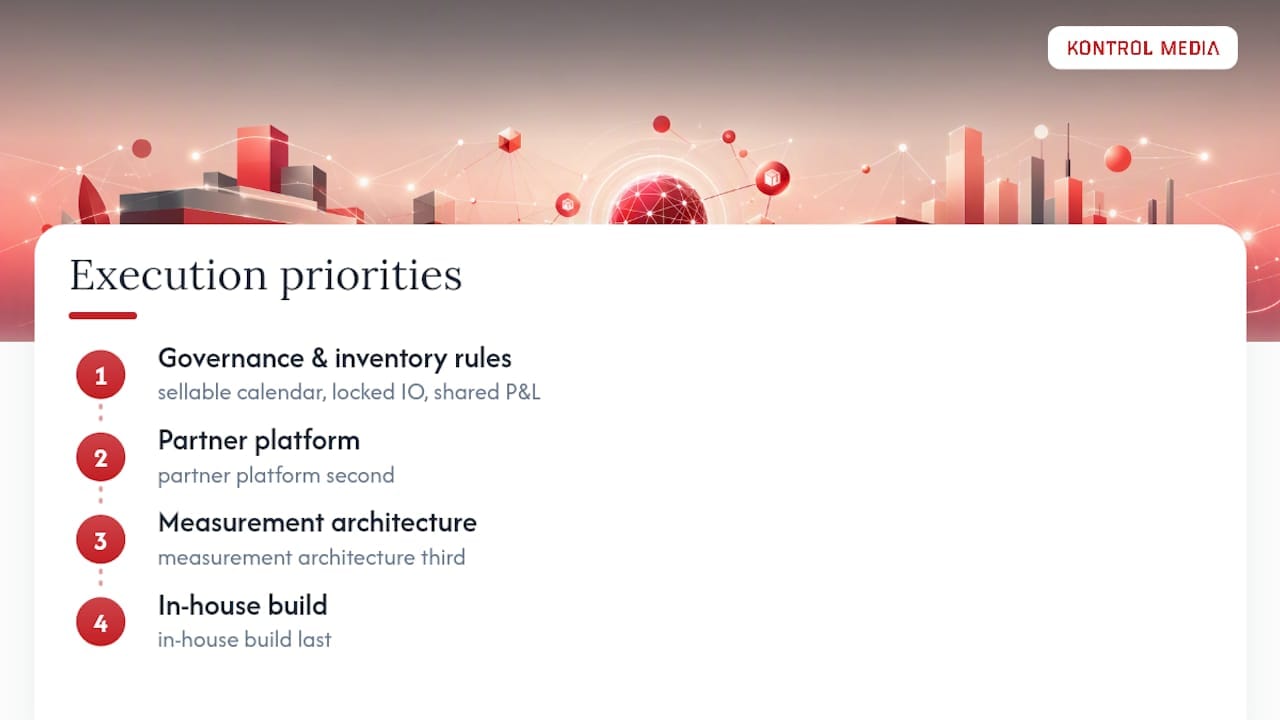
If you’re starting today, prioritize in this order: governance and inventory rules first, a partner platform second, measurement architecture third, and in-house build last. Most organizations invert this order because build feels more strategic than a calendar dispute between merchandising and media. That instinct is backward, and it’s why so many pilots stall at month six instead of scaling.
— Mark Kapczynski
Ready to Turn Retail Media Strategy Into Revenue?
If you’ve read this far, you already know the hard part isn’t picking a platform. It’s the governance, the cross-functional buy-in, and the measurement plumbing that makes advertisers renew. Kontrol Media builds and operates retail and commerce media networks hands-on, so you get a revenue-generating pilot running in months instead of spending a year assembling an internal team from scratch.
We design the pilot, recruit and onboard advertisers, and engineer the closed-loop measurement that proves ROAS instead of promising it. That work benefits retailers and consumer brands alike, especially those without a dedicated media operations function ready to launch on day one. If you’re evaluating whether to build, partner, or run a hybrid model, start a conversation about standing up your network and we’ll walk through what a realistic 90-day pilot looks like for your business.
Sources
For deeper detail on the execution gap driving this playbook, eMarketer’s analysis of retail media’s growth problem is worth a full read. Advertising Week’s piece on why retail media got harder to run unpacks the organizational side in more depth.
For implementation specifics, the Retail Exec roadmap covers pilot benchmarks and partner selection criteria, and Netguru’s technical blueprint walks through clean room architecture. Kontrol Media’s own guide to retail media metrics rounds out the measurement side.
- Retail media’s growth problem isn’t strategy, it’s execution
- Retail Media Got Easier to Buy. But Harder to Run.
- Retail Media Networks (implementation roadmap and partner guidance)
- The challenges of operating retail media networks and how retailers can overcome them
Recommended
- Retail Media Audience Data Activation: A Practical Playbook | Kontrol Media Consultancy
- Retail Media Strategy for Non-Retailers: 2026 Guide | Kontrol Media Consultancy
- Consumer Brand Media Network Best Practices in 2026 | Kontrol Media Consultancy
- Types of Commerce Media Network Models: 2026 Guide | Kontrol Media Consultancy