


Ad sales is the process of selling advertising inventory to brands and businesses that want to reach specific audiences and grow their revenue. The U.S. digital advertising market crossed $294.6 billion in 2025, a 13.9% year-over-year increase tracked by IAB and PwC. Social media, search, and digital video now account for the largest share of that spend. For marketing professionals and executives, understanding how to sell ads effectively means understanding where money is moving, why it moves, and how to position your inventory or media network to capture it.
How does ad sales work and who are the key players?
Ad sales operates as a B2B process at its core. The seller side includes media companies, publishers, digital platforms, and event organizers. The buyer side includes brand marketing teams, media agencies, and procurement departments. Each transaction involves negotiating reach, targeting parameters, pricing, and expected outcomes.
What separates advertising sales from transactional product sales is the campaign-centric nature of the work. A rep selling ad inventory is not closing a one-time deal. They are building a campaign structure that serves a client’s business objective over weeks or months. That distinction changes everything about how you prospect, pitch, and retain accounts.
The typical ad sales cycle involves several stages:
- Prospecting: Identifying brands whose audience matches your inventory’s reach
- Discovery: Understanding the client’s campaign goals, budget cycles, and decision-making structure
- Proposal: Building a media plan that maps inventory to client objectives
- Negotiation: Aligning on pricing, guarantees, and performance benchmarks
- Execution and reporting: Delivering the campaign and proving value through measurement
Multi-stakeholder complexity is the norm, not the exception. A single campaign decision at a mid-size brand may involve a CMO, a media planner, a procurement lead, and an agency partner. Consultative selling skills and strong discovery techniques are what separate average reps from top performers who manage quotas of $1 million to $10 million or more annually.
What are the latest market trends and revenue drivers in ad sales?
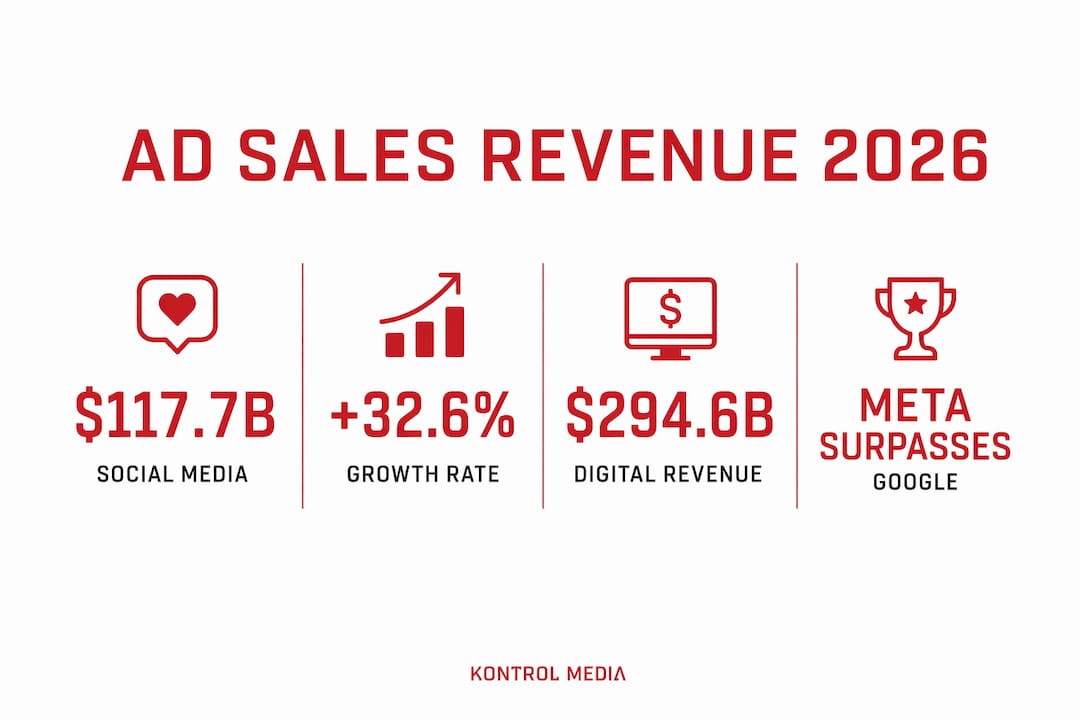
The advertising revenue picture in 2026 is defined by concentration and acceleration. Social media ad revenue hit $117.7 billion in 2025, up 32.6% year over year. Search followed at $114.2 billion, and digital video reached $78 billion, up 25.4%. These three categories now represent the spine of digital advertising spend.
The platform power shift is equally significant. Meta is forecast to surpass Google in total digital ad revenues in 2026, with Meta projected at $243.46 billion versus Google’s $239.54 billion. Meta’s advantage comes from first-party data depth and AI-integrated automation. That shift signals something important: platforms that own the data relationship with consumers are winning the revenue race.
| Category | 2025 Revenue | Year-over-Year Growth |
|---|---|---|
| Social media | $117.7 billion | +32.6% |
| Search | $114.2 billion | Significant growth |
| Digital video | $78 billion | +25.4% |
| Total U.S. digital | $294.6 billion | +13.9% |
Data privacy changes are reshaping targeting across the board. As third-party cookies continue to phase out, first-party data has become the primary currency for precise audience targeting. Publishers and media networks that have built direct audience relationships now hold a structural advantage. Smaller entities without that data infrastructure face real consolidation pressure. The gap between data-rich platforms and everyone else is widening, and ad sales teams need to account for that reality in every client conversation.
What advanced advertising sales techniques drive revenue growth in 2026?
The most effective advertising sales techniques in 2026 combine automation with personalized creative and full-funnel measurement. Automation orchestration syncs campaigns, data, and platforms to create personalized customer journeys at scale. Behavioral analytics and search intent metrics feed targeting decisions that demographic data alone cannot support.
AI-powered campaign tools have changed the baseline expectation for what a well-run campaign looks like. Broad targeting powered by machine learning now outperforms narrow manual segmentation in many contexts. The rep who understands how to position these tools within a client proposal wins more deals than the one still selling on reach and frequency alone.

Creative strategy is equally decisive. User-generated content outperforms studio-produced ads by 3–5x on social platforms. Native-looking ads drive higher engagement than formats that feel like obvious interruptions. Authentic messaging is not a soft preference. It is a measurable performance driver.
The measurement conversation is where many ad sales professionals still leave money on the table. Key pitfalls and best practices include:
- Avoid overvaluing clicks: Clicks are a surface metric. Multi-touch attribution outperforms last-click models in long sales cycles and gives a more accurate picture of campaign contribution.
- Educate buyers on pipeline influence: Clients who understand how advertising accelerates deal velocity are more likely to maintain budgets through uncertain periods.
- Use ROAS and CAC together: Return on Ad Spend and Customer Acquisition Cost are the metrics that connect campaign performance to business outcomes. Blended ROAS across channels gives a more complete view than single-channel reporting.
- Align goals before launch: Effective digital ad strategy requires specific, measurable goals tied to leads, calls, or visits. Vague objectives produce vague results.
Pro Tip: When a client pushes back on budget, shift the conversation from cost to deal velocity. Show them how advertising compresses the time between awareness and purchase. That reframe moves the discussion from expense to investment.
How to build and manage successful ad sales partnerships and teams?
Sustainable advertising revenue comes from relationships, not transactions. The best ad sales teams operate as extensions of their clients’ marketing functions. That means understanding the client’s business deeply enough to recommend changes to their media mix, not just sell them more of what they already buy.
Cross-functional collaboration is the operational backbone of high-performing ad sales. Successful campaigns require alignment across sales, planning, measurement, and operations. When those functions work in silos, campaigns underdeliver and clients churn. When they work together, the client experience improves and renewal rates follow.
Building and scaling a high-performing ad sales team requires a clear structure:
- Define roles with precision. Separate prospecting from account management early. Reps who hunt new business have different skills than those who grow existing accounts.
- Align sales and marketing goals. The alignment between marketing and sales determines whether your pipeline reflects real demand or wishful thinking.
- Train on consultative selling. Product knowledge matters, but the ability to diagnose a client’s business problem and map your inventory to the solution is what closes large deals.
- Measure the right outputs. Track pipeline influence, renewal rates, and average deal size. These tell you more about team health than raw call volume.
- Build for retention, not just acquisition. Long-term revenue streams come from clients who renew and expand. Treat the post-sale relationship as seriously as the pre-sale process.
For executives considering whether to build or outsource parts of the sales function, the sales function without added headcount model is worth examining. It gives you execution capacity without the fixed cost of a full internal team.
Pro Tip: In multi-stakeholder negotiations, identify the economic buyer early and keep them informed throughout the process. Deals stall when the person who controls the budget feels out of the loop.
Key Takeaways
Effective ad sales in 2026 requires campaign-centric selling, first-party data, and cross-functional team alignment to capture advertising revenue at scale.
| Point | Details |
|---|---|
| Market scale and momentum | U.S. digital ad revenue reached $294.6 billion in 2025, with social media and video growing fastest. |
| Platform power is shifting | Meta is forecast to surpass Google in 2026, driven by first-party data and AI automation advantages. |
| Creative quality drives performance | User-generated content outperforms studio ads by 3–5x on social platforms. |
| Measurement beyond clicks | Multi-touch attribution and pipeline influence metrics give a more accurate view of campaign ROI. |
| Team alignment determines outcomes | Cross-functional collaboration across sales, planning, and operations is the foundation of sustained revenue growth. |
The shift I keep seeing in how ad sales actually gets done
I have watched the ad sales conversation change significantly over the past several years, and the clearest shift is this: the reps and teams winning the largest deals are not the ones with the biggest rate cards. They are the ones who walk into a client meeting already knowing what the client’s business problem is and how their inventory connects to solving it.
That sounds obvious. It rarely gets executed. Most ad sales conversations still start with the seller’s story, not the buyer’s challenge. The consultative approach, where you lead with discovery and build the proposal around the client’s goals, is still the exception rather than the standard practice.
The automation and AI tools available now make this easier and harder at the same time. Easier because you can personalize at scale, run smarter targeting, and show attribution data that was impossible to produce five years ago. Harder because clients now expect that level of sophistication as a baseline. The bar has moved up, and teams that are still selling on impressions and reach alone are losing ground to those who can speak fluently about pipeline influence, incrementality testing, and blended ROAS.
The other thing I keep coming back to is the importance of educating your clients. Clients who understand what good measurement looks like are better clients. They do not panic when a single metric dips. They stay invested through the full campaign cycle because they understand how the pieces connect. That education is not a nice-to-have. It is a retention strategy.
The market is consolidating around platforms with data advantages, and that pressure is real for smaller publishers and media networks. The answer is not to compete on scale. It is to compete on specificity, relationship depth, and the ability to prove business outcomes. That is where the opportunity still lives.
— Mark Kapczynski
How Kontrol Media helps you build stronger ad sales results
Kontrol Media works directly with marketing leaders and executives who need more than a media plan. They need a growth strategy that connects advertising investment to measurable business outcomes.
Kontrol Media builds and operates retail media and commerce media networks, helps brands reach home buyers through real estate channel partnerships, and provides hands-on business strategy consulting across sales, marketing, and business development. Clients like Experian, BuzzFeed, REMAX, and Enthusiast Gaming have worked with Kontrol Media to sharpen their advertising revenue strategies and execution. If you are looking to grow your media network’s ad revenue or align your sales and marketing functions for better results, connect with Kontrol Media to start the conversation.
FAQ
What is ad sales?
Ad sales is the process of selling advertising inventory, such as digital placements, video slots, or print space, to brands and businesses that want to reach specific audiences. It operates as a B2B sales function with campaign-centric cycles and multi-stakeholder decision making.
How much does an advertising sales representative earn?
The average U.S. advertising sales rep earns a base salary of $64,097, with commission rates typically ranging from 5% to 15% of sold revenue. Top performers manage annual revenue quotas from $1 million to $10 million or more.
What metrics matter most in ad sales?
Return on Ad Spend, Customer Acquisition Cost, and pipeline influence are the metrics that connect campaign performance to real business outcomes. Multi-touch attribution gives a more accurate picture than last-click models, especially in long B2B sales cycles.
How is digital ad sales different from print ad sales?
Digital ad sales relies on real-time data, audience targeting, and performance measurement tools that print ad sales cannot match. Print ad sales focuses more on fixed placements, circulation-based reach, and longer lead times for creative production.
What skills do top ad sales professionals need?
Top performers combine consultative selling skills with strong discovery techniques, data literacy, and the ability to manage complex multi-stakeholder negotiations. Understanding attribution models and being able to educate clients on ROI metrics are increasingly non-negotiable skills in 2026.
Recommended
- Advertiser Acquisition Strategies for Media Networks in 2026 | Kontrol Media Consultancy
- Retail Media Ad Sales: Strategic Guide for Marketing Pros in 2026 | Kontrol Media Consultancy
- Your Sales Function, Without the Headcount | Kontrol Media Consultancy
- The Shift in Advertising Spend – How Retail Media Networks Are Changing the Game | Kontrol Media Consultancy