


Campaign management is the coordinated process of planning, executing, tracking, and optimizing marketing initiatives to achieve specific business goals. More precisely, it is strategy in action, converting long-term vision into time-bound activities with clear start and end dates. A marketing campaign coordinates advertising, content, and social efforts across multiple channels toward a single defined objective. Yet 44% of businesses fail to link their promotional efforts to measurable business impact, which means most campaigns run without a reliable way to prove their value. Getting that structure right is what separates campaigns that drive growth from campaigns that just spend budget.
What are the essential components of campaign management?
Effective campaign management follows five distinct phases: intake, planning, execution, tracking, and optimization. Each phase builds on the last, and skipping one creates gaps that show up later as missed targets or unreadable data. Understanding the sequence is the first step toward running campaigns that actually deliver.
1. Define the objective
Every campaign starts with a single, measurable goal. Clear, traceable goals tied to revenue growth or lead volume are the foundation for evaluating whether a campaign succeeded. Vague goals like “increase awareness” produce vague results. Tie every objective to a number: a lead volume target, a revenue figure, or a cost-per-acquisition threshold.
2. Segment your audience
Audience segmentation determines who receives your message and through which channel. Build buyer personas based on behavioral data, not assumptions. A persona for a first-time homebuyer looks very different from one for a real estate investor, even if both are in the same ZIP code.
3. Develop your messaging and select channels
Messaging must stay consistent across every channel while adapting to each format. A LinkedIn post and a paid search ad serve different moments in the buyer journey. Channel selection follows audience behavior: go where your audience already spends attention, not where your team feels most comfortable.

4. Build the timeline and assign ownership
A campaign without a timeline is a wish list. Map every deliverable to a date and assign a named owner. Use a shared project management tool so that delays surface immediately rather than the day before launch.
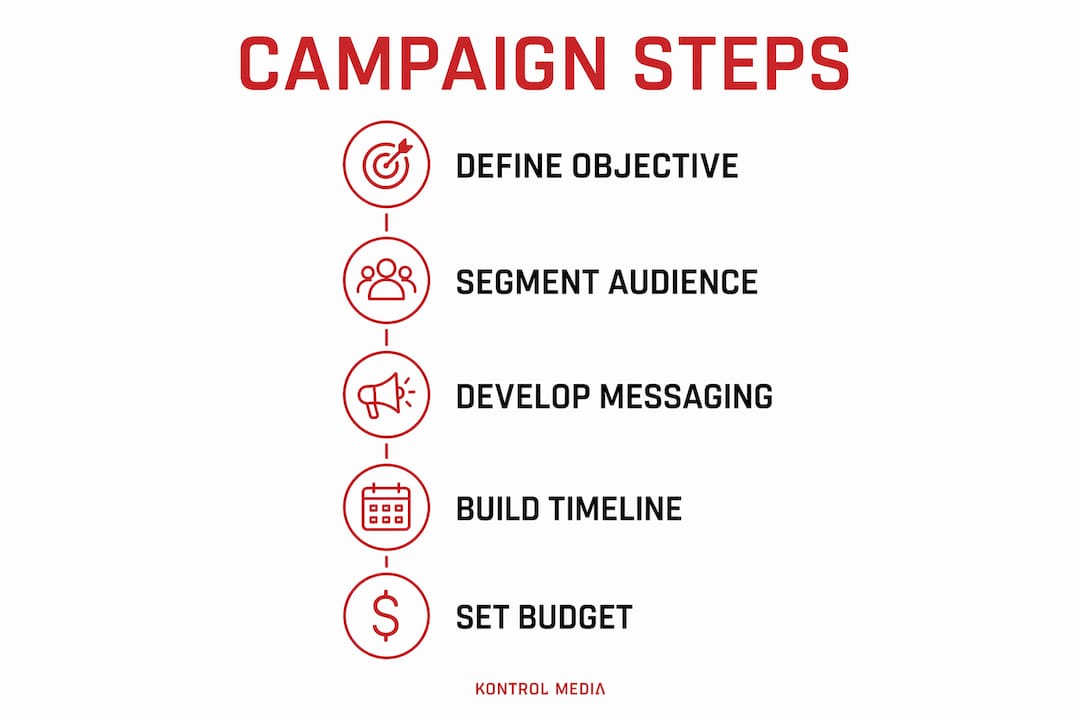
5. Set the budget backward from outcomes
Backward budgeting starts with the desired outcome and works back to the spend required to achieve it. This prevents the common mistake of allocating budget by gut feel or historical percentages. If you need 500 qualified leads at a $40 cost per lead, your budget floor is $20,000 before creative and overhead.
Pro Tip: Build your campaign timeline from the launch date backward to the briefing date. This forces realistic scoping and surfaces resource conflicts before they become emergencies.
Which tools support digital campaign management?
The right tools determine whether your data tells a clear story or a fragmented one. Digital campaign management requires at least three categories of technology working together: tracking, project coordination, and performance reporting.
Tracking and analytics
UTM parameters are the backbone of campaign attribution. Every link you distribute should carry a UTM source, medium, campaign name, and content tag. Small errors in UTM parameters split campaign data into multiple rows in your analytics platform, making performance reports unreliable. Standardized naming conventions and URL encoding prevent those splits and keep your measurement clean.
Project management and collaboration
Campaign execution involves writers, designers, media buyers, and analysts working in parallel. A shared project management platform keeps everyone on the same timeline and makes bottlenecks visible. Without a central coordination layer, campaigns drift: assets arrive late, approvals stall, and launch dates slip.
Performance dashboards and automation
Performance dashboards pull data from paid, owned, and earned channels into a single view. Automated campaign solutions reduce manual reporting time and flag anomalies faster than weekly check-ins. One practical note on data retention: campaign assets remain restorable for 3 months after deletion in most analytics platforms. That window matters when you need to recover a mistakenly archived campaign or audit historical performance.
| Feature category | What it does | Why it matters |
|---|---|---|
| UTM tracking | Tags URLs with source and campaign data | Attributes traffic accurately to each channel |
| Budget management | Monitors spend against allocated limits | Prevents overspend and flags underperforming placements |
| Reporting dashboards | Aggregates cross-channel performance data | Gives a single view for optimization decisions |
| Automation triggers | Sends messages based on user behavior | Reduces manual work and improves response timing |
| Data recovery | Restores deleted campaign objects | Protects against accidental data loss |
Pro Tip: Measure campaign ROI at the channel level, not just the campaign level. Channel-level data tells you where to shift budget mid-flight.
How to implement a step-by-step campaign management process
A repeatable process is what turns a one-time successful campaign into a consistent capability. The following sequence applies to paid media, content campaigns, email programs, and multi-channel launches alike.
Step 1: Define objectives and KPIs. Set one primary KPI per campaign. Secondary metrics provide context, but one number drives decisions. Align that KPI directly to a business goal so that campaign performance translates into language the executive team understands.
Step 2: Build campaign assets with standardized naming. Name every asset, ad set, and tracking link using a consistent convention before anything goes live. A naming convention like “Brand_Channel_Audience_Date” makes filtering and reporting fast. Inconsistent naming is the single most common cause of messy analytics data.
Step 3: Create and QA all tracking links. Run every UTM-tagged URL through a link checker before launch. Confirm that parameters use consistent casing, that spaces are encoded correctly, and that destination pages load without errors. This five-minute check prevents weeks of fragmented data.
Step 4: Launch and monitor the first week closely. The first week of campaign data is the most valuable window for early optimization and budget reallocation. Watch click-through rates, cost per click, and conversion rates daily. If one channel is outperforming others by day three, shift budget toward it rather than waiting for the scheduled mid-campaign review.
Step 5: Analyze and optimize in real time. Optimization is not a one-time event at the end of a campaign. It is a daily or weekly practice of reading data and making small adjustments. Pause underperforming ad sets, test new creative against the control, and adjust bids based on conversion data.
Step 6: Conduct a post-campaign evaluation. Document what worked, what did not, and what you would change. A post-campaign report that sits in a shared folder and gets read by the next campaign team is worth more than a polished deck that no one opens again.
Pro Tip: Set a “kill threshold” before launch: a specific cost-per-result number at which you will pause a placement automatically. This removes emotion from optimization decisions.
What are common challenges in campaign management?
Even well-planned campaigns run into problems. The most common issues are predictable, and most are preventable with the right processes in place.
Poor goal alignment. Campaigns that lack a clear connection to business priorities get cut when budgets tighten. Every campaign brief should answer one question: which business outcome does this support? Without that answer, the campaign is decorative.
Inconsistent tracking. UTM errors, missing tags, and inconsistent naming conventions are the leading cause of unreliable performance data. A single typo in a UTM campaign name creates a separate data row that looks like a new traffic source. Standardized URL-building tools and a pre-launch QA checklist eliminate most of these errors.
Fragmented channel management. Running paid search, social, email, and content from separate teams with no shared reporting creates blind spots. A campaign that looks underperforming in one channel may be driving conversions that are attributed to another. Cross-channel dashboards solve this, but only if all channels use the same naming conventions.
Communication gaps across teams. Delays in creative approvals, legal reviews, or technical implementations push launch dates and compress the optimization window. A shared project timeline with named owners and escalation paths keeps everyone accountable.
Reactive rather than agile adjustments. Waiting for a scheduled review to act on poor performance wastes budget. Build a monitoring cadence into the campaign plan: daily checks in week one, then weekly through the remainder of the flight. Agile adjustments based on real data consistently outperform set-and-forget campaign management.
Key Takeaways
Effective campaign management requires clear objectives, standardized tracking, and a repeatable optimization process tied directly to business outcomes.
| Point | Details |
|---|---|
| Define one primary KPI | Tie every campaign to a single measurable outcome aligned with business priorities. |
| Use backward budgeting | Start with the desired outcome and calculate the spend required to reach it. |
| Standardize UTM naming | Consistent naming conventions prevent fragmented analytics data and unreliable reports. |
| Monitor the first week closely | Early data is the best signal for budget reallocation and creative optimization. |
| Run post-campaign evaluations | Documented lessons from each campaign improve the next one’s planning and execution. |
What I’ve learned after years of watching campaigns succeed and fail
I’ve sat in enough campaign debriefs to know that the difference between a campaign that delivers and one that disappoints rarely comes down to creative quality or budget size. It almost always comes down to whether the team agreed on what success looked like before the campaign launched.
The backward budgeting approach changed how I think about resource allocation. When you start with the outcome you need and work backward to the spend required, the conversation shifts from “how much do we have?” to “what do we need to achieve?” That is a fundamentally different and more productive conversation. It also makes it much easier to defend the budget to leadership, because the math is visible.
The technology piece matters, but not in the way most teams think. The value of a performance dashboard is not the dashboard itself. It is the discipline of looking at the same data, in the same format, at the same cadence, across every channel. That consistency is what makes patterns visible. Without it, you are making decisions based on whichever channel’s account manager sent the most recent email.
Post-campaign analysis is the most underused tool in marketing. Teams celebrate wins and move on. They bury losses and move on faster. The organizations I’ve seen build real campaign capability are the ones that treat every campaign as a data point in a longer learning curve. They write down what they expected, what happened, and why the gap existed. Over time, that institutional knowledge compounds. It becomes the spine of a marketing function that gets better with every campaign it runs.
— Mark Kapczynski
How Kontrol Media approaches campaign planning and growth
Kontrol Media works with marketing teams and business leaders to build campaign programs that connect directly to revenue and growth targets. The work starts with comprehensive business strategy and moves through hands-on execution across sales, marketing, and business development.
Clients like Experian, BuzzFeed, REMAX, and West Monroe have worked with Kontrol Media to align their advertising campaign management with measurable business outcomes. Whether you are building a campaign from scratch or fixing a program that is not performing, Kontrol Media brings the structure, process, and accountability that turns campaign activity into business results. Reach out to explore what a tailored approach looks like for your organization.
FAQ
What is campaign management in marketing?
Campaign management is the end-to-end process of planning, executing, tracking, and optimizing marketing initiatives to achieve a specific business goal. It converts long-term marketing strategy into time-bound, measurable activities.
How do I set goals for a marketing campaign?
Set one primary KPI per campaign and tie it directly to a business outcome such as lead volume, revenue, or cost per acquisition. Traceable goals linked to revenue or lead targets are the standard for evaluating campaign success.
What are UTM parameters and why do they matter?
UTM parameters are tags added to URLs that tell your analytics platform where traffic came from. Inconsistent or misspelled UTM values split campaign data into separate rows, making performance reports unreliable.
How often should I review campaign performance?
Review performance daily during the first week of a campaign, then weekly through the remainder of the flight. The first week provides the most valuable data for budget reallocation and early optimization decisions.
What is backward budgeting in campaign planning?
Backward budgeting starts with the target outcome and calculates the spend required to reach it. This approach aligns budget allocation with business goals rather than arbitrary percentages or historical spend patterns.
Recommended
- Marketing for Private Equity Portfolio Companies: 2026 Guide | Kontrol Media Consultancy
- Key Takeaways from Possible 2026 in Miami That No Slide Deck Could Have Told Me | Kontrol Media Consultancy
- Brand Marketing Versus Performance Marketing: 2026 Guide | Kontrol Media Consultancy
- Retail Media Ad Sales: Strategic Guide for Marketing Pros in 2026 | Kontrol Media Consultancy