


B2B marketing is defined as business-to-business marketing, where companies sell products or services to other organizations, while B2C marketing targets individual consumers directly. Understanding how B2B and B2C marketing differ is not a theoretical exercise. It is the foundation of every channel decision, content investment, and budget allocation you make. Get this wrong, and you spend months running LinkedIn thought leadership campaigns for a consumer app, or flooding Instagram with product demos that a procurement committee will never see.
How b2b and b2c marketing differ at their core
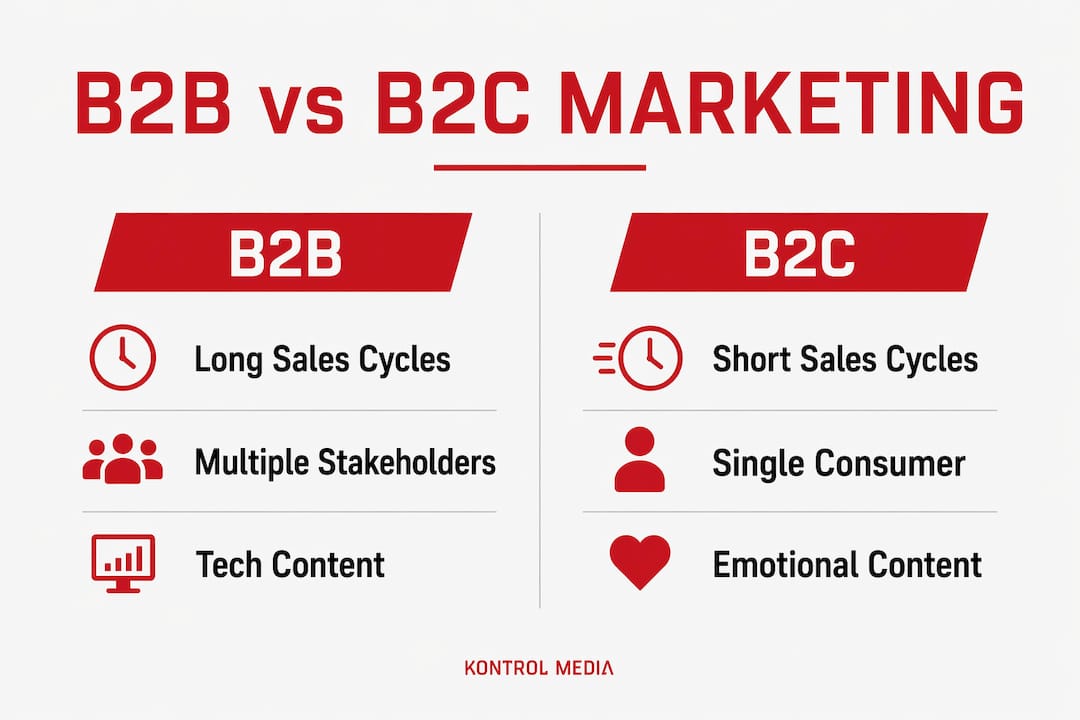
The most fundamental distinction sits in the buyer. B2B marketing targets buying committees of 6 to 13 stakeholders, while B2C marketing targets 1 to 2 individuals. That difference in audience size reshapes everything downstream, from message complexity to channel selection to how you define a conversion.
B2B buyers are organizations. A VP of Operations at a mid-market manufacturer, a procurement lead at a hospital network, or a CTO evaluating software vendors all represent B2B buyers. They are spending company money, and that accountability changes how they decide. B2C buyers spend their own money, often on lower-stakes purchases, and they move on instinct, identity, and desire as much as logic.

Average B2B deal sizes range from $10,000 to over $1,000,000, compared to B2C transaction sizes from $5 to $500. That gap in financial stakes explains why B2B marketing must build deep credibility before asking for a commitment, while B2C marketing can close a sale with a well-timed promotion and a frictionless checkout.
How do sales cycles and decision-making differ?
The B2B sales cycle is long by design, not by accident. Enterprise-level B2B deals can extend 12 to 18 months, requiring continuous education and stakeholder alignment throughout. Each stakeholder in a buying committee brings different priorities: finance wants cost justification, IT wants integration specs, and the end user wants ease of adoption. Marketing must speak to all of them, often simultaneously, across multiple touchpoints.
B2C sales cycles operate in a completely different time frame. A consumer might discover a product on TikTok, read two reviews, and complete a purchase within the same afternoon. The B2B sales cycle stages are structured and sequential; B2C cycles are fluid and often nonlinear.
This timing gap has direct implications for marketing investment. B2B marketers must plan for nurture sequences that run for quarters, not days. B2C marketers optimize for real-time triggers and impulse windows. The two disciplines require fundamentally different patience and measurement horizons.
Pro Tip: If you are running a B2B campaign, map every piece of content to a specific stage of the buying committee’s decision process. Content that speaks to a CFO’s risk concerns will not resonate with a department head evaluating daily usability.
Risk perception also drives decision speed. B2B buyers treat a wrong purchase as a career risk. A bad software implementation or a failed vendor relationship can damage a professional’s reputation internally. That fear slows decisions and raises the bar for proof. B2C buyers face lower personal stakes, which is why social proof, star ratings, and a clear return policy are often enough to close the deal.
What channels and content strategies work for each?
Channel selection is where the B2B vs B2C marketing divide becomes most visible in practice. B2B marketing channels commonly include LinkedIn, email sequences, and industry events, while B2C marketing leverages paid social, influencer partnerships, and behavioral email automation. These are not interchangeable. A B2B software company running influencer campaigns on Instagram will burn budget. A consumer brand investing in LinkedIn whitepapers will reach the wrong people entirely.
| Dimension | B2B Marketing | B2C Marketing |
|---|---|---|
| Primary Channels | LinkedIn, email, webinars, trade events | Instagram, TikTok, paid social, influencer |
| Content Style | Educational, data-driven, case studies | Emotional, visual, entertainment-focused |
| Sales Cycle | Weeks to 18+ months | Minutes to days |
| Buyer Count | 6 to 13 stakeholders | 1 to 2 individuals |
| Deal Size | $10,000 to $1,000,000+ | $5 to $500 |
| Conversion Goal | Pipeline and relationship | Direct purchase |
Content style follows channel logic. B2B content earns trust through specificity: ROI calculators, technical white papers, customer case studies from recognizable companies like Salesforce or IBM, and webinars that address real operational problems. B2C content earns attention through emotion and identity: aspirational imagery, user-generated content, limited-time offers, and storytelling that connects a product to how someone sees themselves.
Automation and segmentation also work differently across the two models. B2B marketing automation tools like HubSpot or Marketo are built to track stakeholder engagement across long nurture sequences and score leads based on behavioral signals. B2C platforms like Klaviyo or Attentive focus on high-frequency, real-time triggers: abandoned cart sequences, post-purchase flows, and browse retargeting that fires within hours.
Pro Tip: In B2B, segment your email sequences by role, not just by company. A message built for a technical evaluator will land flat with a budget owner, even if they work at the same account.
How do buyer motivations shape marketing messages?
Buyer motivation is the psychological engine behind every purchase, and it operates very differently in B2B versus B2C contexts. B2B marketing must establish credibility, demonstrate expertise, and answer objections proactively, because B2B buyers purchase like risk managers. They are not just buying a product. They are buying confidence that the decision will hold up under internal scrutiny.
B2B messaging must address several layers of motivation at once:
- ROI and financial justification: Buyers need to show their CFO that the investment pays back. Concrete numbers, payback periods, and cost-per-outcome data are not optional.
- Risk reduction: Case studies, references, security certifications, and SLAs all serve the same purpose. They lower the perceived downside of choosing you.
- Internal validation: B2B buyers often need to sell the decision upward. Your marketing content becomes their internal pitch deck. Make it easy for them to champion you.
- Long-term relationship signals: B2B buyers want to know you will still be there in three years. Thought leadership, executive visibility, and customer success stories all communicate staying power.
B2C motivation works from a different starting point. Consumers buy to feel something: excitement, belonging, status, comfort, or relief. A Nike campaign does not lead with cost-per-mile analysis. It leads with identity. A Spotify ad does not explain server uptime. It sells the feeling of having the right song at the right moment.
B2B and B2C are not binary opposites but represent different ways to solve purchase risk. B2C marketing helps customers decide faster by reducing emotional friction. B2B marketing helps groups decide safely through validation and consensus-building. Both are solving for confidence, just at different speeds and with different proof points.
B2B pricing is rarely fixed or transparent, often negotiable with custom packages and volume incentives. This means B2B marketing cannot rely on a simple price anchor or a “buy now” button. The message must communicate value in a way that survives a procurement review, a legal check, and a budget cycle.
What metrics and kpis should you prioritize?
Measuring success looks completely different depending on which model you are running. In B2B, marketing aligns closely with sales and customer success, serving as part of a broader system supporting long-term buying readiness. In B2C, marketing often functions as a primary revenue driver with direct conversion paths.
| Metric Category | B2B Focus | B2C Focus |
|---|---|---|
| Volume | Pipeline value, deal count | Conversion rate, order volume |
| Efficiency | Cost per qualified lead, sales cycle velocity | Cost per acquisition, click-through rate |
| Retention | Customer lifetime value, renewal rate | Churn rate, repeat purchase rate |
| Engagement | Stakeholder engagement score, content downloads | Brand affinity, social engagement rate |
| Attribution | Multi-touch attribution, ROI by channel | Last-click attribution, real-time ROAS |
B2B marketers who track only lead volume are measuring the wrong thing. A campaign that generates 500 unqualified leads is less valuable than one that generates 12 leads that each represent a $200,000 opportunity. Pipeline velocity, which measures how fast deals move through each stage, tells you far more about marketing effectiveness than raw lead counts.
B2C marketers live and die by conversion rates, return on ad spend (ROAS), and churn. B2C marketing focuses on rapid experimentation, scaling quickly, and making decisions based on real-time data. A B2C team at a company like Warby Parker or Glossier might run 20 creative variants in a week and kill the underperformers within 48 hours. That speed of iteration is both a strength and a discipline.
Understanding how to measure marketing ROI across both models requires building attribution frameworks that match the actual buying behavior of your audience. Applying last-click attribution to an 18-month B2B sales cycle will make your top-of-funnel content look worthless, even when it is doing the hardest work.
Key takeaways
B2B and B2C marketing require fundamentally different strategies because they serve buyers with different motivations, timelines, and risk profiles.
| Point | Details |
|---|---|
| Buyer complexity drives everything | B2B targets 6 to 13 stakeholders; B2C targets 1 to 2 individuals, shaping all channel and content decisions. |
| Sales cycle length dictates content strategy | B2B cycles run weeks to 18+ months; B2C closes in minutes to days, requiring different nurture investments. |
| Motivation differs at the core | B2B buyers prioritize ROI and risk reduction; B2C buyers respond to emotion, identity, and convenience. |
| Channel selection is non-negotiable | LinkedIn and email sequences serve B2B; paid social and influencer marketing serve B2C audiences. |
| Metrics must match buyer behavior | B2B success lives in pipeline velocity and deal size; B2C success lives in conversion rate and ROAS. |
Where most marketers get this wrong
I have watched smart, experienced marketers apply B2C impulse tactics to B2B buyers, and it almost never works. Running a flash sale on enterprise software or using countdown timers to pressure a procurement committee does not accelerate the deal. It signals that you do not understand how your buyer actually operates.
The deeper truth is that B2B buyers are not slow because they are indecisive. They are slow because the stakes are real. A wrong vendor choice can stall a company’s operations, cost someone their credibility internally, or lock an organization into a multi-year contract that no longer fits. When I think about building a marketing strategy from research to execution, the first question I always ask is: who bears the risk of this purchase? That answer tells you everything about how to structure your message.
What I find genuinely exciting is the cross-pollination happening between the two disciplines right now. B2B marketing can benefit from adopting B2C’s agile testing and rapid iteration methods, while B2C marketing increasingly integrates B2B’s trust-building strategies to improve customer lifetime value. The best B2B teams I have worked with run creative experiments at a pace that would make most B2C teams nod with respect. And the best B2C brands are building loyalty programs and community infrastructure that look a lot like B2B relationship marketing.
The mistake is treating these as sealed categories. They are not. They are different expressions of the same underlying challenge: understanding your buyer well enough to meet them where they are, with the right message, at the right moment.
— Mark Kapczynski
How kontrol media helps you build the right strategy
Misaligned marketing is one of the most expensive problems a business can carry. Whether you are selling to procurement teams at Fortune 500 companies or directly to consumers through digital channels, the strategy has to fit the buyer, not the other way around.
Kontrol Media works with companies ranging from private equity portfolio businesses to large enterprises like Experian and West Monroe to build marketing systems grounded in how buyers actually decide. That means tailored marketing solutions that account for sales cycle length, stakeholder complexity, and the metrics that actually predict revenue. If your current approach is generating activity without generating pipeline or revenue, that is a strategy problem worth solving. Reach out to Kontrol Media to start the conversation.
FAQ
What is the main difference between b2b and b2c marketing?
B2B marketing targets organizational buyers with longer sales cycles and multiple stakeholders, while B2C marketing targets individual consumers with faster, emotion-driven purchase decisions. The difference in buyer makeup shapes every channel, content, and measurement decision.
Why are b2b sales cycles so much longer than b2c?
B2B buying committees of 6 to 13 stakeholders must align on risk, budget, and fit before committing, often over a period of weeks to 18+ months. B2C buyers decide individually and often complete purchases within minutes or days.
Which marketing channels work best for b2b versus b2c?
B2B marketing performs best on LinkedIn, through email sequences, webinars, and industry events. B2C marketing drives results through paid social platforms like Instagram and TikTok, influencer partnerships, and behavioral email automation.
How should b2b and b2c marketers measure success differently?
B2B marketers should prioritize pipeline velocity, deal size, and customer lifetime value. B2C marketers should focus on conversion rates, cost per acquisition, and return on ad spend, since their buying cycles are short enough to measure direct revenue impact quickly.
Can b2b marketers learn anything from b2c strategies?
B2B marketing benefits from adopting B2C’s agile testing and rapid creative iteration, while B2C brands increasingly use B2B-style trust-building and relationship marketing to improve retention and lifetime value.