


Most businesses default to one of two growth assumptions: build a great product and users will come, or hire enough salespeople and revenue will follow. What gets overlooked, often until it’s too late, is that marketing can be the primary engine driving sustainable, scalable growth. Understanding what is marketing-led growth means recognizing that marketing is not a support function. It is the strategic force that shapes perception, builds trust, and creates demand before a single sales conversation ever happens. This guide breaks down the model, its advantages, and how to build one that actually works.
Table of Contents
- Key takeaways
- What is marketing-led growth
- Why MLG works for complex B2B
- Modern operations that sustain MLG
- Pitfalls that undermine marketing-led growth
- Implementing a marketing-led growth engine
- My take on marketing-led growth
- How Kontrol Media helps you build this
- FAQ
Key takeaways
| Point | Details |
|---|---|
| Marketing leads growth | In marketing-led growth, marketing creates demand and trust before sales engages, not after. |
| Best fit for complex B2B | Long sales cycles and sophisticated buyers respond best to education and authority built over time. |
| Operations matter as much as strategy | Agile workflows and AI tools make marketing-led growth predictable and defensible to stakeholders. |
| Governance prevents short-termism | Overweighting quick campaigns at the expense of long-term brand equity undermines investor and leadership trust. |
| Implementation follows a sequence | Start with ICP research and data, then align brand, then automate execution. |
What is marketing-led growth
Marketing-led growth (MLG) is a go-to-market model where marketing functions as the primary driver of customer acquisition, pipeline generation, and revenue expansion. Rather than relying on a product’s self-serve virality or a sales team’s outreach to create demand, MLG builds trust and authority through educational content and thought leadership before the first sales interaction. The market comes to you already informed, already trusting, and already partway through a buying decision.
This is a meaningful distinction from the two models it is most often compared against. Product-led growth (PLG) relies on the product itself to acquire and retain users, typically through free trials or freemium models where the experience converts users into paying customers. Sales-led growth (SLG) puts the sales team at the center, using outbound prospecting, demos, and relationship-building to close deals. Marketing-led growth sits differently. It educates the market and generates demand as a primary responsibility, making the sales team’s job faster and more efficient when they do engage.
| Growth Model | Primary Driver | Best For | Marketing’s Role |
|---|---|---|---|
| Product-led growth | Product experience | Self-serve SaaS, consumer apps | Acquisition and activation support |
| Sales-led growth | Sales team outreach | Enterprise deals, high-touch services | Lead generation, enablement |
| Marketing-led growth | Content, brand, and demand | Complex B2B, long sales cycles | Primary demand and trust creation |
Pro Tip: If your buyers spend weeks or months researching before they ever talk to a vendor, that’s a signal your growth model should be marketing-led. The research phase is where you win or lose the deal.
Why MLG works for complex B2B
The strategic advantages of marketing-driven growth become most visible in environments where trust is hard to establish and buying decisions involve multiple stakeholders. Enterprise software, professional services, financial products, and any solution with a long sales cycle all share a common challenge: buyers are skeptical, well-informed, and risk-averse. A cold outreach email rarely moves them. A body of credible, useful content over time often does.

Marketing-led growth addresses this by building what might be called a trust infrastructure. By the time a prospect enters the sales funnel, they have already consumed your thinking, understood your positioning, and formed a view on your credibility. This compresses sales cycles, improves close rates, and raises the quality of conversations. Sales teams stop educating from scratch and start confirming what prospects already believe.
The benefits of marketing-led growth extend beyond pipeline efficiency. Consider what happens at scale. A well-run MLG engine produces compounding returns: content that ranks, communities that self-sustain, and brand recognition that makes paid acquisition cheaper over time. For marketing for business expansion into new verticals or geographies, this compounding effect is particularly powerful because brand equity transfers.
There is also a retention dimension that often goes unmentioned. Customers acquired through education and genuine value tend to churn less. They understood what they were buying, they trusted the brand before they paid, and they are more likely to expand their relationship over time. That is not just a nice outcome. It directly affects net revenue retention, which is one of the metrics investors scrutinize most closely in B2B businesses.
Modern operations that sustain MLG
Understanding marketing-led strategies at a conceptual level is one thing. Building the operational infrastructure to sustain them is another. The most effective marketing-led growth organizations treat marketing as a system, not a campaign calendar.
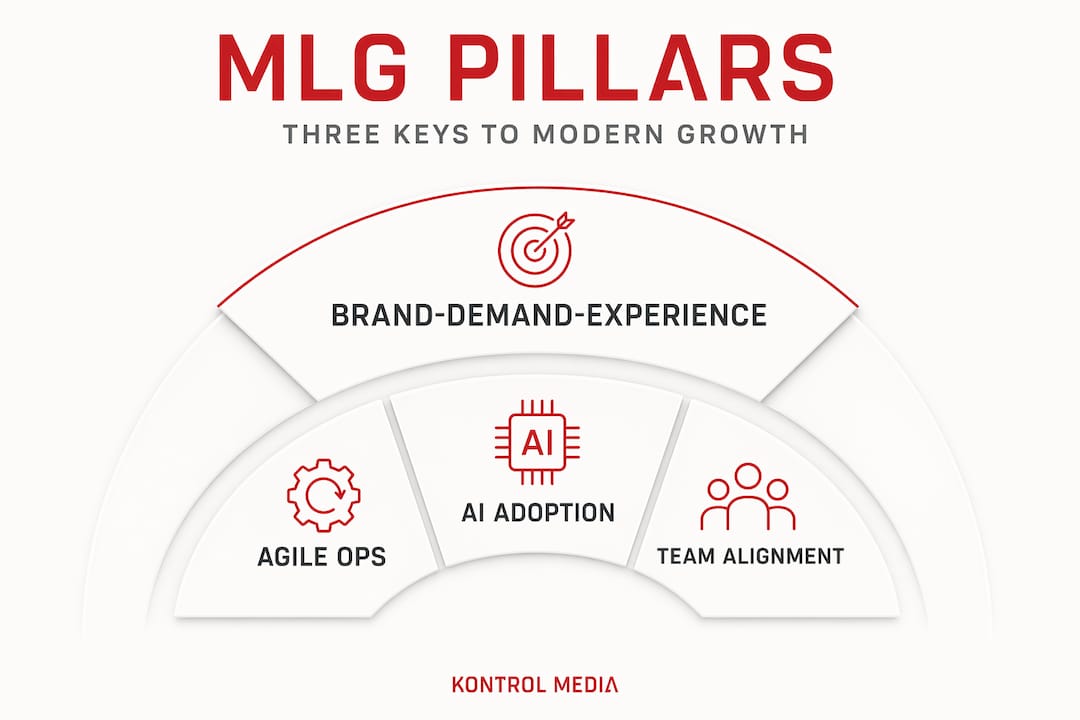
One of the most important shifts is adopting agile marketing operations. 83% of agile marketers report that having a transparent, visible system for managing work significantly increases internal stakeholder trust. That trust matters enormously because marketing-led growth requires long-term investment. If leadership does not trust that marketing is operating predictably, they will cut budgets at the first sign of pressure, which is exactly when the compounding returns are about to kick in.
The second operational pillar is AI adoption, used thoughtfully. AI enables marketers to automate routine creative tasks, reducing ad creative production time from 30 minutes to 30 seconds. That is not a marginal efficiency gain. It is a structural reallocation of human attention toward strategy, customer insight, and brand thinking. High-performing growth operators are already using AI to run experiments, analyze results, and automate campaigns, with some achieving 38% ARR growth with minimal team size.
The third pillar is what drives marketing-led growth at a systemic level: aligning brand, demand, and experience into a single reinforcing loop. Marketing strategy in 2026 is best understood as an operating system built from three loops: brand (mental availability), demand (momentum), and experience (memory). When these loops reinforce each other, each dollar invested works harder over time. When they operate in silos, you get short bursts of activity that do not accumulate into durable market position.
Pro Tip: Reserve 10 to 15 percent of your team’s capacity for strategic thinking and frontier experiments rather than filling every sprint with reactive execution. Teams that protect this bandwidth earn the strategic influence that keeps marketing-led growth funded and trusted.
Pitfalls that undermine marketing-led growth
The marketing-led business model is not immune to failure. In fact, some of its most common failure modes are specific to how the model is misunderstood or misapplied.
The first and most damaging pitfall is short-termism. When organizations feel revenue pressure, they often redirect marketing budgets toward campaigns that produce quick, measurable results at the expense of the brand and content investments that make the model work. Overemphasizing short-term marketing initiatives can lead to poor long-term governance and loss of institutional investor trust. The irony is that the short-term campaigns rarely produce the returns that justify the trade-off, while the long-term investments they replaced would have compounded.
The second pitfall is siloing brand and demand activities. Brand teams and performance marketing teams often operate with different metrics, different timelines, and different leadership sponsors. When they do not share a unified strategy, you end up with brand campaigns that do not generate pipeline and demand campaigns that do not build equity. Neither outcome is acceptable in a true MLG model.
Cross-functional alignment is the third area where organizations consistently struggle. Marketing-led growth requires that product, sales, customer success, and marketing share a common understanding of the ideal customer profile (ICP), the buyer journey, and the metrics that define success. Without that alignment, marketing generates demand that sales cannot close, or closes deals that customer success cannot retain. The long-term versus short-term strategy tension is real, and it requires deliberate governance to manage.
Implementing a marketing-led growth engine
Building or rebuilding a marketing-led growth system follows a logical sequence. Skipping steps is the most common reason implementations stall.
Start with ICP research and first-party data. Before any content or campaign work begins, you need a precise understanding of who your best customers are, what problems they are solving, and where they spend their attention. This is not a one-time exercise. It feeds every downstream decision.
Align brand positioning before scaling demand. Brand is the spine of the entire system. If your positioning is unclear or inconsistent, demand generation campaigns will produce low-quality leads and high churn. Get the story right before you spend on distribution.
Build content and thought leadership systematically. This is the core of the MLG engine. Educational content, point-of-view pieces, and authority-building assets create the trust infrastructure that makes everything else more efficient. Think about brand storytelling as a long-term asset, not a quarterly deliverable.
Automate execution with AI tools. Once the strategy and content architecture are in place, use AI to scale execution without scaling headcount. Marketing budgets are flat or growing minimally in 2026, which means efficiency is not optional. AI-driven automation is how you do more with what you have.
Measure what matters and iterate. The KPIs for an MLG model go beyond lead volume. Track pipeline influenced by content, sales cycle length by acquisition channel, customer lifetime value by cohort, and brand awareness metrics over time.
| KPI | What it measures | Why it matters for MLG |
|---|---|---|
| Content-influenced pipeline | Revenue traced to content touchpoints | Proves marketing’s direct impact on growth |
| Sales cycle length by channel | Time from first touch to close | Shows where trust is being built effectively |
| Customer lifetime value by cohort | Revenue per customer over time | Validates quality of marketing-acquired customers |
| Brand awareness trend | Unaided recall and share of voice | Tracks compounding brand equity investment |
My take on marketing-led growth
I have worked with enough organizations to say this plainly: marketing is the most underutilized strategic lever in most businesses. Not because the people are wrong, but because the model is wrong. Marketing gets treated as a cost center that produces content and campaigns, rather than a growth engine that shapes markets and builds durable competitive advantage.
What I have seen work, consistently, is when marketing leadership takes ownership of the full buyer journey, not just the top of the funnel. When the CMO is in the room for product decisions, pricing conversations, and customer success reviews, the entire organization gets smarter about how to grow. That is what a marketing-led growth model actually looks like in practice. It is not a campaign strategy. It is an organizational posture.
The AI piece is real and worth taking seriously, but I would caution against treating it as the answer. AI gives you speed and scale. It does not give you judgment, positioning, or the ability to understand what a customer actually needs. The teams I have seen win with AI are the ones who used it to free up human attention for harder strategic questions, not the ones who used it to produce more content faster without a coherent strategy behind it. That is a path to noise, not growth.
The mindset shift I would encourage is this: stop asking what marketing can do for sales, and start asking what marketing can do for the market. When you build authority, educate buyers, and create genuine value before asking for anything in return, growth tends to follow. Not immediately, but reliably.
— Mark Kapczynski
How Kontrol Media helps you build this
At Kontrol Media, we have spent years helping businesses move from reactive marketing execution to genuine marketing-led growth. The gap between knowing the model and running it well is where most organizations get stuck, and that is exactly where we focus. Whether you are a private equity portfolio company trying to establish market presence, a mid-market business looking to build a demand engine, or an enterprise organization realigning marketing with revenue goals, we bring both the strategic framework and the hands-on execution to make it real.
Our work spans business and marketing strategy through to sales and business development execution, which means we do not hand you a plan and walk away. We build it with you. If the challenges outlined in this article feel familiar, the full range of our services is a good place to start the conversation.
FAQ
What is marketing-led growth in simple terms?
Marketing-led growth is a model where marketing, rather than product virality or sales outreach, is the primary driver of customer acquisition and revenue. It works by building trust and demand through educational content and brand authority before sales engagement begins.
How does marketing-led growth differ from product-led growth?
Product-led growth uses the product experience itself to acquire and convert users, typically through free trials. Marketing-led growth uses content, thought leadership, and brand positioning to create demand and trust before a prospect ever tries the product or speaks to sales.
What types of businesses benefit most from marketing-led growth?
Companies with complex products, long sales cycles, or high-consideration buying decisions see the greatest return from a marketing-led growth model. This includes B2B SaaS, professional services, financial products, and enterprise solutions where buyer trust is critical.
What are the biggest risks in a marketing-led growth strategy?
The most common risks are short-termism, siloed brand and demand functions, and lack of cross-functional alignment. Short-term marketing initiatives that sacrifice brand investment for quick wins tend to erode the trust infrastructure that makes the model work.
How does AI fit into a marketing-led growth model?
AI handles execution tasks like creative production, campaign automation, and data analysis, freeing marketers to focus on strategy and customer insight. The best outcomes come from teams that use AI to scale what works, not to replace the strategic thinking that determines what is worth scaling.
Recommended
- Unlocking Business Potential: Strategic Marketing and Consulting for Growth | Kontrol Media Consultancy
- Maximizing Business Growth: Strategies for Success | Kontrol Media Consultancy
- Scaling Up: Strategies for Sustainable Business Growth | Kontrol Media Consultancy
- Crafting an Effective Marketing Strategy: From Research to Execution | Kontrol Media Consultancy