


Most marketers can sketch a funnel on a whiteboard in about ten seconds. Far fewer can tell you why their funnel is losing customers at the consideration stage, or what happens to a buyer after they complete a purchase. Understanding what is a marketing funnel goes well beyond drawing a triangle and labeling three boxes. The real value is in treating it as a living system that guides a consumer from the first moment they hear about you all the way through to the point where they are actively telling others to buy from you. That is the version worth building.
Table of Contents
- Key takeaways
- What is a marketing funnel, really?
- How modern discovery breaks the old funnel model
- Extending the funnel beyond the purchase
- Measuring and optimizing your funnel performance
- My honest take on where most funnels go wrong
- How Kontrol Media can help you build a funnel that works
- FAQ
Key takeaways
| Point | Details |
|---|---|
| Funnels are not linear | Modern consumers loop between awareness and consideration, often collapsing stages into a single session. |
| Each stage needs its own tactics | Awareness, consideration, and purchase stages require different content formats, messaging, and KPIs. |
| Post-purchase is where loyalty lives | Retention and advocacy strategies after the transaction drive repeat sales and reduce acquisition costs. |
| Alignment prevents drop-off | Marketing and sales teams must define shared qualification criteria to avoid losing prospects at handoff. |
| Social and AI have changed discovery | 66.6% of US consumers now use social platforms to discover brands, making omnipresence a requirement. |
What is a marketing funnel, really?
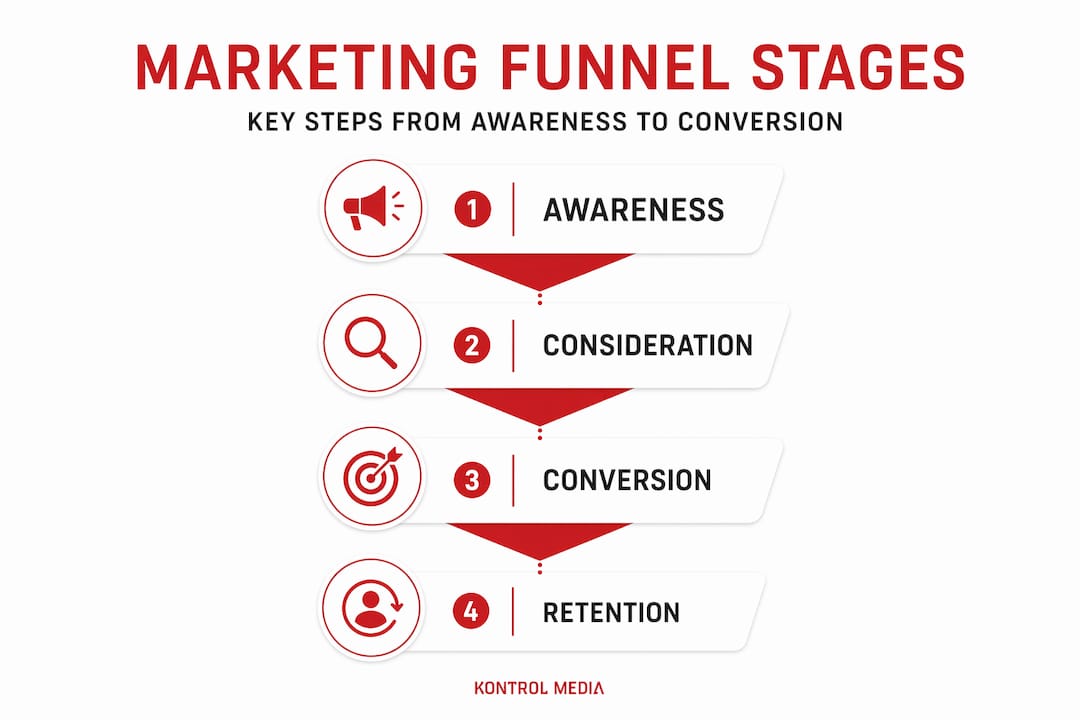
A marketing funnel is a framework that maps the path a consumer takes from first discovering your brand to making a purchase and, ideally, becoming a loyal advocate. The name comes from the shape: wide at the top where many people enter, and narrow at the bottom where a smaller group converts. But the shape is just a metaphor. The real purpose is practical. Funnels help you identify where people drop off, so you can fix the right problem instead of guessing.
The traditional model has three core stages. Top of funnel (TOFU) is about awareness. Middle of funnel (MOFU) is about consideration and engagement. Bottom of funnel (BOFU) is about conversion and purchase. Each stage has its own psychology, its own content needs, and its own set of metrics. Treating all three the same way is one of the most common and costly mistakes marketers make.
Top, middle, and bottom: what each stage actually demands
At the top of the funnel, your job is simple and hard at the same time. You need to reach people who do not know you yet. The tactics that work here are broad by design: short-form video on TikTok and Instagram Reels, SEO-driven blog content, podcast appearances, and paid social campaigns optimized for reach. The goal is not to sell. It is to earn attention and create a first impression worth remembering.
The middle of the funnel is where most brands underinvest. This is the stage where a consumer knows you exist but has not committed. They are comparing options, reading reviews, and asking questions. Email nurture sequences, in-depth how-to content, retargeting ads, and webinars all perform well here. Personalized content at this stage meaningfully improves conversion rates because it speaks to where the buyer actually is mentally, not where you wish they were.
At the bottom of the funnel, friction is the enemy. A consumer who has decided to buy can still be lost to a clunky checkout, a confusing pricing page, or a lack of social proof at the final moment. Demos, testimonials, clear guarantees, and a frictionless transaction experience are the tools that close the gap between intent and action.
| Funnel Stage | Primary Goal | Effective Tactics | Key KPIs |
|---|---|---|---|
| Top (TOFU) | Build awareness | Short-form video, SEO, paid social, influencer content | Reach, impressions, new visitors |
| Middle (MOFU) | Deepen consideration | Email nurtures, retargeting, webinars, reviews | Engagement rate, time on site, email open rate |
| Bottom (BOFU) | Drive conversion | Demos, testimonials, streamlined checkout, offers | Conversion rate, cost per acquisition, revenue |
| Post-Purchase | Retention and advocacy | Loyalty programs, referrals, community, follow-ups | Repeat purchase rate, NPS, referral volume |
Pro Tip: Match your content format to the stage. A 60-second video works at the top. A detailed comparison guide works in the middle. A one-click upsell or a personal thank-you email works at the bottom. Mismatching format and stage is like showing up to a first date and asking someone to move in.
How modern discovery breaks the old funnel model
Here is something most funnel diagrams do not account for: consumers no longer move through stages in a tidy sequence. Discovery, consideration, and purchase can now collapse into a single session. Someone sees a product on Instagram, watches three TikTok reviews, checks a Reddit thread, and buys within 20 minutes. The linear funnel assumes a journey that takes days or weeks. Reality often compresses it into minutes.
The disruption goes deeper than speed. Social platforms have become search engines for a majority of US consumers, which means your top-of-funnel presence is no longer just about Google rankings. If your brand does not show up on TikTok, YouTube Shorts, or Instagram when someone searches your category, you are invisible to a significant portion of your potential audience. Video-first content on platforms like TikTok is no longer optional for brand discovery. It is the entry point.
Then there is the “messy middle.” Google’s research on this concept describes how consumers loop between exploration and evaluation repeatedly before buying, influenced by triggers like promotions, peer recommendations, and algorithm-served content. A consumer might enter your funnel at the awareness stage, drift out, re-enter at the consideration stage from a different channel, and convert weeks later through a retargeting ad. If you are only measuring last-click attribution, you are crediting the wrong touchpoint and making bad budget decisions.
AI-powered chat tools add another layer. When a consumer asks an AI assistant for product recommendations, your brand either surfaces or it does not. That is a funnel entry point that did not exist three years ago, and most brands have not built a strategy around it yet.
Pro Tip: Audit where your current customers actually discovered you. Survey them directly or use multi-touch attribution tools. You will almost certainly find that the first touchpoint was not what your analytics dashboard is telling you. Build your social media strategy around where real discovery is happening, not where it used to happen.
Extending the funnel beyond the purchase
The transaction is not the finish line. It is the beginning of the most valuable part of the customer relationship. Yet most marketing budgets are almost entirely allocated to acquiring new customers, with little left for the people who have already said yes. That is a significant missed opportunity, because strong post-purchase engagement directly increases repeat sales and lifetime value.
The post-purchase funnel has two goals: keep the customer coming back, and turn them into someone who brings others with them. Both require intentional effort. A few tactics that consistently deliver results:
- Send a personalized thank-you message within 24 hours of purchase. Not a generic receipt. A message that acknowledges what they bought and sets expectations for what comes next.
- Build a loyalty program with meaningful rewards. Points systems work, but experiential rewards, early access to new products, and exclusive content create emotional connection that points alone cannot.
- Create a referral program with a clear incentive on both sides. The referring customer and the new customer both need a reason to act. One-sided referral programs consistently underperform.
- Develop a post-purchase email sequence that educates the customer on how to get more value from what they bought. This reduces buyer’s remorse, decreases returns, and increases satisfaction scores.
- Build community around your brand. A Facebook Group, a Discord server, or even a curated hashtag gives customers a place to connect with each other. Community creates belonging, and belonging creates retention.
The brands that do this well treat post-purchase marketing as its own funnel stage with its own budget, its own content calendar, and its own KPIs. They are not hoping customers come back. They are engineering the conditions that make it likely.
Pro Tip: Integrate customer feedback loops into your post-purchase sequence. A simple NPS survey sent 14 days after purchase gives you retention signals early, surfaces dissatisfied customers before they churn, and generates testimonials from your happiest buyers. That feedback feeds directly back into your top-of-funnel messaging.

Measuring and optimizing your funnel performance
You cannot fix what you cannot see. Funnel optimization starts with honest measurement at every stage, and most businesses are measuring the wrong things or measuring too late.
At the top of the funnel, reach and impressions matter, but engagement rate tells you more. A post that reaches 100,000 people and generates no saves, shares, or clicks is not building a funnel. It is just noise. At the middle of the funnel, time on site, pages per session, email open rates, and return visit frequency tell you whether your content is actually moving people toward a decision. At the bottom, conversion rate and cost per acquisition are the obvious metrics, but cart abandonment rate and checkout completion rate reveal where friction is killing intent.
Effective funnel optimization also requires that marketing and sales teams agree on what a qualified lead or prospect looks like at each stage. When marketing and sales define MQLs and SQLs collaboratively, handoff failures decrease and funnel efficiency improves. Marketing builds demand and shapes perception; sales validates and closes. Treating those as the same function creates gaps that cost revenue.
| Funnel Stage | Metric to Track | Optimization Lever |
|---|---|---|
| Awareness | Engagement rate, new visitors | Test content formats; expand to new discovery platforms |
| Consideration | Email open rate, return visits | Improve personalization; add social proof |
| Purchase | Conversion rate, cart abandonment | Reduce friction; add guarantees and testimonials |
| Retention | Repeat purchase rate, NPS | Strengthen loyalty program; improve onboarding sequence |
| Advocacy | Referral volume, review count | Launch referral program; engage community |
Pro Tip: Set a monthly funnel review cadence. Pull stage-by-stage data, identify the single biggest drop-off point, and focus your next 30 days on fixing that one thing. Trying to optimize every stage simultaneously is how you end up improving nothing. Prioritize the leak with the biggest revenue impact first.
My honest take on where most funnels go wrong
I have worked with brands across a wide range of categories, from consumer products to media companies to real estate services, and the pattern I see most often is this: the funnel gets built around the transaction and almost nothing else. The awareness stage gets a budget because everyone understands you need it. The conversion stage gets attention because revenue is visible. Everything in between and everything after gets the scraps.
What I have learned, sometimes the hard way, is that the middle of the funnel and the post-purchase phase are where durable growth actually lives. A brand that converts well but retains poorly is running a treadmill. It has to keep spending to replace the customers it is losing. The brands that compound over time are the ones that treat every post-purchase interaction as an opportunity to deepen the relationship, not just fulfill the order.
I am also skeptical of anyone who still draws a perfectly linear funnel and calls it a strategy. The consumer journey in 2026 is genuinely nonlinear. I have seen brands at Kontrol Media spend significant budget on a sequenced funnel architecture only to discover that most of their customers entered and converted from a single social media touchpoint, skipping the carefully built middle entirely. That does not mean the middle is useless. It means you need to think about brand priorities across all touchpoints simultaneously, not sequentially.
The most productive shift I have seen marketers make is moving from “how do we move people through our funnel” to “how do we show up everywhere our customers are, at every stage, with the right message.” That reframe changes your content strategy, your channel mix, and your measurement approach in ways that consistently produce better results.
— Mark Kapczynski
How Kontrol Media can help you build a funnel that works
If any part of this article made you realize your current funnel has gaps, you are not alone. Most businesses have at least one stage that is underbuilt, undermeasured, or disconnected from the stages around it. That is exactly the kind of problem Kontrol Media was built to solve.
At Kontrol Media, we work with brands at every stage of funnel development, from diagnosing where customers are dropping off to building out post-purchase retention programs that actually move the needle on lifetime value. Our approach combines strategic clarity with hands-on execution across sales, marketing, and business development. Whether you need a full funnel audit or help with a specific stage, we bring the experience and the creative thinking to make it work. Explore our strategic marketing consulting services to see how we approach funnel growth, or dig into our framework for building an effective marketing strategy from research through execution.
FAQ
What is a marketing funnel in simple terms?
A marketing funnel is a framework that maps the consumer journey from first awareness of your brand through purchase and post-purchase loyalty. It helps marketers identify where people drop off and which tactics to use at each stage.
What are the main stages of a marketing funnel?
The core stages are top of funnel (awareness), middle of funnel (consideration and engagement), and bottom of funnel (conversion and purchase), followed by post-purchase stages focused on retention and advocacy.
Why is the traditional linear funnel outdated?
Modern consumers can discover, evaluate, and purchase within a single session, and social platforms now function as search engines for the majority of US consumers, making the old step-by-step model an oversimplification of how people actually buy.
How do you turn customers into brand advocates?
Post-purchase tactics like loyalty programs, referral incentives, personalized follow-ups, and community building convert satisfied buyers into active promoters who bring new customers into your funnel organically.
What metrics should I track to optimize my funnel?
Track engagement rate at the top, email open and return visit rates in the middle, conversion and cart abandonment rates at the bottom, and repeat purchase rate and NPS for post-purchase performance. Aligning marketing and sales on shared definitions at each stage makes these metrics far more actionable.