


Most marketing teams pour their energy into the top of the funnel, chasing awareness, and the bottom, pushing for the close. The middle funnel marketing stage gets treated like a hallway between two real rooms. That’s a costly mistake. Middle funnel marketing, or MOFU, is where prospects are actively evaluating whether your solution deserves a place on their shortlist. Get this stage wrong and you lose deals you should have won. Get it right and you build the kind of trust that makes the sales conversation almost a formality. This guide gives you the frameworks, content formats, and measurement approaches to make MOFU your strongest competitive advantage.
Table of Contents
- Key Takeaways
- What middle funnel marketing actually is
- Content formats that work in the middle funnel
- Lead nurturing techniques that build real trust
- Measuring MOFU success beyond surface metrics
- My honest take on where most teams go wrong
- How Kontrol Media can help you get this right
- FAQ
Key Takeaways
| Point | Details |
|---|---|
| MOFU is the consideration stage | Prospects here are evaluating solutions, not just becoming aware of problems. |
| Match content format to buyer signal | Use ROI calculators for pricing queries, comparison guides for product evaluation searches. |
| Behavioral segmentation wins | Retargeting should reflect the specific content consumed, not serve generic ads to all prospects. |
| Measure quality, not just volume | Track MQL-to-SQL conversion and sales acceptance rates over raw lead counts. |
| Sales and marketing alignment matters | Shared lifecycle definitions and qualification criteria produce better funnel progression outcomes. |
What middle funnel marketing actually is
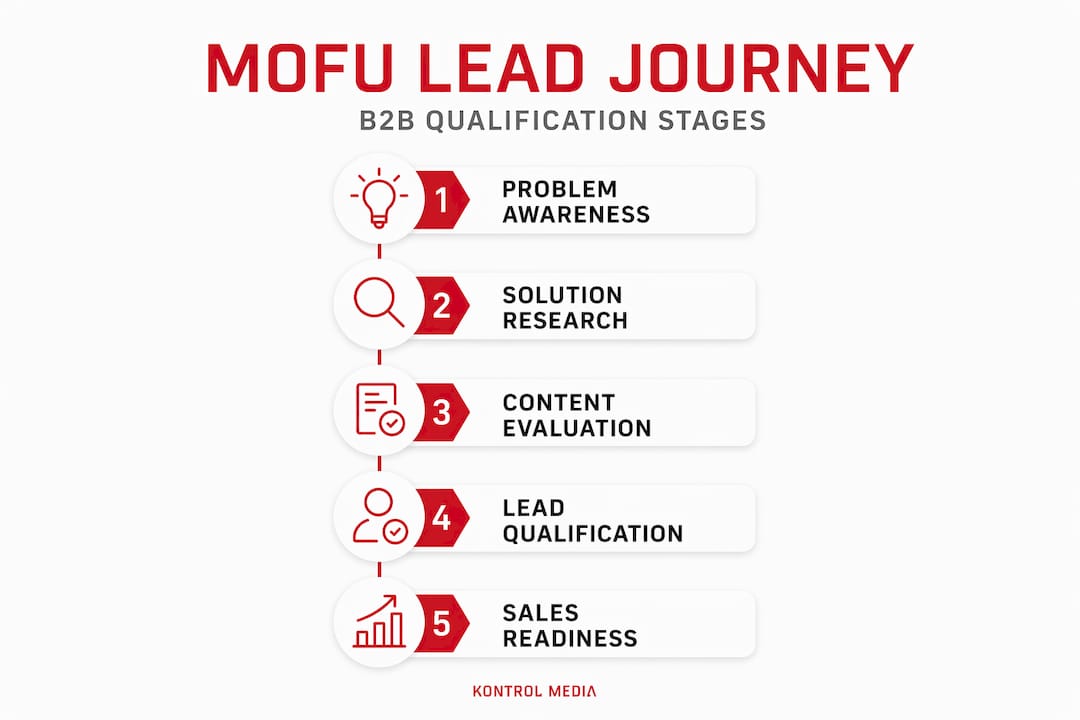
MOFU is the consideration stage where prospects move from problem awareness into actively evaluating solutions. They already know they have a challenge. Now they are weighing their options, comparing vendors, and building an internal case for a purchase decision. Your job at this stage is not to shout louder. It is to educate more specifically and build trust more deliberately.
The five funnel stages include awareness, consideration, conversion, loyalty, and advocacy. MOFU sits squarely in the consideration phase, and the goals there are meaningfully different from TOFU or BOFU. At the top, you attract. At the bottom, you convert. In the middle, you inform, qualify, and earn credibility. That distinction matters because it shapes every content and messaging decision you make.
What separates strong MOFU execution from weak execution is focus on four specific objectives:
- Converting anonymous traffic into identified, engaged prospects through gated or high-value content
- Educating prospects on how your solution addresses their specific scenario, not just the category problem
- Building the kind of trust that makes a prospect willing to hand over more of their time and data
- Qualifying leads so that only sales-ready opportunities advance to the bottom funnel
For B2B middle funnel work, the lead qualification process takes on extra weight. Enterprise buying cycles involve multiple stakeholders, longer timelines, and higher scrutiny. Every touchpoint at this stage is an audition for a longer relationship.
Content formats that work in the middle funnel
Not all content is created equal at the consideration stage. The biggest mistake I see companies make is producing MOFU content that reads like TOFU content with slightly more detail. Generic “things to consider” listicles don’t move a prospect closer to a decision. Specific, data-driven, scenario-based content does. Content that declares a winner per scenario and backs it up with real numbers builds trust faster than any amount of thought leadership.
The most reliable framework for MOFU content selection is what practitioners call format-signal matching. You identify the buyer’s intent signal, the specific query or behavior, and then deploy the content format that serves that exact need. Here is how that maps in practice:
| Buyer Signal | Best Content Format |
|---|---|
| Pricing or cost queries | ROI calculators, pricing comparison guides |
| Product or vendor comparisons | Side-by-side comparison guides, feature matrices |
| Implementation or complexity concerns | Case studies, customer success stories |
| Needs validation from peers | Webinars, community-led demos, testimonials |
| Risk or objection concerns | Objection-handling guides, FAQ documents |
| Hands-on evaluation | Free trials, interactive demos, sandbox environments |
Each of these formats serves a distinct moment in the customer journey stages. A prospect googling “vendor A vs vendor B pricing” is not in the same mental state as one downloading your implementation checklist. Treating them identically is one of the most expensive inefficiencies in funnel marketing strategies today.
Pro Tip: When creating comparison guides, resist the temptation to declare yourself the obvious winner across the board. Acknowledge where a competitor might be a better fit for a specific use case. That candor builds credibility with sophisticated buyers who already know your competitors exist.
The quality bar for MOFU content is genuinely higher than TOFU. An awareness blog post can get away with breadth. A middle of the funnel asset needs depth, specificity, and a clear answer to the prospect’s actual question. If your case study doesn’t include real metrics, timeline, and named outcomes, it’s not doing MOFU work. It’s just a story.

Lead nurturing techniques that build real trust
A well-structured email nurture sequence remains one of the most reliable lead nurturing techniques available to B2B marketers, but most sequences are built around what the company wants to say rather than what the prospect needs to hear next. The distinction is significant. Effective MOFU nurturing starts with behavioral data, what the prospect downloaded, which pages they visited, how far they got in a demo, and uses that data to determine the next logical conversation.
Here’s a practical framework for building a MOFU nurture sequence:
- Trigger enrollment based on a qualifying action, not just a form fill. A webinar registration, a pricing page visit, or a free trial start are all stronger signals than a gated ebook download.
- Segment by role and use case from the start. A CFO evaluating your platform needs different content than a VP of Marketing. The sooner you fork your nurture paths, the more relevant every subsequent message becomes.
- Use a 3-to-1 value ratio. For every email that moves toward conversion, send three that are purely educational or helpful. Prospects in the consideration phase are still building trust. Pushing too hard too early collapses it.
- Incorporate behavioral triggers throughout the sequence. If a prospect clicks a pricing link in email three, that is a signal to accelerate the sequence or route them to sales. Static drip campaigns ignore this entirely.
- Design off-ramps for unready prospects. Not every lead is sales-ready on your timeline. Build a slower-frequency track for prospects who need more time rather than burning them with aggressive follow-up.
For retargeting, mid-funnel retargeting should reflect specific content consumed rather than serving generic brand ads to everyone who visited your site. A prospect who spent eight minutes on your enterprise pricing page deserves a different retargeting message than someone who bounced after reading an awareness blog post. Intent event tracking such as quiz completions, wishlist adds, and free trial starts predicts purchase behavior more accurately than passive clicks, and operationalizing those events into your retargeting audiences changes the economics significantly.
Pro Tip: Layer your retargeting audiences by recency and intent depth. A prospect who completed a product demo within the last 14 days is categorically different from someone who watched a webinar 60 days ago. Price your ad spend accordingly and write separate creative for each segment.
The personalization in marketing work that makes MOFU sequences genuinely effective is not complex, but it does require discipline. Most teams skip behavioral segmentation because it takes more setup. That gap is your competitive opportunity.
Measuring MOFU success beyond surface metrics
Most marketing teams default to measuring MOFU performance with the same metrics they use for TOFU: clicks, opens, downloads, and page views. Those numbers tell you about activity, not about progression. Real MOFU measurement requires tracking the quality of advancement through the funnel.
The metrics that actually matter at the consideration stage are:
| Metric | What It Tells You |
|---|---|
| MQL-to-SQL conversion rate | Whether marketing’s qualified leads are genuinely sales-ready |
| Sales acceptance rate | Whether sales agrees with marketing’s qualification criteria |
| Pipeline velocity | How quickly leads are moving from MOFU to active opportunities |
| Stage aging | Where and why leads are stalling in the consideration phase |
| Cost per engaged lead | Efficiency of MOFU spend vs. conversion outcomes |
Pipeline metrics like MQL-to-SQL conversion and sales acceptance rates tell you far more about MOFU health than raw lead volume. A program generating 500 MQLs per month with a 5% SQL conversion rate is dramatically underperforming one generating 150 MQLs at 40% conversion. Volume without quality is an expensive illusion.
The real test of middle funnel marketing effectiveness is not how many leads enter the stage. It is how many leave it with enough trust, education, and qualification to become genuine revenue opportunities.
Closed-loop marketing between sales and marketing, where sales outcomes feed back into marketing’s lead scoring and campaign decisions, is what separates organizations that optimize MOFU from those that guess at it. When sales and marketing share lifecycle stage definitions and qualification criteria collaboratively, the entire funnel performs better. Attribution windows also matter here: MOFU touches often happen weeks or months before a deal closes, and last-touch attribution systematically undercounts their contribution. Multi-touch models give a more honest picture of where consideration-stage content is driving revenue. For conversion optimization that actually moves the revenue needle, this closed-loop discipline is non-negotiable.
My honest take on where most teams go wrong
I’ve spent a lot of time watching smart marketing teams underinvest in the middle funnel, and the pattern is almost always the same. The top funnel gets budget because awareness is easy to measure and feels like momentum. The bottom funnel gets attention because it’s closest to the money. MOFU gets the leftovers, and then leadership wonders why close rates are disappointing.
What I’ve learned, working across companies ranging from private equity portfolio businesses to large enterprises, is that the consideration stage is where deals are actually won or lost. By the time a prospect hits BOFU, they’ve usually already made a provisional decision. The question is whether that decision was made with your content or your competitor’s. If you abdicated the middle funnel, you likely handed the narrative to someone else.
The format-signal matching framework I described earlier sounds conceptually simple, but the organizational discipline to execute it is genuinely hard. It requires your content team to understand buyer intent signals, your paid team to build segmented audiences based on behavioral data, and your sales team to trust that a slower, more educational nurture will produce better-qualified opportunities. That cross-functional coordination is where most implementations break down, not the strategy itself.
Strategic marketing execution at the MOFU level also requires patience that short-term performance culture often punishes. Nurture sequences take weeks to complete. Trust takes multiple touchpoints to build. Mid-funnel marketing delivers higher ROI when it targets prospects actively evaluating solutions, but that ROI shows up in pipeline quality and close rates, not in the weekly dashboard. Executives who only look at top-of-funnel traffic and bottom-of-funnel conversion will chronically underfund the work that connects those two endpoints.
My honest recommendation is to treat MOFU not as a phase in a funnel but as the spine of your revenue marketing program. Every piece of awareness content should be designed with a MOFU follow-on in mind. Every BOFU conversation should be informed by what the prospect engaged with in the consideration stage. When you build that connective tissue intentionally, the whole funnel performs at a different level.
— Mark Kapczynski
How Kontrol Media can help you get this right
If you are reading this and recognizing gaps in how your organization handles the consideration stage, that recognition is the most productive place to start. At Kontrol Media, we work with companies across marketing, sales, and business development to build funnel marketing strategies that are grounded in business objectives, not just activity metrics. We’ve done this with clients including Experian, West Monroe, and REMAX, and the common thread in every successful engagement is the same: connecting comprehensive business strategy to hands-on execution at every funnel stage. Whether you need to redesign your MOFU content architecture, build out lead scoring and nurture infrastructure, or align your sales and marketing teams around shared qualification criteria, the work starts with a clear picture of where your funnel is actually breaking. We’d be glad to help you find it. Explore how Kontrol Media’s approach to business strategy execution can give your middle funnel the structure and investment it deserves.
FAQ
What is middle funnel marketing?
Middle funnel marketing is the consideration stage of the buyer journey, where prospects who are already aware of a problem begin evaluating specific solutions. It focuses on deep education, trust-building, and lead qualification rather than broad awareness or direct conversion.
What content works best in the middle of the funnel?
Proven MOFU content formats include comparison guides, ROI calculators, case studies with real metrics, product demos, webinars, and objection-handling resources. The most effective approach matches the content format to the specific buyer signal or intent query.
How do you measure middle funnel marketing effectiveness?
The most meaningful MOFU metrics are MQL-to-SQL conversion rate, sales acceptance rate, pipeline velocity, and stage aging. These measure quality of progression toward revenue outcomes rather than passive engagement alone.
Why does sales and marketing alignment matter for MOFU?
When sales and marketing define lifecycle stages and qualification criteria together, leads move through the funnel more efficiently and with higher close rates. Closed-loop feedback from sales outcomes directly improves marketing’s lead scoring and content targeting.
How is B2B middle funnel marketing different from B2C?
B2B middle funnel marketing typically involves longer nurture timelines, multiple stakeholder touchpoints, and a heavier emphasis on ROI justification and risk reduction. Content formats like detailed case studies, enterprise demos, and comparison frameworks carry significantly more weight in B2B consideration cycles than in consumer buying journeys.