


Marketing operations (MOps) is the function that owns the systems, data, and processes that convert marketing strategy into measurable pipeline and revenue. Think of it as the operating layer underneath everything your marketing team does: the lead routing, the attribution model, the dashboard that tells you whether last quarter’s spend actually produced pipeline. Gartner frames MOps as essential for turning marketing into a measurable revenue engine, and the pressure to prove that ROI is only intensifying for CMOs. Without a formal MOps function, creative and demand-generation teams work in disconnected tools with no shared view of what is working.
For executive leaders, the implication is direct: MOps must control or meaningfully influence the martech budget and have cross-functional data access, or it cannot deliver the revenue outcomes you are hiring it to produce.
Table of Contents
- What does the marketing ops function do day-to-day?
- Where should MOps report, and who must hold budget authority?
- How mature is your MOps, and what roles do you need?
- Which KPIs prove that MOps is driving revenue?
- Who must own the martech stack and its governance?
- What mistakes do leaders most often make with MOps?
- How do you stand up or scale MOps in 90 to 180 days?
- Key Takeaways
- Why MOps sits at the center of every growth engagement
- Kontrol Media can build your MOps function with you
What does the marketing ops function do day-to-day?
MOps owns six core responsibility areas, each of which feeds pipeline predictability rather than just operational tidiness.

Martech and integrations. MOps administers the stack — CRM, marketing automation platform (MAP), customer data platform (CDP), and BI tools — and owns the bi-directional syncs that keep data consistent across systems. IT overlaps on reliability and access permissions, but MOps controls the business rules, attribution models, and lead-handoff logic.
Campaign operations. Template builds, QA checklists, routing rules, and launch approvals all run through MOps. This is what separates a repeatable campaign process from a fire drill before every send.
Lead management. MOps defines MQL criteria, lifecycle stages, and the handoff rules that govern when a lead moves from marketing to sales. Clean handoffs reduce marketing and sales misalignment and protect pipeline accuracy.
Attribution and analytics. MOps builds and maintains the attribution schema that connects campaign spend to sourced pipeline. Without this, budget allocation decisions rest on fiction.
Data governance. Field mapping, taxonomy standards, deduplication rules, and data-quality scorecards are MOps responsibilities. Salesforce guidance confirms that centralizing these functions is what enables accurate reporting and integrated customer experiences.
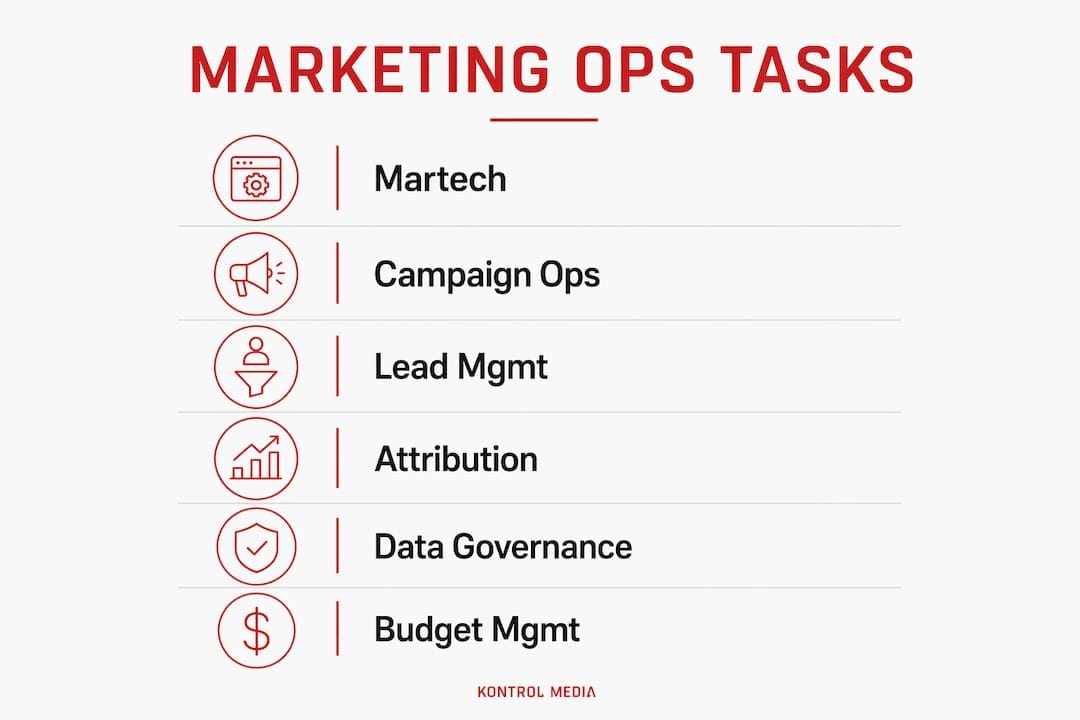
Vendor and budget management. In mature organizations, MOps informs — and often controls — the martech budget, which can reach multi-million dollar scale. That budget authority is what gives the function real leverage.
Pro Tip: Measure campaign velocity (the time from brief to launch) as a proxy for MOps health. When cycle time creeps up, it almost always signals a process bottleneck before it shows up in pipeline numbers.
Where should MOps report, and who must hold budget authority?
The most common reporting structure places MOps under the CMO, which works well in the early and middle stages of organizational maturity. As companies scale, many fold MOps into a Revenue Operations (RevOps) function under the CRO or VP of Revenue Operations. The critical factor in either model is not the org chart line itself — it is whether MOps holds budget authority over the technology stack and has cross-functional data access.
Reporting to the CMO
- Closer alignment with campaign priorities and marketing strategy
- Faster decisions on martech investments
- Risk: MOps can become siloed from sales and customer success data
Reporting under RevOps/CRO
- Unified funnel view from lead to close
- Shared data definitions across marketing, sales, and customer success
- Risk: marketing depth can erode if MOps is pulled toward sales-ops priorities
Salesforce notes that CMO responsibilities have broadened to include technical domains like analytics and data strategy, which makes the case for keeping MOps close to marketing leadership in most mid-market organizations.
Pro Tip: Move MOps under RevOps only when you have a dedicated MOps lead who can protect marketing’s data standards and attribution logic. Folding an immature MOps function into RevOps too early tends to subordinate marketing measurement to sales-pipeline reporting.
How mature is your MOps, and what roles do you need?
Most organizations sit somewhere across four recognizable stages. The table below lets you self-diagnose and identify the next hire or capability gap.
| Maturity Stage | Planning Cadence | Ownership | Measurement Maturity | Minimum Roles |
|---|---|---|---|---|
| Ad Hoc | Reactive, no formal intake | Shared informally across team | Activity metrics only (sends, clicks) | Part-time MAP admin |
| Repeatable | Quarterly planning, basic SLAs | One dedicated MOps person | MQL volume, basic funnel reporting | MOps coordinator, MAP admin |
| Centralized | Monthly operating cadence, intake process | MOps lead with defined scope | Pipeline attribution, campaign ROI | MOps lead, data analyst, automation engineer |
| Strategic Partner | Weekly scorecard, board-level reporting | MOps owns martech budget and attribution | Marketing-sourced pipeline %, martech ROI, data quality score | MOps director, analytics lead, integrations engineer, enablement specialist |
The jump from “Repeatable” to “Centralized” is where most mid-market companies stall. It requires committing a dedicated MOps lead with real authority, not just a MAP admin who also pulls reports. Aligning marketing to business goals at this stage means building an operating cadence where every campaign ties to a measurable business outcome, not just a launch date.
Which KPIs prove that MOps is driving revenue?
Executives should measure MOps success by campaign velocity, data quality, and budget accuracy — not creative output volume. The metrics below connect MOps performance directly to pipeline and revenue.
Marketing-sourced pipeline percentage is the headline number the CRO and CFO both understand. The calculation: marketing-influenced pipeline divided by total pipeline. A healthy benchmark varies by business model, but the direction of the trend matters as much as the absolute figure.
Campaign velocity measures the average days from campaign brief to launch. Slow velocity signals a process bottleneck. Fast velocity with poor conversion signals a strategy or targeting problem.
Lead-to-opportunity conversion rate shows whether MQL definitions are calibrated correctly. A low rate usually means MOps and sales need to renegotiate the handoff criteria.
Data quality score tracks completeness, duplication rate, and enrichment coverage across the CRM and MAP. A declining score is an early warning sign of a governance breakdown, not a data-entry problem.
Martech ROI compares the cost of the technology stack against the pipeline and revenue it enables. MOps should own this calculation and present it at budget reviews. For measuring campaign ROI accurately, attribution schema design is the prerequisite.
A weekly scorecard covering cycle time, on-time launch rate, data completeness, and sourced pipeline gives leadership a real-time view of MOps health without waiting for quarterly reviews.
Who must own the martech stack and its governance?
MOps must own the martech stack — not IT, not the demand-gen team, and not a rotating cast of agency vendors. IT overlaps on infrastructure reliability and access permissions, but the business rules, attribution models, and lead-handoff logic belong to MOps. When those rules live in IT, revenue alignment breaks down.
Core ownership responsibilities by category:
- CRM: MOps owns field definitions, lifecycle stage logic, and lead-routing rules. Sales ops co-owns pipeline stages and forecast fields.
- MAP: MOps owns program architecture, scoring models, and integration with CRM. No campaign goes live without MOps QA.
- CDP/data warehouse: MOps defines the source-of-truth schema and governs identity resolution rules.
- BI and dashboards: MOps builds and maintains the attribution dashboard. Finance and leadership consume it; MOps owns its accuracy.
- Tag management and consent: MOps owns the tagging taxonomy and consent framework, with legal sign-off on data-privacy configurations.
A practical governance checklist: single source-of-truth definitions for every key field, a designated responsible individual (DRI) for each handoff, SLAs for campaign deployment, periodic martech ROI reviews, and a recurring data-quality remediation cadence. Marketing automation best practices reinforce that governance without a named owner defaults to no governance at all.
What mistakes do leaders most often make with MOps?
Treating MOps as IT. MOps requires deep domain expertise in marketing-to-sales handoffs, attribution, and demand funnels. Handing martech ownership to IT produces stable systems that are disconnected from revenue. Corrective action: assign a MOps lead with marketing domain expertise, not a systems administrator.
Implementing automations before strategy. Operations without strategy risks turning work into busy tasks with no revenue alignment. Automating a broken process just breaks it faster. Corrective action: require a documented strategy brief before any new automation is scoped.
Withholding budget authority. MOps without budget control over the martech stack cannot retire redundant tools, negotiate contracts, or prioritize integrations. Corrective action: give the MOps lead a defined budget line and approval authority for tools under a set threshold.
Fragmented data ownership. When CRM, MAP, and web analytics each have different owners with different field definitions, attribution becomes guesswork. Corrective action: mandate a single source-of-truth definition document, owned by MOps, reviewed quarterly.
The most expensive MOps mistake is not a bad tool purchase. It is building a technically functional system that no one in the revenue org trusts — because the data definitions were never agreed upon.
Pro Tip: Before your next board presentation, ask your MOps lead to show you the data-quality score for your CRM. If they cannot produce one in under 24 hours, you have a governance gap, not a data problem.
How do you stand up or scale MOps in 90 to 180 days?
Days 1–30: Audit and define. Map your current martech stack, identify data-ownership gaps, and document the existing campaign process. Establish a single source-of-truth for MQL definitions and pipeline attribution. Assign a DRI for MOps, even if it is a fractional or outsourced role.
Days 31–90: Build the operating cadence. Implement a formal intake process, SLAs for campaign deployment, and a weekly scorecard covering cycle time, data completeness, and sourced pipeline. Connect your MAP and CRM with validated lead-routing rules. Begin tracking marketing-sourced pipeline as a percentage of total pipeline.
Days 91–180: Centralize and measure. Hire or contract the roles your maturity stage requires (data analyst, automation engineer). Conduct the first martech ROI review and retire or consolidate redundant tools. Present a board-ready attribution dashboard showing marketing’s contribution to pipeline.
Budget signal: many mid-market organizations allocate a portion of the total marketing budget to MOps infrastructure and headcount. Outsourced or hybrid models can compress the initial investment while you build internal capability.
For revenue growth at mid-market and enterprise scale, the 180-day milestone should show measurable improvement in campaign velocity and a documented, trusted attribution model — not just a cleaner CRM.
Key Takeaways
Marketing Operations is the function that converts strategy into pipeline, and it requires budget authority, cross-functional data access, and a named owner to deliver that outcome reliably.
| Point | Details |
|---|---|
| MOps is a revenue function | Its primary output is measurable pipeline contribution, not campaign volume or system uptime. |
| Budget authority is non-negotiable | MOps without control over the martech budget cannot govern the stack or retire redundant tools. |
| Maturity determines your next hire | Self-diagnose your stage (ad hoc through strategic partner) before adding headcount or technology. |
| KPIs must connect to pipeline | Track marketing-sourced pipeline percentage, campaign velocity, and data quality score as your core dashboard. |
| Kontrol Media offers managed execution | For leaders who need MOps capacity without building a full team, Kontrol Media provides strategy plus hands-on execution across martech governance and go-to-market operations. |
Why MOps sits at the center of every growth engagement
Every time we engage with a new client — whether it is a PE portfolio company rebuilding its go-to-market motion or a mid-market enterprise trying to prove marketing’s contribution to the board — the same gap appears early. The strategy exists. The intent is real. But the operating layer underneath it is either missing or disconnected from revenue. That is the MOps gap, and closing it is almost always the first move that makes everything else work.
What I find most telling is how often leaders underestimate the sequencing. They want the attribution dashboard before the data definitions are agreed upon. They want the automation before the strategy is documented. The infrastructure has to follow the logic, not lead it. When we work with clients like Experian or West Monroe, the early wins almost always come from establishing that operating cadence first — the intake process, the handoff rules, the weekly scorecard — before adding any new technology.
If you are a CMO or executive leader thinking about where MOps fits in your broader go-to-market engagement, that conversation is worth having early.
Kontrol Media can build your MOps function with you
Most leaders reading this already know they have an MOps gap. The harder question is whether to build the capability internally, hire a full team, or work with a partner who can move faster. Kontrol Media’s consulting model is built for exactly that decision point: we provide strategic marketing and execution across martech governance, campaign operations, and go-to-market alignment — without the 12-month ramp of a full internal build.

Our engagements typically start with a rapid audit of your current stack and attribution model, move into a quick-win operating plan within 30 days, and scale into a phased implementation that matches your team’s capacity. Clients across fintech, media, ecommerce, and real estate have used this model to establish a trusted pipeline attribution framework and a functioning MOps cadence in under 90 days. If you are ready to move from strategy to execution, connect with the Kontrol Media team to scope what a managed or hybrid MOps engagement looks like for your organization.
Recommended
- Growth Marketing Frameworks CMOs Use to Drive Revenue | Kontrol Media Consultancy
- What Is a Marketing Strategy? A Guide for Business Growth | Kontrol Media Consultancy
- Campaign Management: A 2026 Guide for Marketing Leaders | Kontrol Media Consultancy
- What Is Marketing-Led Growth? A Strategic Guide | Kontrol Media Consultancy