



A market penetration strategy is defined as a growth approach that increases sales of existing products within existing markets, making it the lowest-risk quadrant in Igor Ansoff’s 1965 growth matrix. You already know your product. You already know your customers. The goal is simply to capture more of the market you are already competing in. Starbucks opening a second or third location in the same city is the textbook example. The brand, the product, and the customer base are all known quantities. What changes is the depth of reach.
Before going further, it helps to separate two things that often get conflated: market penetration as a metric and market penetration as a strategy. The metric tells you how much of a market you currently hold. The strategy tells you how to grow that number. Separating these two concepts clarifies every planning conversation that follows, because you cannot build a credible growth plan if you are confusing a measurement with a method.
How market penetration rate is measured
The market penetration formula is straightforward: divide your current customers (or revenue) by the total target market size, then multiply by 100. A company generating $50 million in revenue inside a $5 billion market segment holds a 1% penetration rate. That number is your baseline, and every strategy you build should be anchored to it.
The total addressable market (TAM) is the denominator in that equation, and getting it right matters more than most teams realize. Overestimate your TAM and your penetration rate looks deceptively small, making the opportunity seem larger than it is. Underestimate it and you risk declaring victory too early. Data sources like Statista, IBISWorld, and industry trade reports give you defensible estimates. For B2B contexts, firmographic databases and analyst reports from Gartner or Forrester provide granular segmentation.
Penetration rate and market share are related but not identical. Market share measures your revenue relative to total industry revenue. Penetration rate measures how many potential buyers you have actually reached. A company can hold strong market share among a narrow segment while still having low overall penetration across the full addressable market. Tracking both gives you a clearer picture of where real growth headroom exists.
| Metric | Definition | Example |
|---|---|---|
| Market penetration rate | Customers or revenue ÷ TAM × 100 | $50M ÷ $5B × 100 = 1% |
| Market share | Your revenue ÷ total industry revenue × 100 | $50M ÷ $500M × 100 = 10% |
| TAM | Total revenue opportunity in a defined market | $5B addressable segment |
Pro Tip: Before setting a penetration target, validate your TAM with at least two independent data sources. A single analyst report can carry significant methodology bias that skews your baseline by 30% or more in either direction.
What are the key types of market penetration strategies?
Common penetration tactics include penetration pricing, increased marketing investment, distribution expansion, product bundling, loyalty programs, and competitive displacement. Each lever works differently, carries different risk, and fits different competitive conditions. Choosing the right one requires honest assessment of your resources and your market position.
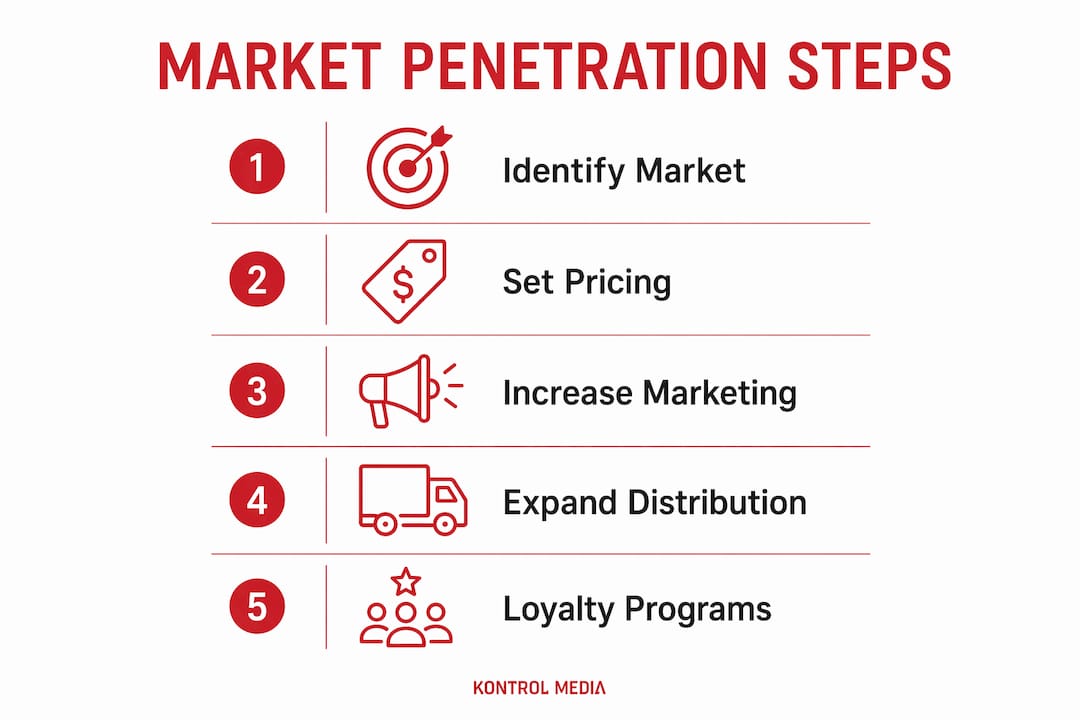
Penetration pricing
Penetration pricing sets an initially low price to attract customers quickly and build market share. Netflix used this approach aggressively in its early streaming years, keeping subscription costs below cable alternatives to accelerate household adoption. The risk is real, though. Low margin pricing can damage long-term profitability if the price floor becomes the market expectation and you cannot raise it later without losing the customers you just acquired. Penetration pricing works best when you have a clear path to either volume-driven cost reduction or a planned price normalization once loyalty is established.
Marketing and distribution expansion
Increasing advertising spend and expanding distribution channels are two of the most direct ways to grow reach within an existing market. More visibility converts latent demand into active purchase. Distribution expansion, specifically adding retail partners, digital channels, or geographic density within the same market, reduces friction between your product and the buyer. The operational consideration here is capacity. Expanding distribution without the fulfillment infrastructure to support it creates a customer experience problem that erodes the gains you just made.
Product bundling and loyalty programs
Bundling increases the perceived value of what you already sell without requiring product development investment. Amazon Prime is the most cited example at scale: combining shipping, streaming, and storage into one subscription deepened penetration across all three categories simultaneously. Loyalty programs work as a retention lever that compounds over time. A customer who earns points or status with your brand has a switching cost that a competitor must overcome. Both tactics treat existing customers as an asset to deepen rather than a baseline to maintain.
Competitive displacement
Competitive displacement works best when you hold measurable cost or quality advantages and are prepared for competitor retaliation. Winning customers from rivals requires a clear, demonstrable reason to switch. That reason must be cost, quality, performance, or access, not just marketing messaging. When T-Mobile launched its “Un-carrier” campaign, it did not just advertise differently. It eliminated contracts, a structural switching barrier, and gave customers a concrete reason to move. Displacement without a defensible advantage is expensive and temporary.
Pro Tip: Do not run multiple penetration tactics simultaneously without a measurement framework in place. When you pull several levers at once, you lose the ability to identify which one is actually driving results, and that makes future investment decisions guesswork.
Market penetration vs market development and other growth strategies
The Ansoff Matrix positions four growth strategies by product and market familiarity. Understanding where each sits helps you allocate resources with clarity rather than optimism.
Market penetration targets existing products in existing markets. It is the lowest-risk option because both the product and the customer base are known quantities. The primary challenge is competitive intensity, not market uncertainty.
Market development takes existing products into new markets or geographies. Expanding into a new country with a proven product carries more risk than deepening presence at home because customer behavior, regulatory environments, and distribution infrastructure are all unknowns. This is a meaningfully different strategic bet.
Product development introduces new products to existing markets. This requires R&D investment and carries the risk that the new product does not resonate, even with a loyal customer base.
Diversification is the highest-risk quadrant: new products in new markets. It is the strategic equivalent of starting over in a new category.
The practical implication for marketing leaders is this: if your current market still has meaningful headroom, penetration almost always delivers a better return on investment than development or diversification. The 5 key elements of business strategy consistently point to market clarity as a prerequisite before expansion. Chasing new markets before saturating existing ones is a common and costly mistake.
How to build and execute a market penetration plan
Execution is where most penetration strategies either prove themselves or quietly collapse. A clear framework keeps the work grounded in data rather than assumptions.
Calculate your current penetration rate. Use the formula above with at least two validated data sources for your TAM. This number is your starting point and your accountability anchor.
Conduct a competitive and customer gap analysis. Map where your current customers are concentrated and where they are not. Identify which customer segments competitors hold that you do not, and understand why. This is not a one-time exercise. It should happen quarterly.
Select your primary lever. Choose the tactic that best fits your current resources and market conditions. A capital-constrained business should not lead with a distribution expansion that requires new infrastructure. A brand with strong customer loyalty should lead with retention and bundling before chasing new acquisition.
Model competitor responses. Penetration moves rarely go uncontested. If you cut price, a well-resourced competitor can match you within weeks. Build a response scenario into your plan before you launch, not after you are already in the market.
Set measurable milestones and review on a defined cadence. Penetration pricing results can appear within 3 to 6 months, but sustainable market share improvement typically takes 12 to 18 months when distribution and loyalty programs are part of the mix. Set quarterly milestones but evaluate the strategy on an annual basis for meaningful assessment.
For B2B companies, account-based marketing is a proven penetration approach that concentrates resources on high-value prospects within the existing market rather than spreading thin across the full addressable base. It pairs well with optimized pricing and partnership development.
Pro Tip: Build retention metrics into your penetration scorecard from day one. Acquiring new customers while losing existing ones at the same rate produces a flat penetration rate with a much higher cost structure. Net penetration growth requires both sides of the equation.
Key takeaways
A market penetration strategy succeeds when acquisition, retention, pricing discipline, and distribution are treated as one integrated system rather than independent tactics.
| Point | Details |
|---|---|
| Penetration is the lowest-risk growth path | It uses known products and markets, reducing uncertainty compared to development or diversification. |
| Measure before you move | Calculate your penetration rate with validated TAM data before selecting any tactical lever. |
| Pricing is a tool, not a strategy | Penetration pricing captures share quickly but requires a clear plan to protect margins over time. |
| Competitive displacement demands proof | Winning customers from rivals requires measurable cost, quality, or access advantages, not just messaging. |
| Sustainable gains take 12 to 18 months | Set quarterly milestones but evaluate overall strategy performance on an annual basis. |
Why penetration strategy is harder than it looks
I have worked with enough growth-stage and mid-market companies to say this plainly: most teams underestimate how systemic a penetration strategy actually is. They pick one lever, usually pricing or advertising, run it for a quarter, and then wonder why the penetration rate barely moved. The honest answer is that a single lever rarely moves the needle on its own. Treating penetration as a system that integrates acquisition, retention, pricing discipline, and distribution is what separates the companies that gain durable share from those that buy temporary volume.
The other thing I see consistently is a failure to engineer market understanding before generating demand. There is a concept in growth marketing that I find underutilized: market engineering, which involves category design and narrative positioning to make the market understand why your product matters before you ask them to buy it. Companies that skip this step spend heavily on demand generation and then wonder why conversion rates are disappointing. The market is not ready for them because they never built the story first.
Competitive retaliation is also underplanned. I have seen well-funded penetration campaigns stall because the team did not model how a larger competitor would respond to a pricing move. Planning for retaliation is not pessimism. It is the difference between a strategy and a wish. The companies that adapt their strategy in real time, based on how the competitive environment responds, are the ones that actually hold the ground they gain.
— Mark Kapczynski
How Kontrol Media helps you grow market share
At Kontrol Media, we work with companies that are serious about growing within their existing markets, not just talking about it. Whether you are a middle-market company looking to deepen penetration in a core vertical or a larger enterprise trying to recapture share from aggressive competitors, the work starts with a clear-eyed assessment of where you actually stand.
We build and execute comprehensive business strategies that cover the full penetration system: pricing analysis, distribution assessment, marketing investment prioritization, and competitive response planning. Clients like Experian, REMAX, and West Monroe have worked with us because we do not just deliver a deck. We stay in the work. If you are ready to move from analysis to execution, let’s talk about your growth strategy.
FAQ
What is the definition of market penetration strategy?
A market penetration strategy is a growth plan that focuses on increasing sales of existing products within existing markets. It occupies the lowest-risk quadrant of the Ansoff Matrix because both the product and the customer base are already known.
How is market penetration rate calculated?
The formula is: (number of customers or revenue ÷ total target market size) × 100. For example, $50 million in revenue within a $5 billion market equals a 1% penetration rate.
What is the difference between market penetration and market development?
Market penetration grows share within an existing market using existing products. Market development takes existing products into new markets or geographies, which carries significantly higher risk and investment requirements.
How long does a market penetration strategy take to show results?
Penetration pricing can produce measurable results within 3 to 6 months, but sustainable market share improvement typically requires 12 to 18 months when distribution expansion and loyalty programs are part of the plan.
What are the biggest risks of a penetration pricing strategy?
The primary risk is margin erosion. If prices are set unsustainably low and cannot be raised later without losing customers, the short-term share gain destroys long-term profitability. Pricing discipline and a clear normalization plan are non-negotiable from the start.
Recommended
- Strategies for Expanding Your Business into New Markets | Kontrol Media Consultancy
- What Is Marketing-Led Growth? A Strategic Guide | Kontrol Media Consultancy
- Maximizing Business Growth: Strategies for Success | Kontrol Media Consultancy
- Unlocking Business Potential: Strategic Marketing and Consulting for Growth | Kontrol Media Consultancy