


Most brands don’t have a messaging problem because they say too little. They have one because they say too much, and none of it sticks. What is brand messaging, really? It’s the verbal architecture that sits beneath every ad, email, and sales conversation your company produces. Get it right, and your audience recognizes you instantly. Get it wrong, and even a generous budget won’t save you from being forgettable. This guide breaks down the definition, the frameworks, and the practical steps to build messaging that actually works.
Table of Contents
- Key takeaways
- What brand messaging actually is
- The core principles of effective brand messaging
- Building a brand messaging framework
- Why consistency is the spine of brand messaging
- How to create brand messaging that resonates
- My honest take on where brand messaging goes wrong
- Ready to build messaging that drives real growth?
- FAQ
Key takeaways
| Point | Details |
|---|---|
| Messaging is not positioning | Positioning defines where you compete; messaging is how you communicate that position to real people. |
| Three Cs drive effectiveness | Clarity, consistency, and constancy are the principles that make brand messaging build trust over time. |
| Frameworks beat taglines | A messaging framework is the full structure beneath your tagline, covering purpose, pillars, tone, and audience. |
| Consistency compounds revenue | Brands with consistent messaging can see up to 33% higher revenue than those without it. |
| Test before you commit | Messaging built without real audience validation almost always misses the mark before full rollout. |
What brand messaging actually is
Brand messaging is the verbal expression of your brand’s positioning. It’s the system of language your organization uses to communicate who you are, what you do, why it matters, and who it’s for. That system includes your value proposition, mission statement, tone of voice, and the core messages that run through every customer touchpoint.
Here’s where a lot of teams get confused. Positioning defines where you compete and why you win in a given market. Messaging is the verbal architecture built on top of that positioning. Confusing the two leads to internally focused language that doesn’t resonate with buyers or differentiate you from competitors.
Messaging is also not the same as copywriting. Copywriting is the execution. Messaging is the strategy that informs every piece of copy your team writes. And your tagline? That’s just the visible tip of the iceberg. The full framework is the supporting structure beneath it, and most customers never see it directly. They only feel its presence when your communication feels coherent and trustworthy.
The components that typically make up a brand messaging system include:
- Value proposition: The specific benefit your brand delivers and why it’s credible
- Mission statement: The purpose that drives your organization beyond profit
- Messaging pillars: The three to five core themes your brand consistently communicates
- Tone of voice: The personality and emotional register of your language
- Audience-specific messages: Variations tailored to different buyer segments without losing the core claim
Each of these elements works together. Remove one, and the system starts to feel inconsistent or hollow.
The core principles of effective brand messaging
The three Cs of brand messaging, clarity, consistency, and constancy, are the foundation of any messaging that actually builds recognition and trust over time.
Clarity means your audience understands your message without effort. This sounds obvious, but most brand messaging fails here first. Teams write for internal approval rather than external comprehension. They use industry jargon, abstract benefits, and vague aspirational language that sounds impressive in a deck and means nothing to a customer.

Consistency means your message sounds like the same brand across every channel, every team, and every campaign. A social post, a sales email, and a homepage headline should all feel like they came from the same source. When they don’t, customers sense the disconnect even if they can’t articulate it.
Constancy is about frequency. Repeated exposure to brand messaging is necessary to build trust and recognition. Customers typically need multiple exposures before a message registers. This is the Rule of 7 in practice: your message needs to show up consistently over time, not just during a campaign sprint.
Beyond the three Cs, every strong brand message contains three structural components:
- The claim: One clear, specific idea about what your brand delivers or stands for
- The reason to believe: Evidence, proof points, or credentials that make the claim credible
- The relevant frame: The context that makes the claim meaningful to your specific audience
“A strong claim communicates one key idea; the reason to believe needs evidence; the relevant frame tailors for audience context.” — Brand Message Strategy: What Most Brands Get Wrong
When messaging lacks any one of these three, it becomes what practitioners call marketing fluff. It sounds like a brand talking about itself without giving the audience a reason to care.
Pro Tip: Before finalizing any brand message, read it aloud to someone outside your industry. If they can’t immediately tell you what you do and why it matters, the message isn’t clear yet.
Building a brand messaging framework
A messaging framework serves as the verbal operating system for everything your brand communicates. It’s not a tagline document. It’s a structured architecture that guides every writer, marketer, and salesperson in your organization toward coherent, on-brand communication.
Here’s how to build one that actually functions:
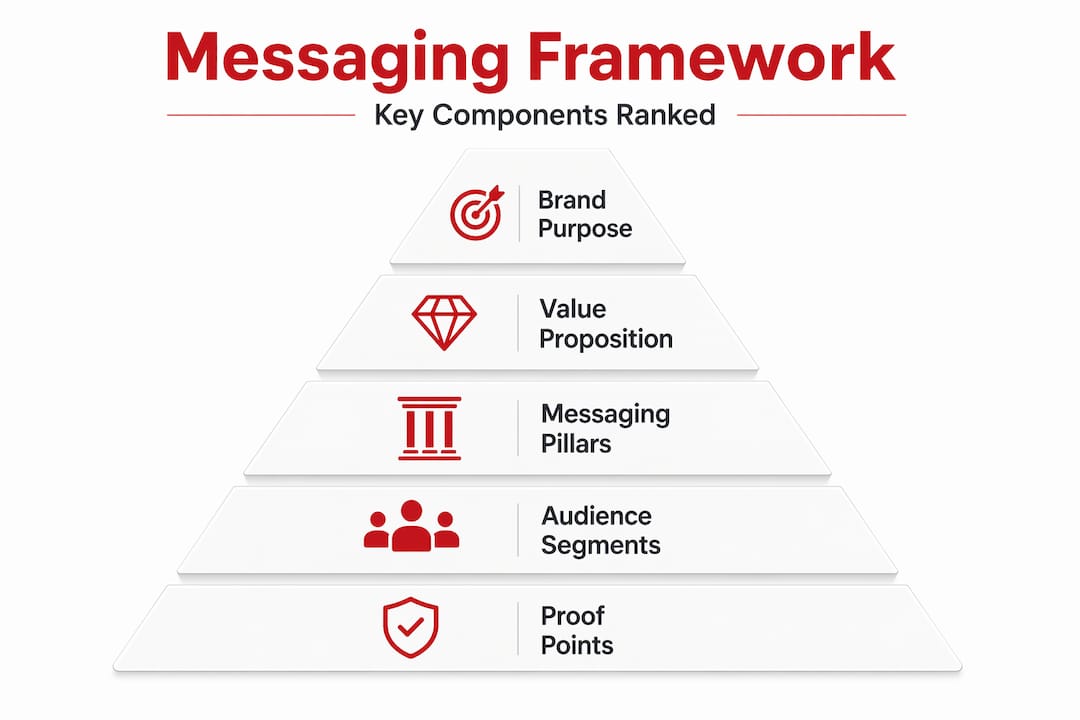
- Define your brand purpose. Start with why your organization exists beyond making money. This isn’t a mission statement exercise in corporate platitudes. It’s about identifying the specific change you want to create in your customers’ lives or industries.
- Articulate your value proposition. What specific outcome does your brand deliver, for whom, and why are you the credible choice? This should be one sentence that a real customer could repeat.
- Establish your messaging pillars. Choose three to five themes that your brand will consistently own in communication. These pillars should map to your audience’s real concerns, not your internal org chart.
- Define your audience segments. Different buyers have different risk profiles and decision triggers. Effective messaging maps to buyer risks and funnel stages rather than internal organizational structure.
- Document your tone and voice. Brand voice is the constant personality of your brand, while tone adjusts based on context or audience. Failing to document both leads to inconsistent messaging across teams and channels.
- Test and validate before rollout. Most messaging frameworks fail because they are built without testing against real audience reactions. Run your messaging past actual customers before committing to it.
The table below shows the critical difference between a brand messaging framework and a product messaging strategy, two things teams frequently conflate:
| Element | Brand messaging framework | Product messaging strategy |
|---|---|---|
| Scope | Entire brand across all channels | Specific product or feature |
| Audience | All segments and stakeholders | Defined buyer persona |
| Lifespan | Long-term, evolving system | Campaign or launch cycle |
| Primary goal | Build recognition and trust | Drive conversion and adoption |
| Owner | Brand or marketing leadership | Product marketing team |
Understanding this distinction helps you allocate the right resources and avoid the common mistake of letting product launches overwrite your brand identity.
Pro Tip: Treat your messaging framework as a living document. Schedule a review every six months with input from sales, customer success, and marketing. The language your customers use to describe your value is often more powerful than the language you invented internally.
Why consistency is the spine of brand messaging
Consistent messaging is not just a best practice. It’s a revenue driver. Brands with consistent messaging can see up to 33% higher revenue compared to those without it. That number reflects the compounding effect of recognition, trust, and preference that builds when customers encounter the same coherent brand repeatedly.
Brand consistency involves repeated use of recognizable, coherent elements that align voice, tone, and visuals. When all three work together, customers develop a sense of familiarity that reduces purchase friction and increases loyalty.
Maintaining that consistency at scale requires systems, not just intentions. Practical tools include:
- Brand guidelines: A documented reference that covers tone, voice, approved language, and messaging pillars
- Templates: More than 80% of businesses use templates to promote brand consistency across assets. Templates reduce the cognitive load on individual contributors and prevent off-brand improvisation.
- Onboarding and training: New team members and agency partners should receive messaging training, not just a style guide PDF they’ll never open
- Editorial review processes: A lightweight approval step that checks for messaging alignment before content goes live
The 5 things brands should prioritize always includes consistency at or near the top, because it’s the one discipline that multiplies the impact of everything else you do.
How to create brand messaging that resonates
Theory is useful. Application is where the work happens. Here’s a practical sequence for building brand messaging that connects with real people and holds up under real-world conditions.
- Start with your audience’s language. Before you write a single word of messaging, gather the exact phrases your customers use to describe their problems and the outcomes they want. Interviews, reviews, and support tickets are gold mines.
- Build your claim around one idea. The most common messaging mistake is trying to say everything at once. Pick the single most important thing your brand delivers and make that the center of gravity for all other messages.
- Gather your proof points. Every claim needs evidence. Case studies, data, certifications, client names, and testimonials all serve as reasons to believe. Map these to your messaging pillars so writers always have them at hand.
- Write for the relevant frame. The same value proposition lands differently depending on whether you’re speaking to a CFO worried about cost or a CMO worried about visibility. Adapt the frame without changing the core claim.
- Test with real people. Share draft messaging with a small group of actual customers or prospects before finalizing. Ask them to describe back what they understood. The gap between what you intended and what they heard is your revision list.
Pro Tip: When testing messaging, avoid asking “Do you like this?” People are polite. Instead, ask “What does this company do?” and “Why would you choose them over an alternative?” Their answers reveal whether your messaging is actually working.
Documenting the final output matters just as much as creating it. A well-crafted marketing strategy always includes a messaging section that gives every team member a shared reference point. Without documentation, messaging drifts the moment a new hire joins or a new agency comes on board.
My honest take on where brand messaging goes wrong
I’ve worked with enough organizations to recognize a pattern. The brands that struggle most with messaging aren’t the ones with nothing to say. They’re the ones trying to say everything at once, to everyone, all the time.
What I’ve learned is that clarity is a discipline, not a talent. It requires the willingness to make choices, to say “this is our one claim” and resist the pressure to add qualifiers, exceptions, and secondary messages that dilute the whole thing. Most teams find that uncomfortable. There’s always a stakeholder who wants their priority included. There’s always a product team that wants their feature mentioned. The result is messaging by committee, and it rarely serves the customer.
What I’ve also found is that the brands that treat their messaging framework as a living system rather than a static file consistently outperform those that don’t. The framework needs testing and ongoing refinement based on real audience feedback. The version you build today should look different in 18 months, shaped by what you’ve learned from customers, not just what felt right in a workshop.
The most effective messaging I’ve encountered always starts with a single, honest claim that the brand can actually prove. Everything else is architecture around that claim.
— Mark
Ready to build messaging that drives real growth?
Strong brand messaging doesn’t exist in isolation. It’s the foundation that makes every campaign, every sales conversation, and every piece of content work harder. At Kontrolmedia, we’ve helped organizations from early-stage startups to established enterprises like BuzzFeed and Remax get clear on what they stand for and how to communicate it in ways that actually move markets.
If your messaging feels scattered, generic, or disconnected from your broader business strategy, that’s exactly the kind of problem we’re built to solve. We don’t hand you a document and walk away. We work alongside your team to build messaging frameworks that hold up across channels, teams, and time. Explore how Kontrolmedia approaches business growth strategies and see whether a more structured approach to messaging could be the shift your brand needs.
FAQ
What is brand messaging in simple terms?
Brand messaging is the system of language a company uses to communicate its value, purpose, and personality across all channels. It includes the value proposition, tone of voice, messaging pillars, and audience-specific language that guide every piece of communication.
How is brand messaging different from brand positioning?
Positioning defines where you compete and why you win in a market, while messaging is the verbal expression of that position in language your audience actually understands and responds to.
What are the key components of a brand messaging framework?
A brand messaging framework typically includes brand purpose, a core value proposition, messaging pillars, audience segments, tone of voice guidelines, and proof points that support each claim.
How do you create brand messaging that resonates?
Start by gathering your audience’s own language, build your messaging around one clear claim, support it with proof points, and test draft messaging with real customers before finalizing it for broader use.
Why does consistent brand messaging matter for revenue?
Consistent brand messaging builds recognition and trust over time, and research shows it can contribute to up to 33% higher revenue compared to brands with fragmented or inconsistent communication.