


Strategic account planning is the structured process of setting goals, gathering stakeholder intelligence, mapping resources, and sequencing engagement to grow, retain, and deepen your most valuable customer relationships. The outcome we aim for is simple to state and harder to execute: measurable expansion and lower churn risk in the accounts that matter most. Use the template and process below to build a working plan this week, not next quarter.
TL;DR:
- Audience insights often remain incomplete without assigning owners and regular update cadences, risking stale intelligence within three months.
- The most critical step is gathering and analyzing stakeholder activity and derived insights, which is frequently neglected and causes planning failures.
- Prioritizing accounts based on revenue concentration, strategic fit, and whitespace potential yields the highest return on strategic account planning efforts.
- Tracking renewal likelihood alongside growth metrics in a simple scorecard offers a clear view of account health for executives.
- Successful execution relies on maintaining a adaptable plan, regular cadence reviews, and deliberate stakeholder engagement beyond just creating the document.
Table of Contents
- What strategic account planning means and where it applies
- Why strategic account planning matters now
- The step-by-step strategic account planning process
- Account plan template and a worked example
- Common challenges and how to fix them
- Skills, team roles, and training that produce results
- Metrics, scorecards, and how often to review them
- How Kontrol Media applies this in practice
- Frameworks and methodologies worth knowing
- Connecting account plans to broader business strategy
- Tools and software that support account planning
- Managing stakeholders and building executive relationships
- Managing risk inside a strategic account plan
- The one habit that separates working plans from shelf-ware
- Put your account plans into execution with Kontrol Media
- FAQ
- Sources
What strategic account planning means and where it applies
Strategic account planning is a formal, written process for managing your highest-value customer relationships with the same rigor you would apply to a major product launch. You may also see it called key account planning or referred to under the broader discipline of SAM, strategic account management. Both terms describe the same core activity: treating a handful of accounts as businesses within your business, each with its own mission, stakeholder map, and growth targets.
The scope matters because not every account deserves this treatment. Transactional account management, renewal reminders, routine check-ins, and support ticket follow-up work fine for smaller or lower-complexity customers. Strategic planning earns its cost when an account has multiple buying influences, meaningful expansion potential, or outsized revenue concentration.
A few terms recur throughout any account plan template, and getting them straight now saves confusion later. A stakeholder map identifies every person who influences, approves, or blocks a decision inside the account. Whitespace refers to products, services, or business units where you have no current footprint but a plausible right to compete. An account mission is the one or two sentence statement of what success looks like for that specific customer over a defined period, the north star every tactic should trace back to.
Why strategic account planning matters now
A formal plan pays off in four measurable ways: wallet expansion inside existing accounts, lower churn, reduced delivery and relationship risk, and a growing base of referenceable customers you can point to in new deals. These aren’t abstract benefits. They show up directly in renewal conversations and expansion pipeline.
Not every account justifies the investment, so prioritize based on a few clear signals. Revenue concentration is the obvious one: accounts responsible for an outsized share of your book deserve outsized attention. Strategic fit matters too, some customers open doors into an industry or use case you’re trying to grow into, independent of their current spend. Whitespace, the gap between what you currently sell and what the account could plausibly buy, is the third signal, and it’s often the most overlooked.
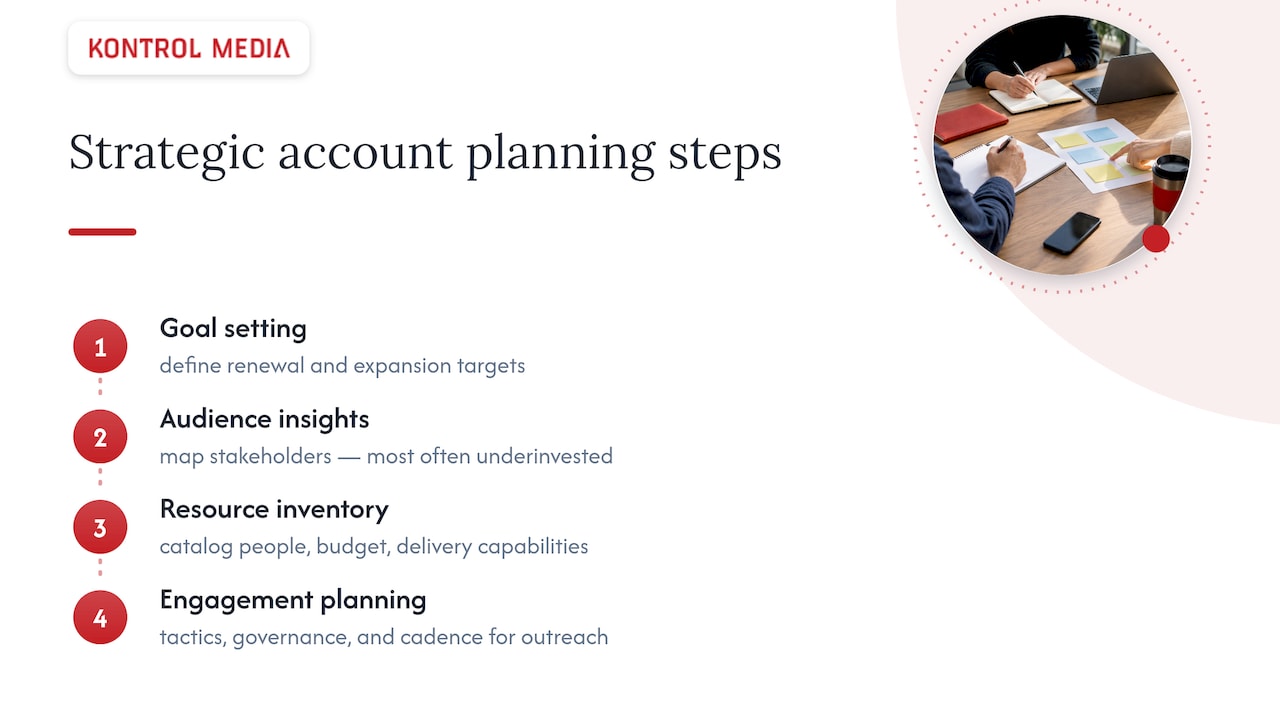
Forrester’s research on the strategic account planning process identifies a four-step structure: goal setting, audience insights, resource inventory, and engagement planning, and notes that organizations most frequently shortchange the audience-insights step. That finding matters because it tells you where your plan is most likely to fail before you even start: not in setting goals, which most teams do reasonably well, but in actually understanding the people you’re trying to influence. Gartner’s guidance on key account management similarly stresses that governance and cadence, not just planning quality, separate accounts that grow from accounts that stall.
The step-by-step strategic account planning process
Here’s the workflow we recommend, built around the four-step backbone Forrester describes and expanded into six owned, sequenced steps that a team can actually run.
- Set the account mission and timebound goals. Write one sentence describing what success looks like in 6 to 18 months, then attach two or three measurable targets to it, a revenue number, a product adoption milestone, a renewal date you’re protecting.
- Gather and classify audience insights. This is the step most plans shortchange, according to Forrester’s analysis, so treat it as non-negotiable rather than optional homework.
- Build the resource inventory. Catalog your internal capabilities against the account’s needs: which products fit, where competitors have a foothold, and where whitespace exists.
- Design the engagement and influence plan. Sequence outreach by stakeholder, pairing each touchpoint with a value exchange rather than a generic check-in.
- Map the opportunity pipeline and milestones. Name specific plays, assign an owner to each, and define what winning looks like before you start executing.
- Set governance and cadence. Decide how often the team reviews the plan and who escalates when a milestone slips.
Step two deserves the most explanation because it’s where plans typically break down. Audience insights fall into three categories: profile data (firmographics, org structure, buying history), activity data (what stakeholders are doing right now, which pages they visit, which events they attend, what they ask support), and derived insights (conclusions you draw by combining the first two, such as “the VP of Operations is likely evaluating alternatives based on recent support escalations”). Assign a named owner to collecting and updating each category. Without ownership, audience intelligence goes stale within a quarter.
Stakeholder mapping belongs inside this step too. For each key account, identify the economic buyer, the technical evaluator, the day-to-day user, and any internal champion or blocker. Note their individual priorities, not just their titles, because a CFO focused on cost reduction and a CFO focused on growth capital require entirely different conversations.
The resource inventory step is where whitespace analysis happens. List every product or service line you offer, mark which ones the account currently buys, and flag the gaps. Cross-reference those gaps against what you know about the account’s broader strategy from step two. A gap with no strategic relevance isn’t worth chasing; a gap that maps directly to a stated priority is your next play.
Engagement planning turns insight into action. Rather than a single relationship manager carrying the whole account, sequence specific people, your solutions engineer, your customer success lead, a subject matter expert, toward specific stakeholders at specific moments. Pair each touch with something of value: a relevant case study, an invitation to a peer roundtable, an early look at a feature roadmap.
Governance closes the loop, with a keen focus on long sales cycles and measurement. Gartner’s research on key account management points to cadence and scorecards as what distinguishes plans that drive real account growth from plans that sit in a shared drive untouched. A monthly internal review and a quarterly account-facing business review, each with a short scorecard, keeps the plan alive.
Account plan template and a worked example
A usable account plan template needs seven fields, each filled with specifics rather than placeholders. Here’s the structure we recommend, followed by a short worked example so you can see how it fits together.
- Account overview: company size, industry, current spend, and contract renewal date.
- Mission and objectives: the one-sentence mission plus two to three measurable goals.
- Stakeholder map: names, roles, priorities, and influence level for each key contact.
- Whitespace and opportunity map: products or services not yet sold, ranked by strategic fit.
- Value propositions by stakeholder: a tailored message for each person on the map.
- Tactical calendar: specific outreach, content, or events scheduled by month.
- KPIs and owners: the metrics tracked and who is accountable for each.
Say an account is a mid-market retailer spending $400,000 a year on your core platform with a renewal in nine months. The mission might read: “Expand this account into our analytics add-on within two quarters while protecting the renewal.” The stakeholder map lists the VP of Ecommerce (economic buyer, priority: reducing stockouts), the Director of Analytics (technical evaluator, priority: faster reporting), and a frontline category manager (champion, priority: easier day-to-day workflow). The whitespace entry flags the analytics add-on as the top opportunity because it directly addresses the VP’s stated priority. The tactical calendar schedules a product demo for the Director of Analytics in month one, a peer case study sent to the VP in month two, and a quarterly business review in month three. KPIs include analytics add-on adoption rate, owned by the account manager, and renewal risk score, owned by customer success.
| Field | Example entry |
|---|---|
| Account overview | Mid-market retailer, $400,000 annual spend, renewal soon |
| Mission | Expand into analytics add-on within two quarters while protecting renewal |
| Top whitespace | Analytics add-on, mapped to VP’s stockout priority |
| KPI owner | Account manager (adoption), customer success (renewal risk) |
Keep the plan alive by versioning it. Date every revision, note who made the change, and review the full document at least quarterly, more often for your top five accounts. A plan nobody updates after the kickoff meeting isn’t a strategic plan, it’s a memo.
Common challenges and how to fix them
The audience-insights gap shows up most often as a plan built entirely on firmographic data with no activity or derived insight behind it. Fix this by assigning a named owner to each insight category and setting a cadence, monthly for activity data, quarterly for derived conclusions, so the plan doesn’t go stale.
Internal alignment breaks down when the account plan lives only in the account manager’s head. A simple RACI chart, who’s responsible, accountable, consulted, and informed, for each major play solves most of this, and bringing in frontline input from support and delivery teams catches risks the account manager alone would miss. Executive sponsorship matters here too: a plan with no senior visibility rarely survives a reorg or a budget cut.
Scaling strategic planning across dozens of accounts without losing the tailoring that makes it work is a real tension. The fix is a repeatable template, like the one above, paired with account-specific inputs rather than a fully custom document for every account.
Measurement challenges often come down to tracking the wrong things. Activity counts, number of calls made, emails sent, feel productive but say nothing about account health. Focus instead on penetration rate, whitespace closed, and renewal risk reduction.
- Audience insights: assign an owner per insight category and a refresh cadence.
- Alignment: build a RACI chart and secure one executive sponsor per account.
- Scaling: standardize the template, customize the inputs.
- Measurement: track penetration and whitespace closed, not call volume.
Pro Tip: Before your next quarterly review, delete any metric from your scorecard that doesn’t change what you’d do next week, it’s probably a vanity number.
Skills, team roles, and training that produce results
The best account teams combine four competencies: stakeholder influence, strategic selling judgment, comfort with data and analytics, and sustained relationship management. RAIN Group’s research on strategic account management ties these competencies, paired with consistent, repeatable processes, to stronger account growth and protection than teams relying on relationship skill alone.
How you organize the team depends on account complexity. A single SAM owner model works for smaller strategic portfolios but creates a bottleneck as accounts grow. A pod model, pairing a SAM lead with a solutions engineer and a customer success manager, spreads the workload and brings technical depth to stakeholder conversations. Cross-functional squads, pulling in product, marketing, and finance as needed, suit your largest or most complex accounts but require more coordination overhead.
Training should mirror the actual work: stakeholder analysis workshops, competitive planning sessions built around real whitespace gaps, and account mission and KPI exercises using the team’s own accounts rather than generic case studies. RAIN Group’s research specifically recommends modules covering these areas because they map to the processes top performers use consistently. For teams building sales capability from the ground up, our guide on building a high-performing sales team covers the hiring and structure questions that come before training does.
Metrics, scorecards, and how often to review them
A compact scorecard beats a sprawling dashboard nobody checks. Track account revenue growth as a percentage, penetration rate across your product or service lines, whitespace closed against what you identified in planning, a customer health score, renewal likelihood, and whether the account is willing to serve as a reference.
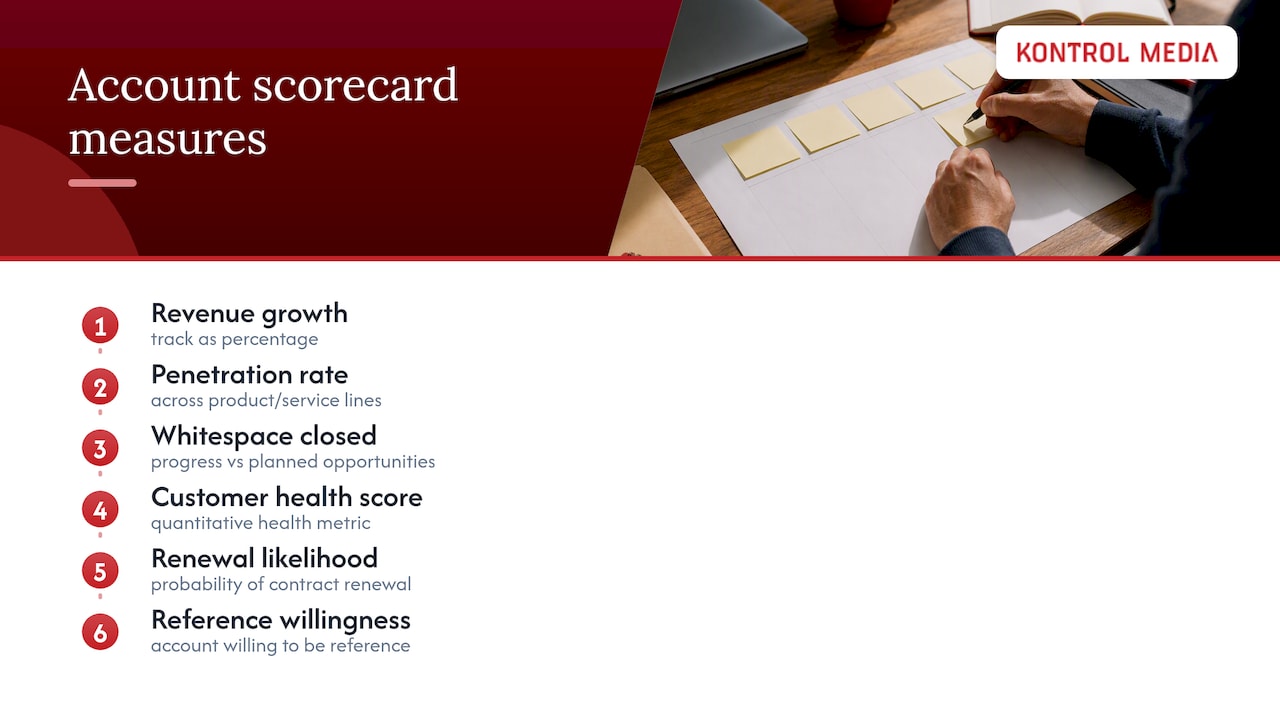
A simple scorecard built around revenue growth, penetration, and renewal likelihood gives executives a one-page view of account health without requiring a full dashboard review. Pair quantitative KPIs with a qualitative relationship-strength rating, since a healthy number can mask a champion who’s about to leave.
Run a short internal check monthly, a fuller team review quarterly, and an account-facing business review on the same quarterly rhythm. Weekly touchpoints belong to the account manager, not the full governance cadence.
How Kontrol Media applies this in practice
An effective approach addresses the common gap Forrester’s research points to: most teams plan goals well and audience insight poorly. Combining strategic guidance with hands-on execution ensures that working an account plan involves running the stakeholder outreach, building the content, and managing the cadence, not just advising on whitespace analysis.
That combined model shows up across our work in business strategy, where we help clients set the account mission and KPI structure before a single outreach email goes out, and in our retail media network operations work, where whitespace analysis and stakeholder sequencing are the daily job, not a quarterly exercise.
Frameworks and methodologies worth knowing
Several named frameworks circulate in SAM literature, and most share more structure than they differ. The four-step model Forrester describes, goals, insights, resources, engagement, is one of the most widely cited and maps closely to the six-step process we walked through above. Account-based marketing (ABM) frameworks overlap heavily with strategic account planning but originate from marketing rather than sales, focusing more heavily on coordinated messaging across a buying committee before a deal exists. Miller Heiman’s strategic selling methodology, still taught widely through programs listed on platforms like edX, emphasizes buying influence roles (economic, user, technical) that map directly onto the stakeholder mapping step in any modern template.
Rather than picking one framework and following it rigidly, most practitioners borrow the goal-setting discipline from one, the stakeholder categorization from another, and the governance cadence from a third. What matters is that every framework you adopt forces the same underlying discipline: a written mission, classified intelligence on the people who matter, and a cadence that keeps the plan current.
Connecting account plans to broader business strategy
An account plan that lives in isolation from your company’s broader strategy will drift, usually toward whatever the account manager finds most urgent that week rather than what matters most to the business. The fix is structural: account missions should trace directly back to a stated company priority, whether that’s expansion into a new vertical, deeper penetration of an existing product line, or protection of revenue concentrated in a handful of relationships.
This also means your sales process and your account planning process shouldn’t run as two separate systems. The stakeholder map you build during planning should feed directly into how your sales team qualifies and sequences opportunities inside that account, and the whitespace you identify should become actual pipeline, tracked the same way any other opportunity is tracked. Our guide to crafting a comprehensive business strategy covers how we think about connecting top-level priorities to execution at the account level, which is the same muscle strategic account planning exercises at a smaller scale.
Tools and software that support account planning
Most teams run strategic account planning on some combination of a CRM for pipeline and activity tracking, a dedicated account-planning module or standalone tool for the plan document itself, and a business intelligence layer for the customer health scoring that feeds the scorecard. The CRM holds the activity data category from your audience insights; a planning tool or even a well-structured shared document holds the mission, stakeholder map, and tactical calendar; and a BI layer or simple spreadsheet model calculates penetration and health scores from underlying usage data.
The specific tool matters less than whether the three layers talk to each other. A beautifully designed account plan that lives disconnected from your CRM’s activity log will drift out of date within weeks, because nobody updates a document that isn’t part of their daily workflow. The practical fix is to anchor the plan’s live fields, stakeholder status, pipeline stage, next action, inside whatever system your team already opens every day, and treat the fuller written plan as a quarterly artifact that gets refreshed from that live data rather than maintained independently.
Managing stakeholders and building executive relationships
Executive relationships inside key accounts rarely form through a single meeting. They build through a sequence of value exchanges, each one proving you understand a priority specific to that executive rather than a generic pitch about your product.
Start by separating stakeholders by influence type rather than title alone: the economic buyer who controls budget, the technical evaluator who assesses fit, and the day-to-day user who lives with the outcome. Executives most often fall into the first category, and the path to their attention runs through evidence that you’ve already solved a problem they care about for someone like them, a relevant case study, a benchmark, an invitation to a peer conversation rather than a product demo. Champions inside the account, often not the most senior person in the room, are usually your fastest route to an introduction, so invest in them deliberately rather than treating them as a means to an end.
Executive relationships also need a different cadence than day-to-day contacts. A quarterly business review with the economic buyer, kept tight and focused on business outcomes rather than product features, does more for the relationship than monthly check-ins that executive calendars rarely accommodate anyway.
Managing risk inside a strategic account plan
Every strategic account carries risk that a plan should name explicitly rather than hope around. Concentration risk tops the list: an account responsible for an outsized share of revenue creates exposure if that relationship sours or the customer’s own business contracts. Diversifying your stakeholder relationships inside the account, so no single departure can unravel the whole relationship, is the direct mitigation.
Competitive risk shows up in the resource inventory step. If a competitor already holds a foothold in a whitespace area you’ve identified, your engagement plan needs a defensive component, not just an expansion pitch. Champion risk deserves its own line: if the plan depends heavily on one internal advocate, their departure or reassignment can stall momentum overnight, so cultivating at least one backup relationship at a similar level is worth the deliberate effort.
Renewal risk is the most measurable of these, and it belongs on the scorecard discussed earlier rather than treated as a separate exercise. A plan that tracks renewal likelihood alongside growth metrics catches early warning signs, a drop in product usage, a change in primary contact, in time to act rather than in the quarter before the contract expires.
The one habit that separates working plans from shelf-ware
The principle we come back to most often: a plan earns its place only if it changes what someone does this week. We test every section of a draft plan by asking whether a specific person could act on it tomorrow morning, not just agree with it in a meeting. If a stakeholder map lists a name but no stated priority, it’s not done. If a KPI has no owner, it’s not a KPI.
That single filter, specific action, specific owner, catches most of the planning theater before it wastes a quarter.
— Mark Kapczynski
Put your account plans into execution with Kontrol Media
Building the plan is the easier half. Running the stakeholder outreach, keeping the cadence, and closing the whitespace you’ve identified takes dedicated hands, which is where most account plans stall even when the document itself is solid. Our business strategy, marketing, and sales services cover that execution layer directly, from setting the account mission through running the outreach calendar.
For accounts where the growth opportunity runs through a retail or commerce media channel, our retail media network operations team handles the day-to-day running of that whitespace rather than leaving it as a line item nobody owns. If outreach capacity is the gap, our sales function services give you account execution without adding headcount. Reach out through our contact page to talk through where your current plans are stalling and what execution support would look like.
FAQ
What is the difference between account management and strategic account planning?
Account management typically covers routine maintenance of a customer relationship, renewals, support, basic check-ins, while strategic account planning is a formal, written process reserved for high-value accounts with a defined mission, stakeholder map, and measurable growth targets. The distinction is about depth and intentionality, not just account size.
How often should a strategic account plan be updated?
Most practitioners review the full plan quarterly and update live fields like stakeholder status or pipeline stage more frequently, often monthly. Gartner’s guidance on key account management ties cadence directly to execution quality, so a plan reviewed only at kickoff tends to go stale fast.
Which accounts qualify for strategic account planning?
Accounts with high revenue concentration, strong strategic fit for your broader business goals, or significant whitespace opportunity are the best candidates. Not every customer needs this level of investment, and applying it too broadly dilutes the attention your actual top accounts require.
What skills matter most for a strategic account manager?
RAIN Group’s research on strategic account management identifies stakeholder influence, strategic selling judgment, analytical comfort, and sustained relationship management as the competencies most tied to top performance. Consistent, repeatable processes paired with those skills matter as much as the skills themselves.
Can strategic account planning be outsourced?
Yes, companies without dedicated internal account management capacity often bring in outside support to build and execute account plans, particularly for outreach sequencing and cadence management. We offer this through our sales function services, which handle execution for teams that have the strategy but lack the hands to run it.
Sources
- The Four-Step Strategic Account Planning Process – Which Step Most Organizations Get Wrong
- Strategic Account Management Research | RAIN Group
- Key account management | Gartner