


Search Engine Optimization (SEO) is defined as the process of improving a website’s organic visibility in search engine results to drive qualified traffic and measurable business growth. For marketing professionals and business owners, mastering SEO best practices is not optional. Google’s algorithms now evaluate content through the E-E-A-T framework, which stands for Experience, Expertise, Authoritativeness, and Trustworthiness, and the bar keeps rising. The Google Search Essentials 2026 framework sets the technical and content standards every site must meet to qualify for search eligibility. Get these fundamentals right, and organic traffic becomes one of your most cost-effective acquisition channels.
What are the foundational technical SEO requirements?
Technical SEO is the infrastructure layer that determines whether search engines can find, read, and rank your pages at all. Google Search Essentials 2026 mandates three non-negotiable technical requirements: crawlability, indexability, and rendering. If any one of these fails, your content simply does not appear in search results, regardless of how well it is written.
A proper technical SEO audit covers crawlability, indexing, canonicalization, performance, and JavaScript rendering reliability. The most common errors that block search eligibility include crawl traps, canonical mistakes, index bloat, redirect chains, and rendering instability. Each of these issues can silently suppress rankings for months before anyone notices.
The audit process itself does not need to be overwhelming. Start with these core checks:
- Crawlability: Verify your robots.txt file does not block key pages, and confirm Googlebot can access your site without login walls or JavaScript barriers.
- Indexability: Use Google Search Console to identify pages marked “noindex” by mistake or excluded from the sitemap.
- Canonicalization: Check that duplicate URLs point to a single canonical version to prevent splitting ranking signals.
- Redirect chains: Resolve multi-hop redirects (A to B to C) into direct redirects (A to C) to preserve link equity.
- Core Web Vitals: Measure Largest Contentful Paint, Interaction to Next Paint, and Cumulative Layout Shift scores, since Google uses these as ranking signals.
Pro Tip: Run a crawl with a tool like Screaming Frog or Sitebulb at least once per quarter. A single crawl session often surfaces dozens of fixable issues that compound into significant ranking losses over time.
How to create people-first content that meets E-E-A-T standards
People-first content is a measurable standard in 2026, not a vague aspiration. Under the E-E-A-T framework, Google’s algorithms actively reward content that demonstrates real-world experience, clear expertise, and verified authorship. Content that reads like it was produced at scale, without genuine insight, now faces aggressive algorithmic penalties.

Demonstrating experience is the part most marketers underestimate. Including project case studies, verified author bios with credentials, and first-person observations tied to real outcomes all signal trustworthiness to Google’s systems. A blog post written by a named professional with a linked LinkedIn profile and cited data outperforms an anonymous article every time.
Google’s 2026 spam policies aggressively target scaled content abuse, expired domain abuse, and site reputation abuse. AI-driven spam detection is faster and more aggressive than in prior years, penalizing low-value content produced at volume. The practical implication is clear: one well-researched, experience-backed article outperforms ten thin pieces.
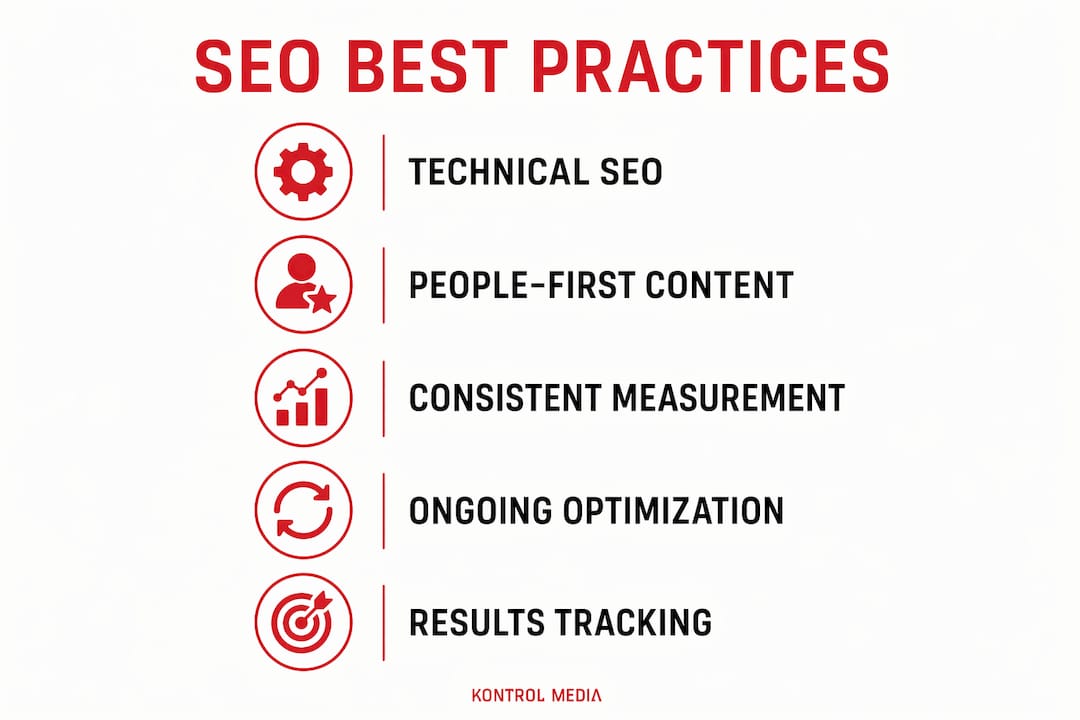
Structuring content for clarity matters just as much as the substance. Semantic headings using H2 and H3 tags, combined with structured data markup, improve both user experience and search engine comprehension. Google reads your heading hierarchy as a signal of content organization and topical depth.
Here is what people-first content looks like in practice:
- Author credentials: Name the author, list their relevant experience, and link to a bio page or professional profile.
- Original data: Reference proprietary research, client results, or first-party observations rather than recycling industry reports.
- Direct answers: Lead every section with the answer, then expand with evidence. Do not bury the key point in paragraph three.
- Cited sources: Link to authoritative external sources to show your claims are grounded in evidence.
Pro Tip: Add a “What we learned from this” section at the end of case studies. That single addition signals lived experience to both readers and Google’s quality raters, and it takes less than 100 words to write.
What are effective SEO strategies to improve organic traffic?
Improving organic traffic requires a coordinated approach across keyword targeting, site architecture, link building, and content planning. These are not independent tactics. They reinforce each other, and weakness in one area limits the ceiling of the others.
Target long-tail keywords first. Head terms like “SEO” carry enormous competition. Long-tail phrases like “technical SEO audit for B2B SaaS” attract lower volume but far higher purchase intent. Start there, build authority, then compete for broader terms.
Structure your site for topic clusters. Group related content under a single pillar page, with supporting articles linking back to it. This architecture concentrates ranking signals and tells Google you cover a topic with depth. A consulting firm, for example, might build a pillar on “business strategy” with cluster pages on market entry, competitive analysis, and go-to-market planning.
Build links through original research and partnerships. Earning links from authoritative sites remains one of the strongest ranking signals. Publishing original data, contributing expert commentary to industry publications, and forming content partnerships are the most reliable link-building methods that carry no penalty risk.
Update existing content on a regular cadence. Pages with established authority tend to rank better and cover more keywords over time. The average top-10 ranking page is about two years old, and the number-one position is held by pages nearly three years old. Refreshing older articles with new data, updated examples, and improved structure extends their ranking life significantly.
Use analytics to identify conversion drop-off points. Organic traffic that does not convert is a signal problem, not a volume problem. Review Google Analytics 4 landing page reports to find pages with high bounce rates and low engagement time, then revise the content structure and calls to action on those specific pages.
The original content advantage is real and growing. Brands that publish proprietary insights, not recycled industry takes, build the kind of topical authority that compounds over months and years.
How to measure SEO success and optimize ongoing efforts
SEO measurement starts with SMART goal setting: goals that are Specific, Measurable, Achievable, Relevant, and Time-bound. Without this structure, SEO campaigns drift. A goal like “increase organic traffic” is not a goal. “Increase organic traffic to the services page by 30% within six months” is one.
The core metrics every marketing professional should track are organic traffic volume, keyword rankings, click-through rate from search results, engagement rate, and conversion rate. Each metric tells a different part of the story. Rankings show visibility. Traffic shows reach. Conversions show whether the right audience is arriving.
Conversion benchmarks give you a realistic target. Typical e-commerce organic conversion rates sit between 1–3%, with top-performing stores reaching 4–6%. B2B organic lead conversion ranges from 2–5%. These numbers matter because they tell you when your SEO is working and when the problem is actually your offer or landing page, not your rankings.
Google Search Console is the most direct tool for diagnosing ranking issues. It shows which queries drive impressions versus clicks, which pages are indexed, and which pages have manual actions or coverage errors. Pair it with Google Analytics 4 to connect search performance to on-site behavior and revenue.
Pro Tip: Set up a monthly SEO scorecard with five metrics: organic sessions, average position for your top 20 keywords, conversion rate by landing page, crawl errors, and Core Web Vitals scores. Review it on the same day each month. Consistency in measurement is what separates teams that improve from teams that react.
When traffic dips, resist the urge to make sweeping changes. Isolate the variable first. Check Search Console for manual actions, review recent algorithm update dates, and compare the affected pages against your E-E-A-T checklist before changing anything structural.
SEO takes approximately 3–6 months to show meaningful results, and competitive keywords may require 12–24 months of consistent effort. That timeline is not a flaw in the channel. It is the moat. Brands willing to invest consistently build compounding advantages that paid channels cannot replicate.
Key Takeaways
Effective SEO requires technical eligibility, people-first content, and consistent measurement working together to build compounding organic visibility over time.
| Point | Details |
|---|---|
| Technical eligibility comes first | Fix crawlability, indexability, and rendering before investing in content or links. |
| E-E-A-T is now measurable | Add verified author bios and original case studies to meet Google’s 2026 content standards. |
| Long-tail keywords build authority faster | Target specific, high-intent phrases before competing for broad head terms. |
| Conversions reveal the real story | Benchmark against 1–3% for e-commerce and 2–5% for B2B to know if SEO is actually working. |
| Patience is a competitive advantage | Meaningful SEO results take 3–6 months; top rankings often require two or more years of consistent effort. |
What I’ve learned about SEO that most guides won’t tell you
The most persistent mistake I see marketing professionals make is treating SEO as a one-time project rather than an operating system. They audit the site, publish a batch of content, build a few links, and then move on. Six months later, they wonder why rankings stalled. The truth is that SEO rewards consistency more than intensity.
What I find genuinely underappreciated in 2026 is the relationship between technical health and content performance. I have watched well-written, well-researched articles sit on page four of Google for months, not because the content was weak, but because the site had index bloat or a broken canonical structure diluting its authority. Fix the technical layer first. Content quality cannot compensate for infrastructure failures.
The E-E-A-T shift is also more significant than most people realize. Google is not just rewarding expertise in the abstract. It is looking for evidence of lived experience: the case study with real numbers, the author who has actually done the thing they are writing about, the article that references proprietary data instead of the same three industry reports everyone else cites. That is a higher bar, and it is the right bar.
My honest take on the timeline question: most businesses underinvest in SEO precisely because the results are not immediate. But the brands I have seen build durable organic channels are the ones that treated it like a long-term asset, not a quarterly campaign. The compounding effect is real. A page that ranks well today, refreshed and maintained, can generate leads for years without additional spend.
If you are a business owner or marketing leader reading this, the most practical thing you can do right now is run a business strategy audit that includes your digital visibility as a core component. SEO does not exist in isolation from your broader growth strategy. The brands that win treat them as one system.
— Mark Kapczynski
How Kontrol Media approaches SEO-driven growth
Kontrol Media works with marketing teams and business owners who need more than a checklist. The consultancy brings hands-on execution across business strategy, marketing, and sales development, with clients including Experian, BuzzFeed, HuffPost, RE/MAX, and West Monroe.
If your organic visibility has plateaued or your content is not converting at the rates your business needs, the issue is rarely just one thing. It is usually a combination of technical gaps, content that does not demonstrate real expertise, and measurement that is not tied to business outcomes. Kontrol Media’s marketing and business services are built to address all three layers, not just the surface. For brands looking to connect SEO performance to revenue, the ROI measurement framework Kontrol Media uses with clients is a practical starting point.
FAQ
What is SEO and why does it matter for business?
SEO is the process of improving a website’s organic visibility in search engine results to attract qualified traffic without paying for each click. For businesses, it is one of the highest-return acquisition channels when executed consistently over time.
How long does SEO take to show results?
SEO takes approximately 3–6 months to show meaningful results, with competitive keywords requiring 12–24 months of consistent effort. Early indexing can happen within weeks, but sustained traffic and conversions follow later.
What is E-E-A-T and how does it affect rankings?
E-E-A-T stands for Experience, Expertise, Authoritativeness, and Trustworthiness. Google uses these signals to evaluate content quality, and in 2026, demonstrating real-world experience through author credentials and original case studies is a measurable ranking factor.
What are the most important technical SEO fixes?
The highest-priority technical fixes are resolving crawl errors, correcting canonical mistakes, eliminating redirect chains, and improving Core Web Vitals scores. These issues directly block search eligibility before content quality even becomes a factor.
What conversion rate should I expect from organic search traffic?
E-commerce sites typically see organic conversion rates of 1–3%, with top performers reaching 4–6%. B2B businesses should target organic lead conversion rates in the 2–5% range as a realistic benchmark for measuring SEO effectiveness.
Recommended
- SEO Mastery In 2024 And Beyond | Kontrol Media Consultancy
- The Power of Original Content: Insights from an SEO Expert | Kontrol Media Consultancy
- Consumer Brand Media Network Best Practices in 2026 | Kontrol Media Consultancy
- Top Digital Marketing Trends for Manufacturers to Know | Kontrol Media Consultancy