


A messaging framework is defined as a structured strategic document that guides every statement a brand makes across sales, marketing, and customer communications. It is not a tagline, a brand voice guide, or a style sheet. Those tools serve a purpose, but a messaging framework sits beneath all of them, defining what you say and why it matters before anyone writes a single word of copy. Professional frameworks prioritize consistency across every customer-facing channel, from sales scripts to website headlines to marketing materials. That consistency is not a cosmetic preference. It is the difference between a brand that buyers trust and one they forget.
What are the core components of a messaging framework?
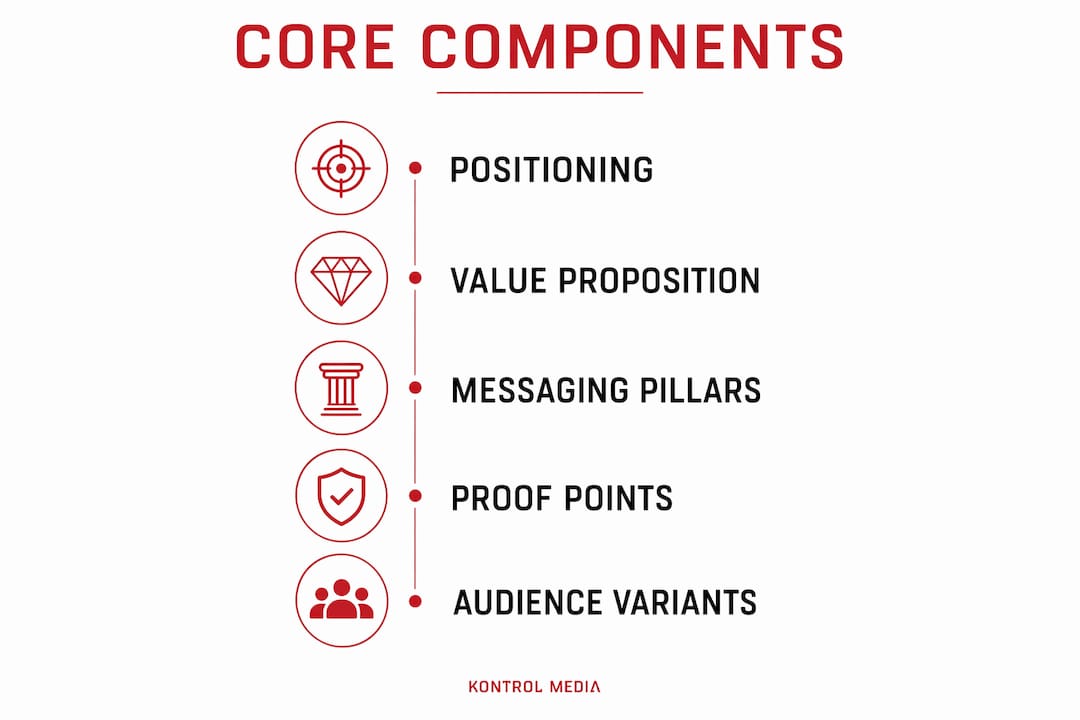
A complete messaging framework contains five to seven core elements, and skipping any one of them creates gaps that show up in the market. Effective frameworks include a positioning statement, a value proposition, messaging pillars, evidence-based proof points, target audience personas, and brand voice guidelines. Each element does a specific job, and together they form the spine of your brand communication.
The positioning statement defines where your brand sits in the market relative to the problem you solve. It answers the question buyers ask before they even know they are asking it: “Why this company over any other?” The value proposition sits one level below that, translating the positioning into a concrete promise tied to a specific outcome the buyer cares about.

Messaging pillars are the three to five core claims that support your value proposition. Each pillar must be distinct, defensible, and linked to verifiable evidence. Every claim that lacks verifiable proof belongs in the brand vision, not the messaging framework. That is a hard rule, and it is one most teams violate when they build frameworks in a conference room without customer data.
Skilled marketers use a traceability chain that links each pillar to specific evidence: a case study, a data point, a customer quote, or a third-party certification. This approach keeps sales teams honest and gives buyers a reason to believe the claims they encounter throughout the funnel.
Audience variants address the reality that different buyer personas care about different things. A CFO evaluating your product weighs risk and cost. A VP of Marketing weighs speed and creative control. Tailored messaging variants avoid the one-size-fits-all trap and increase resonance with each segment. Building these variants into the framework from the start prevents the ad hoc customization that leads to message drift.
The table below shows how each component functions within the overall architecture.
| Component | Primary function |
|---|---|
| Positioning statement | Defines market context and competitive differentiation |
| Value proposition | States the specific outcome the brand delivers |
| Messaging pillars | Three to five core claims, each tied to proof |
| Audience variants | Persona-specific emphasis on relevant pillars |
| Proof modules | Data, testimonials, and certifications that make claims credible |
| Brand voice guidelines | Tone and language rules that keep delivery consistent |
How do you build a messaging framework step by step?
The build process starts with a discovery phase, and that phase is where most teams cut corners. Skipping discovery and basing messaging on internal assumptions produces generic, ineffective messaging that sounds like every other brand in the category. The antidote is customer language. Pull it from interviews, sales call recordings, support emails, and win/loss reviews.
Here is the structured process that produces frameworks built to last.
Audit existing messaging assets. Collect every piece of customer-facing content: website copy, sales decks, email sequences, and case studies. Identify inconsistencies, outdated claims, and gaps between what you say and what customers actually value.
Conduct customer interviews. Talk to at least eight to ten customers across different segments. Ask them to describe the problem they had before finding you, the moment they decided to buy, and the language they use to explain your value to colleagues. Analyzing customer language from interviews and sales conversations grounds your framework in authentic buyer terms.
Define your positioning and value proposition. Use the customer language you collected to write a positioning statement that reflects how buyers actually think about the category. Avoid internal jargon. If a customer would not say it, do not put it in the framework.
Develop messaging pillars with traceable proof. Write three to five pillar statements. For each one, document the specific proof that supports it: a customer quote, a metric, a case study reference, or a third-party validation. No proof, no pillar.
Create audience variants. Identify your two or three primary buyer personas. For each persona, note which pillars matter most and which proof points carry the most weight. Write variant language that emphasizes those elements without contradicting the core framework.
Draft, test, and refine. Share the draft with sales leaders, marketing leads, and at least two customers. Test primary messages in paid channels or sales conversations. Refine based on what lands and what falls flat.
Establish governance. Assign a framework owner, set a review cadence of at least twice per year, and document the triggers that require an unscheduled update: a product launch, a market shift, or a significant change in competitive positioning.
Pro Tip: Record your customer interviews and run them through a transcription tool. Then search the transcripts for the exact phrases buyers use to describe their pain. Those phrases belong in your messaging pillars, not the language your product team invented.
Following this structured process reduces content revision costs by 30–50% in the first year. That number reflects the time teams waste rewriting copy that was never grounded in a clear framework to begin with.
A brand positioning strategy that feeds directly into the framework development process produces the clearest, most defensible positioning statements. The two documents should be built in sequence, with positioning defined first.
What are the most common messaging framework mistakes?
The most damaging mistake is building the framework entirely from internal assumptions. Teams gather in a room, debate what they think customers care about, and produce a document that reflects their own priorities rather than buyer reality. The result is messaging that sounds polished internally and falls flat externally.
- Treating the framework as a static document. Markets shift. Products evolve. Customer language changes. A framework that is not reviewed at least semi-annually becomes a liability, not an asset.
- Overloading messaging pillars. Seven pillars are not better than four. Each additional pillar dilutes the others and makes it harder for sales teams to remember and apply the framework consistently.
- Using vague or unsubstantiated claims. Phrases like “world-class service” or “industry-leading quality” carry no weight without proof. Buyers have heard them too many times to believe them.
- Neglecting activation. A framework that lives in a shared drive and never gets embedded into sales training, website copy, or marketing briefs is a wasted investment.
- Ignoring persona segmentation. Sending the same message to a technical buyer and a financial buyer wastes both their time and yours. Audience variants are not optional for organizations with multiple buyer types.
Pro Tip: Run a “proof audit” on every pillar before finalizing the framework. If you cannot attach a specific case study, data point, or customer quote to a claim within 60 seconds, that claim is not ready for the framework.
Consulting resources like Pocket PMO’s use cases illustrate how persona-specific messaging strategies apply across consulting contexts, which is useful for teams building frameworks for service-oriented businesses.
How do you operationalize and maintain a messaging framework?
Building the framework is the first half of the work. Embedding it into daily operations is the half that most organizations skip. Running messaging workshops and embedding framework language in websites, sales decks, and training programs creates the consistency that makes the investment pay off.
The operationalization process follows a clear sequence.
Run a cross-functional alignment workshop. Bring together marketing, sales, customer success, and product teams. Walk through the framework, explain the reasoning behind each pillar, and give teams the chance to ask questions and raise objections before the framework goes live.
Integrate framework language into all customer-facing assets. Update the website, rewrite sales deck headlines, revise email templates, and align onboarding materials. Every touchpoint should reflect the same core claims and tone.
Build reusable proof modules. Proof modules such as data points, customer testimonials, and certifications make claims believable throughout the buyer funnel. Package these as reusable assets that any team member can pull into a proposal, a blog post, or a sales email.
Assign a framework owner. One person is responsible for the document’s accuracy and relevance. That person schedules semi-annual reviews, tracks feedback from sales and marketing teams, and flags when a trigger event requires an update.
The triggers that require an unscheduled review include a major product change, a shift in the competitive set, new customer research that contradicts existing pillars, or a significant change in the market the brand serves. Waiting for the scheduled review when one of these events occurs is how frameworks go stale.
Measuring adoption matters as much as measuring output. Track whether sales teams are using framework language in their calls. Monitor whether website copy reflects the current pillars. Flag message drift when customer-facing content starts to diverge from the framework. These signals tell you whether the framework is working as a living communication strategy or gathering dust as a document.
For organizations building brand messaging systems at scale, the governance structure is as important as the framework content itself.
Key Takeaways
A messaging framework is only as strong as the customer research behind it and the governance structure that keeps it current.
| Point | Details |
|---|---|
| Start with customer language | Base every pillar on real buyer interviews, not internal assumptions. |
| Link every claim to proof | Attach a case study, data point, or quote to each pillar before publishing. |
| Build audience variants | Persona-specific messaging increases resonance and reduces message drift. |
| Activate across all channels | Embed framework language in websites, sales decks, and training materials. |
| Govern with a review cadence | Assign an owner and review the framework at least twice per year. |
Why messaging frameworks deserve more respect than they get
I have worked with enough marketing teams to know that messaging frameworks are simultaneously the most requested and most underinvested asset in brand communication. Leaders ask for them, approve a budget, and then treat the finished document like a compliance checkbox rather than a working tool.
The frameworks that actually move the needle share one quality: they were built from the outside in. The teams that did the customer interviews, pulled the language from sales call recordings, and forced themselves to attach proof to every claim produced documents that sales teams actually used. The teams that skipped discovery produced documents that sat in shared drives and were quietly ignored.
Activation is the step I see skipped most often, and it is the step that determines whether the investment pays off. A framework that does not get embedded into sales training, website copy, and marketing briefs is not a framework. It is a strategy document with no execution behind it. The brand messaging strategies that produce lasting results are the ones where the framework becomes the operating language of the entire go-to-market team.
The other thing I would push back on is the idea that frameworks are a one-time project. Markets shift. Buyer priorities change. The language your customers use to describe their problems evolves. A framework that was accurate eighteen months ago may be actively misleading today. The semi-annual review cadence is not bureaucracy. It is the minimum maintenance required to keep your messaging credible.
— Mark Kapczynski
How Kontrol Media can help you build a framework that works
Kontrol Media works with marketing leaders and business teams to develop messaging frameworks grounded in customer research and built for cross-functional activation. The work goes beyond document creation. It includes discovery workshops, customer language analysis, pillar development with traceable proof, and alignment sessions that get sales, marketing, and leadership speaking the same language.
For organizations at any stage, from private equity portfolio companies to large enterprises, a well-built framework is one of the highest-return investments in the go-to-market toolkit. Clients like Experian, BuzzFeed, and West Monroe have seen what happens when messaging is grounded in evidence and activated consistently. If you are ready to build a comprehensive business strategy that includes a messaging framework built to last, Kontrol Media is the right partner to make that happen. Reach out to start the conversation.
FAQ
What is a messaging framework?
A messaging framework is a structured strategic document that defines a brand’s positioning, value proposition, core claims, and audience variants to guide consistent communication across all channels. It is finalized before any visual design or extensive copywriting begins.
How is a messaging framework different from brand guidelines?
A messaging framework defines the strategic logic behind what a brand says and why it matters, while brand guidelines cover visual identity and tone. The framework is built first and informs the guidelines.
How many messaging pillars should a framework include?
Three to five pillars is the standard range. Each pillar must be distinct and linked to specific proof such as a case study, data point, or customer quote. More than five pillars dilutes focus and reduces sales team adoption.
How often should a messaging framework be updated?
The framework should be reviewed at least twice per year. Unscheduled updates are required after major product changes, significant market shifts, or new customer research that contradicts existing pillars.
What is the biggest mistake teams make when building a messaging framework?
The most common mistake is skipping the discovery phase and building the framework from internal assumptions rather than customer language. This produces generic messaging that fails to resonate with actual buyers.
Recommended
- Crafting an Effective Marketing Strategy: From Research to Execution | Kontrol Media Consultancy
- What Is a Marketing Funnel? A Guide for Marketers | Kontrol Media Consultancy
- Growth Marketing Frameworks CMOs Use to Drive Revenue | Kontrol Media Consultancy
- Branding and Messaging Strategies for Marketers | Kontrol Media Consultancy