


Paid media sales is the practice of media owners monetizing their ad inventory by selling targeted placements to brands and agencies across digital channels. The industry term most professionals use is “media monetization,” but paid media sales captures the full commercial process: prospecting advertisers, structuring deals, and delivering measurable outcomes. For marketing executives and business owners, this practice sits at the intersection of revenue generation, audience data, and creative execution. Kontrol Media works directly in this space as a rep firm, building revenue-generating partnerships between publishers, retail media networks, and the brands that want to reach their audiences.
What are the main types and channels of paid media today?
Paid media breaks into five core categories, each with distinct economics and use cases.
Search ads capture demand that already exists. Platforms like Google Search serve ads to users actively looking for a product or service, making cost-per-click advertising one of the highest-intent formats available. The tradeoff is cost: competitive keywords in finance or insurance can run well above $10 per click.
Social media ads on platforms like Meta, TikTok, and LinkedIn trade on audience targeting rather than intent. You reach people based on who they are, not what they searched. This makes social formats ideal for awareness and consideration, though attribution is messier than search.

Video ads on YouTube and connected TV (CTV) command premium CPMs because they hold attention longer than static formats. CTV in particular has become a serious channel for brands that want the reach of television with the targeting of digital.
Display and banner ads remain the backbone of programmatic buying. They scale efficiently but carry lower engagement rates than search or video. Native and sponsored content formats sit adjacent to display, blending paid placements into editorial environments to reduce friction.
Paid influencer and affiliate placements round out the mix. These formats blur the line between media buying and partnership marketing, which is exactly where the most interesting growth is happening right now.
| Channel | Primary Buying Model | Strength | Challenge |
|---|---|---|---|
| Search ads | Cost-per-click (CPC) | High purchase intent | High cost in competitive categories |
| Social media ads | CPM / CPC | Precise audience targeting | Attribution complexity |
| Video / CTV | CPM | High attention and reach | Premium pricing |
| Display / programmatic | CPM / CPC | Scale and efficiency | Lower engagement rates |
| Native / sponsored content | CPM / flat fee | Contextual relevance | Requires editorial alignment |
| Partnership / influencer ads | CPA / revenue share | Authenticity and trust | Creative coordination overhead |
The channel mix that works depends on where your audience is and what action you need them to take. Most effective paid media campaigns use at least three channels simultaneously, with budgets shifting based on performance data week over week.
How are partnership ads and retail media transforming paid media sales?
Partnership ads are rewriting the economics of digital advertising sales. These formats combine a creator’s authentic voice with a brand’s product, running as paid placements in the creator’s feed rather than a separate ad unit. Partnership ads yield 25–40% lower CPA than standard brand ads at the top of the funnel. That cost advantage exists because the content blends into user feeds rather than interrupting them.
The creative challenge with partnership ads is fatigue. Ad creative fatigue is the silent killer of ROAS, and most brands underestimate how fast it sets in. Refreshing creatives every 7–10 days reduces CPA spikes on platforms like TikTok and Instagram Reels. Brands that refresh weekly see meaningfully lower customer acquisition costs over time.
Retail media networks represent a different kind of transformation. These are ad businesses built on top of existing retail or commerce platforms, monetizing the digital surfaces that retailers already own. The margin profile is striking: onsite retail media can deliver margins of 70–90% because the retailer owns the inventory at near-zero cost. Offsite retail media, which extends audiences beyond the retailer’s own properties, carries compressed margins of around 20–40% due to inventory and infrastructure costs.
The rise of retail media networks has created a new category of paid media sales that requires both advertising expertise and retail operational knowledge. Success in this space depends on a few non-negotiable factors:
- First-party data quality: the richer the purchase and behavioral data, the more precise the targeting and the higher the CPMs you can command
- Incrementality measurement: proving that ads drove net-new sales, not just credited existing purchase intent
- Advertiser education: most brand teams need guidance on how retail media differs from traditional display buying
- Operational alignment: ad operations, customer experience, and merchant teams must coordinate to avoid degrading the shopper experience
Pro Tip: Start with onsite formats before expanding to offsite. Onsite inventory is owned, high-margin, and easier to prove incrementality on. Offsite is a growth lever, not a foundation.
What are effective sales and operational strategies for paid media in 2026?
Building a paid media sales function requires a clear decision on structure. You can hire a dedicated internal sales team, engage a rep firm like Kontrol Media, or combine both. Rep firms bring existing brand relationships and category expertise that an internal hire takes years to develop. For publishers and media networks that are early in their monetization journey, a sales function without the headcount is often the faster path to revenue.
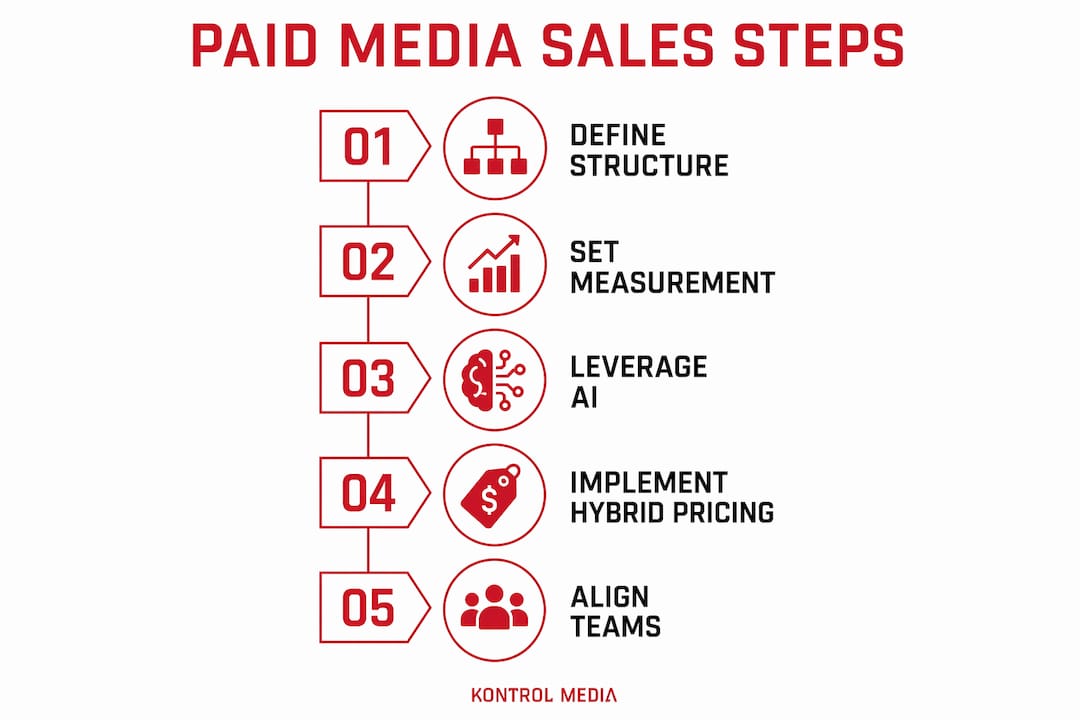
Once the sales structure is set, measurement becomes the central operational challenge. Last-click attribution systematically undercounts the contribution of upper-funnel channels. Incrementality testing through holdout groups is the most credible method for proving true ad impact. Conversion lift studies compare exposed audiences against control groups to isolate the actual sales effect. This methodology matters enormously when you are selling media to sophisticated brand advertisers who will ask hard questions about proof of performance.
Programmatic creative tools are changing how paid media campaigns scale. AI-driven programmatic creative generates dozens of ad variants without manual creator coordination, solving the bottleneck that kills creative refresh cycles. This is especially relevant for partnership ad programs where creative volume is the constraint on performance.
Hybrid pricing models add another layer of sophistication to media sales. A common structure layers a guaranteed CPM floor with performance-based clicks, rewarding media networks that have deep data and proven audiences. A base CPM of $3–$8 combined with a per-click fee of $0.20–$0.80 aligns publisher and advertiser incentives around actual engagement.
Pro Tip: When pitching hybrid pricing to brand advertisers, lead with the CPM floor as a risk-reduction mechanism. The performance component becomes a bonus they want to earn, not a fee they resent.
Aligning marketing and sales to hit revenue goals is the operational discipline that separates high-performing media networks from struggling ones. Retail media programs require coordinated efforts across ad operations, customer experience, and advertiser engagement. Without that coordination, revenue growth comes at the cost of user experience, which is a trade-off that destroys long-term value.
How can businesses optimize paid media sales partnerships with publishers and media networks?
The quality of your publisher and network partners determines the ceiling on your paid media performance. Selecting partners based solely on audience size is a mistake. Audience relevance, data transparency, and operational reliability matter more than raw reach.
Effective deal structuring in paid media partnerships starts with clarity on measurement. Both parties need to agree on what success looks like before a campaign launches. Measuring ROI across paid media campaigns requires shared definitions of attribution windows, conversion events, and reporting cadences. Ambiguity on these points creates disputes that damage relationships.
Creative freshness is a partnership responsibility, not just an advertiser one. Publishers and media networks that help advertisers refresh creative on schedule retain budgets longer. The brands that stay are the ones seeing results, and results require creative that does not wear out.
Transparency is the foundation of durable partnerships. Advertisers want to know where their ads ran, who saw them, and what happened next. Publishers that provide clean, auditable reporting build trust that translates into larger commitments and longer contracts.
Advertiser acquisition strategies for media networks also require executive sponsorship on both sides. Retail media networks that achieve maturity share one common trait: leadership alignment between the media network team and the core business. Without that alignment, the media business gets deprioritized every time the core business faces pressure.
Key Takeaways
Paid media sales requires first-party data, incrementality measurement, and aligned sales operations to generate sustainable revenue at scale.
| Point | Details |
|---|---|
| Partnership ads cut CPA | Partnership ad formats yield 25–40% lower CPA than standard brand ads by blending into user feeds. |
| Onsite retail media leads on margin | Onsite retail media delivers 70–90% margins because the retailer owns the inventory at near-zero cost. |
| Creative refresh is non-negotiable | Refreshing ad creatives every 7–10 days prevents fatigue and keeps customer acquisition costs from spiking. |
| Incrementality testing proves value | Holdout group testing separates true ad-driven sales from baseline conversions, which matters to sophisticated advertisers. |
| Operational alignment drives growth | Coordinating ad ops, merchant teams, and customer experience is what separates high-performing media programs from stalled ones. |
What I’ve learned about paid media sales that most playbooks miss
The honest truth about paid media sales in 2026 is that the bottleneck is rarely the channel or the budget. It is almost always the creative and the measurement. I have watched well-funded media programs stall because the advertiser ran the same three creative assets for four months and then blamed the platform when ROAS collapsed. The platform did not fail. The creative did.
The second thing most playbooks miss is the tension between brand ads and partnership ads. Brands want to run both, but they often treat them as separate programs with separate teams and separate budgets. The ones that win integrate them. Partnership ad creative informs brand ad creative. Brand ad data tells you which partnership formats are converting. When those two programs talk to each other, the whole system gets more efficient.
Fragmentation is the structural challenge that nobody has fully solved. A marketing executive managing paid media across search, social, CTV, retail media, and partnership placements is essentially running five different businesses with five different measurement frameworks. The temptation is to consolidate everything into one dashboard and call it done. The reality is that each channel has its own attribution logic, and forcing them into a single view creates false confidence.
What I find works is building a measurement hierarchy: incrementality testing at the program level, conversion lift studies at the campaign level, and last-click as a directional signal only. That structure gives you confidence in the big decisions without getting lost in the noise of daily metrics.
The future of paid media sales belongs to media owners who treat their ad business as a product, not an afterthought. That means investing in data infrastructure, building real sales relationships, and being honest with advertisers about what the numbers actually show.
— Mark Kapczynski
How Kontrol Media helps you build and scale media revenue
Scaling paid media sales is not a solo effort. It requires brand relationships, category expertise, and the operational discipline to turn ad inventory into consistent revenue.
Kontrol Media works as a rep firm and growth consultancy for publishers and retail media networks that are serious about building sustainable ad revenue. We bring long-standing brand relationships to the table, which shortens the sales cycle and opens doors that cold outreach rarely does. Our business strategy consulting work covers everything from pricing architecture and advertiser acquisition to sales team structure and measurement frameworks. If you are building or scaling a media network, or if your current paid media program is not generating the revenue it should, we can help you close that gap.
FAQ
What is paid media sales?
Paid media sales is the process of media owners selling advertising placements to brands and agencies across digital channels, using audience data and pricing models to generate revenue from their inventory.
How do retail media networks make money?
Retail media networks generate revenue through onsite ad formats like sponsored products and search, which carry margins of 70–90%, and through offsite audience extensions with margins of 20–40%.
What is incrementality testing in paid media?
Incrementality testing uses holdout groups to compare sales among audiences exposed to ads versus those who were not, isolating the true revenue impact of a paid media campaign beyond baseline conversions.
How often should paid media creatives be refreshed?
Refreshing ad creatives every 7–10 days prevents creative fatigue on high-frequency platforms like TikTok and Instagram Reels, keeping CPA from spiking as audiences become desensitized to repeated formats.
What is a hybrid CPM pricing model in media sales?
A hybrid CPM model combines a guaranteed base CPM floor with a per-click performance fee, aligning publisher and advertiser incentives around actual engagement rather than impressions alone.
Recommended
- Advertiser Acquisition Strategies for Media Networks in 2026 | Kontrol Media Consultancy
- Retail Media Ad Sales: Strategic Guide for Marketing Pros in 2026 | Kontrol Media Consultancy
- Media Buying in 2026: Strategies to Maximize Ad Spend | Kontrol Media Consultancy
- Ad Sales Strategies That Drive Real Revenue in 2026 | Kontrol Media Consultancy