


Business strategy consulting is the expert process of advising organizations to develop and execute effective strategies that improve performance and drive sustainable growth. Firms like Bain & Company and Strategy& have built entire practices around this discipline, and for good reason. Strategic consulting improves governance, financial discipline, and leadership alignment for long-term value creation. The difference between companies that scale and those that stall often comes down to whether leadership has access to objective, forward-looking guidance. Business strategy consulting provides exactly that.
What is business strategy consulting and how does it work?
Business strategy consulting is a professional service where external advisors work with organizational leadership to define direction, resolve performance gaps, and build plans for growth. The standard industry term for the broader discipline is “strategic advisory,” though business strategy consulting typically refers to the more structured, project-based engagement model. Both terms appear throughout the field, and understanding the distinction helps you choose the right kind of support.
External strategic advisors provide objective viewpoints that challenge internal assumptions, enabling a shift from short-term tactics to long-term growth. That objectivity is the spine of the service. Internal teams are too close to daily operations to see structural problems clearly. A skilled consultant walks in without the politics, reads the room, and tells you what your own team may be reluctant to say.
Strategic business advisory brings an impartial external perspective that is essential for objective business evaluation and sustainable growth planning. It helps identify inefficiencies, diversify revenue streams, and align operations across departments. For business leaders managing complexity at scale, that outside view is not a luxury. It is a structural advantage.
How does strategy consulting differ from other advisory services?
The distinctions between corporate strategy consulting, strategic advisory, and operational consulting matter more than most leaders realize. Choosing the wrong type of engagement wastes time and budget.
| Service Type | Primary Focus | Best Used When |
|---|---|---|
| Business strategy consulting | Long-term direction, growth planning, market positioning | Entering new markets, restructuring, scaling |
| Strategic advisory | Ongoing high-level decision support, capital allocation | Leadership transitions, board-level guidance |
| Operational consulting | Process efficiency, cost reduction, execution | Fixing broken workflows, reducing overhead |
| Management consulting | Broad organizational improvement | Large-scale transformation programs |
Senior strategic advisors offer confidential, high-level decision support that is distinct from operational roles like fractional CFOs. The relationship is ongoing and depends on trust built over time. This is not a project with a defined end date. It is a standing dialogue about where the business is going and what stands in the way.
Business growth consulting sits closer to the strategy consulting end of this spectrum. It focuses on identifying and executing specific growth levers, whether that means new customer segments, new channels, or new geographies. Operational consulting, by contrast, focuses on making existing processes run better. Both are valuable, but they answer different questions.
The clearest signal that you need strategy consulting rather than operational support is this: if you are not sure what to do, you need strategy. If you know what to do but cannot execute it well, you need operations.
What frameworks and tools do strategy consultants use?
The most effective consulting engagements in 2026 use a combination of proven frameworks and custom financial models built for the specific business. The days of pulling a generic SWOT analysis off the shelf and calling it a deliverable are over.

Generic frameworks like SWOT are less effective in volatile markets than bespoke 3-way financial modeling for cash flow management. Tailored approaches improve actionability and strategic foresight. A 3-way financial model integrates the income statement, balance sheet, and cash flow statement into a single dynamic tool. It lets leadership test assumptions, stress-test scenarios, and make capital allocation decisions with real numbers behind them.
In 2026, strategic advisory shifted from annual compliance reviews to proactive support emphasizing cash flow forecasting and 3-way financial modeling. Insolvency risks have reached multiyear highs, which means liquidity protection is now a front-line concern, not a back-office function. Consultants who understand this are building funded growth strategies, not just growth plans.
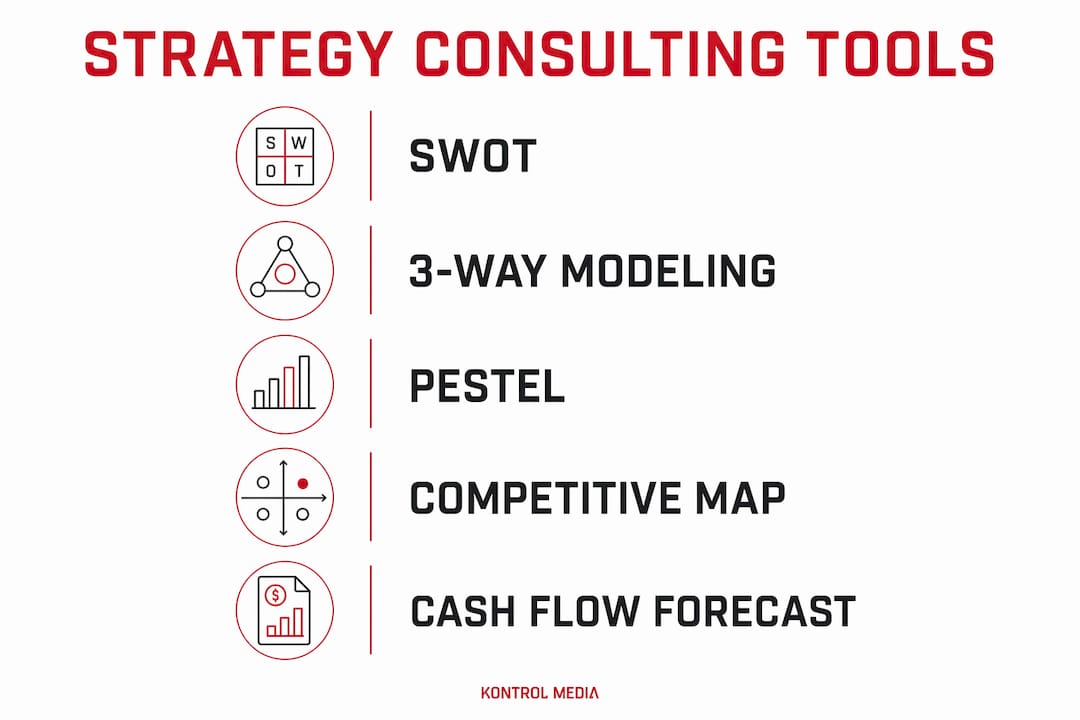
Beyond financial modeling, effective consultants use PESTEL analysis to map macro-level forces, competitive landscape mapping to identify positioning gaps, and leadership and cultural assessments to understand what the organization can actually execute. A brilliant strategy that the team cannot implement is not a strategy. It is a document.
Pro Tip: Before engaging any consulting firm, ask them to show you a sample deliverable from a comparable engagement. Generic slide decks with recycled frameworks are a red flag. You want to see bespoke analysis built around a real business problem.
The crafting of a comprehensive business strategy requires more than frameworks. It requires an honest assessment of leadership capacity, market timing, and financial runway. Consultants who skip that assessment tend to produce plans that look good in a boardroom and fail in the field.
What results does strategic consulting actually deliver?
The business case for strategy consulting is concrete and measurable. Poor succession planning in S&P 500 companies costs up to $1 trillion annually, but effective successions can increase valuations by 20–25%. That single data point reframes how leaders should think about consulting fees. The cost of not having expert guidance during a leadership transition dwarfs the cost of the engagement itself.
| Impact Area | Outcome |
|---|---|
| Succession planning | 20–25% valuation increase with effective execution |
| Leadership alignment | Faster decision-making and reduced internal conflict |
| Cash flow management | Improved liquidity and funded growth capacity |
| Market positioning | Clearer differentiation and stronger competitive defense |
| Change management | Higher adoption rates and reduced implementation risk |
“Strategic consulting enables organizations to move from reactive decision-making to proactive value creation. The firms that invest in this capability consistently outperform those that rely solely on internal judgment.” — ZRG Partners
Consulting also delivers results in areas that are harder to quantify but equally important. Leadership alignment, for example, determines whether a strategy gets executed or quietly shelved after the consultant leaves. Change management support during a major transformation reduces resistance and accelerates adoption. These are not soft benefits. They show up in revenue, retention, and market share.
Sustainable business growth requires more than a good plan. It requires the organizational capacity to execute that plan consistently over time. Strategy consultants who understand this build execution infrastructure alongside the strategy itself.
How do you choose and work with the right consulting firm?
Selecting the right consulting partner is a decision that deserves as much rigor as any major capital investment. The wrong fit costs you time, money, and organizational momentum.
- Define the problem first. Before you talk to any firm, write a one-page brief describing the specific challenge you need to solve. Vague mandates produce vague results.
- Evaluate industry depth. A firm with direct experience in your sector will compress the learning curve significantly. Ask for case examples from comparable businesses.
- Assess the integration approach. Find out how the firm works with internal teams. Do they embed with your people or operate separately? The answer matters more than the methodology.
- Check the cadence. Embedded consultants working on a 90-day cadence prevent change resistance and create sustainable transformation. Siloed consultants who isolate themselves from internal teams can sabotage implementation.
- Clarify deliverables and metrics. Every engagement should have defined milestones and measurable outcomes. If a firm cannot articulate what success looks like, walk away.
The embedded versus siloed distinction is worth dwelling on. A consultant who sits outside your organization, delivers a report, and disappears is providing a product. A consultant who works alongside your leadership team, attends key meetings, and adjusts recommendations based on real-time feedback is providing a service. The latter produces durable change. The former produces a document.
Data analytics plays an increasingly central role in how consultants diagnose problems and track progress. Firms that use first-party data to inform recommendations, rather than relying on industry benchmarks alone, deliver more precise and relevant guidance.
Pro Tip: Prioritize long-term advisory relationships over one-off projects wherever possible. A consultant who understands your business over multiple years builds institutional knowledge that a short-term engagement cannot replicate. The compounding value of that relationship is significant.
Key Takeaways
Effective business strategy consulting combines objective external perspective, bespoke financial modeling, and embedded execution support to deliver measurable, lasting organizational improvement.
| Point | Details |
|---|---|
| External objectivity drives value | Advisors challenge internal assumptions and shift focus from short-term tactics to long-term growth. |
| Bespoke models outperform generic frameworks | 3-way financial modeling and cash flow forecasting outperform SWOT in volatile markets. |
| Succession planning has direct financial impact | Effective successions can increase company valuations by 20–25% in S&P 500 contexts. |
| Embedded consultants produce lasting change | A 90-day integration cadence prevents change resistance and builds sustainable transformation. |
| Define the problem before hiring | A clear brief before engagement produces sharper recommendations and better outcomes. |
The consulting relationship most leaders underestimate
I have spent years watching organizations hire consultants and then wonder why nothing changed. The pattern is almost always the same. Leadership brings in a firm, receives a polished strategy document, and then returns to running the business exactly as before. The strategy sits in a shared drive. The problems persist.
What I have come to believe is that the consulting relationship itself is the product. The frameworks matter, but the real value is in the ongoing dialogue between an advisor who sees the business clearly and a leader who is willing to act on what they hear. That requires trust, and trust takes time to build.
The shift toward proactive, future-facing advisory reflects something real about the current economic environment. Volatility is not a temporary condition. It is the operating context. Leaders who treat strategic advice as an annual exercise are already behind. The organizations that are pulling ahead are the ones treating their consulting relationships the way they treat their best executive hires: as long-term investments in organizational capacity.
Generic advice is the enemy of real progress. The most valuable thing a consultant can do is tell you something specific, uncomfortable, and true about your business. That requires a relationship deep enough to earn that kind of candor. One-off engagements rarely get there.
If you are considering a consulting partnership in 2026, my honest recommendation is this: start with a defined problem, find a firm that will embed with your team, and commit to at least two full cycles before evaluating results. The compounding effect of sustained advisory engagement is where the real return lives.
— Mark Kapczynski
How Kontrol Media approaches business strategy for growth
Kontrol Media works with business leaders who need more than a strategy document. The focus is on hands-on execution across sales, marketing, and business development, with tailored approaches built for each client’s specific stage and market.
Clients like Experian, BuzzFeed, REMAX, and West Monroe have worked with Kontrol Media to address market entry challenges, misaligned marketing strategies, and growth stalls. The work spans private equity portfolio companies, middle market public companies, and large enterprises. If you are ready to move from planning to execution, the key elements of a business strategy are a strong starting point. For a deeper conversation about your specific situation, connect with the Kontrol Media team directly.
FAQ
What is business strategy consulting?
Business strategy consulting is a professional service where external advisors help organizations define direction, close performance gaps, and build plans for sustainable growth. It combines objective analysis with tailored recommendations to improve leadership alignment and market positioning.
How is strategy consulting different from management consulting?
Strategy consulting focuses on long-term direction and growth planning, while management consulting addresses broader organizational improvement including processes and structure. The two often overlap, but strategy consulting is more focused on what to do, and management consulting on how to operate.
What does a 90-day consulting cadence mean?
A 90-day cadence means consultants work in structured cycles with internal teams, reviewing progress and adjusting strategy every quarter. This embedded approach prevents change resistance and produces more durable results than one-off project engagements.
Why do companies use external strategy consultants instead of internal teams?
External consultants provide objective viewpoints that internal teams cannot, because internal leaders are too close to daily operations to challenge core assumptions effectively. That impartiality is the primary reason companies bring in outside strategic business advice during critical decisions.
How do I know if my business needs strategy consulting?
If your leadership team disagrees on priorities, growth has stalled without a clear cause, or you are entering a new market or transition phase, strategy consulting is the right call. The clearest signal is uncertainty about what to do, not just how to do it.
Recommended
- Navigating Uncertainty: Creating a Resilient Business Strategy | Kontrol Media Consultancy
- Unlocking Business Potential: Strategic Marketing and Consulting for Growth | Kontrol Media Consultancy
- Maximizing Business Growth: Strategies for Success | Kontrol Media Consultancy
- 5 Key Elements to Include in Your Business Strategy for Success | Kontrol Media Consultancy