


Ad operations is defined as the end-to-end process of planning, trafficking, delivering, and optimizing paid media campaigns across digital and traditional channels. It is the function that sits at the intersection of sales, finance, and media execution, and when it works well, it is the single biggest driver of billing accuracy and revenue predictability in any media organization. Most marketing teams underestimate it. The ones that get it right treat it as a revenue engine, not a back-office task. This guide breaks down the core components, workflow best practices, emerging trends, and the metrics that actually matter for decision-makers who want results.
What are the key components of ad operations management?
Ad operations serves as the backbone of scalable, data-driven advertising, ensuring campaign onboarding, event tracking, and alignment between sales, ad ops, and finance all happen without gaps. The formal industry term for this discipline is “advertising operations,” though “ad ops” is the shorthand used across every level of the media business. Understanding what the function actually covers is the first step to improving it.
Campaign trafficking, creative QA, delivery monitoring, troubleshooting, reporting, and optimization comprise the core stages of advertising operations management. Each stage is a checkpoint. Miss one, and you risk under-delivery, billing disputes, or wasted impressions that never get recovered.

The infrastructure underneath these stages matters just as much as the people running them. Modern advertising operations integrate Order Management Systems with revenue management platforms to create a single source of truth. That integration enables predictive analytics that improve forecasting accuracy and reduce the manual reconciliation that kills team productivity.
| Ad ops function | Primary purpose |
|---|---|
| Campaign trafficking | Uploading and configuring creatives in the ad server |
| Creative QA | Verifying specs, tracking pixels, and load performance |
| Delivery monitoring | Tracking pacing against contracted impressions or clicks |
| Billing reconciliation | Matching delivered data to invoicing for revenue accuracy |
| Performance reporting | Surfacing insights to sales and clients on campaign results |
Pro Tip: Document every workflow, even the ones that feel obvious. Teams that treat documentation as a competitive asset, not a chore, reduce onboarding time and eliminate the single-point-of-failure problem that plagues most ad ops departments.
How to structure workflows to reduce revenue leakage
Workflow structure is where most digital advertising management efforts either succeed or collapse. The goal is not just speed. The goal is accuracy at scale, because inaccurate delivery data flows directly into billing errors, and billing errors are revenue leakage in its most preventable form.
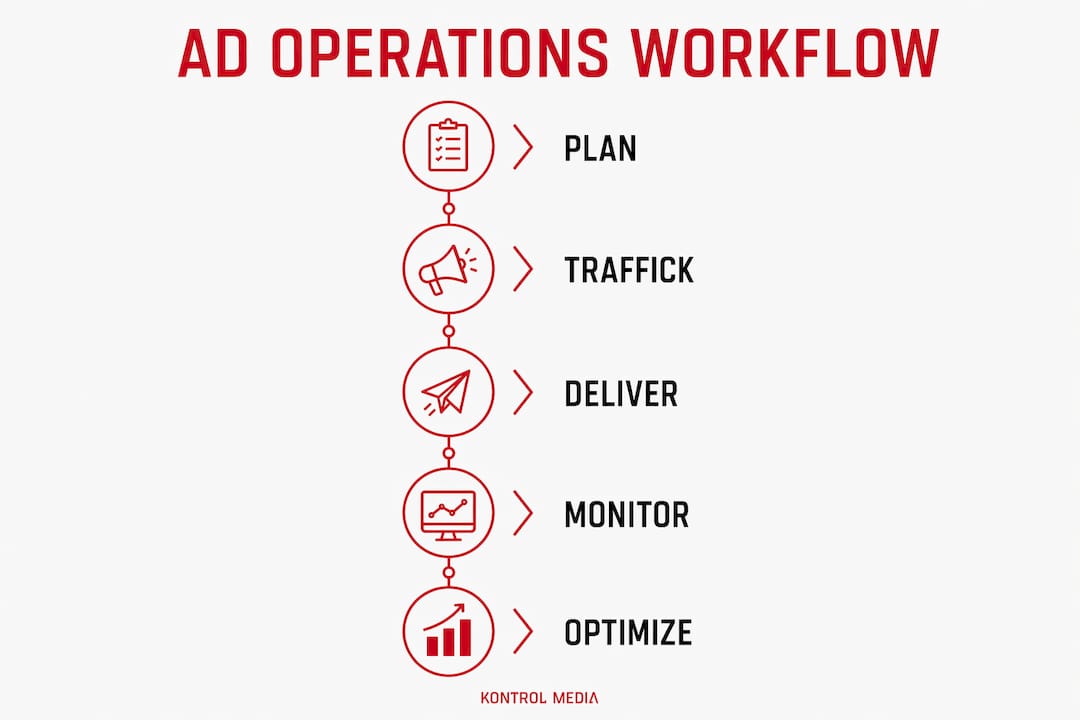
Teams that digitize and document core ad ops workflows can increase revenue per employee by up to 42% and reduce operational costs by minimizing errors and onboarding time. That number reflects what happens when process replaces tribal knowledge. It also reflects what you lose every month you delay the transition.
Efficiency gains in advertising operations come more from cross-functional collaboration and a continuous improvement culture than from adding automation tools alone. Automation without alignment just moves problems faster. The structure below addresses both.
- Audit your current state. Map every handoff between sales, ad ops, and finance. Identify where data lives in spreadsheets, email threads, or individual memory.
- Centralize your order data. Move campaign details into a shared OMS that all three teams can access in real time.
- Standardize trafficking templates. Create approved creative spec sheets and trafficking checklists that remove ambiguity from every campaign launch.
- Automate delivery alerts. Set pacing thresholds that trigger notifications before under-delivery becomes a billing problem.
- Align billing milestones with delivery data. Connect your ad server reporting directly to your finance system so invoices reflect actual delivery, not estimates.
- Run weekly cross-functional reviews. Sales, ad ops, and finance should share one dashboard and one set of numbers. Separate reports create separate realities.
Pro Tip: The most expensive conversation in any media company is the one between ad ops and finance at month-end when the numbers don’t match. Build the process so that conversation never needs to happen.
Aligning advertising operations metrics with finance KPIs prevents revenue leakage and enables timely, accurate billing. This is not a technical recommendation. It is a revenue protection strategy. If your ad ops team reports to a technology function rather than a revenue function, that reporting structure is costing you money.
Applying process improvement methodologies like Lean Six Sigma to ad ops workflows gives teams a structured framework for identifying waste, reducing cycle times, and building repeatable quality into every campaign launch.
What emerging trends are reshaping ad operations in 2026?
The ad tech ecosystem is moving fast, and the organizations that treat advertising operations as a static back-office function will feel that speed as disruption rather than opportunity. Several forces are reshaping how ad ops teams work right now.
AI-driven automation is reducing manual processes in advertising operations, bridging gaps between sales, ad ops, and finance, and enabling deeper operational intelligence. This is not theoretical. Teams using AI-powered pacing tools are catching delivery shortfalls days earlier than teams relying on manual checks.
The major trends defining ad ops in 2026:
- Privacy-first data governance. Workflows built with privacy-first principles improve data quality, reduce operational slowdowns, and create more reliable revenue performance. First-party data strategies are now a workflow requirement, not a marketing preference.
- Unified platform adoption. The shift toward a single platform connecting sales, ad ops, and finance eliminates the version-control problems that create billing disputes.
- Predictive analytics integration. OMS platforms with built-in forecasting allow revenue leaders to model inventory availability and pricing before campaigns are even sold.
- Non-digital channel resurgence. Print, out-of-home, and audio are returning to media plans. Ad ops teams need workflows that handle multi-channel delivery tracking, not just digital impressions.
- Real-time reporting expectations. Advertisers now expect campaign dashboards, not weekly PDFs. Ad ops infrastructure must support live data access.
Media organizations investing in unified, intelligence-driven ad ops systems position themselves to grow through channel fragmentation rather than be slowed by it. The organizations still running campaigns through disconnected point solutions are accumulating technical debt that compounds every quarter.
How do you measure the impact of optimized ad operations?
Measurement is where advertising operations strategies either prove their value or disappear into a spreadsheet nobody reads. The metrics that matter are the ones tied directly to revenue outcomes, not just technical delivery.
Treating ad ops metrics as finance-aligned KPIs, rather than solely technical indicators, is the difference between a team that prevents revenue loss and one that reports it after the fact. The role of data analytics in this context is to connect operational signals to business outcomes in real time.
| Metric | What it measures | Revenue impact |
|---|---|---|
| Delivery accuracy | Actual vs. contracted impressions | Directly affects billing completeness |
| Pacing rate | Daily delivery vs. target schedule | Prevents under-delivery and makegoods |
| Inventory utilization | Sold vs. available inventory | Identifies unsold revenue opportunity |
| Forecast variance | Projected vs. actual revenue | Improves sales planning accuracy |
| Billing readiness | Campaigns cleared for invoicing | Reduces days-sales-outstanding |
Integrated dashboards that link ad ops data to billing and finance systems are the infrastructure behind these metrics. Without that integration, each team is working from a different version of the truth, and discrepancies compound into disputes. Review these metrics weekly at the operational level and monthly at the leadership level. Quarterly reviews alone are too slow to catch pacing problems before they become billing problems.
The ad sales strategies that generate the most revenue are the ones backed by ad ops data that sales teams can actually trust. When delivery data is clean and current, sales can price inventory accurately, make confident commitments to advertisers, and close deals faster.
Key Takeaways
Effective ad operations is the foundation of billing accuracy, revenue predictability, and campaign performance at scale, and it requires workflow discipline, cross-functional alignment, and finance-connected metrics to deliver results.
| Point | Details |
|---|---|
| Define the full scope | Ad ops covers trafficking, QA, delivery, billing, and reporting, not just campaign setup. |
| Digitize and document workflows | Documented processes can increase revenue per employee by up to 42% and reduce costly errors. |
| Align metrics with finance | Delivery accuracy and forecast variance must connect to billing KPIs to prevent revenue leakage. |
| Adopt unified platforms | A single OMS connected to revenue management eliminates data silos and billing disputes. |
| Treat ad ops as a revenue function | Teams that report ad ops to revenue leadership outperform those that treat it as a technical support role. |
Ad ops is not a support function. It never was.
I have worked with media organizations at every stage of maturity, from early-stage digital publishers to large enterprise media networks, and the pattern is consistent. The teams that struggle with revenue predictability almost always have the same root cause: ad ops is treated as the team that “sets up the campaigns” rather than the team that protects the revenue.
That framing is expensive. When ad ops sits downstream of every decision, with no seat at the revenue planning table, you get billing disputes, makegoods, and forecast variance that nobody can explain. I have seen finance teams spend weeks reconciling numbers that should have matched on day one, simply because the ad ops workflow was never connected to the billing system.
The cultural shift that actually moves the needle is simple to describe and hard to execute. Ad ops leaders need to speak the language of revenue, not just delivery. That means knowing what a 5% pacing shortfall costs in billing terms, not just in impression terms. It means showing up to sales forecasting meetings with data, not just to trafficking reviews with creative specs.
The teams I have seen get this right share one habit: they treat every workflow decision as a revenue decision. Documentation is not administrative overhead. It is the mechanism that lets a new team member execute a campaign correctly on day one without asking three people for help. Automation is not a cost-cutting measure. It is what frees your best ad ops people to focus on the exceptions that actually require judgment.
The advertiser acquisition strategies that scale are the ones built on an ad ops foundation that can actually deliver what sales promises. Get the operations right first. The revenue follows.
— Mark Kapczynski
How Kontrol Media helps you build ad operations that drive revenue
Kontrol Media works with media organizations, retail media networks, and enterprise brands to build advertising operations that connect directly to revenue outcomes. The work is hands-on: from workflow audits and OMS integration to cross-functional alignment between sales, ad ops, and finance.
If your team is dealing with billing disputes, pacing shortfalls, or forecast variance that nobody can explain, those are symptoms of an ad ops structure that needs rebuilding, not patching. Kontrol Media’s business and marketing services are designed for organizations ready to treat advertising operations as a growth function. For teams building or scaling a retail or commerce media network, the retail media network guide is a practical starting point for understanding how ad ops fits into the larger revenue architecture.
FAQ
What is ad operations in digital advertising?
Ad operations is the end-to-end process of trafficking, delivering, monitoring, and optimizing paid media campaigns. It connects sales commitments to actual campaign execution and billing outcomes.
How does ad ops affect revenue?
Poor ad operations causes delivery shortfalls, billing errors, and forecast inaccuracies that directly reduce revenue. Teams that align ad ops metrics with finance KPIs prevent revenue leakage before it occurs.
What metrics should ad ops teams track?
Delivery accuracy, pacing rate, inventory utilization, forecast variance, and billing readiness are the core metrics. Each one connects operational performance to a specific revenue or billing outcome.
How does automation improve advertising operations?
AI-driven automation reduces manual trafficking work, catches pacing issues earlier, and bridges data gaps between sales, ad ops, and finance. It works best when paired with strong cross-functional communication and documented workflows.
What is an Order Management System in ad ops?
An Order Management System, or OMS, is the platform that centralizes campaign data across sales, ad ops, and finance. When integrated with a revenue management platform, it creates a single source of truth that eliminates billing disputes and improves forecasting accuracy.
Recommended
- Ad Sales Strategies That Drive Real Revenue in 2026 | Kontrol Media Consultancy
- Advertiser Acquisition Strategies for Media Networks in 2026 | Kontrol Media Consultancy
- Retail Media Ad Sales: Strategic Guide for Marketing Pros in 2026 | Kontrol Media Consultancy
- Align Marketing and Sales to Hit Revenue Goals | Kontrol Media Consultancy