


Reaching new-to-brand customers in retail media comes down to three decisions: define “new” the same way your retail partners do, buy the full path from discovery to purchase rather than only the bottom of the funnel, and measure whether those buyers were incremental or would have shown up anyway. Most programs get the first wrong, half-do the second and skip the third. We build and operate retail and commerce media networks, and the gap between a campaign that reports new customers and one that creates them is almost always in those three decisions.
TL;DR
- New-to-brand (NTB) means a shopper who has not bought your brand from that retailer in a set lookback window, commonly 12 months, so every network’s number depends on its definition.
- Combine onsite sponsored formats with offsite media. Walmart Connect reports that advertisers using Sponsored Products, Sponsored Brands and Sponsored Videos together saw a 135% year-over-year increase in NTB sales versus Sponsored Products alone.
- Target category buyers, competitive purchasers and lapsed customers, not only your own past buyers.
- Treat NTB percentage as a starting point and validate with test-and-control incrementality before you scale budget.
- Retailers that want brands to spend need clean definitions, offsite reach and credible measurement. That is network design work, and it can be done once and operated well.
Table of Contents
- What new-to-brand actually means
- Start with the audience you want to win
- Combine onsite and offsite placements
- Match creative and offer to the stage of the shopper
- Prove the customers are incremental
- Compare networks on the same terms
- A note on new homeowners and movers
- For retailers: the network is the product
- How Kontrol Media helps
- Our perspective
- FAQ
- Sources
What new-to-brand actually means
New-to-brand is a reporting label applied after a sale is attributed to an ad. The retailer checks the shopper’s purchase history, and if there is no prior purchase of your brand inside the lookback window, the order counts as new. The widely used window is 12 months, and as one retail media reference explains, Amazon introduced the label in 2019 on the basis that the shopper had not bought the brand on Amazon in the previous 12 months.
Two details change what the number means for you. First, the unit is the brand, not the product. A loyal buyer of your shampoo who tries your conditioner is new to the product line but not new to the brand, and some networks count it one way and some the other. Second, the retailer only sees its own sales. A customer who buys you every month at a competing grocer, or on your own website, can be “new” at the retailer you are testing. That is still useful, because it is new to that retailer’s shelf, but it is not the same as winning a household you never had.
The Association of National Advertisers has tried to settle this. Its retail media measurement framework, reported by the Path to Purchase Institute in August 2026, recommends a common 52-week definition for “new to” customers and a 14-day attribution lookback, along with baseline metrics such as impressions, viewability, clicks and invalid traffic. The same report found 55% of surveyed advertisers named the lack of standardization as their top barrier. Until networks converge, the practical rule is simple: write down each network’s definition before you compare results.
Start with the audience you want to win
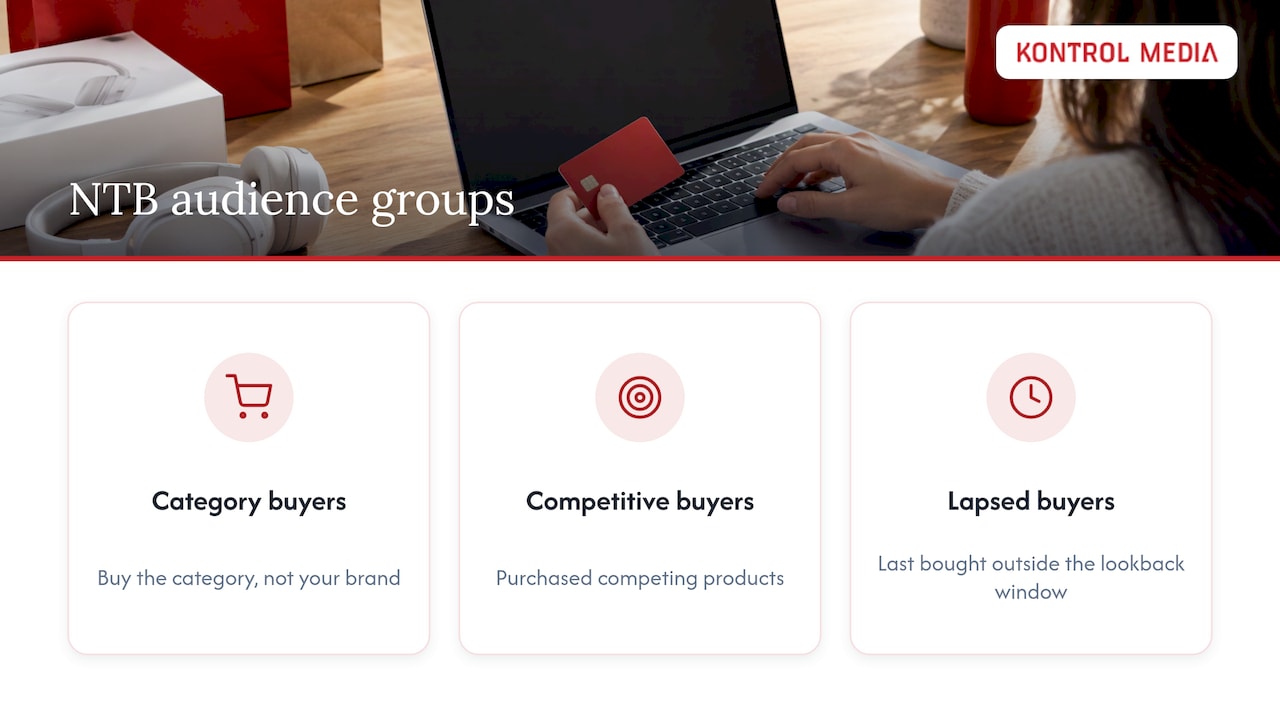
NTB reach begins with who you target. If your audience is built from your own buyers, you will mostly find people who already know you. To find the shoppers you have not met, you need three groups.
The first is category buyers: people who buy in your category but not your brand. They have proven demand, and you only need to win the choice. The second is purchasers of competing products, which is the retail media version of conquesting. The third is lapsed customers who last bought outside the lookback window. Walmart Connect describes this same trio, saying brands can use first-party data-led targeting to find category buyers, competitive purchasers or lapsed customers and engage them from discovery to purchase.
The retailer’s first-party data, meaning the purchase records it collects directly from shoppers, is what makes this credible. A retailer can see what people actually bought, not what they said they intended to buy. If you want a step-by-step on turning that data into campaigns, our audience data activation playbook walks through it.
A practical tip: build separate audiences for each of the three groups and give each its own creative and budget line. Blending them hides which group is producing the new buyers, and the answer usually differs by category.
Combine onsite and offsite placements
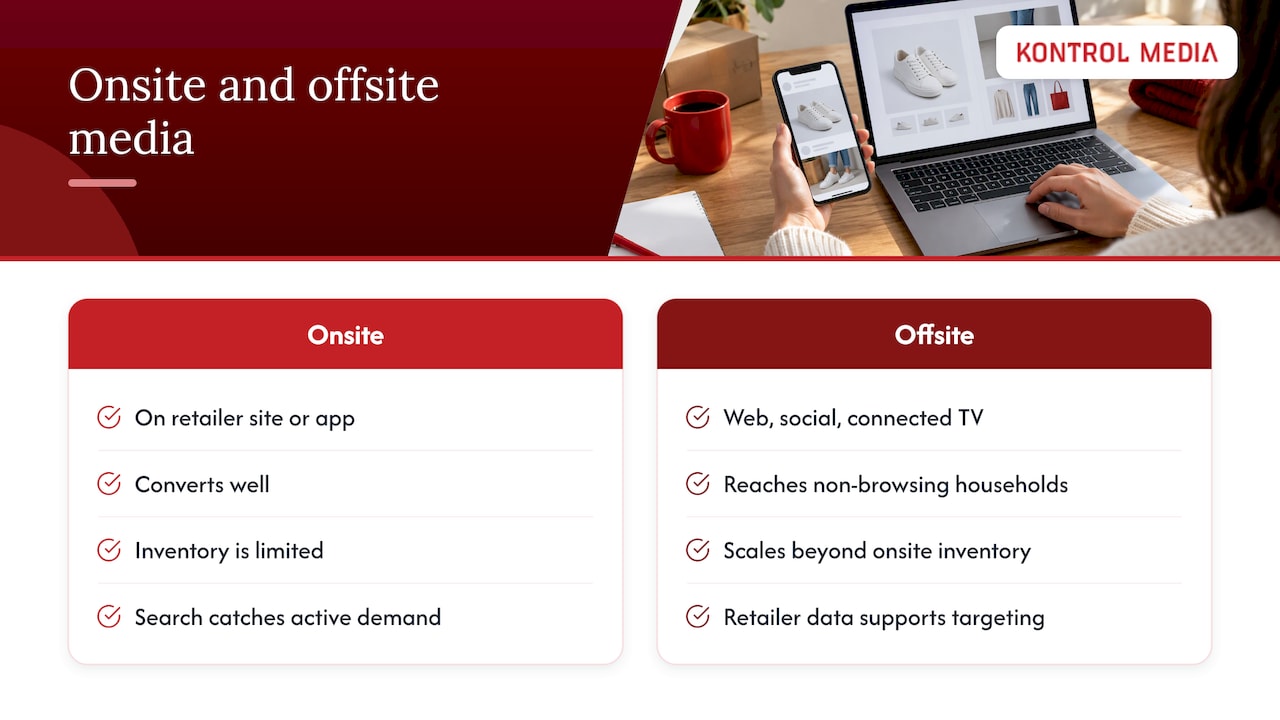
Onsite ads reach shoppers who are already on the retailer’s site or app. They convert well, but the space is limited, and sponsored search mostly catches people who are already searching for a product type. To reach households that are not browsing your category at that moment, you need offsite media.
The IAB’s Retail Media Buyer’s Guide from July 2023 explains that offsite channels, including web, app, display, social, connected TV, audio, digital video, digital out-of-home and in-game, let brands scale beyond limited onsite inventory, reach new households and run conquesting campaigns, while still drawing on the retailer’s first-party data for targeting and closed-loop measurement. Closed loop means the retailer can connect the ad exposure to a purchase in its own records.
The evidence for mixing formats is consistent. Beyond the 135% figure above, which Walmart Connect reports for the period February 2024 through January 2025, consider a coordinated food-delivery campaign. DoorDash’s case study of Magnum Ice Cream, published in June 2026, combined connected TV, YouTube, paid social, email and onsite sponsored placements and reported 85% period-over-period growth in new consumers, with a significant share coming from shoppers new to the category. That is a company case study, so read it as an illustration of the approach and not a benchmark for your budget.
Our view on sequencing is to prove onsite return first, then expand. The logic is laid out in our guide to proving onsite ROAS before scaling offsite. Onsite gives you a clean baseline, and offsite then has something to be compared against.
Match creative and offer to the stage of the shopper
A shopper who has never bought your brand needs a reason to switch, and the reason differs by audience. A category buyer needs a clear difference. A competitive buyer may need a reason to try, such as a trial size, a bundle or a price point that makes the first purchase low risk. A lapsed customer needs a reminder of why they liked you.
The Kraft Heinz Philadelphia Cream Cheese campaign shows how this plays out. In a Walmart Connect case study covering April 28 to June 9, 2025, onsite and offsite display delivered 23% new-to-brand buyers and a 7.8% display incrementality figure, with $22.43 of return per ad-exposed dollar, while TikTok-only ads returned $11.38. Here, new-to-brand buyers were defined as shoppers who had not purchased the featured items in the prior 12 months. The takeaway is not the specific numbers but the structure: a single seasonal theme, carried across placements, with each placement judged on its own return.
Three creative habits tend to help NTB campaigns:
Lead with the product’s job, not your brand history, because the shopper does not yet care about your story. Use the retailer’s own context, such as a recipe, a room or an occasion, so the ad feels native to where the shopper is buying. And make the first-purchase path short, with a product detail page that is ready to convert: reviews, accurate content and stock on hand.
Prove the customers are incremental
This is where most programs lose credibility with their CFO. A high NTB percentage does not prove your ads created those customers. Some of them would have bought you anyway, and the network’s attribution will still credit the campaign.
Incrementality testing answers that. It compares an exposed group with a control group that did not see the ad, and measures the difference in sales. Albertsons Media Collective’s onsite incrementality measurement uses test-and-control frameworks to isolate media’s causal impact from purchases that would have happened regardless. In the example it cites, an S. Martinelli & Co. campaign showed $7.45 incremental ROAS, 65% new-to-brand buyers and a 33% sales lift.
Method matters more than most buyers expect. The same announcement cites research from Albertsons Media Collective, Ovative and Northwestern University’s Kellogg School of Management finding that incremental ROAS can vary by 6.5 times, and flip the result in 83% of campaigns, depending on measurement methodology alone. If you compare two networks without comparing their methods, you are comparing two different rulers.
The ANA framework adds a few guardrails: independent third-party measurement where possible, and context such as product and category sales, inventory, pricing and basket size, so a stockout or a price cut is not mistaken for ad performance. We cover the mechanics in our pieces on incrementality in retail media and iROAS measurement, and the wider scorecard in our key metrics guide.
Compare networks on the same terms
If you run campaigns across several networks, build a one-page comparison before the first dollar is spent. Ask each network the same five questions, drawn from the issues the ANA framework and industry writing flag: what lookback window defines new, whether new is measured at brand or product-line level, whether in-store purchases are counted or only digital ones, whether view-through conversions earn credit, and what attribution window applies.
Store purchases deserve special attention. McKinsey’s March 2026 commerce media report finds that 47% of advertisers now use in-store advertising, up from 35% the prior year, yet nearly eight in ten find it at least moderately difficult to bring in-store results into network reporting. Only 3% say networks measure audience incrementality very accurately. Half say better measurement would unlock more investment. That is a clear signal that brands want proof and will pay for networks that provide it.
A note on new homeowners and movers
Some of the most valuable NTB moments happen outside the retailer’s walls. A household that has just bought a home resets its brand choices across categories from mattresses to appliances to financial services. If your brand sells into that moment, the real estate channel reaches buyers before and as they move. Our guide to three-touch new homeowner marketing shows how brands approach the first 30 to 90 days after a purchase.
For retailers: the network is the product
If you are a retailer, the NTB question flips. Brands will spend where they can reach new buyers and prove it. That means your network needs clean definitions, offsite reach beyond your own pages and measurement that a finance team will accept. McKinsey’s team observes that omnichannel activation is now a core requirement as networks evolve into full-stack partners, and that linking offline and online campaigns and measuring how placements influence purchases remains the hardest execution problem. Targeting, measurement and attribution were rated very important by 45% of buyers.
The decision to build or buy the technology underneath comes first, and we lay out our reasoning in the build versus buy verdict. Once the network exists, winning advertisers is its own discipline, covered in our guide to advertiser acquisition for media networks.
How Kontrol Media helps
Kontrol Media works on both sides of this problem. For retailers and consumer businesses, we stand up retail and commerce media networks and handle retail media network operations. For CMOs and PE portfolio companies, we provide business and marketing strategy along with execution across sales, marketing and business development, so the plan does not stall between the deck and the launch. Our client list includes Experian, BuzzFeed, HuffPost and REMAX.
If you are planning a network or a new-to-brand push, you can see the full range on our services page.
Our perspective
I have sat on both sides of this table, and the pattern repeats. A brand asks for new customers, the network delivers a report with a healthy new-to-brand percentage, and everyone is pleased until someone asks what would have happened without the spend.
We think the fix is operational rather than clever. Agree the definition before the campaign, build audiences around people who have never bought you, give offsite media a real role beside onsite, and run a test-and-control read before you scale. None of that is glamorous, but it is the spine of a program a CFO will keep funding.
For retailers, the same discipline is the product. Networks that make definitions transparent and measurement credible earn bigger budgets, and that is the work we do when we build and run them alongside the teams that own the shelf, the data and the advertiser relationships.
Mark Kapczynski
FAQ
What counts as a new-to-brand customer?
A shopper who has not bought your brand from that retailer inside a set lookback window, most often 12 months. The ANA framework recommends a common 52-week definition. Always confirm whether a network counts at brand or product-line level.
Is a high new-to-brand percentage proof that my ads worked?
No. It shows who bought after seeing an ad, not who bought because of it. Test-and-control incrementality measurement separates the two, and the method you choose can change results substantially.
Should I use onsite or offsite retail media to find new customers?
Use both, in order. Prove return onsite first, then add offsite channels to reach households that are not currently searching your category. Walmart Connect reports stronger NTB sales growth when sponsored formats are combined.
How long should the lookback window be?
Twelve months is the common convention, and the ANA recommends 52 weeks for “new to” definitions with a 14-day attribution lookback. Whatever you choose, apply it consistently so networks can be compared.
Sources
- New-to-brand reference on Amazon’s 12-month definition
- ANA retail media measurement framework, Path to Purchase Institute
- Walmart Connect: Acquire new customers
- IAB Retail Media Buyer’s Guide, July 2023
- DoorDash Ads: Magnum Ice Cream case study
- Walmart Connect: Kraft Heinz case study
- Albertsons Media Collective onsite incrementality measurement
- McKinsey: Commerce media at an inflection point