


The cost of a retail media network depends on which side of it you sit on. A brand buying ads pays per click, per thousand impressions or a flat fee for a slot, and in 2026 most sponsored product clicks land between about $0.60 and $1.60, with display CPMs mostly in the $7 to $22 range. A retailer building its own network pays in technology, people, data and measurement, and that bill runs well into six figures before the first advertiser shows up. Below, I break down both, with the numbers we see and the ones published in the market.
TL;DR
- Brands pay on one of three models: cost per click for sponsored products, CPM for display, video and offsite, and a fixed fee for takeovers and in-store screens.
- Recent benchmarks put sponsored product CPCs at roughly $0.62 to $1.60 on the major networks, and onsite display CPMs at roughly $7 to $22.
- Entry points vary widely: some self-serve sponsored ads start around $10 a day, while managed programmatic and display flights start in the tens of thousands of dollars.
- Raw CPM is the wrong yardstick. Judge cost against incrementality, not clicks or headline ROAS.
- For retailers, the largest costs are technology, people, measurement and the months of delay before revenue, which is why build versus buy is the first budget decision.
Table of Contents
- How retail media pricing works
- What brands pay: CPC and CPM benchmarks
- Minimum budgets: what it takes to get in the door
- Why the same click costs more on one network than another
- Is the cost worth it? Measure incrementality, not CPM
- What it costs a retailer to run its own network
- Perspective
- Work with a team that has run these networks
- FAQ
- Sources
How retail media pricing works
Before comparing numbers, it helps to know that the price you pay is mostly set by the format, not by negotiation. Most networks sell on three models:
- Auction priced per click. Sponsored product listings in search and category pages. You bid against other brands for a keyword or placement and pay when a shopper clicks.
- Auction or reserved priced per thousand impressions (CPM). Onsite display, video and offsite placements. Some networks run these as an open auction, others reserve them for brands buying against a commitment.
- Fixed fee. Homepage takeovers, category sponsorships and most in-store screen inventory. You buy a slot for a period, with the highest minimums and the longest lead times.
Offsite media is its own case. The IAB’s buyer’s guide notes that retail media networks in the U.S. sell offsite media on a CPM basis, and that retailers often recommend test budgets that depend on the channel and audience size. That is a useful reminder that a retailer’s offsite price often bundles several things: the media itself, the retailer’s audience data and sometimes a managed service fee. When two quotes look far apart, check which of those layers each one includes.
What brands pay: CPC and CPM benchmarks
A caveat I give every client: retail media prices are auction prices, so they move with season, category and competition. Treat the figures below as a planning range, then confirm against the network’s current rate card or your account rep.
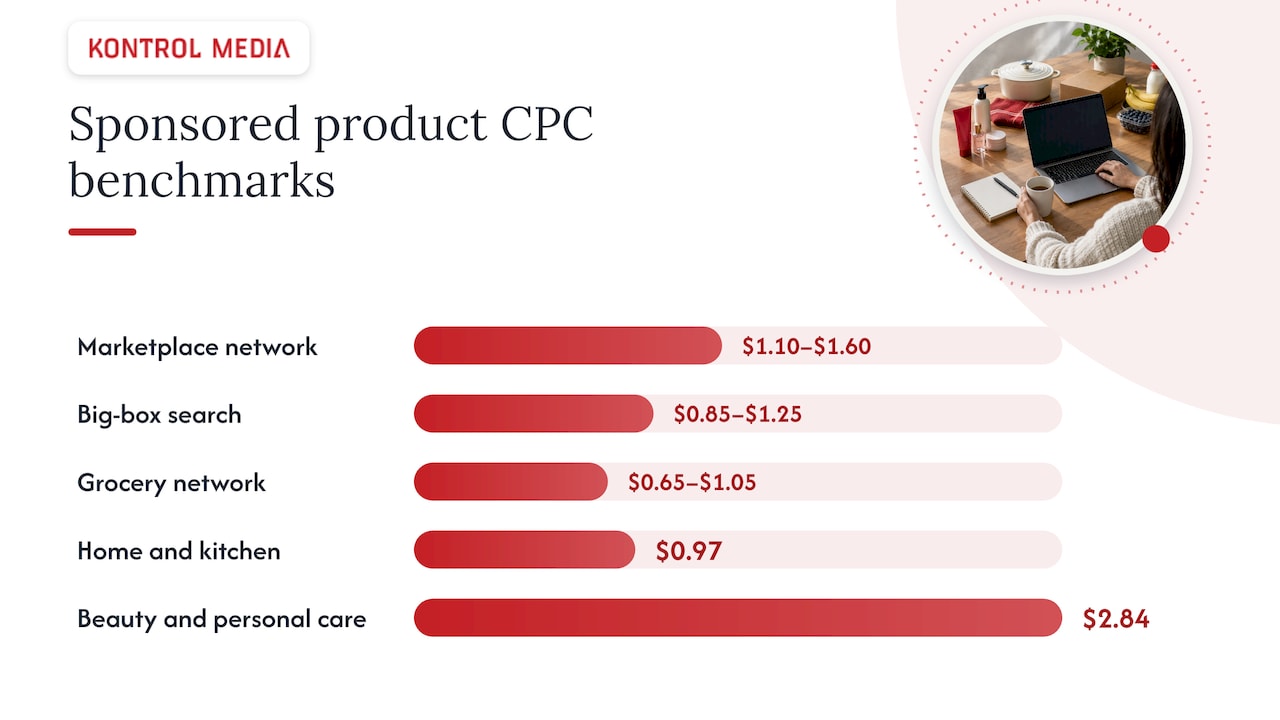
For sponsored product clicks, 2026 benchmark roundups put the largest marketplace network at roughly $1.10 to $1.60 per click, a big-box retailer’s sponsored search at $0.85 to $1.25, and a grocery delivery network at $0.65 to $1.05. Category matters more than most brands expect. Q2 2026 data shows marketplace sponsored product CPCs ranging from $0.97 in home and kitchen to $2.84 in beauty and personal care, and competitive categories such as supplements and baby products can pass $3.50 in peak periods. The same source puts a grocery delivery network’s self-serve featured product ads at about $0.62 per click across categories in the first half of 2026.
For display and video, the picture looks like this:
| Format | Typical 2026 CPM range | Notes |
|---|---|---|
| Offsite display and video through a marketplace DSP | $6 to $14 | Programmatic, reaches shoppers off the retailer’s site |
| Big-box retailer onsite display | $7 to $14 | Lower competition than the largest marketplace |
| Mass-merchant onsite display | $9 to $16 | Premium audience in home and general merchandise |
| National grocer onsite plus offsite | $10 to $22 | Loyalty-card data drives the premium |
| Drugstore and electronics onsite display | $8 to $18 | Narrower inventory |
| Grocery delivery display and shoppable video | $8 to $15 | Higher floors than self-serve sponsored ads |
The first five rows come from the CMO Mag 2026 benchmark and the last from the Online Store News comparison. Premium formats cost more. A Digiday report from 2024 cited CTV at around $33 CPM and a wide overall retail media CPM spread of $25 to $65 depending on media type and network, which shows how far a premium video buy can sit from a sponsored product click.
Prices also drift over time, and not always in the same direction on every network. In a mid-2021 snapshot, marketplace sponsored product CPCs rose 36% year over year to $1.22 while a big-box network’s fell 13% to $1.13. Five years on, the ranges above are in broadly the same neighborhood, but the spread between categories has widened.
Minimum budgets: what it takes to get in the door
CPC and CPM tell you the unit price. Minimums tell you whether you can play at all.
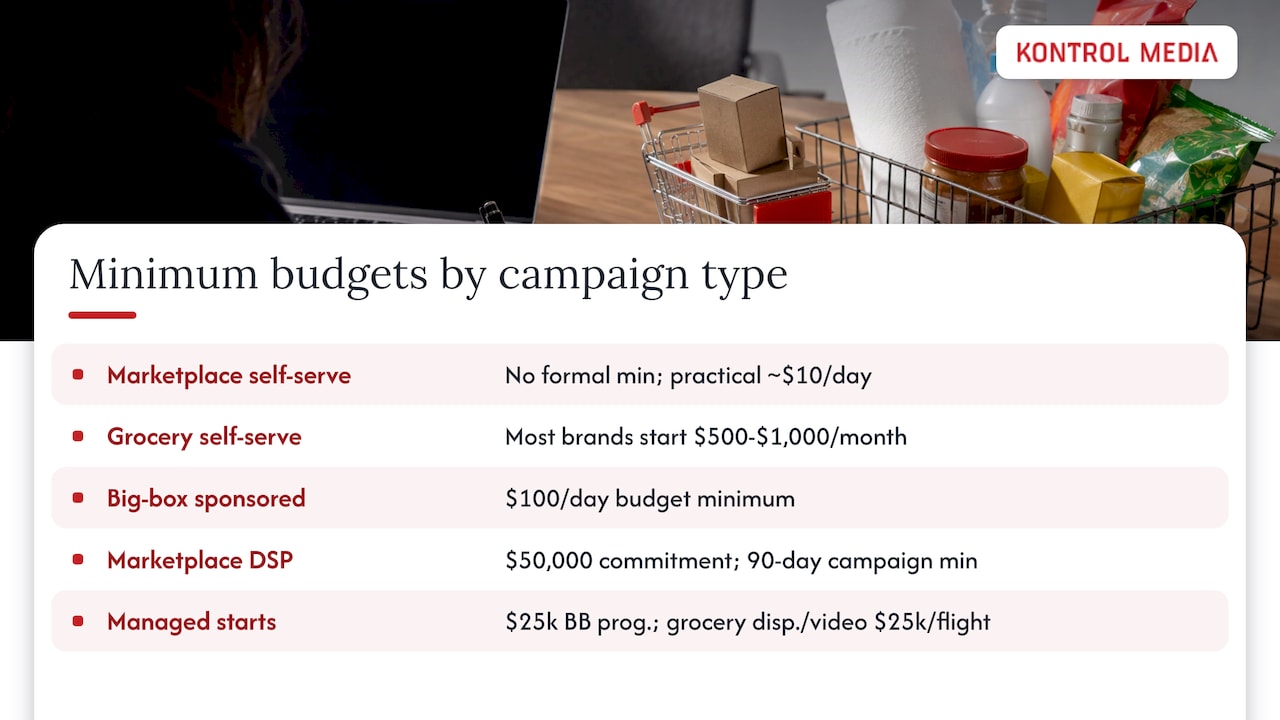
Self-serve sponsored products are the low-friction entry. Marketplace sponsored products have no formal minimum and are practically accessible from about $10 a day, and the same comparison reports that most brands on a grocery delivery network’s self-serve tool start at $500 to $1,000 a month. A big-box network’s sponsored products are accessible at a $100 daily budget minimum.
Programmatic and managed buys sit in a different tier. The same roundup reports that managed-service DSP buys on the largest marketplace have historically carried a $50,000 commitment with a 90-day minimum campaign window, and that big-box programmatic campaigns start at around $25,000. Grocery delivery display and shoppable video managed campaigns typically start at $25,000 per flight. Fixed-fee takeovers and in-store screens usually sit above all of this.
A practical way to budget: start with a sponsored product test sized to collect enough clicks and orders to read results, then earn your way into display and offsite once onsite return is proven. We lay out that sequence in our piece on proving onsite ROAS before scaling offsite.
Why the same click costs more on one network than another
Three things move price more than anything else.
Competition for the shelf. The networks with the most advertisers charge the most. Digiday reported in 2024 that ad prices on one big-box retailer’s network could be up to 40% cheaper than the largest marketplace’s, largely because fewer advertisers were bidding. Later benchmark data shows the same direction: Q1 2026 display CPMs on the big-box network averaged about 28% lower than on the marketplace DSP, according to a survey of 312 brands summarized in 2026.
Category and season. Beauty, supplements and baby products are crowded, so keyword bids climb, especially around peak shopping periods. A pantry staple or home goods brand will usually see a lower floor.
Data richness and format. A grocer with loyalty-card purchase data can charge more because it can prove closed-loop sales. A premium video slot or in-store screen costs more than a sponsored listing because the inventory is scarcer and the creative is heavier.
There is also a pressure coming from buyers. An agency executive told Digiday in 2024 that retail media networks will have to price in line with what a brand could buy directly or prove their media performs significantly better. I agree, and it is the reason measurement belongs in the cost conversation.
Is the cost worth it? Measure incrementality, not CPM
Retail media CPMs sit above general Google and Meta benchmarks. The same 2026 benchmark that lists the network prices notes that Google Search CPCs for most consumer categories run roughly $2 to $4 and Meta CPMs about $8 to $12. The point of paying more is that the retailer sees the sale. Closed-loop data changes the math if you measure what the ad caused rather than what it touched.
That is where many budgets go wrong. NielsenIQ’s 2026 analysis found that incrementality and cross-channel measurement are brands’ top retail media measurement pain point, and that using ROAS as a stand-in for incrementality is among the most common and costly mistakes. A campaign with a flattering ROAS can be mostly harvesting shoppers who would have bought anyway.
A simple way to size a first budget:
- Pick the network where your shoppers already buy, not the cheapest one.
- Set the test budget from the CPC or CPM range for your category, multiplied by the clicks or impressions you need to read a result, and add the network’s minimum if you are going managed.
- Decide in advance how you will test incrementality, for example holdouts or geo splits.
- Compare cost per incremental sale, not cost per click.
If you want the framework, our guides to incrementality in retail media, iROAS measurement and the key retail media metrics walk through each step.
What it costs a retailer to run its own network
If you are a retailer or a consumer business, the question flips: not what you pay for ads, but what it takes to sell them. The budget has four lines, set against the ad revenue you expect.
Technology. The ad server, auction, booking and reporting stack, whether you license it or build it. A custom build means engineering salaries, cloud costs and permanent maintenance. The first build is the visible cost. The cost that surprises teams is the one that repeats every year, because the platform needs new formats, new integrations and constant fixes.
People. Ad sales, campaign management, yield and data roles, and customer success for advertisers. Networks stall most often here, not on technology. A platform with no one selling into it earns nothing.
Data and measurement. Clean, field-level data is what makes a network credible to advertisers. If your attribution cannot survive an audit, brands will cut budgets after the first quarterly review. We cover the requirements in four field-level data rules for audit-grade attribution.
Media and store costs. Outside inventory bought for offsite campaigns, plus screens, connectivity and installation if you add in-store media.
Then there is the cost nobody puts on the spreadsheet: time. Every month spent building is a month without revenue, and every engineer assigned to ad infrastructure is not working on another commerce priority. That is why we usually start with the build versus buy decision before anyone writes a line of code. The ceiling on what you can earn is also worth sizing early. Our note on retail data monetization shows how first-party data can become a meaningful share of revenue, and our guide on advertiser acquisition for media networks covers how to fill the network once it exists.
Perspective
I have sat on both sides of this table: the brand trying to justify a retail media line item, and the retailer trying to turn its shopper data into a real advertising business. The cost question is almost never really about cost.
On the brand side, the mistake is shopping on CPM. A cheaper impression that does not drive an incremental sale is the most expensive media you can buy. We push clients to agree on the measurement plan before they agree on the budget, because the plan tells you which price is actually a good one.
On the retailer side, the mistake is treating the network as a technology project. Technology is the easy part to quote. The harder part is the advertiser pipeline, the operating rhythm, the data discipline and the people who make a network feel trustworthy to a CMO. Building all of that from scratch is slow, and the revenue you forgo while you wait is a cost too.
That is why we do both strategy and hands-on operation. We stand up networks, run them and sell into them, so the budget you approve reflects what it takes to reach revenue, not just to reach launch.
Mark Kapczynski
Work with a team that has run these networks
Kontrol Media helps retailers and consumer businesses stand up and operate retail and commerce media networks, and helps brands put their media dollars where they are measurable. If you are sizing a network, we can stand up your retail or commerce media network or take over day-to-day retail media network operations. Pricing is scoped to your engagement, so the quickest way to get a number is to talk through your goals with us.
If you are a retailer deciding between building and buying, start with our build versus buy verdict and then get in touch to scope the work.
FAQ
How much does it cost to advertise on a retail media network?
It depends on the format. Self-serve sponsored products can start around $10 to $100 a day depending on the network, and sponsored CPCs mostly run from about $0.60 to $1.60 outside the most competitive categories. Managed display and programmatic campaigns often start at $25,000 or more per flight or campaign.
Is retail media more expensive than Google or Meta?
Per impression, usually yes. Benchmarks place retail media display CPMs at roughly $7 to $22, against about $8 to $12 for Meta and $2 to $4 per click for Google Search in most consumer categories. The difference is that retail media ties spend to purchase data at the retailer, so the right comparison is cost per incremental sale.
What is a good starting budget for a first campaign?
Size it to the volume you need to read a result. For self-serve sponsored products, many brands begin with a few hundred to a thousand dollars a month on a smaller network. If you go managed, plan around the network’s minimum and a 90-day window, then decide in advance how you will test incrementality.
How much does it cost to launch a retail media network?
There is no single number, because it depends on whether you license or build the technology, how large your sales and operations team is, and what measurement you offer. Plan around four lines: technology, people, data and measurement, and media or store costs. Many retailers reduce upfront risk and time to revenue by working with an experienced partner to stand up and operate the network.
Sources
- What Is Retail Media? A 2026 Guide for Brands
- IAB Retail Media Buyer’s Guide, July 2023
- Retail Media CPMs 2026: Full Benchmark by Network, CMO Mag
- Amazon DSP vs. Walmart Connect in 2026, Ecommerce Times
- Why retail media’s reckoning is said to be on the horizon, Digiday
- Advertisers shift retail media spending beyond Amazon, Digiday
- Amazon, Walmart, Instacart: How Much They Charge for Ads, Business Insider
- Measure Retail Media Incrementality and Prove Impact, NielsenIQ