


Clicks are cheap to count and easy to celebrate, but they don’t pay salaries. A strategic partnership drives revenue when two companies with the same customer agree on a shared outcome, split the work and the risk, and measure sales instead of traffic. This guide covers how to choose that partner, structure the deal, stay inside the rules and prove the money is real. It is for marketing and growth leaders who are tired of reporting reach while the revenue line stays flat. The same discipline sits behind why consultants struggle to scale: attention is not the business, outcomes are.
TL;DR
- Judge every partnership by revenue, pipeline or closed deals, not by impressions, clicks or audience size.
- Pick partners who share your customer’s problem and add something you can’t, rather than partners who simply have a big list.
- Agree on KPIs, incentives, responsibilities and disclosure before launch, and write them down.
- Pay-per-click style incentives can reward traffic by any means, so tie rewards to outcomes and monitor how partners promote you.
- Retail media and real estate channels show how a trusted partner’s audience turns into measured sales.
Table of Contents
- Why clicks are the wrong scoreboard
- What the evidence says about partnership revenue
- Choose partners by shared problem, not by audience size
- Align goals, incentives and responsibilities before launch
- Keep incentives honest: disclosure and FTC rules
- How retail and commerce media turn partnerships into ad revenue
- Reaching home buyers and owners through real estate professionals
- The metrics that prove a partnership is paying off
- Our perspective on partnerships that pay
- Work with Kontrol Media
- FAQ
- Sources
Why clicks are the wrong scoreboard
I’ve sat in plenty of quarterly reviews where the dashboard was green and the business was not. Traffic was up, cost per click was down, and nobody could say which of those visitors had become a customer. Clicks measure a moment of curiosity. Revenue measures a decision.
Partnerships change the question. Instead of renting attention from an auction, you borrow trust from someone your customer already listens to. That trust is what shortens the path from interest to purchase, and it is why a partner-sourced lead often behaves differently from a paid-search lead. The catch is that a partnership only works if both sides can name the outcome they are chasing. If the only shared metric is visits, you have rebuilt paid media with extra meetings.
If you want the longer argument on this, we’ve written about why to stop paying for clicks and drive revenue from partners, and about media campaigns versus strategic partnerships when deciding where budget should go.
What the evidence says about partnership revenue
Two pieces of research make the case better than any opinion of mine.
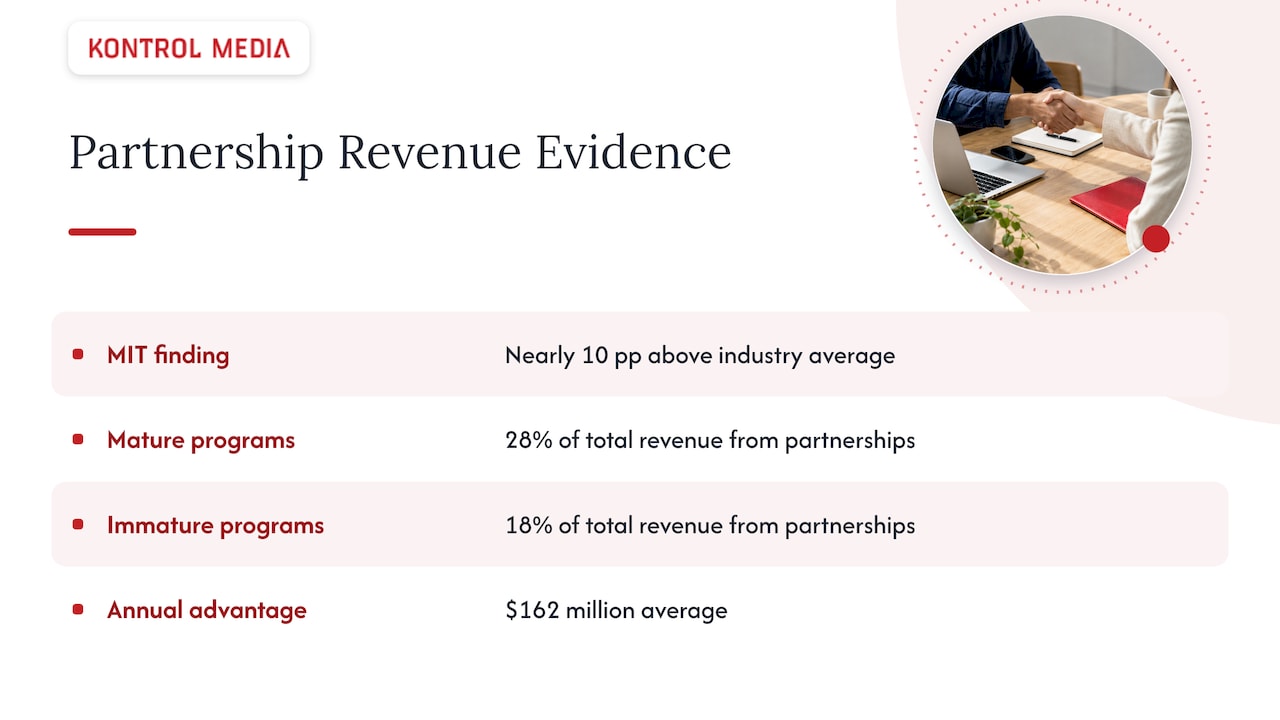
MIT’s Center for Information Systems Research studied how companies grow through digital partners. It found that high performers using partners to expand both their reach (new customers) and their range (new products) grew revenue nearly 10 percentage points above their industry average. Notice that reach alone is only half of that formula. The gain came from pairing new audiences with new things to sell them.
The second is a Forrester study commissioned by Impact in 2019. It reported that companies with mature partnership programs generated 28% of total revenue from partnerships, against 18% for immature programs, an average advantage of $162 million a year. Because the study was commissioned by a partnership software company, read it as a directional signal, not a guarantee for your category. The word that matters is maturity: defined processes, owners and measurement, not just a signed agreement.
That same finding points to something many leaders miss. Showing the revenue plan, not just the audience or the upside story, is what persuades a partner to invest. A good parallel is the argument that a cash-flow plan belongs in any sales pitch: the partner wants to see how money moves, not only how big the opportunity sounds.
Choose partners by shared problem, not by audience size
The most common mistake is picking the partner with the biggest following. Follower counts and email list size are starting points for questions, not answers. A smaller group can be perfect for a narrow activity, while a large audience of the wrong people produces applause and no sales.
A stronger screen starts with the customer. Write down who your buyer is and what problem they are trying to solve, then do the same for the potential partner. Good fits tend to show these traits, based on guidance on building an ideal partner profile:
- Customer overlap, meaning the same buyer at a different point in their journey.
- Complementary, non-competing products or services.
- A fit with the go-to-market motion you actually want, whether that is referral, reseller, affiliate or integration.
Intercom offers a useful real-world example. Its team built a prioritization framework that weighed mutual customers, account mapping and partner engagement, and it reported 30% year-over-year growth in partner-sourced revenue. The lesson is not to copy the framework. It is that the selection was systematic and based on shared accounts, not on gut feel about who looked impressive.
One more filter: shared customers alone do not create commitment. HubSpot’s partnership playbook argues that a partnership needs a specific mutual reason for both organizations to invest. Before you pitch, ask what is in it for them in their own terms, such as a retention lift, a new revenue line or a stronger offer for their customers. If you can’t answer, you don’t have a partnership yet, you have a hope.
Align goals, incentives and responsibilities before launch
Partnerships fail quietly. Nobody quits; the activity just fades because no one owned it. The fix is boring and effective: a one-page agreement on the following.
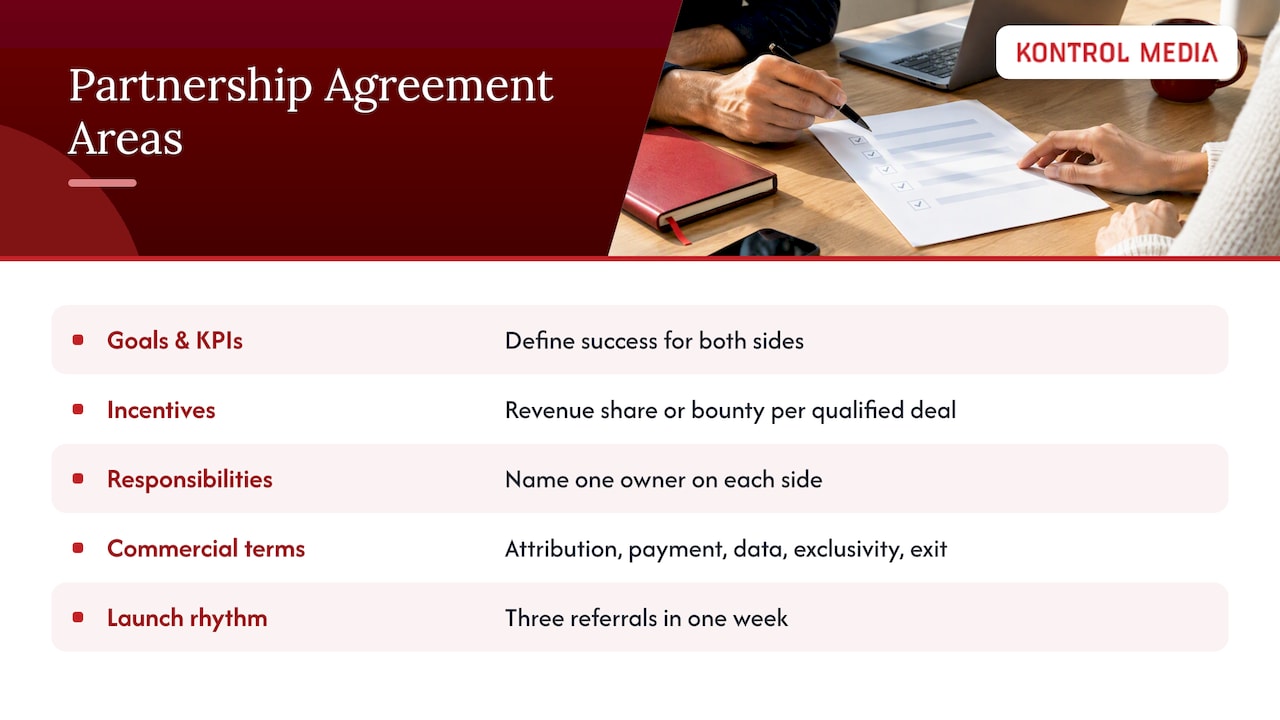
Goals and KPIs. Each side states what success means for them. Intercom’s approach is to discuss each side’s KPIs, goals and incentives upfront so the initiative can be structured and measured. Your KPI might be sourced pipeline, while theirs is customer retention. Both can be served by the same program if you plan for it.
Incentives. Pay for outcomes you actually want. A flat fee for exposure invites low effort. A revenue share or a bounty per qualified deal invites effort, but it also invites shortcuts, which brings us to compliance.
Responsibilities. Who creates the content, who follows up on leads, who answers customers, and how fast? Name a person on each side, not a team.
Commercial terms. Cover attribution rules, payment timing, data sharing, exclusivity and how either party exits. Have counsel review anything that involves customer data or exclusivity.
Launch rhythm. Intercom ran a dedicated Partner Week with one partner in Q4 2022 and received three referrals in a single week, and it uses Slack alerts and a request channel so internal teams can engage partners easily. Small, visible sprints like this build proof before you scale.
If you want a structured start, our walkthrough of a 90 day partnership development strategy lays out how we sequence it.
Keep incentives honest: disclosure and FTC rules
If partners promote you to their audience for pay, free product or commission, the U.S. Federal Trade Commission expects honesty about it. The agency has said endorsers who receive payment or free products should disclose that material connection when consumers would not otherwise expect it. A disclosure also has to be visible: the FTC describes a clear and conspicuous disclosure as difficult to miss and easily understandable, so consumers should not have to hunt for it.
There is also a management point here. In that same 2010 speech, the FTC said pay-per-click compensation can push affiliates to drive traffic by any means, including deceptive claims, and that sponsoring companies need to manage their programs better. The agency has acted on it: in 2011 it proposed a $250,000 settlement over affiliate endorsements that failed to disclose commissions. Practical safe use looks like this:
- Put disclosure requirements in the partner agreement in plain language.
- Give partners approved wording and examples of placement.
- Review live partner content on a schedule, and act when it drifts.
- Reward qualified outcomes rather than raw traffic volume.
For your specific program, ask your attorney to confirm the requirements, since rules vary by channel and claim.
How retail and commerce media turn partnerships into ad revenue
Retail media is the clearest example of partnership-driven revenue because the measurement is built in. A retailer holds first-party purchase data, a brand wants proof of sales, and the partnership between them is judged on transactions.
Two cases show the pattern. In 2025, Albertsons Media Collective and NBCUniversal piloted closed-loop measurement that linked connected TV ad exposure with retail transactions. Chobani’s campaign saw over 69% higher onsite ROAS and over 43% higher offsite ROAS than a previous campaign without premium CTV. Earlier, a 2023 campaign between iHeartPodcasts and Mattress Firm used deterministic transaction data to measure incremental impact, and it reported a 45% lift in incremental sales for brick-and-mortar stores. These are single campaigns, not promises for every advertiser, but they share a design: partners agreed in advance on how sales would be measured.
If you are a retailer or consumer business weighing this, start with what a commerce media network is and the types of commerce media network models before deciding how much to build yourself.
Reaching home buyers and owners through real estate professionals
Real estate is a channel where trust does most of the selling. A buyer who is moving needs a mortgage, insurance, furniture, internet, a mover and a hundred other things, and the agent is the person they ask. REALTOR.com PRO describes partnership marketing in this field as an alliance between organizations with similar client bases that share campaign costs and outcomes, with benefits that include wider audience reach and credibility borrowed from a trusted partner.
For a brand, that means the agent’s endorsement can do what a banner cannot. For the agent, a relevant brand partner adds value to clients. Done well, both sides win, which is the whole definition of a strategic partnership. We go deeper in our guides to real estate agent partnerships and advertising to home buyers through real estate agents. Remember that any agent promoting a brand for compensation falls under the disclosure expectations above.
The metrics that prove a partnership is paying off
Pick a small set of numbers and review them monthly with your partner.
- Sourced and influenced revenue: closed business that began with, or was accelerated by, the partner.
- Qualified pipeline: opportunities that meet your sales definition, not raw leads.
- Conversion and cycle time: do partner leads close faster or at higher rates than other sources?
- Incrementality: would these sales have happened anyway? Holdout tests and transaction-level matching answer this better than click attribution.
- Partner health: activity, engagement and the partner’s own results, since a partnership that only serves you will not last.
Forrester’s research adds a reason to take this seriously: it found high-maturity partnership programs are more likely to exceed stakeholder expectations on business metrics such as profitability. For a framework on the measurement side, see our piece on measuring the ROI of marketing and advertising campaigns.
Our perspective on partnerships that pay
We have worked on both sides of this table, building revenue-generating marketing partnerships for brands and agencies, and standing up and operating retail and commerce media networks. The pattern repeats: the partnerships that last begin with a commercial question, not a creative one.
Clicks tell you someone looked. Revenue tells you someone decided. When we advise a CMO, we ask which partner already holds the trust of the customer we want, and what we can build together that neither side could build alone. Whether that is an advertising and outreach program through real estate agents or a retail media network that monetizes first-party data, the work only counts when it reaches the revenue line.
We also believe strategy without execution is a slide deck. Our approach is to stay in the work, across sales, marketing and business development, so the agreement on paper becomes meetings, campaigns and measured results. And yes, it should be enjoyable. Partners who like working together keep working together.
Mark Kapczynski
Work with Kontrol Media
If you want a partner for the partner strategy, that is what we do. We combine business strategy with hands-on execution, from building revenue-generating marketing partnerships through real estate agents to setting up and running retail and commerce media networks.
Explore our business strategy, marketing and sales services, see how we stand up a retail or commerce media network, or look at our real estate channel programs.
FAQ
What is a strategic partnership in marketing?
It is a structured agreement between two companies that serve the same customer, where each contributes something distinct and both share in the results. Unlike a one-off sponsorship, it has shared goals, defined responsibilities and ongoing measurement. Our guide on forming win-win collaborations goes further.
How do I find the right partner?
Start with your customer’s problem and look for companies that help solve a different part of it without competing with you. Check customer overlap, what each side would contribute and whether the partner has a real reason to invest. Treat audience size as a prompt for questions, not a verdict.
How long before a partnership produces revenue?
It depends on your sales cycle and how quickly you launch, so no honest number fits every business. A focused pilot with a single partner, a clear KPI and a short review window will show whether the model works before you scale it.
Do I need to disclose partner promotions?
In the United States, the FTC expects endorsers who receive payment or free products to disclose that connection when audiences would not expect it, and the disclosure must be easy to notice. Build this into your agreement and ask your attorney to confirm what applies to your channel.
Sources
- MIT CISR: Three Strategies to Grow via Digital Partnering
- Forrester study commissioned by Impact on partnership program maturity
- How to Find Business Partners, a Step-by-Step Guide
- Intercom’s Playbook: Driving 30% More Sourced Revenue
- FTC speech on advertising and marketing enforcement challenges
- FTC warning letter on clear and conspicuous disclosure
- FTC press release on a $250,000 affiliate endorsement settlement
- Grocery Dive: Albertsons pilot with Chobani
- iHeartMedia: iHeartPodcasts and Mattress Firm incremental sales lift
- REALTOR.com PRO: Why partnership marketing is perfect for real estate