


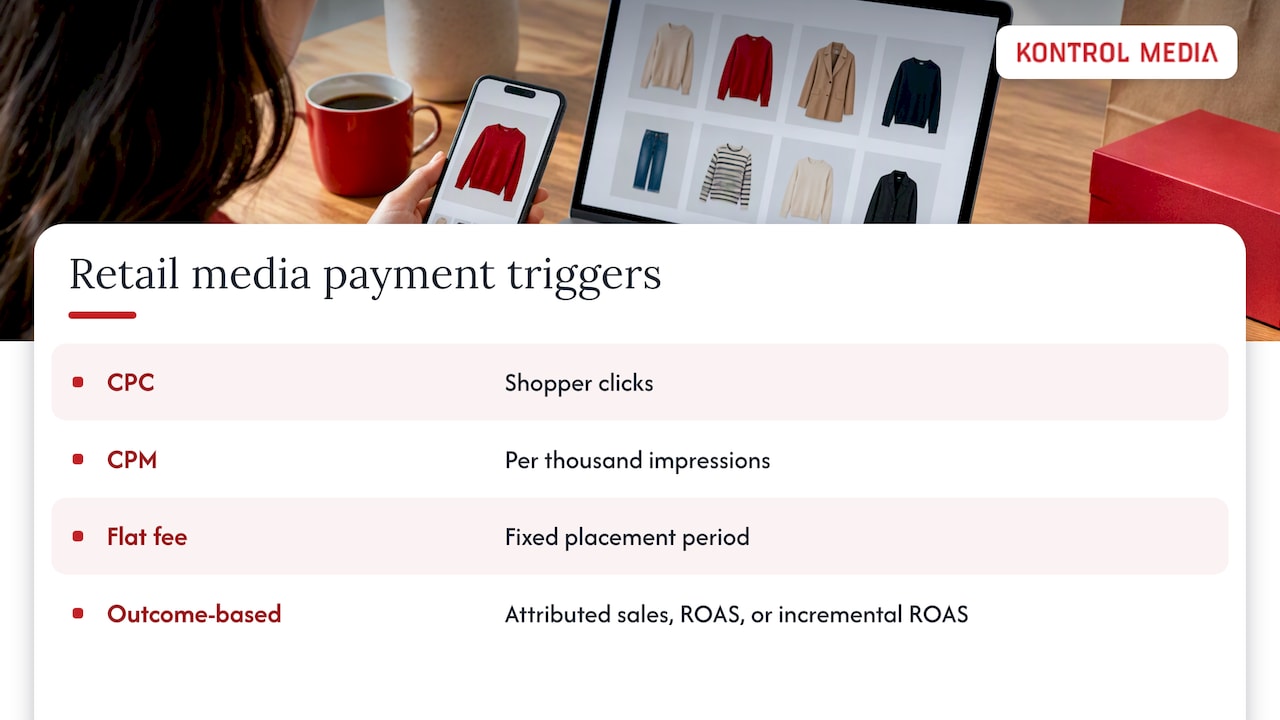
Retail media networks price inventory in four main ways: cost per click (CPC) for sponsored products and search, cost per thousand impressions (CPM) for display, video and most offsite formats, flat-fee or time-slot sponsorships for premium placements, and outcome-based deals tied to sales or return on ad spend. Which one applies depends on where the ad runs (onsite, offsite or in-store), how the network measures it, and how much control the seller has over supply. This guide explains each model, what U.S. benchmarks suggest, and how to choose a structure whether you are buying media or building a network to sell it.
TL;DR
- Sponsored products are generally sold on biddable CPC, display and video on CPM, and premium placements on fixed tenancy or flat fees.
- Published CPMs vary widely by network and format, so treat any single benchmark as a starting point and ask for a rate card.
- Audience-data fees are not standardized: major U.S. retailers charge different percentages, with different caps.
- Sellers should start with a hybrid of CPC and CPM plus a minimum spend, then add sponsorships as measurement matures.
- Compare price only alongside attribution window, incrementality and margin, never on CPM alone.
Table of Contents
- The four pricing models in plain terms
- How pricing changes across onsite, offsite and in-store
- What U.S. benchmarks actually show
- What actually sets the rate
- Comparing prices without fooling yourself
- How to choose a model if you are building a network
- Pricing when the audience is homebuyers and homeowners
- Our perspective: price the proof, not the impression
- Getting help with pricing and operations
- FAQ
- Sources
The four pricing models in plain terms
I have sat on both sides of retail media conversations, and the confusion almost always starts with the vocabulary. A “price” in retail media is really three decisions bundled together: the unit you pay for, the format you buy, and the proof you get back. Start with the unit.
CPC (cost per click). The advertiser pays when a shopper clicks. IAB Canada’s guide to retail media lists CPC by product or keyword, CPC by SKU and CPM among the common cost structures, and notes that networks may set minimum bids, such as a minimum CPC for sponsored search clicks. CPC fits intent-heavy placements where a shopper is already searching the shelf.
CPM (cost per thousand impressions). The advertiser pays for exposure. It dominates display, video and many offsite formats, and the same IAB Canada guide notes minimum CPMs for programmatic display and video.
Flat fee or sponsorship. A fixed price buys a defined placement for a defined period: a homepage takeover, a category-page tenancy, a screen at the front of a store. The price is set by the seller rather than by an auction.
Performance or outcome-based. Payment is tied to attributed sales, return on ad spend (ROAS) or incremental ROAS. This is the least common model and the hardest to administer, because both sides must agree on how a sale is credited.
How pricing changes across onsite, offsite and in-store
IAB Europe’s Retail Media 101 guide splits retail media into onsite (the retailer’s own digital properties), offsite (reaching shoppers beyond those properties) and in-store environments. For onsite, it describes sponsored product and search ads as generally bought on biddable CPC, some display and video on CPM, and fixed tenancy opportunities as an additional option.
That gives a rough map you can use when reading any rate card.
| Environment | Typical formats | Most common pricing unit | What drives the rate |
|---|---|---|---|
| Onsite | Sponsored products, search | Biddable CPC | Keyword demand, category competition, minimum bids |
| Onsite | Display, video | CPM | Placement, audience, share of voice |
| Onsite | Homepage or category takeovers | Fixed tenancy or flat fee | Traffic, exclusivity, duration |
| Offsite | Display, social, CTV | CPM | Audience data quality, channel, reach |
| In-store | Screens, digital signage | Flat rate by time slot or CPM | Zone, daypart, measured audience |
The in-store row deserves a note. Impression-based pricing only works when the network can defend its impression counts. That is why in-store inventory tends to be sold by placement and time slot until measurement standards mature, and why a network should price slot by slot rather than guess at an average across the chain.
If you are deciding where to spend first, our guide on proving onsite ROAS before scaling offsite walks through that sequence in more depth.
What U.S. benchmarks actually show
Benchmarks are useful for sanity checks and dangerous as budgets. The figures below come from different years and methods, so they do not line up neatly, which is itself the lesson.
In August 2022, AdExchanger reported retail media CPMs on major big-box store sites in the $20 to $50 range. By September 2024, Digiday cited figures that put onsite display near $15, offsite display at $8 to $9 and connected TV around $33, with overall retail media CPMs ranging from $25 to $65 depending on media type and network. Those numbers describe different samples, and a $15 onsite display CPM next to a $20 to $50 range from two years earlier tells you the market is not converging on a single price.
What has converged, at least loosely, is the shape of the cost structure. Sellers charge for the ad, and some also charge for the data used to target it.
Audience-data fees are their own line item
A 2025 eMarketer report on leaked data fees outlined how inconsistent this is: Walmart charged 20% to 30% of media costs capped at a $3.50 CPM, Albertsons 15% to 45% capped at $5, and Costco 40% capped at $4. If you are an advertiser, that means two campaigns with identical headline CPMs can cost different amounts once data is layered in. Ask every network whether audience fees are included in the quoted rate or added on top.
What actually sets the rate
When we audit a network’s pricing, the same factors keep appearing, in roughly this order of influence.
Audience quality. First-party purchase data lets a seller promise that an impression reaches a buyer of the category. That is worth a premium over a generic audience, but only if the network can show it.
Placement and context. A sponsored product at the top of a search result near the point of purchase is not the same asset as a banner at the bottom of a page. Position, share of voice and exclusivity all move price.
Closed-loop measurement. The IAB Retail Media Buyer’s Guide presents closed-loop measurement, connecting ad exposure to sales through first-party data across online and in-store channels, as a key advantage of the channel. Networks that can prove sales impact can defend higher prices. Our article on field-level data rules for audit-grade attribution covers what that proof requires.
Minimums and overhead. Networks often set a minimum bid or a minimum monthly spend so that reporting and ad operations cost does not exceed the revenue from small accounts.
Competition for the shelf. In auction formats, category competition does the pricing for you. A crowded category with strong brand budgets will clear well above a thin one.
Comparing prices without fooling yourself
A lower CPM is not a cheaper outcome. To compare networks, line up the price against what the same dollar buys in measured results.
Start with the objective. The IAB buyer’s guide describes retail media as performance media and recommends a top-down approach: define the business outcome, then prioritize retailers and budgets, supported by closed-loop measurement and attribution models such as last touch, multi-touch and assisted sales. Then check three things for each quote.
Attribution window. IAB Canada’s guide notes windows such as 1, 7, 14 and 30 days, click or view. A 30-day view window will report more sales than a 7-day click window on identical delivery. ROAS from two networks is only comparable when the windows match.
Attributed versus incremental sales. ROAS credits sales that may have happened anyway. Geo-based tests, which hold some regions back as a control and compare sales against the exposed regions, are the cleanest way to see what the spend truly added. If a network resists any holdout testing, factor that into your read of its price.
Margin and new customers. A sale of a product you would have sold to a loyal buyer costs the same as a sale to a new one. Our key metrics guide for retail media lays out how to build a measurement stack that goes beyond a single ROAS number.
For CPC-led programs specifically, what still works in cost-per-click ad models is a useful companion on bidding discipline.
How to choose a model if you are building a network
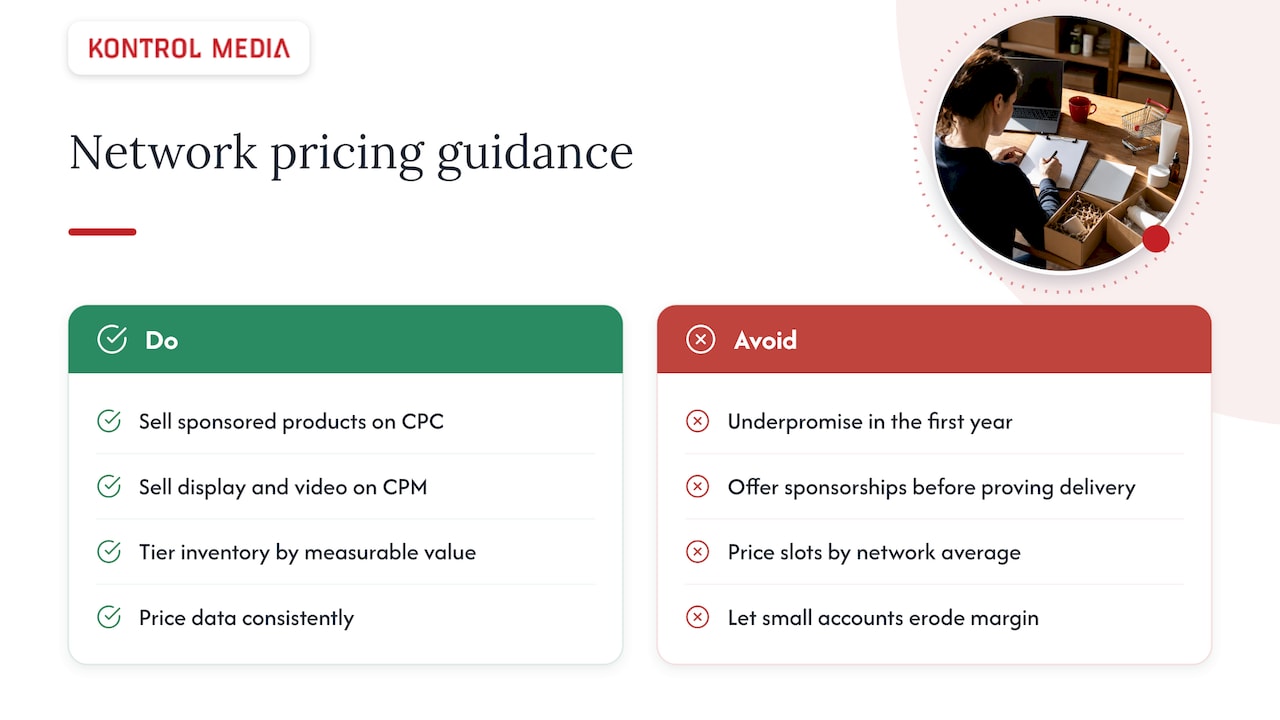
If you are a retailer or consumer business launching a commerce media network, pricing is not just a rate card, it is a promise about what you can reliably deliver. Underpromise on the first year.
Here is the pattern we see work for mid-market sellers.
Start hybrid. Sell sponsored products on CPC, because the auction does the price discovery for you. Sell display and video on CPM. Add a minimum monthly spend that covers reporting and ad-ops cost, so small accounts do not erode your margin.
Price by slot, not by network average. This matters most in-store, where zone and time of day change audience size dramatically. Tier your inventory into premium, standard and remnant slots based on what you can measure, and publish delivery expectations with each tier.
Introduce sponsorships once you can prove delivery. Fixed-fee placements are attractive to brands that want certainty, but they are only defensible when you can show traffic and sales effect. Sell them too early and you will be discounting them within a quarter.
Treat data as a separate product. The inconsistency in audience-data fees across large retailers shows there is no settled standard. Decide whether data is bundled into your rate or priced as a percentage, and be consistent. Our guide on turning first-party data into revenue and the 90-day monetization plan go deeper on this decision.
Decide build versus buy early. Your pricing flexibility depends on your tech and operations. We cover that tradeoff in our build versus buy verdict, and the sequencing in the pilot-to-revenue roadmap.
Pricing when the audience is homebuyers and homeowners
Brands often want to reach people in the market for a home, and the pricing conversation changes because the channel is different. Instead of a retailer’s shelf, the inventory sits with agents, housing platforms and moving-related touchpoints. Housing-intent audiences are available through some platforms: Zillow, for instance, has announced that brands can reach Pinterest users through Zillow housing-intent segments, such as fixer-upper shoppers and recent homeowners, based on behavior rather than broad demographics.
Be careful with how you target. The U.S. Department of Housing and Urban Development issued 2024 guidance on advertising through digital platforms warning that custom and mirror audience tools used for housing-related transactions can lead to discriminatory ad delivery and potential Fair Housing Act violations. If your campaign touches a housing transaction itself, such as a listing, mortgage or rental, have counsel review audience setup before you buy. A brand selling paint or furniture to new homeowners sits in a different place than a lender, but the question is worth asking early.
Our perspective: price the proof, not the impression
After years of operating and advising on these programs, the pattern we see is simple. Networks that struggle price their inventory off whatever the loudest competitor charges. Networks that thrive price off what they can prove.
We have watched retailers launch with an ambitious CPM, discover that brands will not pay it without sales evidence, and then slash the rate card within two quarters. The discount does more damage than a modest start would have, because buyers remember the first number. We would rather see a network launch with a hybrid structure, a clear minimum, a small number of tiers and a measurement plan that includes a holdout test, and then raise prices as the evidence accumulates.
The same logic applies to brands buying media. The cheapest CPM is rarely the best deal, and the most expensive is rarely the worst. Ask what you get back: the attribution window, the incrementality evidence, the data fees and the reporting cadence. A network that answers those questions plainly is usually one you can build with, and in our experience the conversations that start with measurement end with fairer prices on both sides.
That is also where hands-on execution matters. A rate card is a document, but pricing is an operating discipline: who approves discounts, how inventory is forecast, how invoices reconcile with reporting. We have found that is where most networks lose margin, and it is fixable.
— Mark Kapczynski
Getting help with pricing and operations
If you are designing a rate card, launching a network or trying to bring order to one that is already live, we work with retailers and consumer businesses on both the strategy and the day-to-day execution. You can start with how we stand up a retail or commerce media network, or see how our retail media network operations team runs pricing, sales and reporting once you are live.
Brands and agencies looking to reach homebuyers and homeowners through real estate agents can see what we offer on our real estate channel page. For broader strategy, sales and marketing support, start at our services overview.
FAQ
What is the most common retail media pricing model?
There is no single one, because the model follows the format. Sponsored product and search ads are generally bought on biddable CPC, display and video on CPM, and premium placements on fixed tenancy, according to IAB Europe. Most programs mix at least two of these.
Are retail media CPMs higher than Google or Meta?
Often, but the comparison depends on format and network. Reported retail media CPMs have ranged from about $20 to $50 on major big-box sites in 2022 and $25 to $65 across media types in 2024. The premium is justified only if first-party purchase data and closed-loop measurement show stronger sales results.
What is a minimum bid in retail media?
It is the lowest price a network will accept for a placement, such as a minimum CPC for sponsored search or a minimum CPM for programmatic display and video. IAB Canada notes that networks may set these. Minimums protect the seller’s margin and keep low-value bids from filling premium inventory.
Should a new retail media network sell on performance?
Usually not at first. Performance pricing requires agreed attribution and reliable closed-loop data, which take time to build. Most mid-market sellers do better starting with CPC and CPM plus a minimum spend, then adding sponsorships or outcome-based deals as measurement proves out.
How do I compare two retail media quotes?
Match the attribution window, ask whether audience-data fees are included, and request any incrementality or holdout results. Then compare cost per incremental sale rather than CPM. Two identical CPMs can produce very different returns once these factors are accounted for.
Sources
- IAB Canada: A Guide to Retail Media
- IAB Europe: Retail Media 101 Guide
- IAB: Retail Media Buyer’s Guide
- eMarketer: Leak outlines Walmart, Best Buy, Costco data fees
- AdExchanger: Retail Media Needs A Reality Check
- Digiday: There’s a point of diminishing returns
- HUD: Guidance on Advertising through Digital Platforms
- Zillow: Brands can now reach Zillow’s home shoppers on Pinterest