


The fastest way to reach high-intent audiences is to meet people at the moments they signal they are ready to buy, in places where that signal is trustworthy, and then to measure whether your ad created the sale or merely sat next to it. That sounds simple. In practice, most budgets chase the same last-click searchers everyone else is chasing, and most reporting gives credit to sales that would have happened anyway.
We work on this problem from three angles: retail and commerce media networks, the real estate channel for brands that want to reach home buyers and homeowners, and broader go-to-market strategy. This guide pulls those experiences together into one practical playbook for marketing leaders.
TL;DR
- High intent is a pattern of behavior (research, comparison, pricing views, add-to-cart, a life event like a move), not a demographic. Define the signals before you buy the reach.
- Buyers do not move in a straight line, so targeting only people already committed to your brand leaves earlier, cheaper opportunities on the table.
- The richest intent signals live where purchases happen: your own first-party data, retail and commerce media networks, and trusted human channels such as real estate agents.
- Judge success by incremental sales, not blended ROAS, and match your lookback window to your real sales cycle.
- Anything sponsored or endorsed needs a disclosure the consumer actually notices, regardless of what the platform’s tag says.
Table of Contents
- What high intent actually means
- Stop fishing only at the bottom of the funnel
- Search: still the loudest intent signal, and changing fast
- Retail and commerce media: intent at the point of purchase
- The real estate channel: reaching people at a life event
- Perspective: where we see teams go wrong
- A practical plan for the next 90 days
- How we can help
- FAQ
- Sources
What high intent actually means
A high-intent audience is a group of people whose behavior says they are close to a decision. A visit to a pricing page, a cart with items in it, a search for a specific model plus the word “near me,” or a mortgage pre-approval all qualify. A thirty-five-year-old with a certain income does not.
That distinction matters because demographic targeting describes who someone is, while intent describes what they are about to do. Most of the top-ranking advice on audience targeting starts with buyer personas, which is a fine foundation. But personas tell you where to look. Intent tells you when to speak.
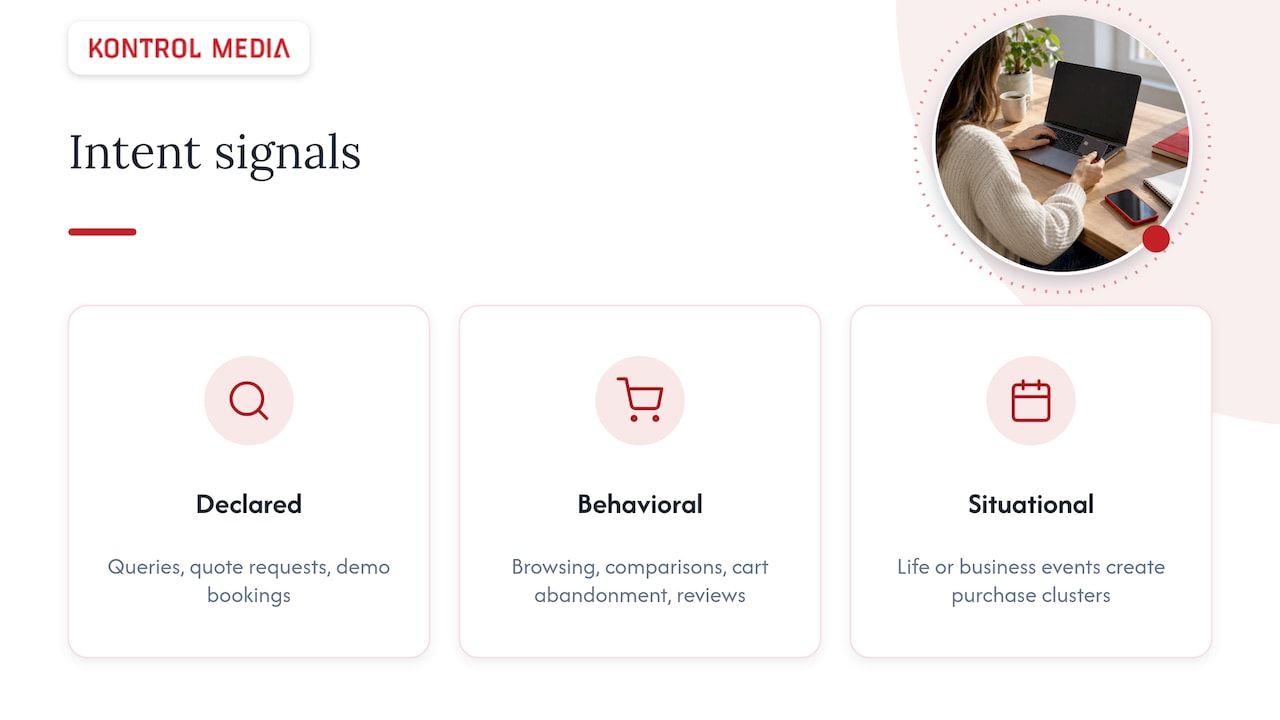
It helps to sort signals into three tiers.
Declared intent is when the buyer tells you directly: a search query, a quote request, a demo booking. It is the most reliable and the most contested, because every competitor bids on it.
Behavioral intent is inferred from what people do: browsing categories, comparing products, abandoning a cart, reading reviews. It is often richer than declared intent and cheaper to reach, but it requires data you can trust.
Situational intent comes from a life or business event: buying a home, opening a store, taking on private equity investment, entering a new market. The event creates a cluster of purchases, and whoever is present early tends to be remembered.
Stop fishing only at the bottom of the funnel
Most teams over-invest in the last step. They bid on branded and late-stage keywords, retarget cart abandoners, and call the resulting conversions proof that the strategy works. Those people were already close.
The research suggests the journey is messier than the funnel diagram implies. A 2025 analysis of Bing search behavior for phones, laptops and vehicles found that the path to purchase is circuitous, and that terms related to the category but not to a specific brand or product capture intent earlier. The same study reports that adding these associated keywords improved the accuracy of identifying intent by 8 to 15 percentage points when five days of search history were used.
The practical lesson is not to abandon bottom-funnel spend. It is to run a second, deliberate layer above it. Build audiences around the category conversation (the problems, comparisons and questions people raise before they name a brand), and give them a reason to remember you when they narrow the list.
Google’s own guidance for the upper funnel points the same direction. For brand-building and discovery campaigns, it recommends measuring softer actions such as unique visitors, session duration and video engagement, and moving to harder conversions like add-to-cart as people go deeper. It also suggests separating new-customer efforts from existing-customer efforts, often with more relaxed bidding so the campaign can actually reach people.
Search: still the loudest intent signal, and changing fast
Search remains the first place most marketers look, and for good reason. Someone typing a query is announcing what they want. But the mechanics are shifting toward automation.
Google reported in its 2025 summary that advertisers activating AI Max for Search saw 14% more conversions or conversion value on average, with gains of 27% for those moving from primarily exact and phrase match setups. These are Google’s own figures, so treat them as a starting hypothesis to test in your account, not a promise.
Independent data adds nuance. An Adalysis study of 16,825 campaigns, reported by Search Engine Land, found that broad match can deliver higher revenue per conversion even though it often comes with higher CPAs, while exact match remains the most efficient. So the decision is not which match type is best. It is whether you are optimizing for the cheapest conversion or for the most valuable customer, and whether your bidding is fed good conversion data.
A sensible search plan for a mid-market team looks like this:
- Keep exact match on the terms that already convert, so you protect efficiency.
- Test broad match with automated bidding in a ring-fenced campaign, with a revenue-based or value-based goal.
- Add associated, category-level terms in a separate budget line and judge them on assisted and new-customer outcomes, not last-click CPA.
- Feed back offline outcomes (qualified lead, closed deal) so the algorithm learns what a good buyer looks like.
Search is also changing shape as AI answers take up more of the results page, which is why we wrote about thriving in a post-AI search landscape.
Retail and commerce media: intent at the point of purchase
If search shows what someone wants, retail media shows what they are doing about it. Ads placed on a retailer’s site, app or loyalty channels reach shoppers who are already in a buying environment, and the retailer can connect exposure to actual transactions using first-party data.
That closed loop is why the channel has grown so quickly. It is also why measurement discipline matters. A shopper who was going to buy your product anyway and happened to see a sponsored placement inflates your numbers without adding a sale.
The IAB’s November 2025 guidelines address this directly. For proving real business impact, they recommend a mix of experiments, model-based counterfactuals and econometric models that isolate incremental sales, meaning those that would not have occurred without the ad. We go deeper on what that means in practice in our piece on incrementality in retail media and on the calculation in our iROAS measurement guide.
Two more details are worth knowing before you plan a campaign.
First, the lookback window. The IAB Europe commerce media measurement standards, which are European but widely referenced, treat a 30-day lookback as the default while expecting networks to offer flexible, customizable windows for longer sales cycles such as finance and travel. If you sell something people consider for months, a 30-day default will undercount your impact. Ask for the window that matches how your customers actually buy.
Second, sequence. We usually advise retailers and brands to prove onsite ROAS first, then scale offsite, because onsite placements carry the cleanest signal and give you a baseline for everything that follows. For the full set of numbers to track, see our key metrics for retail media.
The real estate channel: reaching people at a life event
Situational intent is the most underused kind, and few moments carry as much of it as buying a home. A move sets off purchases across furniture, insurance, mortgage, utilities, appliances, home services, banking and more, often within weeks.
And the people guiding that moment are mostly agents. The National Association of Realtors’ 2025 Profile of Home Buyers and Sellers reports that 88% of home buyers purchased through a real estate agent or broker, based on transactions completed between July 2024 and June 2025. An agent is therefore a trusted voice sitting next to the buyer at the exact moment the brand decision opens up.
That is the logic behind the real estate channel work we do for brands and their agencies: building revenue-generating media partnerships that reach home buyers and homeowners through advertising and outreach involving real estate agents. The formats vary. Agent email programs, agent ad programs, an agent influencer network, in-market homebuyer emails, and partnerships that reach buyers through tools they already use are all ways to meet people while the decision is live. You can see the full set on our real estate channel page.
Disclose the relationship clearly
Anything that involves agents, influencers or partners carries a compliance obligation. The FTC’s 2023 update to its Endorsement Guides made clear that a platform’s built-in disclosure tool may not be enough on its own. The responsibility sits with the advertiser to make the disclosure clear and conspicuous.
For native or sponsored content, the FTC’s guidance says the disclosure should be placed as close as possible to the advertising content and judged by the net impression on a reasonable consumer. Build this into creative briefs from day one, and ask your legal counsel to review any program involving endorsements before launch.
Perspective: where we see teams go wrong
We have sat on both sides of this table, as operators who build and run media networks and as strategists brought in when growth stalls. The pattern repeats. A team decides it needs a high-intent audience, buys the most expensive version of it, and then measures success with a metric that flatters the spend.
Our view is that intent is not something you purchase, it is something you earn the right to read. That means three habits.
Start with your own data. Your CRM, site behavior, purchase history and sales conversations already contain a map of what a ready buyer looks like. Before renting anyone else’s audience, write down the five or six signals that preceded your last fifty best customers.
Go where trust already exists. A shopper on a retailer’s site, a buyer sitting with an agent, a gamer in an environment they chose: these are places where the audience is paying attention for reasons unrelated to your ad. Partnerships in those places often outperform pure impressions because you borrow credibility instead of buying attention. We wrote about the discipline behind this in proving media partnership impact in 90 days.
Measure like a skeptic. If a channel’s results look too good, ask what would have happened without it. Holdouts, geo tests and incrementality studies are less glamorous than a dashboard, but they are what let a CMO defend a budget in front of a CFO. Our guide to measuring the ROI of your campaigns walks through the basics.
There is room for some joy in this work, too. The best programs we have seen came from teams that were curious, willing to test small, and honest when a test failed. That is the spirit we try to bring to every engagement.
— Mark Kapczynski
A practical plan for the next 90 days
Here is how we would structure the first quarter for a marketing leader who wants more high-intent reach without more waste.
Days 1 to 30: define and instrument
List your intent signals by tier (declared, behavioral, situational). Audit your conversion tracking so offline outcomes feed back into your platforms. Decide on the lookback window that fits your sales cycle, and write it down before any results come in so nobody is tempted to move it later.
Days 31 to 60: test in three places
Run one search test (broad match with automated bidding in a separate campaign, plus category-level terms). Run one retail or commerce media test if your category supports it, starting onsite. Run one partnership test with a channel that reaches a situational audience. Keep each test small enough to lose and large enough to read.
Days 61 to 90: measure incrementally and reallocate
Use holdouts or geo splits to estimate incremental sales for each test. Compare cost per incremental sale, not cost per attributed sale. Move budget toward what held up, and write down what you learned about your buyer’s real journey, because it will differ from the diagram on your strategy deck.
How we can help
If you want a partner who will build the plan and also run it, our business, marketing and sales services cover go-to-market strategy and hands-on execution. For retailers and consumer businesses that want to monetize their own audiences, we help stand up a retail or commerce media network and run retail media network operations. For brands that want to reach home buyers and homeowners, start with our real estate channel programs. Reach out through kontrolmedia.com to talk through your situation.
FAQ
What is the best way to reach a high-intent audience?
Start with the signals you can observe: searches, site behavior, cart activity, and life events like a home purchase. Then place your message where those signals are visible and trustworthy, such as search, retail media networks or trusted human channels. Layer a category-level approach above your branded bidding so you reach people before they have chosen a brand.
How do I know if high-intent traffic is really driving new sales?
Compare results against a control. Experiments such as randomized holdouts, model-based counterfactuals and econometric models are the methods the IAB’s guidance recommends for isolating sales that would not have happened without your ad. Blended ROAS alone cannot tell you that.
Is broad match a good way to find high-intent searchers?
It can be, with the right setup. An Adalysis study of 16,825 campaigns found broad match often produced higher revenue per conversion but at a higher CPA, while exact match was the most efficient. Use automated bidding with good conversion data, and judge the test on revenue and new customers, not CPA alone.
Do I need to disclose partnerships and influencer content?
Yes. The FTC expects disclosures to be clear and conspicuous, and a platform’s built-in tag may not be sufficient on its own. Put the disclosure close to the content, make sure it is visible on every device, and have counsel review your program.
How does the real estate channel help with sales?
Buying a home triggers many other purchases, and most buyers work with an agent. According to NAR’s 2025 profile, 88% of buyers did. Reaching buyers through agent-led programs puts your brand in front of them while they are making those decisions.
Sources
- Search conversion journeys and the missed opportunity of associated keywords (Frontiers in Communication, 2025)
- Maximize your customer journey from discovery to decisions (Google)
- Google Ads Highlights of 2025
- Broad match drives higher revenue per conversion (Search Engine Land)
- IAB Guidelines for Incremental Measurement in Commerce Media
- IAB Europe Commerce Media Measurement Standards V2.1
- NAR 2025 Profile of Home Buyers and Sellers
- FTC announces updated Endorsement Guides (2023)
- FTC Native Advertising: A Guide for Businesses